



Build Your Custom Market Intelligence Report
Customize Your ReportBolivia Ice Cream Market Key Highlights
By Product Type:
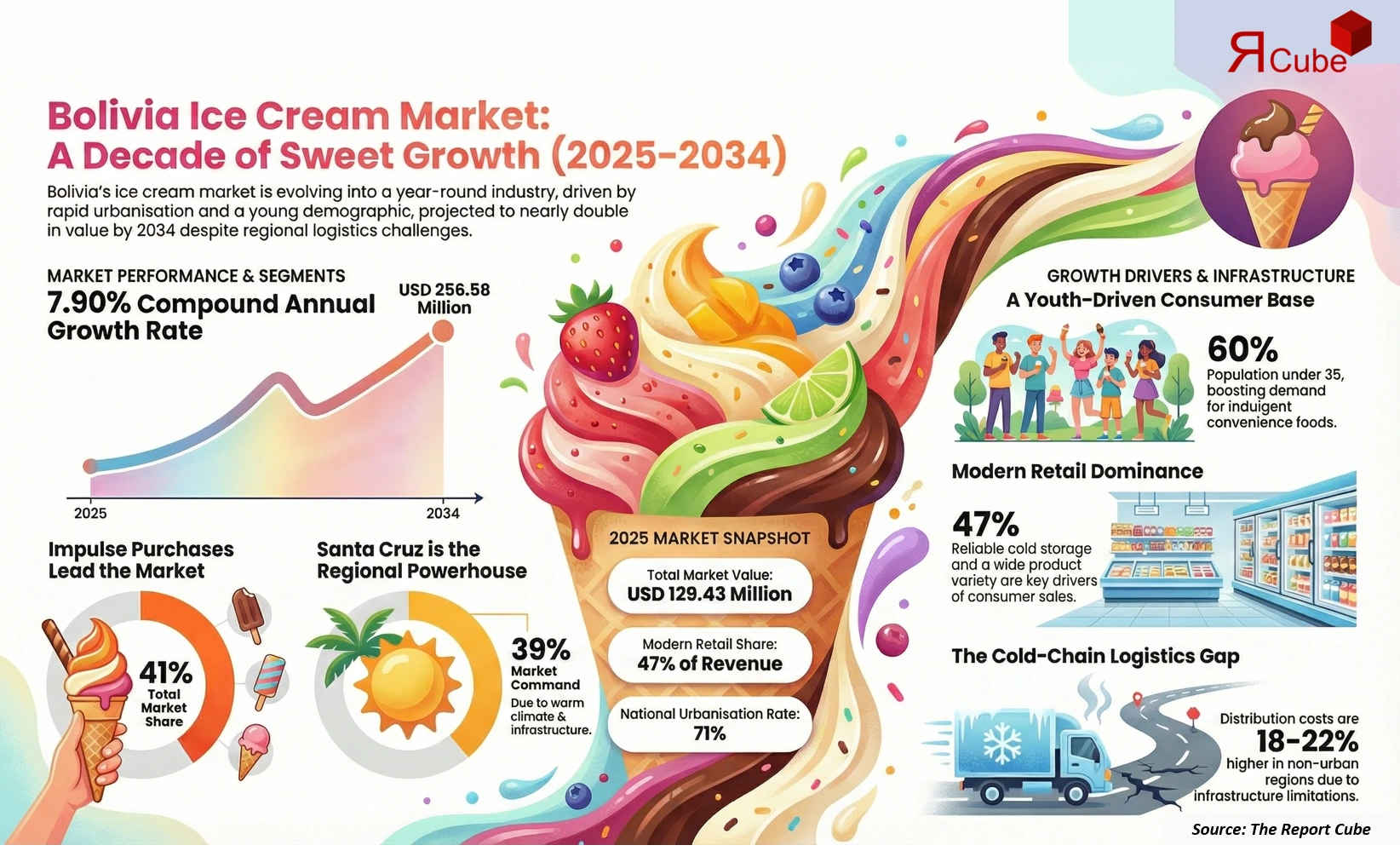
Impulse Ice Cream leads the market, accounting for around 41% market share.
By Distribution Channel:
Modern grocery retailers dominate the market, contributing nearly 47% of total revenue in 2025.
Regional Outlook:
Santa Cruz dominates the Bolivia Ice Cream Market with approximately 39% market share.
Government Initiatives & Policies
- Bolivia Food Safety and Quality Regulation Program: Strengthens cold-chain compliance and food processing standards, indirectly supporting packaged ice cream production.
- National Industrialization Policy of Bolivia: Encourages domestic food manufacturing and value-added dairy processing.
Bolivia Ice Cream Market Insights & Analysis
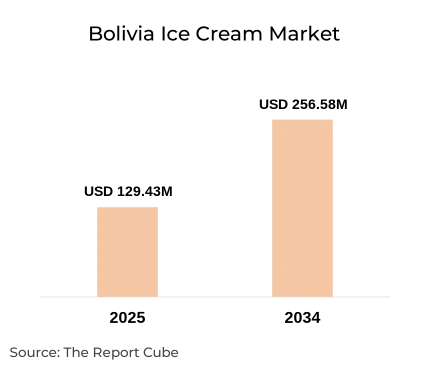
The Bolivia Ice Cream Market is anticipated to register a CAGR of 7.90% during 2026-2034. The market size was valued at USD 129.43 million in 2025 and is projected to reach USD 256.58 million by 2034. The market is transitioning from seasonal consumption patterns toward year-round demand.
This transformation is supported by rising urbanization, which exceeded 71% in 2025, alongside improving cold storage penetration across retail channels. Ice cream is increasingly viewed not only as a summer indulgence but as an everyday dessert, especially among younger demographics. The expansion of supermarkets and branded ice cream parlors has also improved product visibility and accessibility, encouraging impulse purchases.
Additionally, innovation in flavors, packaging, and portion sizes has played a critical role in reshaping consumer preferences. As disposable income gradually increases and international brands strengthen their presence, the Bolivia Ice Cream Market is evolving into a structured and growth-oriented segment of the country’s food industry.
Bolivia Ice Cream Market Dynamics
Key Driver: Rising Urban Consumption and Youth Demographics
A major growth driver of the Bolivia Ice Cream Market is the rising urban youth population, which increasingly favors indulgent and convenience-based food products. Nearly 60% of Bolivia’s population is below the age of 35, making ice cream a highly appealing category. Urban consumers demonstrate higher spending on impulse desserts, with per-capita ice cream consumption increasing by an estimated 8% annually since 2022. The availability of affordable single-serve formats further supports frequent purchases. Additionally, brand-led marketing and seasonal promotions continue to strengthen emotional and lifestyle-based consumption, positioning ice cream as an accessible luxury across income groups.
Book your FREE 30-minute expert consultation today
Contact UsIndustry Trends: Premiumization and Flavor Localization
The Bolivia Ice Cream Market is witnessing a gradual shift toward premium and artisanal offerings, particularly in urban centers. Consumers are increasingly attracted to unique flavors such as tropical fruits and locally inspired ingredients. Artisanal and unpackaged ice cream sales grew by nearly 12% in 2025, reflecting demand for freshness and customization. At the same time, global brands are adapting product portfolios to align with local taste preferences, blending international quality standards with regional flavor profiles. This trend enhances consumer engagement while supporting higher margin growth.
Major Challenge: Cold Chain Limitations in Secondary Regions
Despite strong growth prospects, cold-chain limitations remain a challenge for the Bolivia Ice Cream Market. While major cities benefit from modern refrigeration infrastructure, smaller towns face inconsistent cold storage availability. Distribution costs for frozen products are estimated to be 18-22% higher in non-urban regions, affecting pricing and profitability. Power supply variability further complicates storage reliability. These factors restrict deep market penetration and slow expansion beyond core urban markets.
Opportunity: Expansion of Plant-Based and Health-Oriented Options
An emerging opportunity within the Bolivia Ice Cream Market lies in the growing interest in plant-based and health-oriented products. Urban consumers are increasingly conscious of sugar intake and dairy alternatives, driving interest in frozen yogurt and plant-based ice cream. Although currently accounting for less than 6% of total sales, this segment is growing at double-digit rates. As awareness improves and pricing becomes competitive, these products are expected to attract new consumer segments, reinforcing long-term market diversification.
Bolivia Ice Cream Market Segment-wise Analysis
By Product Type:
- Impulse Ice Cream
- Take-Home Ice Cream
- Artisanal/Unpackaged Ice Cream
- Frozen Yoghurt and Plant-based Options
Impulse ice cream dominates the Bolivia Ice Cream Market with approximately 41% market share in 2025. Its leadership is driven by affordability, portability, and widespread availability through kiosks and convenience outlets. Single-stick and cone formats remain highly popular among school-age consumers and working professionals. Frequent product launches and promotional pricing further support volume growth, making impulse ice cream a core revenue generator for manufacturers.
By Distribution Channel:
- Modern Grocery Retailers
- Traditional Small Grocers
- Specialized Ice Cream Parlours
- Online/E-commerce Platforms
Modern grocery retailers lead the Bolivia Ice Cream Market, accounting for nearly 47% of total sales. Supermarkets offer reliable cold storage, wider product assortments, and promotional bundling, which enhances consumer trust. The expansion of modern retail chains in Santa Cruz and La Paz has significantly improved frozen dessert accessibility. As organized retail continues to grow, its influence on pricing transparency and product innovation is expected to strengthen.
Regional Projection of Bolivia Ice Cream Industry
- Santa Cruz
- La Paz
- Cochabamba
- Potosí
- Others
Santa Cruz leads the Bolivia Ice Cream Market with an estimated 39% market share, supported by strong retail infrastructure and higher consumer purchasing power. The region’s warm climate further encourages frequent ice cream consumption. La Paz and Cochabamba follow, driven by population concentration and growing foodservice sectors. Meanwhile, Potosí and other regions represent emerging markets with gradual improvements in cold-chain logistics.
Bolivia Ice Cream Market Recent Developments
- 2025: PIL Andina expanded its frozen dessert production capacity to meet rising urban demand.
- 2025: Delizia launched new tropical fruit-based ice cream variants tailored to local preferences.
- 2025: Nestlé Bolivia enhanced its cold-chain partnerships to improve national distribution reach.
- 2025: Several artisanal brands expanded standalone ice cream parlors in Santa Cruz and La Paz.
Need insights for a specific region within this market?
Request Regional DataWhy Choose This Report?
- Provides a comprehensive overview of the overall market analysis, encompassing key trends, consumer behavior analysis, and risk assessment to support strategic decision-making.
- Provides accurate, up-to-date insights into market size, segmentation, and emerging opportunities, helping to minimize risk & capitalizing on growth.
- Gives deep understanding of target audience preferences, investment habits, and communication channels for enhanced product development & marketing effectiveness.
- Delivers competitive analysis & benchmarking, uncovering the strengths & weaknesses of market competitors to guide strategies.
- Consolidate comprehensive market intelligence, reducing reasoning & streamlining research efforts.
- Facilitates customized market segmentation & risk mitigation strategies, fine-tuned to the business objectives.
- Aids in identifying both market challenges & untapped opportunities within the industry to drive long-term business growth.
- Provides valuable information based on actual customer data & search trends.
Table of Contents
- Introduction
- Objective of the study
- Product Definition
- Market Segmentation
- Study Variables
- Research Methodology
- Secondary Data Points
- Companies Interviewed
- Primary Data Points
- BreakDown of Primary Interviews
- Secondary Data Points
- Executive Summary
- Market Dynamics
- Drivers
- Challenges
- Opportunity Assessment
- Recent Trends and Developments
- Policy and Regulatory Landscape
- Bolivia Ice Cream Market Overview (2021-2034)
- Market Size, By Value (in USD Millions)
- Market Share, By Product Type
- Impulse Ice Cream
- Take-Home Ice Cream
- Artisanal/Unpackaged Ice Cream
- Frozen Yoghurt and Plant-based Options
- Market Share, By Distribution Channel
- Modern Grocery Retailers
- Traditional Small Grocers
- Specialized Ice Cream Parlours
- Online/E-commerce Platforms
- Market Share, By Flavor
- Chocolate
- Mango
- Vanilla
- Strawberry
- Butterscotch
- Others
- Market Share, By Format
- Cup
- Stick
- Cone
- Brick
- Others
- Market Share, By Region
- Santa Cruz
- La Paz
- Cochabamba
- Potosí
- Others
- Market Share, By Competitors
- Competition Characteristics
- Revenue Shares
- Bolivia Impulse Ice Cream Ice Cream Market Overview, 2021-2034F
- By Value (USD Million)
- By Distribution Channel- Market Size & Forecast 2019-2030, USD Million
- By Flavor- Market Size & Forecast 2019-2030, USD Million
- By Format- Market Size & Forecast 2019-2030, USD Million
- By Region - Market Size & Forecast 2021-2034, USD Million
- Bolivia Take-Home Ice Cream Ice Cream Market Overview, 2021-2034F
- By Value (USD Million)
- By Distribution Channel- Market Size & Forecast 2019-2030, USD Million
- By Flavor- Market Size & Forecast 2019-2030, USD Million
- By Format- Market Size & Forecast 2019-2030, USD Million
- By Region - Market Size & Forecast 2021-2034, USD Million
- Bolivia Artisanal/Unpackaged Ice Cream Ice Cream Market Overview, 2021-2034F
- By Value (USD Million)
- By Distribution Channel- Market Size & Forecast 2019-2030, USD Million
- By Flavor- Market Size & Forecast 2019-2030, USD Million
- By Format- Market Size & Forecast 2019-2030, USD Million
- By Region - Market Size & Forecast 2021-2034, USD Million
- Bolivia Frozen Yoghurt and Plant-based Options Ice Cream Market Overview, 2021-2034F
- By Value (USD Million)
- By Distribution Channel- Market Size & Forecast 2019-2030, USD Million
- By Flavor- Market Size & Forecast 2019-2030, USD Million
- By Format- Market Size & Forecast 2019-2030, USD Million
- By Region - Market Size & Forecast 2021-2034, USD Million
- Competitive Outlook (Company Profile - Partial List)
- PIL Andina
- Company Overview
- Business Segments
- Strategic Alliances/Partnerships
- Recent Developments
- Delizia
- Company Overview
- Business Segments
- Strategic Alliances/Partnerships
- Recent Developments
- Helados Panda
- Company Overview
- Business Segments
- Strategic Alliances/Partnerships
- Recent Developments
- Helados Frigo
- Company Overview
- Business Segments
- Strategic Alliances/Partnerships
- Recent Developments
- Yogurcito
- Company Overview
- Business Segments
- Strategic Alliances/Partnerships
- Recent Developments
- Nestlé Bolivia
- Company Overview
- Business Segments
- Strategic Alliances/Partnerships
- Recent Developments
- Unilever Bolivia
- Company Overview
- Business Segments
- Strategic Alliances/Partnerships
- Recent Developments
- Savory
- Company Overview
- Business Segments
- Strategic Alliances/Partnerships
- Recent Developments
- Brescia Ice Cream
- Company Overview
- Business Segments
- Strategic Alliances/Partnerships
- Recent Developments
- Others
- PIL Andina
- Contact Us & Disclaimer
Top Key Players & Market Share Outlook
- PIL Andina
- Delizia
- Helados Panda
- Helados Frigo
- Yogurcito
- Nestlé Bolivia
- Unilever Bolivia
- Savory
- Brescia Ice Cream
- Others
Frequently Asked Questions






