



Build Your Custom Market Intelligence Report
Customize Your ReportSoutheast Asia Influencer Market Key Highlights
By Influencer Tier:
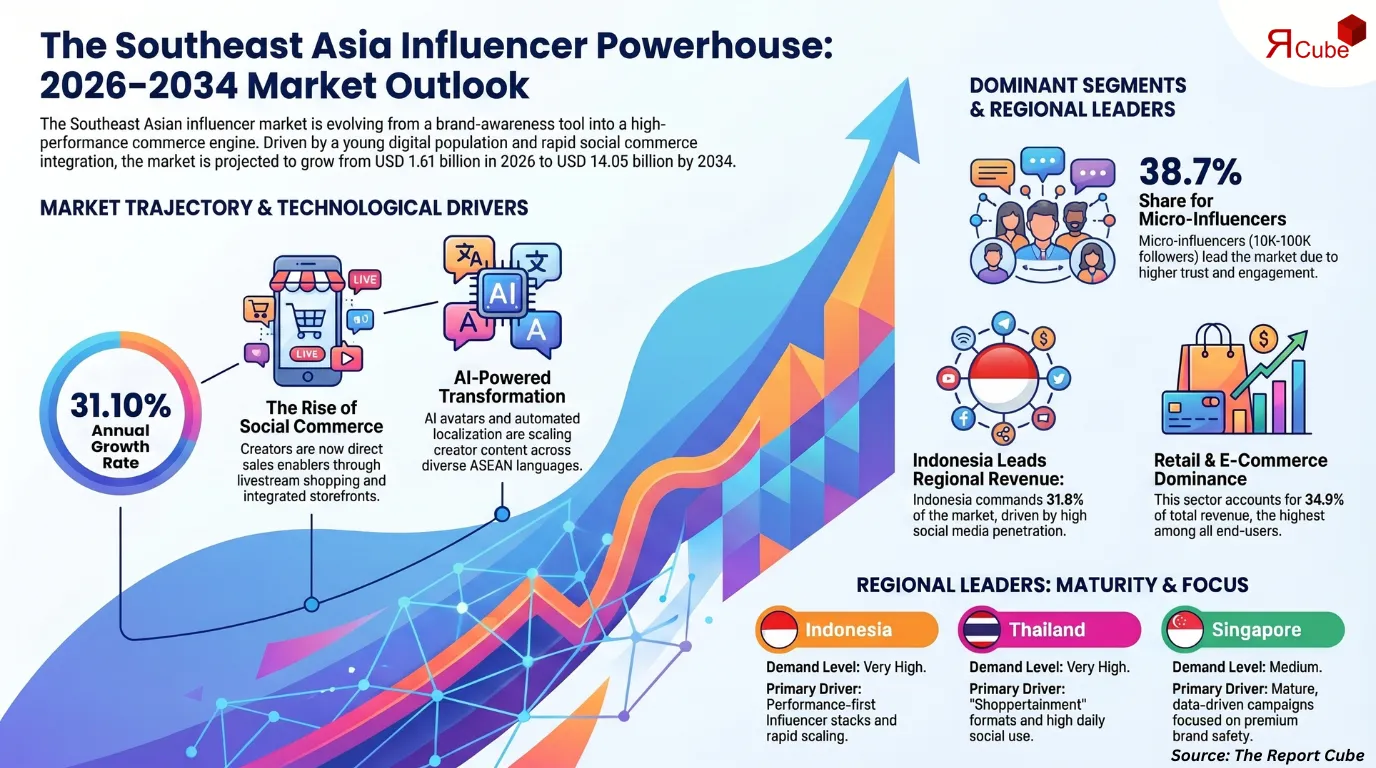
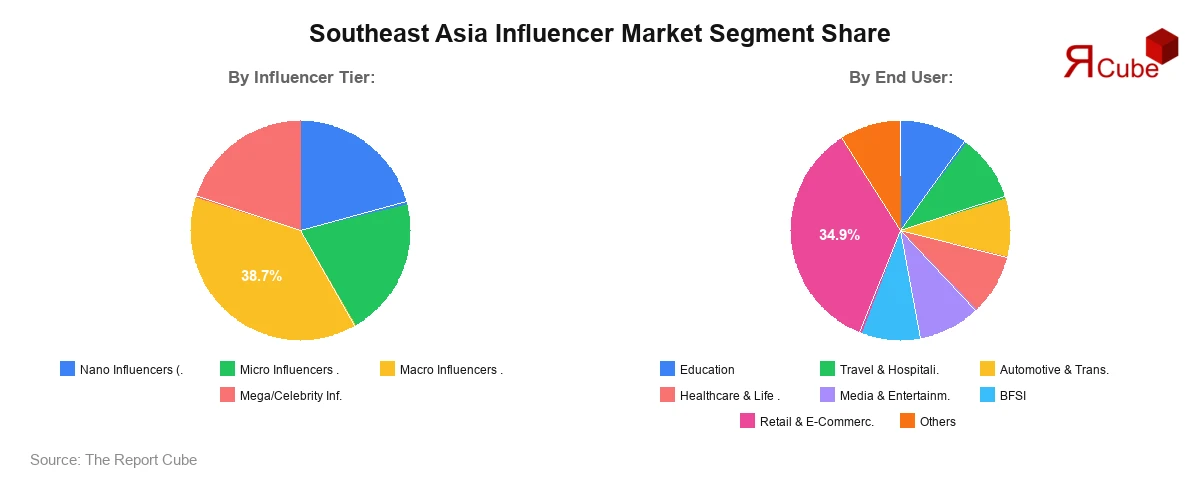
Micro Influencers (10K-100K Followers) segment leads the market with approximately 38.7% share.
By End User:
Retail & E-Commerce segment dominates the market with nearly 34.9% of revenue.
Regional Outlook:
Indonesia dominates the Southeast Asia Influencer market with around 31.8% share.
Southeast Asia Influencer Market Insights & Analysis
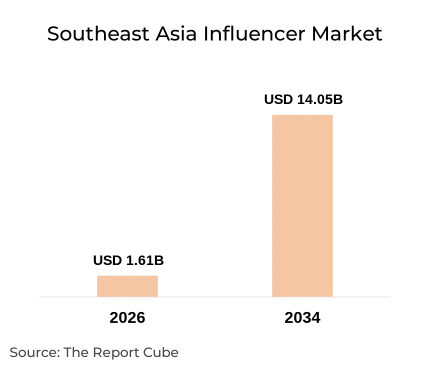
The Southeast Asia Influencer Market is anticipated to register a CAGR of around 31.10% during the forecast period 2026-2034. The market size is valued at USD 1.61 billion in 2026 and is projected to reach USD 14.05 billion by 2034. The growth of the market is being fueled by the growing commercialization of the creator economy across ASEAN countries. Brands operating in retail, beauty, consumer electronics, travel, and food sectors are increasingly integrating influencer-led campaigns into their broader customer acquisition strategies. The region's young digital population, coupled with high daily social media engagement, has transformed creators into influential purchase decision drivers. As digital advertising becomes more performance-oriented, businesses are allocating larger budgets toward influencer partnerships that deliver measurable engagement, conversion rates, and brand visibility.
The market is also benefiting from the rapid evolution of influencer marketing technology platforms. Solution providers are investing heavily in analytics capabilities, campaign automation, influencer verification systems, and affiliate commerce integrations. The rise of creator storefronts, social commerce ecosystems, and performance-based monetization models has strengthened the connection between content engagement and revenue generation. Regional enterprises and SMEs are increasingly adopting specialized influencer management platforms to improve campaign transparency, optimize creator selection, and track return on investment. These developments are contributing to the maturation of Southeast Asia's influencer ecosystem and creating sustainable growth opportunities across both developed and emerging ASEAN economies.
Southeast Asia Influencer Market Impact Analysis
| Factor | Type | Specific Impact on Market | Magnitude | Business Implication |
|---|---|---|---|---|
| Growth in Social Media Usage | Market | Expanding online audiences increase reach of creator content | High | Supports higher campaign volumes and diversified platform presence |
| E-commerce and Social Commerce Rise | Market | Influencers now drive a sizeable share of online product sales | High | Brands must align creator programs tightly with conversion goals |
| Shift to Micro and Niche Influencers | Consumer | Audiences increasingly trust smaller creators with strong affinity | Medium | Requires granular segmentation and always on micro creator networks |
| Platform Diversification and KOS Models | Technological | New formats like key opinion sellers reshape buying journeys | High | Mandates creator commerce playbooks tailored to each platform |
| Regulatory Scrutiny on Advertising Transparency | Regulatory | Stricter disclosure norms affect how sponsored posts are framed | Medium | Necessitates clear compliance guidelines and standardized contracts |
| Demand for Authentic and Localized Content | Consumer | Viewers favor culturally relevant endorsements over generic ads | High | Pushes brands to co create storytelling with regional creator voices |
| Use of AI and Data in Campaign Optimization | Technological | Advanced analytics improve creator selection and performance tracking | Medium | Encourages investment in measurement tools and ROI attribution models |
Southeast Asia Influencer Market Dynamics
Key Driver: Rapid Expansion of Social Commerce Ecosystems
One of the strongest growth catalysts for the Southeast Asia Influencer Market is the increasing integration of social media and e-commerce platforms. Consumers across Indonesia, Thailand, Vietnam, Malaysia, and the Philippines are increasingly discovering products through creator-generated content before completing purchases through integrated shopping features. This shift has transformed influencers from brand awareness tools into direct sales enablers. Retailers and online marketplaces are actively developing creator-focused programs that encourage influencers to drive traffic, conversions, and customer engagement through affiliate marketing and live commerce initiatives.
The growing popularity of livestream shopping, creator storefronts, and commission-based marketing models has strengthened the commercial value of influencer partnerships. Major e-commerce companies operating across ASEAN continue to expand investments in creator monetization infrastructure, enabling brands to measure campaign effectiveness more accurately. As businesses seek scalable customer acquisition channels with measurable outcomes, influencer-led commerce is expected to remain a key driver supporting long-term market growth.
Industry Trends: Technology-Driven Transformation of Influencer Marketing
Technology innovation is reshaping the Southeast Asia influencer market landscape. Brands increasingly rely on sophisticated influencer marketing platforms that combine campaign management, audience analytics, performance tracking, and fraud detection capabilities within a unified ecosystem. These solutions help marketers identify suitable creators, evaluate audience quality, and optimize campaign performance based on real-time data. The growing adoption of cloud-based influencer marketing software is improving operational efficiency for brands, agencies, and creators throughout the region.
Another notable trend is the emergence of AI-enhanced content production and virtual commerce solutions. Companies are introducing avatar-powered livestreaming, automated content localization, and multilingual campaign management capabilities to address the diverse linguistic landscape of Southeast Asia. The ability to deliver personalized creator experiences across multiple markets is becoming increasingly important for brands seeking regional scale. These innovations are helping organizations reduce campaign execution costs while improving audience engagement and overall marketing effectiveness.
Book your FREE 30-minute expert consultation today
Contact UsMajor Challenge: Transparency and Influencer Fraud Risks
Although the market continues to expand rapidly, concerns regarding campaign transparency remain a significant challenge. Brands frequently encounter difficulties assessing the authenticity of influencer audiences, particularly when evaluating follower quality, engagement rates, and campaign attribution metrics. Fraudulent activities such as fake followers, engagement manipulation, and automated interactions can distort campaign performance measurements and negatively affect marketing returns.
The challenge becomes more complex in cross-border campaigns involving multiple social media platforms and diverse consumer markets. Differences in platform algorithms, reporting methodologies, and engagement benchmarks often make campaign comparisons difficult. As marketing budgets increase, organizations are demanding greater accountability and performance verification from creators and platform providers. This trend is driving stronger adoption of influencer auditing tools, compliance monitoring solutions, and advanced analytics platforms designed to improve trust and transparency within the ecosystem.
Opportunity: Rising Influence of Micro and Nano Creator Communities
Micro and nano influencers are creating significant growth opportunities across the Southeast Asia Influencer Market. Unlike larger celebrity creators, these influencers often maintain highly engaged niche communities that value authenticity and direct interaction. Their ability to build trust with followers makes them particularly attractive for brands targeting specific demographics, geographic markets, or product categories.
Small and medium-sized businesses across Southeast Asia increasingly view micro and nano influencer partnerships as cost-effective alternatives to traditional advertising channels. These collaborations often generate stronger engagement metrics while allowing brands to allocate marketing budgets more efficiently. As local creator communities continue to expand and social commerce adoption accelerates, demand for influencer discovery platforms, relationship management tools, and performance tracking solutions supporting this segment is expected to grow substantially throughout the forecast period.
Southeast Asia Influencer Market Segment-wise Analysis
By Influencer Tier:
- Nano Influencers (1K-10K Followers)
- Micro Influencers (10K-100K Followers)
- Macro Influencers (100K-1M Followers)
- Mega/Celebrity Influencers (1M+ Followers)
Micro Influencers account for the largest share of the Southeast Asia Influencer Market, representing approximately 38.7% of total industry revenue. Their leadership position is primarily supported by strong audience engagement, credibility, and campaign affordability. Unlike celebrity influencers, micro creators typically maintain closer relationships with followers, resulting in higher interaction rates and stronger audience trust. This characteristic has become particularly valuable as brands increasingly prioritize meaningful engagement over audience size alone.
The segment is witnessing strong adoption across beauty, fashion, consumer goods, travel, and technology sectors. Businesses operating in competitive consumer markets often utilize micro influencers to reach highly targeted communities with localized messaging. The segment's effectiveness in driving product discovery, purchase consideration, and customer retention continues to attract marketing investments. As performance-focused marketing strategies gain momentum across ASEAN countries, micro influencers are expected to remain the preferred creator category for both global brands and regional enterprises.
By End User:
- Education
- Travel & Hospitality
- Automotive & Transportation
- Healthcare & Life Sciences
- Media & Entertainment
- BFSI
- Retail & E-Commerce
- Others
Retail & E-Commerce remains the largest end-user segment within the Southeast Asia Influencer Market, accounting for nearly 34.9% of overall revenue. The segment's dominance reflects the growing influence of social media content on online purchasing decisions. Influencers have become critical components of customer acquisition strategies, particularly within beauty, fashion, lifestyle, food, and consumer electronics categories where visual content significantly impacts consumer behavior.
The expansion of social commerce platforms, affiliate marketing programs, and creator-led product promotions has strengthened the relationship between influencers and online retailers. Brands increasingly leverage influencers not only for awareness generation but also for measurable sales outcomes. Advanced tracking technologies now allow businesses to monitor conversions, customer engagement, and campaign profitability more accurately. These capabilities continue to encourage higher marketing investments, reinforcing the segment's leadership within the regional market.
Regional Projection of Southeast Asia Influencer Industry
- Malaysia
- Indonesia
- Singapore
- Cambodia
- Vietnam
- Thailand
- Philippines
- Others
Indonesia represents the largest market within Southeast Asia, contributing approximately 31.8% of regional revenue. The country's leadership position is supported by its large population, extensive social media penetration, rapidly growing digital economy, and vibrant creator ecosystem. Indonesia hosts millions of active content creators who engage audiences across multiple platforms, making the country one of the most influential digital advertising markets in the region.
The increasing popularity of social commerce and mobile-first consumer behavior continues to strengthen demand for influencer marketing solutions. Brands operating in beauty, retail, gaming, food delivery, and consumer electronics sectors are among the largest adopters of influencer-driven campaigns. Furthermore, ongoing investments in digital infrastructure and e-commerce development are creating favorable conditions for creator-led commerce expansion. These factors are expected to sustain Indonesia's leadership position throughout the forecast period while supporting broader Southeast Asia influencer market growth.
Need insights for a specific region within this market?
Request Regional DataCountries Analysis of Southeast Asia Influencer Market
The Southeast Asia influencer market shows country-wise contrasts in scale, maturity, and platform behavior, shaped by demographics and social commerce adoption [web:1758][web:1771].
| Country | Demand Level | Key Platforms | System Dominance | Core Demand Logic | Growth Nature |
|---|---|---|---|---|---|
| Malaysia | High | TikTok, Instagram, Facebook | Micro and mid-tier creators | Social commerce and Gen Z reach [web:1763] | ROI-led, steady expansion [web:1771] |
| Indonesia | Very High | TikTok, Instagram, YouTube | Performance-first influencer stack | Largest user base and low CPMs [web:1768][web:1771] | Fastest regional scaling path [web:1758][web:1768] |
| Singapore | Medium | Instagram, TikTok, Xiaohongshu | Data-driven premium campaigns | High income and strict brand safety [web:1761] | Mature, value over volume [web:1765][web:1769] |
| Cambodia | Emerging | Facebook, TikTok | Low-cost nano creator programs | Mobile-first mass reach at low spend [web:1758] | Early-stage, price sensitive [web:1764] |
| Vietnam | High | TikTok, Facebook, Instagram | Commerce-linked short video | Rising middle class and e-commerce [web:1768][web:1771] | Strong, double-digit CAGR [web:1759][web:1760] |
| Thailand | Very High | TikTok, Instagram, Facebook | Shoppertainment-heavy formats | Longest daily social use globally [web:1768][web:1771] | Social commerce hyper growth [web:1762][web:1763] |
| Philippines | High | TikTok, Facebook, YouTube | Nano and micro creator clusters | High engagement, youth skew [web:1762][web:1771] | Engagement-led, always-on growth [web:1758] |
| Others (SEA) | Medium | TikTok, Facebook, Instagram | Regional cross-border campaigns | Brands test low-cost new markets [web:1758][web:1766] | Experimental, platform-driven lift [web:1764] |
Government Initiatives & Policies
- Singapore Digital Enterprise Blueprint (2025): Singapore expanded support for digital businesses and content-driven enterprises through capability development, AI adoption, and digital commerce initiatives. The framework strengthens opportunities for creators, digital marketers, and influencer-focused businesses.
- Malaysia Digital Strategic Initiatives (2025-2026): Malaysia's Ministry of Digital continues advancing digital economy growth through digital adoption incentives, AI ecosystem development, and support for digital entrepreneurs, creating favorable conditions for influencer marketing and creator-commerce businesses.
Southeast Asia Influencer Industry Recent Developments
- 2025: Fanclip launched a unified creator-commerce platform designed specifically for Southeast Asia. The solution integrates creator storefronts, influencer CRM, campaign attribution, payouts, discovery tools, and analytics capabilities. The development improves operational efficiency, campaign scalability, and ROI transparency for brands, agencies, and creators across ASEAN markets.
- 2025: AnyMind Group introduced "AnyLive for Creators," an AI-powered live commerce platform that enables influencers to create AI avatars for continuous livestream selling. Supporting eight regional languages and major social platforms, the solution enhances content scalability, localization, and monetization efficiency.
- May 2025: Lazada committed USD 100 million annually to expand its LazAffiliate Programme across Southeast Asia. The initiative introduced creator storefronts, enhanced commissions, performance dashboards, and campaign acceleration tools, strengthening influencer-led commerce and creator monetization opportunities.
Why Choose This Report?
- Provides a comprehensive overview of the overall market analysis, encompassing key trends, consumer behavior analysis, and risk assessment to support strategic decision-making.
- Provides accurate, up-to-date insights into market size, segmentation, and emerging opportunities, helping to minimize risk & capitalizing on growth.
- Gives deep understanding of target audience preferences, investment habits, and communication channels for enhanced product development & marketing effectiveness.
- Delivers competitive analysis & benchmarking, uncovering the strengths & weaknesses of market competitors to guide strategies.
- Consolidate comprehensive market intelligence, reducing reasoning & streamlining research efforts.
- Facilitates customized market segmentation & risk mitigation strategies, fine-tuned to the business objectives.
- Aids in identifying both market challenges & untapped opportunities within the industry to drive long-term business growth.
- Provides valuable information based on actual customer data & search trends.
Table of Contents
- Introduction
- Objective of the Study
- Product and Category Definition
- Market Segmentation
- Study Variables
- Research Methodology
- Secondary Data Points
- Breakdown of Secondary Sources
- Primary Data Points
- Breakdown of Primary Interviews
- Secondary Data Points
- Executive Summary
- Market Dynamics
- Emerging Opportunities
- Adoption Trends
- Demand Drivers
- Disruption Analysis (Challenges)
- Industry Analysis & Strategic Insights
- Supply/Value Chain Analysis
- Pricing Analysis
- Go-To-Market (GTM) Strategy
- BCG Matrix
- Recent Trends and Developments
- Import and Export Analysis
- Regulatory and Policy Landscape
- Country-wise policies
- Government Initiatives
- Southeast Asia Influencer Marketing Platform Market Overview and Forecast Analysis (2021-2034)
- Market Size, By Value, By Growth Rate (CAGR/USD Billion)
- Market Share, By Offering
- Services
- Managed Services
- Professional Services
- Deployment & Integration
- Support & Maintenance
- Consulting
- Software
- Software, By Deployment Mode
- On-premises
- Cloud
- Software, By Type
- Mobile-based
- Web-based
- Services
- Market Share, By Marketing Type
- Thought Leadership & Brand Building
- Lead Generation & Sales Enablement
- Employee Advocacy
- Content Marketing & Distribution
- Event Promotion & Attendance
- Product Launches & Promotions
- Others
- Market Share, By Influencer Tier
- Nano Influencers (1K-10K followers)
- Micro Influencers (10K-100K followers)
- Macro Influencers (100K-1M followers)
- Mega/Celebrity Influencers (1M+ followers)
- Market Share, By Pricing Model
- Commission-based
- Subscription-based
- Pay-per-campaign
- Market Share, By Application
- Campaign Management
- Compliance & Fraud Detection
- Influencer Relationship Management (IRM/CRM)
- Product Seeding & Affiliate Tracking
- Analytics & Performance Tracking
- Content Creation & Management
- Social Listening & Sentiment Analysis
- Influencer Discovery & Search
- Payment & Contract Management
- Others
- Market Share, By End User
- Education
- Travel & Hospitality
- Automotive & Transportation
- Healthcare & Life Sciences
- Media & Entertainment
- Gaming
- Advertising & Marketing Agencies and PR Agencies
- Others
- BFSI
- Retail & E-Commerce
- Beauty & Personal Care
- Sports & Fitness
- Fashion & Lifestyle
- Food & Beverages
- Others
- Others
- Market Share, By Country
- Malaysia
- Indonesia
- Singapore
- Cambodia
- Vietnam
- Thailand
- Philippines
- Others
- Market Share, By Company
- Revenue Shares & Analysis
- Competitive Landscape
- Malaysia Influencer Marketing Platform Market Overview and Forecast Analysis (2021-2034)
- Market Size, By Value, By Growth Rate (CAGR/USD Billion/Million)
- Market Share, By Offering
- Market Share, By Marketing Type
- Market Share, By Influencer Tier
- Market Share, By Pricing Model
- Market Share, By Application
- Market Share, By End User
- Indonesia Influencer Marketing Platform Market Overview and Forecast Analysis (2021-2034)
- Market Size, By Value, By Growth Rate (CAGR/USD Billion/Million)
- Market Share, By Offering
- Market Share, By Marketing Type
- Market Share, By Influencer Tier
- Market Share, By Pricing Model
- Market Share, By Application
- Market Share, By End User
- Singapore Influencer Marketing Platform Market Overview and Forecast Analysis (2021-2034)
- Market Size, By Value, By Growth Rate (CAGR/USD Billion/Million)
- Market Share, By Offering
- Market Share, By Marketing Type
- Market Share, By Influencer Tier
- Market Share, By Pricing Model
- Market Share, By Application
- Market Share, By End User
- Cambodia Influencer Marketing Platform Market Overview and Forecast Analysis (2021-2034)
- Market Size, By Value, By Growth Rate (CAGR/USD Billion/Million)
- Market Share, By Offering
- Market Share, By Marketing Type
- Market Share, By Influencer Tier
- Market Share, By Pricing Model
- Market Share, By Application
- Market Share, By End User
- Vietnam Influencer Marketing Platform Market Overview and Forecast Analysis (2021-2034)
- Market Size, By Value, By Growth Rate (CAGR/USD Billion/Million)
- Market Share, By Offering
- Market Share, By Marketing Type
- Market Share, By Influencer Tier
- Market Share, By Pricing Model
- Market Share, By Application
- Market Share, By End User
- Thailand Influencer Marketing Platform Market Overview and Forecast Analysis (2021-2034)
- Market Size, By Value, By Growth Rate (CAGR/USD Billion/Million)
- Market Share, By Offering
- Market Share, By Marketing Type
- Market Share, By Influencer Tier
- Market Share, By Pricing Model
- Market Share, By Application
- Market Share, By End User
- Philippines Influencer Marketing Platform Market Overview and Forecast Analysis (2021-2034)
- Market Size, By Value, By Growth Rate (CAGR/USD Billion/Million)
- Market Share, By Offering
- Market Share, By Marketing Type
- Market Share, By Influencer Tier
- Market Share, By Pricing Model
- Market Share, By Application
- Market Share, By End User
- Competitive Analysis, 2026
- Market Share of Key Players
- Competitive Mapping for Each Segment and Companies Operating Regionally
- Malaysia Influencer Marketing Platform Companies Share & Competitive Analysis, 2026
- Indonesia Influencer Marketing Platform Companies Share & Competitive Analysis, 2026
- Singapore Influencer Marketing Platform Companies Share & Competitive Analysis, 2026
- Cambodia Influencer Marketing Platform Companies Share & Competitive Analysis, 2026
- Vietnam Influencer Marketing Platform Companies Share & Competitive Analysis, 2026
- Thailand Influencer Marketing Platform Companies Share & Competitive Analysis, 2026
- Philippines Influencer Marketing Platform Companies Share & Competitive Analysis, 2026
- Company Profile (Partial List)
- HypeAuditor
- Company Overview
- Product Portfolio
- Strategic Alliances/Partnerships
- Recent Developments
- CreatorIQ
- Company Overview
- Product Portfolio
- Strategic Alliances/Partnerships
- Recent Developments
- Meltwater
- Company Overview
- Product Portfolio
- Strategic Alliances/Partnerships
- Recent Developments
- GRIN
- Company Overview
- Product Portfolio
- Strategic Alliances/Partnerships
- Recent Developments
- AnyMind Group
- Company Overview
- Product Portfolio
- Strategic Alliances/Partnerships
- Recent Developments
- Kobe
- Company Overview
- Product Portfolio
- Strategic Alliances/Partnerships
- Recent Developments
- Partipost
- Company Overview
- Product Portfolio
- Strategic Alliances/Partnerships
- Recent Developments
- HIIP Asia
- Company Overview
- Product Portfolio
- Strategic Alliances/Partnerships
- Recent Developments
- Traackr
- Company Overview
- Product Portfolio
- Strategic Alliances/Partnerships
- Recent Developments
- Upfluence
- Company Overview
- Product Portfolio
- Strategic Alliances/Partnerships
- Recent Developments
- Others (Partial List)
- HypeAuditor
- Contact Us and Disclaimer
Top Key Players & Market Share Outlook
- HypeAuditor
- CreatorIQ
- Meltwater
- GRIN
- AnyMind Group
- Kobe
- Partipost
- HIIP Asia
- Traackr
- Upfluence
- Others
Frequently Asked Questions