



Build Your Custom Market Intelligence Report
Customize Your ReportGlobal Infrared Sensors Market Key Takeaways
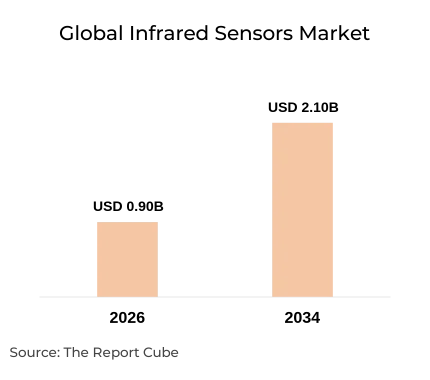
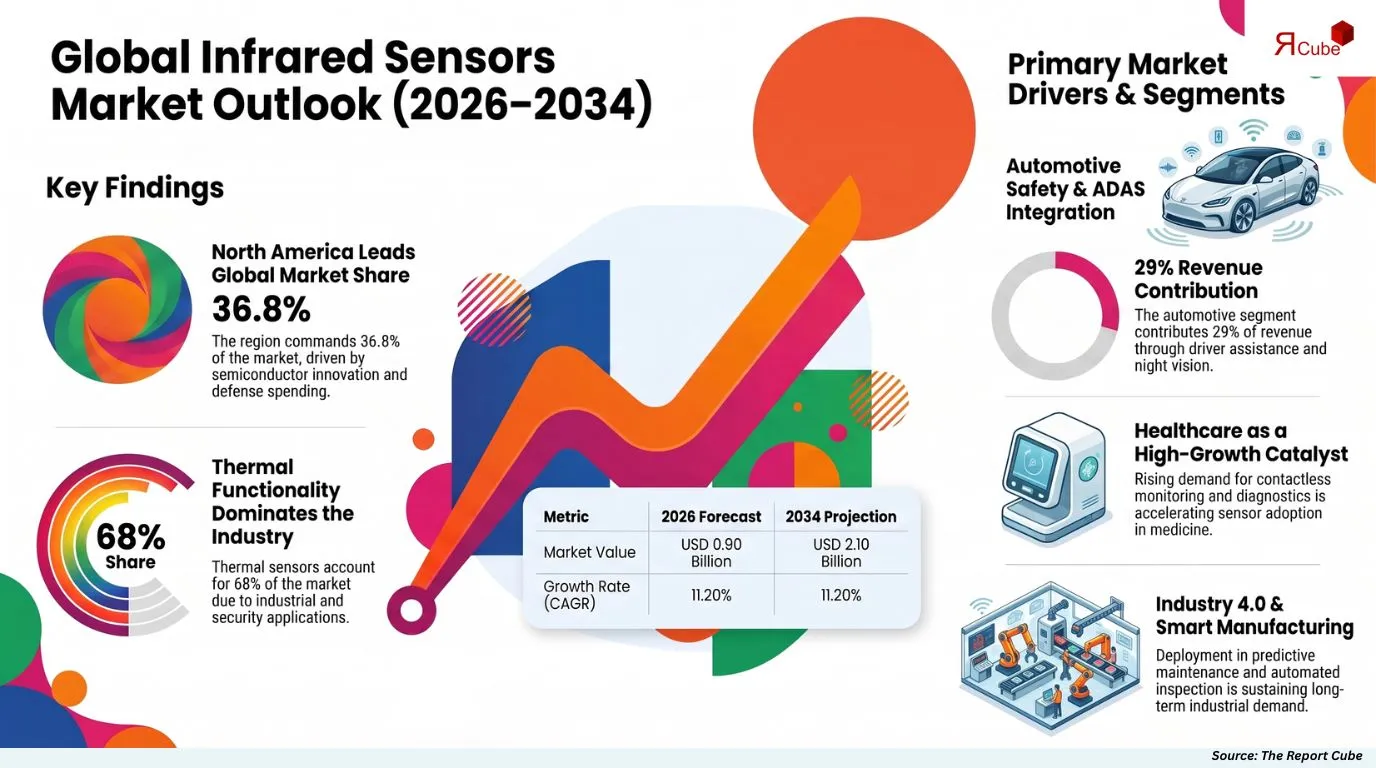
- Market size estimated at USD 0.90 billion during 2026 across global industries.
- Industry projected to achieve USD 2.10 billion market value by 2034 worldwide.
- Global Infrared Sensors Market expected to expand at a robust 11.20% CAGR through 2034.
- Texas Instruments Incorporated, Excelitas Technologies Corp., and Teledyne Technologies Incorporated remain leading market participants.
- Thermal functionality segment dominates owing to extensive industrial monitoring and security surveillance applications.
- Automotive end-user segment records significant adoption through advanced driver assistance and vehicle safety systems.
- North America maintains leading regional market share supported by semiconductor innovation and defense investments.
- Healthcare applications witness accelerating demand through non-contact diagnostics, patient monitoring, and medical imaging technologies.
Global Infrared Sensors Market Insights & Analysis
The Global Infrared Sensors Market is anticipated to register a 11.20% CAGR during 2026-2034. The market size was valued at USD 0.90 billion in 2026 and is projected to reach USD 2.10 billion by 2034. Growing deployment of infrared sensing technologies across automotive safety, industrial automation, aerospace, and medical diagnostics continues strengthening global demand. Rising investments in smart manufacturing, defense modernization programs, and Industry 4.0 initiatives are accelerating sensor integration, while semiconductor manufacturers continue expanding infrared imaging and sensing portfolios to address high-performance industrial requirements.
Healthcare and automotive industries are increasingly adopting infrared sensors for contactless temperature measurement, driver monitoring, predictive maintenance, and advanced imaging solutions. Government-backed smart infrastructure projects, expanding intelligent transportation networks, and continuous innovation in miniature MEMS-based infrared sensing technologies are expected to sustain long-term market expansion throughout the forecast period.
Global Infrared Sensors Market Dynamics
The Global Infrared Sensors Market is expanding steadily as infrared detection technologies become increasingly important across industrial automation, automotive safety, medical diagnostics, consumer electronics, and defense applications. Continuous advances in semiconductor fabrication, thermal imaging accuracy, miniaturization, and low-power sensing technologies are improving sensor performance while expanding commercial deployment across diverse industries.
|
Factor |
Type |
Specific Impact on Market |
Magnitude |
|---|---|---|---|
|
ADAS adoption |
Driver |
Higher demand for automotive infrared sensing |
High |
|
Industrial automation |
Driver |
Increased deployment in predictive maintenance |
High |
|
Semiconductor supply fluctuations |
Challenge |
Temporary manufacturing and delivery constraints |
Medium |
|
Smart healthcare expansion |
Opportunity |
Growing adoption of contactless medical monitoring |
High |
|
Thermal imaging innovation |
Trend |
Enhanced detection accuracy across industries |
High |
Key Market Driver: Advanced Vehicle Safety Demand
Growing adoption of Advanced Driver Assistance Systems (ADAS), autonomous driving technologies, and occupant monitoring systems significantly increases infrared sensor deployment. Automotive manufacturers continue integrating thermal sensing for pedestrian detection, night vision, and cabin monitoring, improving vehicle safety while supporting stringent global safety regulations and intelligent mobility initiatives.
Automotive OEMs are also expanding infrared-enabled safety platforms as electric vehicles become more sophisticated. Improved sensor sensitivity, compact packaging, and faster image processing capabilities enable reliable performance across varying environmental conditions, strengthening long-term adoption throughout passenger and commercial vehicle segments.
Major Industry Challenge: Semiconductor Supply Constraints
Fluctuations in semiconductor component availability and specialized infrared detector materials continue creating manufacturing challenges across the industry. Dependence on advanced fabrication processes, precision packaging, and global electronics supply chains occasionally affects production schedules and delivery timelines for infrared sensing solutions.
Despite these temporary constraints, manufacturers are diversifying supply networks, increasing localized production capacities, and strengthening partnerships with semiconductor foundries. These initiatives are expected to improve supply resilience while supporting stable production volumes during the forecast period.
Emerging Trend Shaping Outlook: Thermal Imaging Technology Evolution
Continuous advancements in thermal imaging resolution, MEMS fabrication, artificial intelligence-enabled image analytics, and compact infrared modules are reshaping industry growth. Modern infrared sensors deliver higher sensitivity, lower power consumption, and improved environmental reliability across industrial inspection, healthcare, security, and consumer electronics applications.
Emerging smart factories, connected infrastructure, and intelligent surveillance systems increasingly rely on real-time infrared sensing for predictive maintenance, anomaly detection, and automated decision-making. These innovations are expected to create substantial opportunities for manufacturers through 2034.
Need Specific Data, Let’s Customize the Report for You
Request CustomizationGlobal Infrared Sensors Market Segment-wise Analysis
The Global Infrared Sensors Market is segmented by functionality and end-user industries, with demand primarily supported by industrial automation, healthcare modernization, intelligent transportation, and expanding thermal imaging applications across commercial and defense sectors.
By Functionality
- Thermal
- Quantum
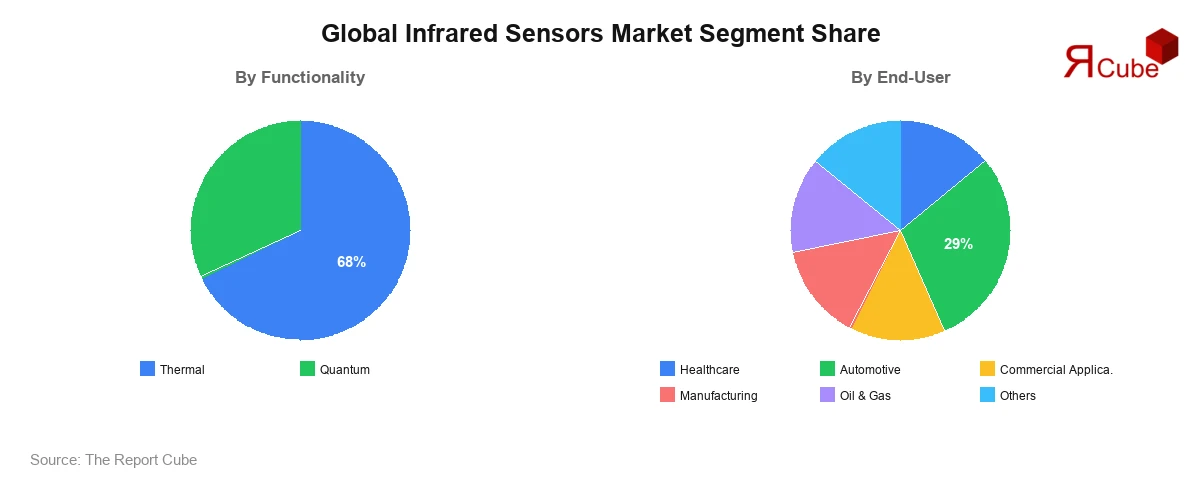
Thermal infrared sensors account for approximately 68% of the global market, supported by widespread deployment in industrial monitoring, security surveillance, predictive maintenance, firefighting, and healthcare diagnostics. Their ability to operate without active illumination, combined with improving imaging accuracy and declining sensor size, continues driving commercial adoption across multiple industries.
Quantum infrared sensors represent nearly 31.6% of market revenue and remain essential for high-precision applications requiring exceptional sensitivity and rapid response. Defense surveillance, aerospace imaging, scientific research, and advanced spectroscopy increasingly utilize quantum sensing technologies where superior detection performance justifies higher implementation complexity.
By End-User
- Healthcare
- Automotive
- Commercial Applications
- Manufacturing
- Oil & Gas
- Others
The automotive segment contributes approximately 29% of total market revenue, benefiting from expanding deployment of driver monitoring systems, night vision technologies, pedestrian detection, and autonomous driving platforms. Increasing global production of electric vehicles and regulatory emphasis on advanced safety technologies continue supporting sustained demand for infrared sensing solutions.
Healthcare remains one of the fastest-growing end-user segments, supported by rising adoption of contactless thermometry, medical imaging, patient monitoring, and diagnostic equipment. Manufacturing, oil & gas, and commercial applications also experience strong growth as organizations increasingly implement infrared sensors for predictive maintenance, process optimization, equipment inspection, energy management, and workplace safety.
Regional Projection of Global Infrared Sensors Market
The Global Infrared Sensors Market demonstrates strong geographical diversification, supported by increasing investments in semiconductor manufacturing, automotive electronics, industrial automation, healthcare modernization, and defense technologies. North America continues to lead due to its advanced semiconductor ecosystem, while Asia-Pacific records the fastest expansion owing to rapid industrialization, electronics manufacturing, and smart infrastructure development.
|
Region |
Estimated Market Share |
Key Growth Factors |
Consumer Trends |
|---|---|---|---|
|
North America |
36.8% |
Semiconductor innovation, defense spending, automotive electronics |
High adoption of thermal imaging and industrial automation |
|
Europe |
27.1% |
Industrial automation, automotive safety regulations |
Growing demand for smart manufacturing solutions |
|
Asia-Pacific |
25.9% |
Electronics manufacturing, healthcare expansion, smart cities |
Rapid adoption across consumer and automotive electronics |
|
Latin America |
5.4% |
Industrial modernization and energy projects |
Increasing security and monitoring applications |
|
Middle East & Africa |
4.8% |
Oil & gas infrastructure and smart surveillance |
Rising deployment in industrial safety systems |
- North America
- Europe
- Asia-Pacific
- Latin America
- Middle East & Africa
North America accounts for approximately 36.8% of the global market, supported by the presence of leading semiconductor manufacturers, strong defense procurement, advanced automotive technologies, and continuous investments in industrial automation. The United States remains the regional growth engine through widespread adoption of infrared sensors in aerospace, healthcare, intelligent transportation, and security infrastructure.
Asia-Pacific is expected to witness the fastest growth throughout the forecast period as China, Japan, South Korea, and India continue expanding semiconductor fabrication, consumer electronics production, and electric vehicle manufacturing. Europe also maintains significant market demand through Industry 4.0 implementation, stringent automotive safety standards, and increasing deployment of predictive maintenance technologies across manufacturing industries.
Global Infrared Sensors Market: Recent Development (2025)
- Hamamatsu Photonics launched RoHS-compliant mid-infrared detector modules with integrated preamplifiers for improved room-temperature sensing applications.
- Hamamatsu Photonics began mass production of innovative terahertz detection modules utilizing proprietary metasurface emission technology worldwide.
- Hamamatsu completed new manufacturing infrastructure expansion, strengthening advanced photonics production capacity supporting future infrared sensing technologies.
- Industry participants accelerated compact infrared sensor innovation targeting industrial automation, semiconductor inspection, healthcare diagnostics, and intelligent mobility.
Global Infrared Sensors Market Future Outlook (2034)
The Global Infrared Sensors Market is projected to reach USD 2.10 billion by 2034, expanding at a 11.20% CAGR during the forecast period. Increasing deployment across autonomous vehicles, industrial automation, healthcare diagnostics, smart buildings, aerospace, and intelligent surveillance will continue supporting sustained market growth. Continuous improvements in sensor miniaturization, energy efficiency, and detection accuracy are expected to enhance commercial adoption.
Artificial intelligence-powered image processing, edge computing, and advanced thermal analytics will significantly improve infrared sensing capabilities across multiple industries. Integration with Industry 4.0 platforms, connected healthcare systems, smart cities, and next-generation automotive safety technologies will create long-term opportunities for manufacturers. Ongoing semiconductor innovation and expanding application diversity are expected to strengthen the market's competitive landscape and support steady global expansion through 2034.
Global Infrared Sensors Market Report Coverage
|
Report Attribute |
Details |
|---|---|
|
Market Name |
Global Infrared Sensors Market |
|
Market Size (2026) |
USD 0.90 Billion |
|
Market Size (2034) |
USD 2.10 Billion |
|
Forecast Period |
2026–2034 |
|
CAGR (2026–2034) |
11.20% |
|
Base Year |
2025 |
|
Forecast Year |
2034 |
|
Historical Years |
2021–2025 |
|
Segments Covered |
By Functionality, By End-User, By Spectrum Range |
|
Regions Covered |
North America, Europe, Asia-Pacific, Latin America, Middle East & Africa |
|
Key Companies |
Texas Instruments Incorporated, Excelitas Technologies Corp., Teledyne Technologies Incorporated, Murata Manufacturing Co., Ltd., Hamamatsu Photonics K.K., Honeywell International Inc., RTX Corporation, NXP Semiconductors N.V., Omron Corporation, Others |
|
Report Format |
PDF, Excel, PPT |
|
Customization |
Available as per client requirements |
Why Choose This Report?
- Comprehensive market sizing with reliable industry-focused forecasting methodology.
- Detailed segment analysis highlighting dominant revenue-generating market opportunities.
- Extensive regional assessment covering emerging and mature global markets.
- Competitive landscape featuring major manufacturers and strategic developments.
- In-depth market dynamics supported by current industry intelligence.
- Future growth opportunities across healthcare, automotive, and industrial sectors.
- Accurate market estimates prepared using primary and secondary research.
- Actionable insights supporting strategic investment and business planning decisions.
Table of Contents
- Introduction
- Objective of the study
- Product Definition
- Market Segmentation
- Study Variables
- Research Methodology
- Secondary Data Points
- Companies Interviewed
- Primary Data Points
- Breakdown of Primary Interviews
- Secondary Data Points
- Executive Summary
- Market Dynamics
- Drivers
- Challenges
- Opportunity Assessment
- Recent Trends and Developments
- Policy and Regulatory Landscape
- Global Infrared Sensors Market Overview and Forecast Analysis (2021-2034)
- Market Size, By Value, By growth rate (CAGR/USD Billions)
- Demand - Supply Trends
- Market Share, By Spectrum Range
- Long Wave
- Short Wave
- Mid Wave
- Market Share, By Functionality
- Thermal
- Quantum
- Market Share, By End-User
- Healthcare
- Automotive
- Commercial Applications
- Manufacturing
- Oil & Gas
- Others
- Market Share, By Region
- North America
- Europe
- Asia-Pacific
- Latin America
- Middle East & Africa
- Market Share, By Competitors
- Competition Characteristics
- Revenue Shares
- Global Long Wave Infrared Sensors Market Overview, 2021-2034F
- By Value (USD Million)
- By Functionality- Market Size & Forecast 2021-2034, USD Million
- By End-User- Market Size & Forecast 2021-2034, USD Million
- Global Short Wave Infrared Sensors Market Overview, 2021-2034F
- By Value (USD Million)
- By Functionality- Market Size & Forecast 2021-2034, USD Million
- By End-User- Market Size & Forecast 2021-2034, USD Million
- Global Mid Wave Infrared Sensors Market Overview, 2021-2034F
- By Value (USD Million)
- By Functionality- Market Size & Forecast 2021-2034, USD Million
- By End-User- Market Size & Forecast 2021-2034, USD Million
- Competitive Outlook (Company Profile - Partial List)
- Texas Instruments Incorporated
- Company Overview
- Business Segments
- Strategic Alliances/Partnerships
- Recent Developments
- Excelitas Technologies Corp.
- Company Overview
- Business Segments
- Strategic Alliances/Partnerships
- Recent Developments
- Teledyne Technologies Incorporated
- Company Overview
- Business Segments
- Strategic Alliances/Partnerships
- Recent Developments
- Murata Manufacturing Co., Ltd.
- Company Overview
- Business Segments
- Strategic Alliances/Partnerships
- Recent Developments
- Hamamatsu Photonics K.K.
- Company Overview
- Business Segments
- Strategic Alliances/Partnerships
- Recent Developments
- Honeywell International Inc.
- Company Overview
- Business Segments
- Strategic Alliances/Partnerships
- Recent Developments
- RTX Corporation
- Company Overview
- Business Segments
- Strategic Alliances/Partnerships
- Recent Developments
- NXP Semiconductors N.V.
- Company Overview
- Business Segments
- Strategic Alliances/Partnerships
- Recent Developments
- Omron Corporation
- Company Overview
- Business Segments
- Strategic Alliances/Partnerships
- Recent Developments
- Others
- Texas Instruments Incorporated
- Contact Us & Disclaimer
Top Key Players & Market Share Outlook
- Texas Instruments Incorporated
- Excelitas Technologies Corp.
- Teledyne Technologies Incorporated
- Murata Manufacturing Co., Ltd.
- Hamamatsu Photonics K.K.
- Honeywell International Inc.
- RTX Corporation
- NXP Semiconductors N.V.
- Omron Corporation
- Others
Frequently Asked Questions






