



Build Your Custom Market Intelligence Report
Customize Your ReportChina Electric Vehicle Sensor Market Insights & Analysis
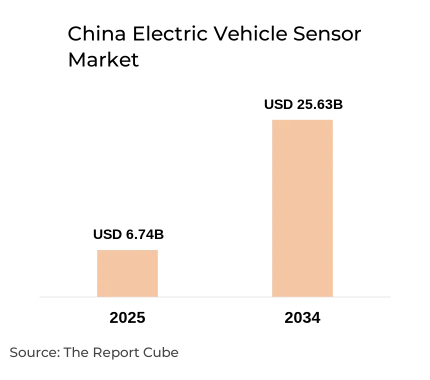
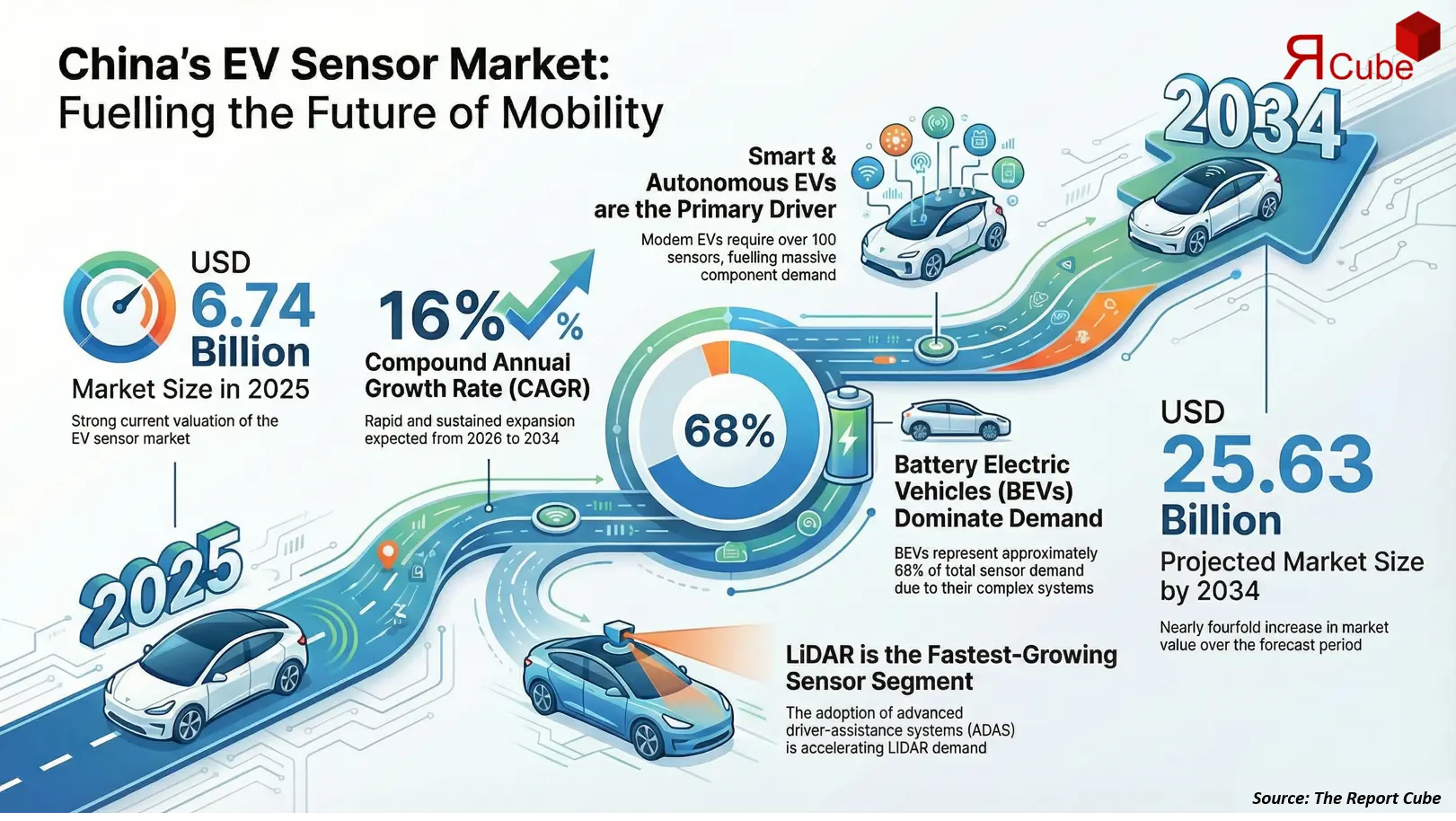
The China Electric Vehicle Sensor Market is anticipated to register a CAGR of 16% during the forecast period 2026-2034. The market size was valued at USD 6.74 billion in 2025 and is projected to reach USD 25.63 billion by 2034. This sharp expansion reflects China’s aggressive electrification roadmap, rising penetration of smart electric vehicles, and strong policy push toward autonomous and connected mobility solutions.
China remains the world’s largest electric vehicle producer and consumer, with EV penetration exceeding 35% of new vehicle sales in major urban centers. As EV architectures become more software-driven and sensor-intensive, demand for high-precision sensing components has increased across powertrain, battery management, safety, and autonomous driving systems. Sensors are now central to improving energy efficiency, thermal safety, vehicle reliability, and real-time decision-making, directly impacting vehicle performance and consumer trust.
Furthermore, domestic innovation combined with strong participation from global semiconductor and automotive electronics players is reshaping the competitive landscape. Chinese EV manufacturers are integrating advanced LiDAR, radar, and image sensors to differentiate vehicles through enhanced driver assistance and intelligent cockpit features. This convergence of electrification, automation, and digitalization positions the China Electric Vehicle Sensor Market as one of the fastest-growing segments within the broader automotive electronics industry.
China Electric Vehicle Sensor Market Recent Developments
- 2025: Bosch expanded local production of automotive-grade sensors to support China’s growing EV and ADAS demand.
- 2025: Hesai Technology launched next-generation automotive LiDAR optimized for mass-market electric vehicles.
Government Initiatives & Policies
- New Energy Vehicle Industry Development Plan: Supports smart EV components, sensors, and autonomous technologies.
- Made in China 2025 - Automotive Electronics: Encourages localization of high-end sensors and semiconductors.
China Electric Vehicle Sensor Market Dynamics
Key Driver: Rapid Adoption of Smart and Autonomous Electric Vehicles
The primary driver of the China Electric Vehicle Sensor Market is the rapid adoption of smart and autonomous electric vehicles. Modern EVs require significantly higher sensor content than internal combustion vehicles, often integrating over 100 sensors per vehicle. These sensors monitor battery temperature, current flow, motor position, wheel speed, and environmental perception. With China targeting large-scale deployment of Level 2+ and Level 3 autonomous driving systems by the end of the decade, demand for LiDAR, radar, and image sensors is accelerating. In 2024, over 45% of newly launched EV models in China featured advanced driver assistance systems as standard. This shift directly fuels sensor demand, making sensing technologies a foundational element of next-generation EV platforms.
Book your FREE 30-minute expert consultation today
Contact UsIndustry Trends: Integration of Advanced Sensing for Safety and Efficiency
A key trend shaping the market is the integration of advanced sensing technologies to enhance safety, efficiency, and driving intelligence. Battery management systems increasingly rely on high-accuracy current and temperature sensors to prevent thermal runaway and extend battery life. At the same time, pressure and position sensors improve regenerative braking and powertrain efficiency. On the perception side, EV manufacturers are combining LiDAR, radar, and image sensors to achieve sensor fusion, enabling more reliable object detection in complex driving environments. This trend is supported by declining sensor costs and local manufacturing scale, allowing even mid-range EVs to adopt features previously limited to premium models. As a result, sensor density per vehicle continues to rise, strengthening long-term market growth.
Major Challenge: Cost Sensitivity and Supply Chain Complexity
Despite strong growth prospects, cost sensitivity remains a major challenge in the China Electric Vehicle Sensor Market. EV manufacturers operate in a highly competitive pricing environment, placing pressure on component suppliers to deliver high performance at lower costs. Advanced sensors such as LiDAR and high-resolution image sensors still represent a significant portion of vehicle electronics cost. Additionally, supply chain complexity, particularly for automotive-grade semiconductors, can create lead-time risks and pricing volatility. Smaller domestic suppliers may face difficulties meeting stringent automotive reliability standards, while global players must navigate localization requirements. These factors can slow adoption rates for advanced sensors in entry-level EV segments.
Opportunity: Localization and Growth of Domestic Sensor Ecosystem
The growing emphasis on localization presents a major opportunity for the China Electric Vehicle Sensor Market. Government policies actively encourage domestic production of critical automotive components, including sensors and semiconductors. Chinese companies specializing in LiDAR, radar, and acoustic sensors are rapidly closing the technology gap with global leaders, supported by strong demand from domestic EV brands. Localization reduces dependency on imports, shortens supply chains, and improves cost competitiveness. As local suppliers scale production and improve quality, they are expected to capture increasing market share, particularly in mid-range and high-volume EV models. This trend creates long-term growth potential across both hardware and sensor-related software solutions.
China Electric Vehicle Sensor Market Segment-wise Analysis
By Sensor Type:
- Current Sensors
- Temperature Sensors
- Position Sensors
- Pressure Sensors
- Speed Sensors
- LiDAR Sensors
- RADAR Sensors
- Image Sensors
- Other Sensors
Current and Temperature Sensors collectively account for approximately 34% of the market, driven by their critical role in battery management and power electronics. Among advanced sensors, LiDAR Sensors are the fastest-growing sub-segment, contributing nearly 14% market share in 2025 and expanding rapidly due to autonomous driving adoption. Image and radar sensors also hold significant shares, supporting ADAS and safety systems. As EV platforms become more intelligent, demand is shifting from basic sensing toward high-value perception sensors, increasing overall market value and technological complexity.
By Vehicle Type:
- Battery Electric Vehicles
- Plug-in Hybrid Vehicles
- Fuel Cell Electric Vehicles
Battery Electric Vehicles dominate the market, representing around 68% of total sensor demand in 2025. BEVs require extensive sensor integration across batteries, motors, inverters, and safety systems, resulting in higher sensor content per vehicle. Plug-in Hybrid Vehicles follow with approximately 22% market share, benefiting from transitional demand as consumers shift toward full electrification. Fuel Cell Electric Vehicles currently account for a smaller share but present long-term potential, particularly in commercial and heavy-duty applications. The dominance of BEVs ensures sustained sensor demand growth throughout the forecast period.
Regional Projection of China Electric Vehicle Sensor Industry
- East China
- North China
- South China
- Central China
- West China
East China leads the China Electric Vehicle Sensor Market with an estimated 41% market share. The region benefits from a high concentration of EV manufacturers, semiconductor fabs, and technology hubs, particularly in Shanghai and surrounding provinces. South China follows, supported by strong electronics manufacturing and innovation ecosystems. East China’s dominance is reinforced by advanced R&D infrastructure, higher EV adoption rates, and proximity to key suppliers. As regional governments continue to support smart mobility and industrial clusters, East China is expected to maintain its leadership position during the forecast period.
Need insights for a specific region within this market?
Request Regional DataWhy Choose This Report?
- Provides a comprehensive overview of the overall market analysis, encompassing key trends, consumer behavior analysis, and risk assessment to support strategic decision-making.
- Provides accurate, up-to-date insights into market size, segmentation, and emerging opportunities, helping to minimize risk & capitalizing on growth.
- Gives deep understanding of target audience preferences, investment habits, and communication channels for enhanced product development & marketing effectiveness.
- Delivers competitive analysis & benchmarking, uncovering the strengths & weaknesses of market competitors to guide strategies.
- Consolidate comprehensive market intelligence, reducing reasoning & streamlining research efforts.
- Facilitates customized market segmentation & risk mitigation strategies, fine-tuned to the business objectives.
- Aids in identifying both market challenges & untapped opportunities within the industry to drive long-term business growth.
- Provides valuable information based on actual customer data & search trends.
Table of Contents
- Introduction
- Objective of the Study
- Product and Category Definition
- Market Segmentation
- Study Variables
- Research Methodology
- Secondary Data Points
- Breakdown of Secondary Sources
- Primary Data Points
- Breakdown of Primary Interviews
- Secondary Data Points
- Executive Summary
- Market Dynamics
- Drivers
- Challenges
- Opportunity Assessment
- Recent Trends and Developments
- Regulatory and Policy Landscape
- China Electric Vehicle Sensor Market Overview (2020-2034)
- Market Size, By Value (USD Billion)
- Market Share, By Sensor Type
- Current Sensors
- Temperature Sensors
- Position Sensors
- Pressure Sensors
- Speed Sensors
- LiDAR Sensors
- RADAR Sensors
- Image Sensors
- Other Sensors
- Market Share, By Vehicle Type
- Battery Electric
- Plug-in Hybrid
- Fuel Cell Electric
- Market Share, By Application
- Powertrain
- Battery Management
- ADAS & Safety
- Chassis & Body
- Charging Systems
- Market Share, By Region
- East
- North
- South
- Central
- West
- Market Share, By Company
- Market Share, By Company
- Competition Characteristics
- Revenue Shares & Analysis
- East China EV Sensor Market
- Market Size, By Value (USD Billion)
- Market Share, By Sensor Type
- Market Share, By Vehicle Type
- Market Share, By Application
- Market Share, By Province/Cluster
- North China EV Sensor Market
- Market Size, By Value (USD Billion)
- Market Share, By Sensor Type
- Market Share, By Vehicle Type
- Market Share, By Application
- Market Share, By Province/Cluster
- South China EV Sensor Market
- Market Size, By Value (USD Billion)
- Market Share, By Sensor Type
- Market Share, By Vehicle Type
- Market Share, By Application
- Market Share, By Province/Cluster
- Central China EV Sensor Market
- Market Size, By Value (USD Billion)
- Market Share, By Sensor Type
- Market Share, By Vehicle Type
- Market Share, By Application
- Market Share, By Province/Cluster
- West China EV Sensor Market
- Market Size, By Value (USD Billion)
- Market Share, By Sensor Type
- Market Share, By Vehicle Type
- Market Share, By Application
- Market Share, By Province/Cluster
- Competitive Outlook and Company Profiles
- Bosch
- Company Overview
- Product Portfolio
- Strategic Alliances/Partnerships
- Recent Developments
- Denso
- Company Overview
- Product Portfolio
- Strategic Alliances/Partnerships
- Recent Developments
- Continental
- Company Overview
- Product Portfolio
- Strategic Alliances/Partnerships
- Recent Developments
- NXP
- Company Overview
- Product Portfolio
- Strategic Alliances/Partnerships
- Recent Developments
- Infineon
- Company Overview
- Product Portfolio
- Strategic Alliances/Partnerships
- Recent Developments
- Analog Devices
- Company Overview
- Product Portfolio
- Strategic Alliances/Partnerships
- Recent Developments
- Allegro MicroSystems
- Company Overview
- Product Portfolio
- Strategic Alliances/Partnerships
- Recent Developments
- Hesai Technology
- Company Overview
- Product Portfolio
- Strategic Alliances/Partnerships
- Recent Developments
- RoboSense
- Company Overview
- Product Portfolio
- Strategic Alliances/Partnerships
- Recent Developments
- Goertek
- Company Overview
- Product Portfolio
- Strategic Alliances/Partnerships
- Recent Developments
- Others
- Bosch
- Contact Us and Disclaimer
Top Key Players & Market Share Outlook
- Bosch
- Denso
- Continental
- NXP
- Infineon
- Analog Devices
- Allegro MicroSystems
- Hesai Technology
- RoboSense
- Goertek
- Others
Frequently Asked Questions






