



Build Your Custom Market Intelligence Report
Customize Your ReportChina Electric Vehicle Market Insights & Analysis
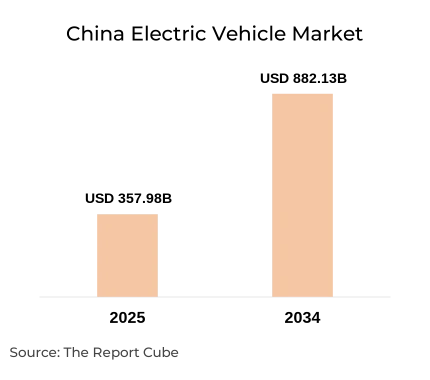
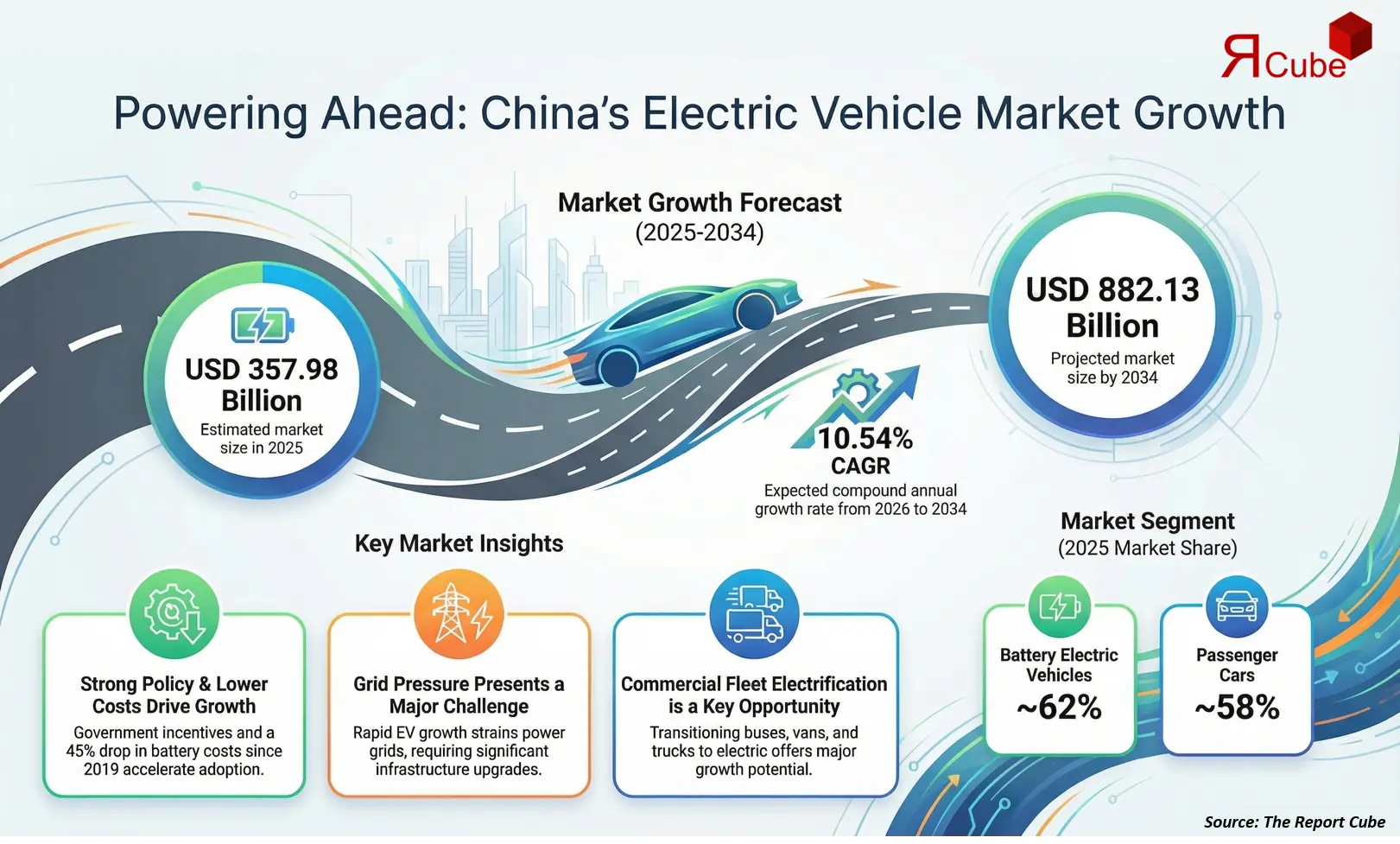
The China Electric Vehicle Market is anticipated to register a CAGR of 10.54% during the forecast period 2026-2034. The market size was valued at USD 357.98 billion in 2025 and is projected to reach USD 882.13 billion by 2034. China continues to dominate the global electric vehicle landscape due to its mature manufacturing ecosystem, large domestic demand base, and strong policy-driven adoption across passenger and commercial vehicle segments.
The market’s expansion is closely linked to China’s long-term decarbonization strategy, urban air quality goals, and energy security objectives. With electric vehicles accounting for over 35% of new vehicle sales in major metropolitan areas by 2024, adoption is no longer limited to early adopters but has entered the mass-market phase. Improvements in battery energy density, declining lithium-ion battery costs, and expanding fast-charging infrastructure have significantly enhanced consumer confidence and total cost of ownership economics.
Furthermore, domestic automakers are rapidly strengthening their competitive positioning by integrating advanced software, connected vehicle features, and autonomous-ready platforms into electric models. Export momentum, especially to Europe and Southeast Asia, is also reinforcing production scale advantages. These interconnected developments collectively position the China Electric Vehicle Market as one of the fastest-growing and most strategically important automotive markets globally through 2034.
China Electric Vehicle Market Recent Developments
- 2025: BYD launched next-generation blade battery platforms with extended range and enhanced thermal safety.
- 2025: SAIC Motor expanded intelligent EV production capacity to support rising domestic and export demand.
Government Initiatives & Policies
- New Energy Vehicle Industry Development Plan: National roadmap promoting EV adoption, charging infrastructure, and battery innovation.
- Dual Credit Policy: Regulatory framework encouraging automakers to increase EV production and efficiency.
China Electric Vehicle Market Dynamics
Key Driver: Strong Policy Support and Cost Competitiveness
Government policy support remains the most influential driver of the China Electric Vehicle Market. National and provincial incentives, including purchase tax exemptions, registration privileges, and charging subsidies, have significantly accelerated adoption. At the same time, battery pack costs in China have declined by nearly 45% since 2019, making electric vehicles increasingly price-competitive with internal combustion engine vehicles. This cost parity has expanded EV adoption beyond Tier-1 cities into lower-tier urban and semi-urban regions. Additionally, state-backed investments in charging infrastructure have resulted in more than 9 million public and private charging points nationwide by 2024, reducing range anxiety and supporting daily usage. These combined factors create a reinforcing cycle of affordability, accessibility, and consumer trust, driving sustained market growth.
Book your FREE 30-minute expert consultation today
Contact UsIndustry Trends: Integration of Smart Technologies and Vertical Supply Chains
A key trend shaping the market is the deep integration of smart technologies into electric vehicles. Chinese EV manufacturers are embedding advanced driver-assistance systems, over-the-air software updates, and AI-powered cockpit features as standard offerings. This software-centric approach differentiates domestic brands and enhances user experience. Simultaneously, vertical integration across batteries, power electronics, and vehicle platforms is strengthening cost control and supply chain resilience. Leading players are investing heavily in in-house battery production and semiconductor partnerships to mitigate raw material volatility. These trends not only improve margins but also accelerate innovation cycles, reinforcing China’s leadership in next-generation electric mobility solutions.
Major Challenge: Grid Pressure and Regional Infrastructure Gaps
Despite strong momentum, the rapid growth of electric vehicles poses challenges for power grid stability and regional infrastructure readiness. High EV penetration in urban clusters has increased peak electricity demand, requiring upgrades in distribution networks and energy storage capacity. In lower-tier cities and rural regions, charging infrastructure deployment remains uneven, limiting adoption potential. Additionally, concerns around battery recycling capacity and lifecycle management are gaining attention as EV volumes rise. Addressing these challenges will require coordinated investments in smart grids, renewable integration, and recycling ecosystems to ensure sustainable long-term growth.
Opportunity: Electrification of Commercial and Public Transport Fleets
The electrification of commercial vehicles and public transport represents a major growth opportunity within the China Electric Vehicle Market. Electric buses already account for over 70% of new bus registrations in urban areas, demonstrating proven scalability. Light commercial vehicles and urban delivery fleets are increasingly transitioning to electric models to reduce operating costs and meet emission regulations. As logistics demand continues to rise, electric trucks and vans are expected to see double-digit annual growth. This shift not only expands market volume but also enhances utilization rates for charging infrastructure, creating a more balanced and resilient EV ecosystem.
China Electric Vehicle Market Segment-wise Analysis
By Vehicle:
- Battery Electric Vehicles
- Plug-in Hybrid Vehicles
- Hybrid Electric Vehicles
- Fuel Cell Vehicles
Battery Electric Vehicles dominate the market, accounting for approximately 62% of total market share in 2025. Their leadership is driven by falling battery costs, expanding charging networks, and strong consumer preference for fully electric solutions. Plug-in Hybrid Vehicles hold nearly 24% share, particularly appealing to consumers in regions with limited charging access. Hybrid Electric Vehicles maintain a smaller but stable presence, while Fuel Cell Vehicles remain niche, primarily focused on pilot projects and commercial applications. The dominance of BEVs underscores China’s commitment to full electrification.
By Vehicle Type:
- Passenger Cars
- Light Commercial Vehicles
- Buses/Coaches
- Trucks/Vans
Passenger Cars represent the largest segment, contributing nearly 58% of the overall market revenue. Strong urban demand, diverse model offerings, and competitive pricing fuel this dominance. Buses and Coaches follow with around 18% share, supported by municipal electrification mandates. Light Commercial Vehicles account for approximately 14%, driven by last-mile delivery growth. Trucks and Vans, while currently smaller, are emerging as a high-growth segment as battery technology improves payload and range capabilities.
Regional Projection of China Electric Vehicle Industry
- East China
- North China
- South China
- Central China
- West China
- Northeast China
East China leads the China Electric Vehicle Market, accounting for nearly 40% of total sales. The region benefits from high urbanization, strong consumer purchasing power, and dense charging infrastructure networks. Cities such as Shanghai and Hangzhou serve as innovation hubs for EV adoption and smart mobility. South China and North China follow, driven by manufacturing clusters and supportive local policies. While Central and West China currently lag in penetration, ongoing infrastructure investments are expected to gradually narrow the regional adoption gap during the forecast period.
Need insights for a specific region within this market?
Request Regional DataWhy Choose This Report?
- Provides a comprehensive overview of the overall market analysis, encompassing key trends, consumer behavior analysis, and risk assessment to support strategic decision-making.
- Provides accurate, up-to-date insights into market size, segmentation, and emerging opportunities, helping to minimize risk & capitalizing on growth.
- Gives deep understanding of target audience preferences, investment habits, and communication channels for enhanced product development & marketing effectiveness.
- Delivers competitive analysis & benchmarking, uncovering the strengths & weaknesses of market competitors to guide strategies.
- Consolidate comprehensive market intelligence, reducing reasoning & streamlining research efforts.
- Facilitates customized market segmentation & risk mitigation strategies, fine-tuned to the business objectives.
- Aids in identifying both market challenges & untapped opportunities within the industry to drive long-term business growth.
- Provides valuable information based on actual customer data & search trends.
Table of Contents
- Introduction
- Objective of the Study
- Product and Category Definition
- Market Segmentation
- Study Variables
- Research Methodology
- Secondary Data Points
- Breakdown of Secondary Sources
- Primary Data Points
- Breakdown of Primary Interviews
- Secondary Data Points
- Executive Summary
- Market Dynamics
- Drivers
- Challenges
- Opportunity Assessment
- Recent Trends and Developments
- Regulatory and Policy Landscape
- China Electric Vehicle Market Overview (2020-2034)
- Market Size, By Value (USD Billion)
- Market Share, By Vehicle
- Battery Electric
- Plug‑in Hybrid
- Hybrid Electric
- Fuel Cell
- Market Share, By Vehicle Type
- Passenger Cars
- Light Commercial
- Buses/Coaches
- Trucks/Vans
- Market Share, By Price Band
- Under 100k CNY
- 100k–200k CNY
- 200k–300k CNY
- Above 300k CNY
- Market Share, By Range
- Under 300 km
- 300–500 km
- Above 500 km
- Market Share, By Drive Type
- Front‑Wheel Drive
- Rear‑Wheel Drive
- All‑Wheel Drive
- Market Share, By Region
- East
- North
- South
- Central
- West
- Northeast
- Market Share, By Company
- Market Share, By Company
- Competition Characteristics
- Revenue Shares & Analysis
- East China Electric Vehicle Market
- Market Size, By Value (USD Billion)
- Market Share, By Vehicle
- Market Share, By Vehicle Type
- Market Share, By Price Band
- Market Share, By Range
- Market Share, By Drive Type
- Market Share, By Province
- Shanghai
- Jiangsu
- Zhejiang
- Shandong
- Anhui
- North China Electric Vehicle Market
- Market Size, By Value (USD Billion)
- Market Share, By Vehicle
- Market Share, By Vehicle Type
- Market Share, By Price Band
- Market Share, By Range
- Market Share, By Drive Type
- Market Share, By Province
- Beijing
- Tianjin
- Hebei
- Shanxi
- Inner Mongolia
- South China Electric Vehicle Market
- Market Size, By Value (USD Billion)
- Market Share, By Vehicle
- Market Share, By Vehicle Type
- Market Share, By Price Band
- Market Share, By Range
- Market Share, By Drive Type
- Market Share, By Province
- Guangdong
- Guangxi
- Hainan
- Central China Electric Vehicle Market
- Market Size, By Value (USD Billion)
- Market Share, By Vehicle
- Market Share, By Vehicle Type
- Market Share, By Price Band
- Market Share, By Range
- Market Share, By Drive Type
- Market Share, By Province
- Henan
- Hubei
- Hunan
- West China Electric Vehicle Market
- Market Size, By Value (USD Billion)
- Market Share, By Vehicle
- Market Share, By Vehicle Type
- Market Share, By Price Band
- Market Share, By Range
- Market Share, By Drive Type
- Market Share, By Province
- Sichuan
- Chongqing
- Shaanxi
- Yunnan
- Rest of West China
- Northeast China Electric Vehicle Market
- Market Size, By Value (USD Billion)
- Market Share, By Vehicle
- Market Share, By Vehicle Type
- Market Share, By Price Band
- Market Share, By Range
- Market Share, By Drive Type
- Market Share, By Province
- Liaoning
- Jilin
- Heilongjiang
- Competitive Outlook and Company Profiles
- BYD Company Ltd.
- Company Overview
- Product Portfolio
- Strategic Alliances/Partnerships
- Recent Developments
- SAIC Motor Corporation
- Company Overview
- Product Portfolio
- Strategic Alliances/Partnerships
- Recent Developments
- Geely Auto Group
- Company Overview
- Product Portfolio
- Strategic Alliances/Partnerships
- Recent Developments
- Chery Automobile
- Company Overview
- Product Portfolio
- Strategic Alliances/Partnerships
- Recent Developments
- Great Wall Motor
- Company Overview
- Product Portfolio
- Strategic Alliances/Partnerships
- Recent Developments
- NIO Inc.
- Company Overview
- Product Portfolio
- Strategic Alliances/Partnerships
- Recent Developments
- XPeng Inc.
- Company Overview
- Product Portfolio
- Strategic Alliances/Partnerships
- Recent Developments
- Li Auto Inc.
- Company Overview
- Product Portfolio
- Strategic Alliances/Partnerships
- Recent Developments
- Tesla Inc. (China)
- Company Overview
- Product Portfolio
- Strategic Alliances/Partnerships
- Recent Developments
- GAC Aion
- Company Overview
- Product Portfolio
- Strategic Alliances/Partnerships
- Recent Developments
- Others
- BYD Company Ltd.
- Contact Us and Disclaimer
Top Key Players & Market Share Outlook
- BYD Company Ltd.
- SAIC Motor Corporation
- Geely Auto Group
- Chery Automobile
- Great Wall Motor
- NIO Inc.
- XPeng Inc.
- Li Auto Inc.
- Tesla Inc. (China)
- GAC Aion
- Others
Frequently Asked Questions






