



Build Your Custom Market Intelligence Report
Customize Your ReportChina Injectable Drug Delivery Devices Market Key Highlights
By Product:
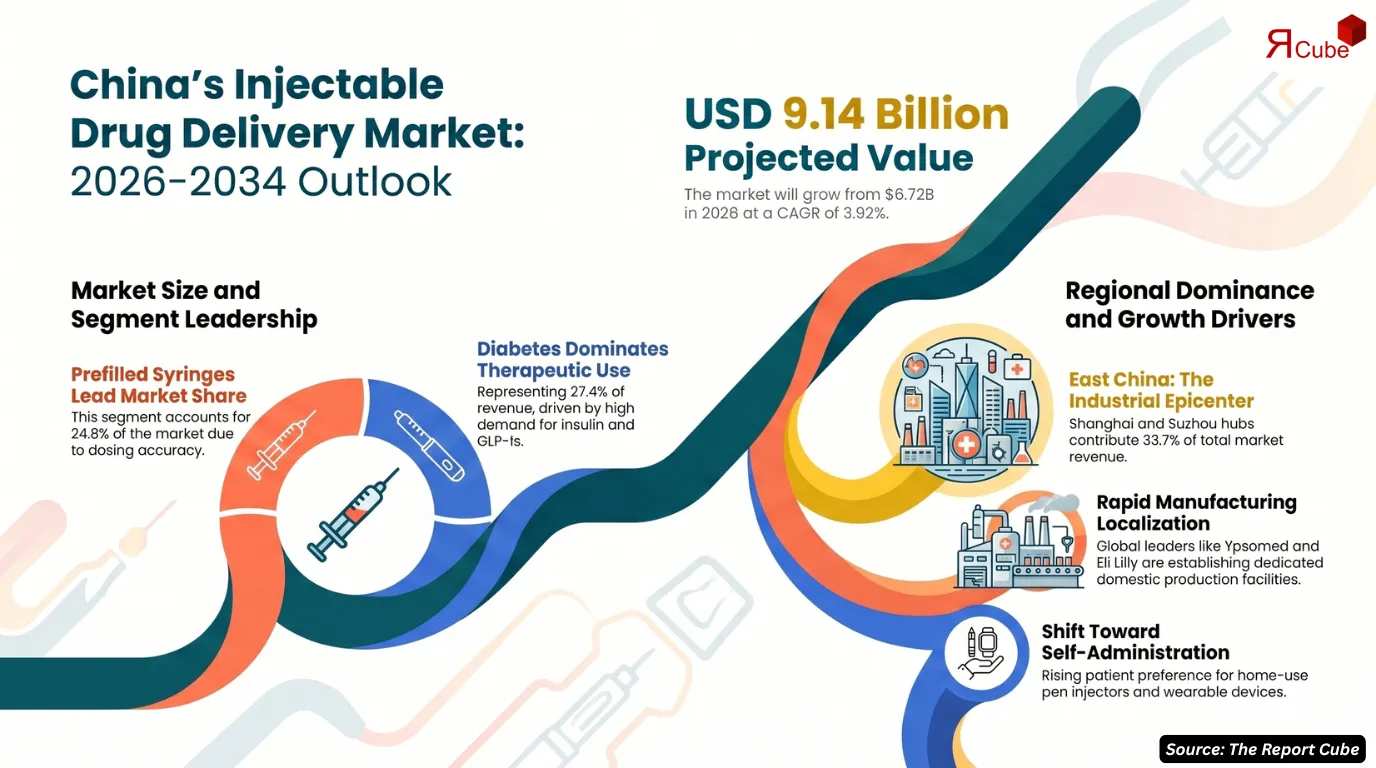
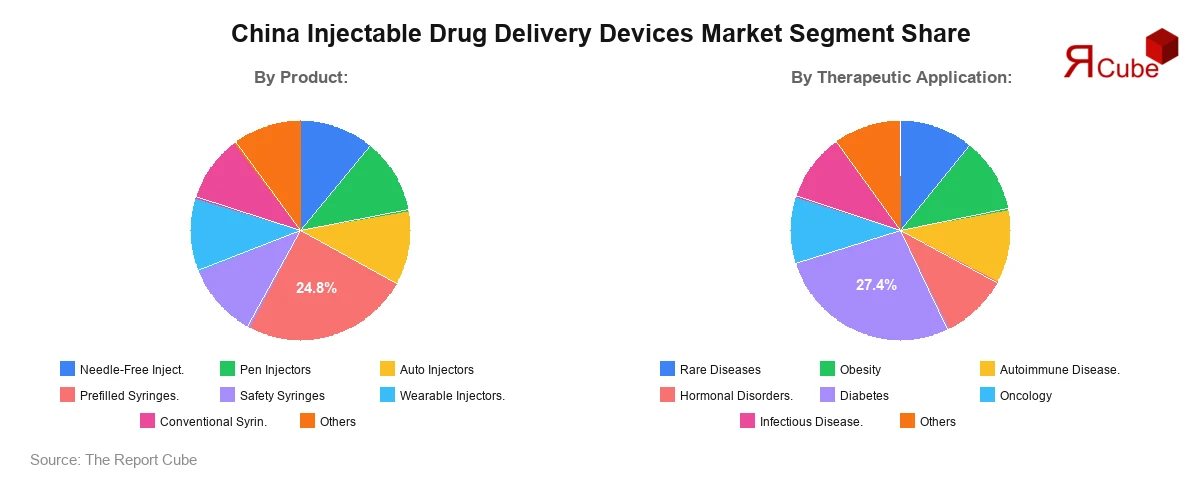
Prefilled Syringes segment leads the market with nearly 24.8% share.
By Therapeutic Application:
Diabetes segment dominates the market with around 27.4% of revenue.
Regional Outlook:
East China region dominates the China Injectable Drug Delivery Devices market with approximately 33.7% share.
China Injectable Drug Delivery Devices Market Insights & Analysis
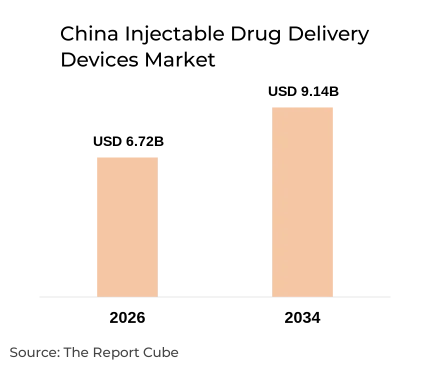
The China Injectable Drug Delivery Devices Market is anticipated to register a CAGR of around 3.92% during the forecast period 2026-2034. The market size is valued at USD 6.72 billion in 2026 and is projected to reach USD 9.14 billion by 2034. The market growth is being supported by the rapid increase in chronic disease incidence and the growing clinical reliance on injectable therapies. China continues to experience rising cases of diabetes, cancer, autoimmune disorders, and obesity-related conditions, all of which require long-term injectable treatment regimens. As treatment protocols increasingly shift toward biologics and specialty pharmaceuticals, healthcare providers are adopting advanced delivery devices that improve dosage accuracy, patient safety, and therapeutic outcomes. Prefilled syringes, pen injectors, and auto injectors are becoming integral components of modern treatment pathways due to their convenience and reduced administration errors.
Investment activity across China's pharmaceutical and medical device sectors is strengthening the country's position within the global injectable drug ecosystem. Domestic biologics production capacity has expanded significantly as multinational pharmaceutical companies and local innovators continue to establish manufacturing facilities across key industrial clusters. The commercialization of high-value biologics, including monoclonal antibodies, GLP-1 therapies, and bispecific antibodies, is generating sustained demand for compatible injectable delivery platforms. Large-scale investments announced by companies such as Ypsomed and Eli Lilly highlight the increasing localization of both drug and device manufacturing. These developments are improving supply chain resilience while creating new opportunities for advanced injectable delivery technologies throughout the Chinese healthcare market.
China Injectable Drug Delivery Devices Market Impact Analysis
| Factor | Type | Specific Impact on Market | Magnitude | Business Implication |
|---|---|---|---|---|
| Rising Chronic Disease Burden | Market | Greater need for parenteral therapies in diabetes and oncology | High | Drives demand for advanced injectable devices across hospitals |
| Growth of Biologics and Biosimilars | Technological | Complex biologic drugs require specialised injectable platforms | High | Supports uptake of prefilled syringes and auto injector systems |
| Shift Toward Self Administration | Consumer | Patients prefer at home dosing with convenient device formats | High | Boosts market for wearable injectors and home use pen devices |
| Regulatory Emphasis on Safety | Regulatory | Guidelines promote needlestick safety and device traceability | Medium | Accelerates adoption of safety syringes and compliant packaging |
| Hospital and Clinic Capacity Expansion | Market | New facilities increase procedural volumes requiring injections | Medium | Creates incremental device demand from public and private centres |
| Domestic Manufacturing Incentives | Environmental | Policy support encourages local production of delivery devices | Medium | Enables cost optimisation and improved supply chain resilience |
| Competition from Global and Local Players | Competitive | Multiple suppliers intensify pricing and innovation pressures | High | Requires differentiation through design, reliability and services |
China Injectable Drug Delivery Devices Market Dynamics
Key Driver: Expansion of Biologic Therapies and Chronic Disease Treatment Programs
China's healthcare system is witnessing sustained growth in the use of biologics for cancer, autoimmune disorders, metabolic diseases, and rare conditions. Many of these therapies require injectable administration, creating long-term demand for advanced delivery devices. The increasing diagnosis rate of diabetes and obesity-related disorders has accelerated the adoption of insulin pens, GLP-1 injectors, and prefilled syringe systems. Hospitals and specialty clinics are increasingly prioritizing delivery solutions that improve treatment accuracy while reducing medication waste.
Commercialization of innovative biologics developed by domestic pharmaceutical companies is further supporting market expansion. The licensing agreement between AbbVie and RemeGen for the bispecific antibody RC148 highlights the growing depth of China's biologics pipeline. As more injectable therapies advance toward commercialization, pharmaceutical manufacturers require reliable delivery platforms capable of supporting high-value biologic products. This structural shift is strengthening demand across the China injectable drug delivery devices market and creating opportunities for both global and domestic device manufacturers.
Industry Trends: Localization of Manufacturing and Growth of Patient-Centric Devices
Manufacturing localization has become a defining trend across the China injectable drug delivery devices industry. Global device manufacturers are increasingly establishing production facilities within China to improve supply chain responsiveness, reduce import dependence, and meet growing pharmaceutical demand. Investments in regional manufacturing infrastructure are enabling faster delivery timelines and improving collaboration between pharmaceutical companies and device suppliers.
Patient convenience continues to influence product development strategies. Healthcare providers are encouraging greater use of self-injection systems that support treatment adherence outside hospital settings. Pen injectors, wearable injectors, and autoinjectors are gaining wider acceptance because they simplify administration procedures and improve dosing consistency. Device developers are also integrating enhanced safety mechanisms and user-friendly designs to support elderly patients and individuals requiring long-term therapy. These innovations are strengthening the adoption of injectable drug delivery devices in China across multiple therapeutic categories.
Book your FREE 30-minute expert consultation today
Contact UsMajor Challenge: Cost Pressures and Technical Requirements for Advanced Device Production
Manufacturing advanced injectable drug delivery systems requires highly specialized engineering capabilities, precision molding technologies, and strict sterile production environments. Companies investing in autoinjectors, wearable injectors, and combination products must allocate significant capital toward quality assurance systems and regulatory compliance programs. These requirements can create operational challenges, particularly for emerging manufacturers attempting to scale production.
Compatibility requirements between injectable biologics and delivery systems add another layer of complexity. Drug viscosity, stability characteristics, and administration requirements must be carefully evaluated during device development. Delays associated with product validation and regulatory approvals can extend commercialization timelines and increase overall development costs. Maintaining consistent quality standards while controlling manufacturing expenses remains a key challenge across the China injectable drug delivery devices market.
Opportunity: Rising GLP-1 Adoption and Expansion of Domestic Injectable Supply Chains
Growing utilization of GLP-1 receptor agonists for diabetes and obesity management is creating substantial opportunities throughout China's injectable drug delivery ecosystem. These therapies often rely on autoinjectors, pen injectors, and prefilled delivery systems designed for frequent patient use. Rising awareness of metabolic disease management and increasing physician adoption of innovative treatment options are expected to support continued demand for specialized injection devices.
Domestic pharmaceutical manufacturing expansion provides an additional growth avenue. Eli Lilly's commitment to increase injectable production capacity in Suzhou and its partnership with Pharmaron reflect broader investment trends occurring throughout China's pharmaceutical sector. Increased biologics manufacturing activity requires a parallel expansion of device supply chains, fill-finish capabilities, sterile packaging systems, and administration technologies. As pharmaceutical output rises, demand for injectable drug delivery devices in China is expected to increase steadily throughout the forecast period.
China Injectable Drug Delivery Devices Market Segment-wise Analysis
By Product:
- Needle-Free Injectors
- Pen Injectors
- Auto Injectors
- Prefilled Syringes
- Safety Syringes
- Wearable Injectors
- Conventional Syringes
- Others
Prefilled Syringes hold the largest share of the China Injectable Drug Delivery Devices Market, accounting for approximately 24.8% of industry revenue in 2026. Market leadership is supported by strong adoption across biologics, vaccines, oncology therapies, and chronic disease management programs. Pharmaceutical companies increasingly favor prefilled systems because they simplify administration procedures, reduce dosing errors, and improve sterility throughout the product lifecycle. Their compatibility with high-value biologic formulations has made them a preferred packaging and delivery format among leading drug manufacturers.
Demand is being further supported by China's expanding biosimilar and biologics pipeline, where administration precision is critical to treatment effectiveness. Healthcare providers also benefit from reduced preparation time and improved workflow efficiency compared with traditional vial-and-syringe methods. As pharmaceutical companies continue to commercialize complex injectable therapies, prefilled syringes are expected to maintain a strong competitive advantage within the China injectable drug delivery devices market.
By Therapeutic Application:
- Rare Diseases
- Obesity
- Autoimmune Diseases
- Hormonal Disorders
- Diabetes
- Oncology
- Infectious Diseases
- Others
Diabetes remains the leading therapeutic application segment, representing nearly 27.4% of total market revenue. China's large diabetic population continues to generate substantial demand for insulin delivery systems, including pen injectors, autoinjectors, and prefilled syringe technologies. Government efforts to improve chronic disease management and broaden healthcare access have strengthened treatment adoption rates across both developed and emerging provinces.
The growing use of injectable GLP-1 therapies is creating additional momentum within this segment. Pharmaceutical manufacturers are introducing advanced delivery solutions that improve patient convenience while supporting long-term adherence. Rising awareness regarding early disease management and improved access to innovative diabetes treatments are expected to sustain strong demand for injectable drug delivery devices throughout the forecast period.
Regional Projection of China Injectable Drug Delivery Devices Industry
- North China
- Northeast China
- East China
- South Central China
- Southwest China
- Northwest China
East China accounts for the largest share of the China Injectable Drug Delivery Devices Market, contributing approximately 33.7% of total revenue. The region serves as the country's primary pharmaceutical and biotechnology manufacturing center, supported by extensive research infrastructure, advanced healthcare facilities, and a highly developed industrial ecosystem. Major cities including Shanghai, Suzhou, Hangzhou, and Nanjing host numerous multinational pharmaceutical companies, biologics manufacturers, and medical device production facilities.
Investment activity remains particularly strong across East China. The establishment of Ypsomed's Changzhou autoinjector manufacturing facility and continued expansion of pharmaceutical production capacity across Jiangsu and Shanghai demonstrate the region's strategic importance. Strong healthcare spending, a large patient population, and advanced distribution networks further strengthen regional demand for injectable drug delivery technologies. These advantages are expected to help East China maintain its leadership position throughout the forecast period.
Need insights for a specific region within this market?
Request Regional DataChina Injectable Drug Delivery Devices Market Regional Analysis
The China injectable devices market differs by region due to varied industrial depth, healthcare capacity, and patient access patterns across the country.
| Cluster | Demand Level | Key Areas | System Dominance | Core Demand Logic | Growth Nature |
|---|---|---|---|---|---|
| North China | Very High | Beijing, Tianjin, Hebei hubs [web:2305] | Hospital injectors & pens [web:2298] | Tier 3 hospitals, policy pilots [web:2299] | Innovation and tender led [web:2298] |
| Northeast China | Medium | Shenyang, Dalian, Harbin belts [web:2305] | Conventional syringes, vials [web:2289] | Aging base, chronic disease care [web:2302] | Upgrade from legacy devices [web:2298] |
| East China | Extremely High | Shanghai, Suzhou, Hangzhou [web:2305] | Auto injectors, smart pens [web:2301] | Biologics and CRO clusters [web:2305] | Fastest market scaling [web:2298] |
| South Central China | High | Guangzhou, Shenzhen, Wuhan [web:2305] | Self injection and pens [web:2301] | Urban insurance and exports [web:2292] | Chronic care penetration [web:2283] |
| Southwest China | Medium | Chengdu, Chongqing, Guiyang [web:2305] | Hospital driven syringe use [web:2291] | Expanding tertiary networks [web:2302] | Infrastructure led uptake [web:2299] |
| Northwest China | Low to Medium | Xi'an, Urumqi, Lanzhou [web:2305] | Cost focused syringe lines [web:2289] | Public spend, sparse density [web:2299] | Gradual inclusion growth [web:2304] |
Government Initiatives & Policies
- Healthy China 2030 Initiative: Continued implementation during 2025-2026 supports chronic disease prevention, healthcare modernization, and broader access to advanced treatment technologies, encouraging adoption of injectable biologics and drug delivery devices.
- 14th Five-Year Plan for Pharmaceutical Industry Development: China continues promoting domestic medical device innovation, biologics manufacturing expansion, and advanced drug delivery technologies through strategic industrial policies and investment support programs.
China Injectable Drug Delivery Devices Industry Recent Developments
- 2025: Ypsomed Holding AG inaugurated its first dedicated autoinjector manufacturing facility in Changzhou, China. The company invested nearly CHF 150 million in the 15,000-square-meter site, strengthening local production capacity and improving supply responsiveness for Chinese pharmaceutical customers utilizing autoinjector and pen injector technologies.
- 2026: AbbVie and RemeGen entered a USD 5.6 billion licensing agreement for RC148, a PD-1/VEGF-targeted bispecific antibody. The transaction highlights China's growing role in global injectable biologics development and is expected to increase domestic demand for advanced injectable delivery platforms and supporting infrastructure.
- 2026: Eli Lilly announced a USD 3 billion investment plan over ten years to expand injectable and oral GLP-1 manufacturing in China. The initiative includes enhanced production capacity at the Suzhou facility and a USD 200 million partnership with Pharmaron, supporting higher demand for injectable delivery devices.
Why Choose This Report?
- Provides a comprehensive overview of the overall market analysis, encompassing key trends, consumer behavior analysis, and risk assessment to support strategic decision-making.
- Provides accurate, up-to-date insights into market size, segmentation, and emerging opportunities, helping to minimize risk & capitalizing on growth.
- Gives deep understanding of target audience preferences, investment habits, and communication channels for enhanced product development & marketing effectiveness.
- Delivers competitive analysis & benchmarking, uncovering the strengths & weaknesses of market competitors to guide strategies.
- Consolidate comprehensive market intelligence, reducing reasoning & streamlining research efforts.
- Facilitates customized market segmentation & risk mitigation strategies, fine-tuned to the business objectives.
- Aids in identifying both market challenges & untapped opportunities within the industry to drive long-term business growth.
- Provides valuable information based on actual customer data & search trends.
Table of Contents
- Introduction
- Objective of the Study
- Product and Category Definition
- Market Segmentation
- Study Variables
- Research Methodology
- Secondary Data Points
- Breakdown of Secondary Sources
- Primary Data Points
- Breakdown of Primary Interviews
- Secondary Data Points
- Executive Summary
- Market Dynamics
- Emerging Opportunities
- Adoption Trends
- Demand Drivers
- Disruption Analysis (Challenges)
- Industry Analysis & Strategic Insights
- Supply/Value Chain Analysis
- Pricing Analysis
- Go-To-Market (GTM) Strategy
- BCG Matrix
- Recent Trends and Developments
- Import and Export Analysis
- Regulatory and Policy Landscape
- Region-wise Policies
- Government Initiatives
- China Injectable Drug Delivery Devices Market Overview and Forecast Analysis (2021-2034)
- Market Size, By Value, By Growth Rate (CAGR/USD Billion)
- Market Share, By Product
- Needle-Free Injectors
- Pen Injectors
- Auto Injectors
- Prefilled Syringes
- Safety Syringes
- Wearable Injectors
- Conventional Syringes
- Others
- Market Share, By Therapeutic Application
- Rare Diseases
- Obesity
- Autoimmune Diseases
- Hormonal Disorders
- Diabetes
- Oncology
- Infectious Diseases
- Others
- Market Share, By Formulation Packaging
- Dual-Chamber Systems
- Cartridges
- Vials
- Prefilled Syringes
- Ampoules
- Market Share, By Usage Pattern
- Other Usage Patterns
- Immunization
- Curative Care
- Market Share, By Route of Administration
- CNS-Based Administration (Central Nervous System)
- Organ-Based Administration
- Dermal-Based Administration
- Circulatory/Musculoskeletal System-Based Administration
- Market Share, By End User
- Long-Term Care Settings
- Hospitals & Clinics
- Nursing Homes
- Home Care Settings
- Other End Users
- Market Share, By Region
- North
- Northeast
- East
- South Central
- Southwest
- Northwest
- Market Share, By Company
- Revenue Shares & Analysis
- Competitive Landscape
- North China Injectable Drug Delivery Devices Market Overview and Forecast Analysis (2021-2034)
- Market Size, By Value, By Growth Rate (CAGR/USD Billion/Million)
- Market Share, By Product
- Market Share, By Therapeutic Application
- Market Share, By Formulation Packaging
- Market Share, By Usage Pattern
- Market Share, By Route of Administration
- Market Share, By End User
- Northeast China Injectable Drug Delivery Devices Market Overview and Forecast Analysis (2021-2034)
- Market Size, By Value, By Growth Rate (CAGR/USD Billion/Million)
- Market Share, By Product
- Market Share, By Therapeutic Application
- Market Share, By Formulation Packaging
- Market Share, By Usage Pattern
- Market Share, By Route of Administration
- Market Share, By End User
- East China Injectable Drug Delivery Devices Market Overview and Forecast Analysis (2021-2034)
- Market Size, By Value, By Growth Rate (CAGR/USD Billion/Million)
- Market Share, By Product
- Market Share, By Therapeutic Application
- Market Share, By Formulation Packaging
- Market Share, By Usage Pattern
- Market Share, By Route of Administration
- Market Share, By End User
- South Central China Injectable Drug Delivery Devices Market Overview and Forecast Analysis (2021-2034)
- Market Size, By Value, By Growth Rate (CAGR/USD Billion/Million)
- Market Share, By Product
- Market Share, By Therapeutic Application
- Market Share, By Formulation Packaging
- Market Share, By Usage Pattern
- Market Share, By Route of Administration
- Market Share, By End User
- Southwest China Injectable Drug Delivery Devices Market Overview and Forecast Analysis (2021-2034)
- Market Size, By Value, By Growth Rate (CAGR/USD Billion/Million)
- Market Share, By Product
- Market Share, By Therapeutic Application
- Market Share, By Formulation Packaging
- Market Share, By Usage Pattern
- Market Share, By Route of Administration
- Market Share, By End User
- Northwest China Injectable Drug Delivery Devices Market Overview and Forecast Analysis (2021-2034)
- Market Size, By Value, By Growth Rate (CAGR/USD Billion/Million)
- Market Share, By Product
- Market Share, By Therapeutic Application
- Market Share, By Formulation Packaging
- Market Share, By Usage Pattern
- Market Share, By Route of Administration
- Market Share, By End User
- Competitive Analysis, 2026
- Market Share of Key Players
- Competitive Mapping for Each Segment and Companies Operating Regionally
- North China Injectable Drug Delivery Devices Companies Share & Competitive Analysis, 2026
- Northeast China Injectable Drug Delivery Devices Companies Share & Competitive Analysis, 2026
- East China Injectable Drug Delivery Devices Companies Share & Competitive Analysis, 2026
- South Central China Injectable Drug Delivery Devices Companies Share & Competitive Analysis, 2026
- Southwest China Injectable Drug Delivery Devices Companies Share & Competitive Analysis, 2026
- Northwest China Injectable Drug Delivery Devices Companies Share & Competitive Analysis, 2026
- Company Profile (Partial List)
- Gerresheimer AG
- Company Overview
- Product Portfolio
- Strategic Alliances/Partnerships
- Recent Developments
- Owen Mumford
- Company Overview
- Product Portfolio
- Strategic Alliances/Partnerships
- Recent Developments
- West Pharmaceutical Services, Inc.
- Company Overview
- Product Portfolio
- Strategic Alliances/Partnerships
- Recent Developments
- Baxter International Inc.
- Company Overview
- Product Portfolio
- Strategic Alliances/Partnerships
- Recent Developments
- Stevanato Group S.p.A.
- Company Overview
- Product Portfolio
- Strategic Alliances/Partnerships
- Recent Developments
- Terumo Corporation
- Company Overview
- Product Portfolio
- Strategic Alliances/Partnerships
- Recent Developments
- SHL Medical
- Company Overview
- Product Portfolio
- Strategic Alliances/Partnerships
- Recent Developments
- Cardinal Health, Inc.
- Company Overview
- Product Portfolio
- Strategic Alliances/Partnerships
- Recent Developments
- Haselmeier
- Company Overview
- Product Portfolio
- Strategic Alliances/Partnerships
- Recent Developments
- Nemera
- Company Overview
- Product Portfolio
- Strategic Alliances/Partnerships
- Recent Developments
- SCHOTT Pharma AG & Co. KGaA
- Company Overview
- Product Portfolio
- Strategic Alliances/Partnerships
- Recent Developments
- Becton, Dickinson and Company
- Company Overview
- Product Portfolio
- Strategic Alliances/Partnerships
- Recent Developments
- B. Braun SE
- Company Overview
- Product Portfolio
- Strategic Alliances/Partnerships
- Recent Developments
- Ypsomed Holding AG
- Company Overview
- Product Portfolio
- Strategic Alliances/Partnerships
- Recent Developments
- Others (Partial List)
- Gerresheimer AG
- Contact Us and Disclaimer
Top Key Players & Market Share Outlook
- Gerresheimer AG
- Owen Mumford
- West Pharmaceutical Services, Inc.
- Baxter International Inc.
- Stevanato Group S.p.A.
- Terumo Corporation
- SHL Medical
- Cardinal Health, Inc.
- Haselmeier
- Nemera
- SCHOTT Pharma AG & Co. KGaA
- Becton, Dickinson and Company
- B. Braun SE
- Ypsomed Holding AG
Frequently Asked Questions






