



Build Your Custom Market Intelligence Report
Customize Your ReportKey Takeaways
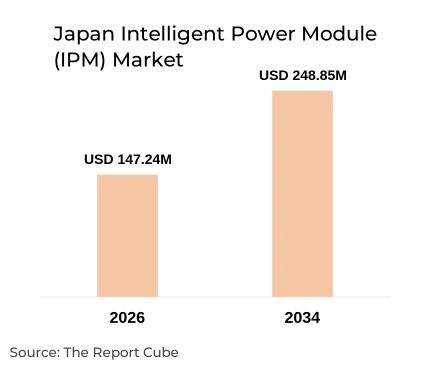
- Japan Intelligent Power Module (IPM) Market valued at USD 147.24 million in 2026, reflecting steady demand growth.
- Industry projected to reach USD 248.85 million by 2034 at 6.78% CAGR.
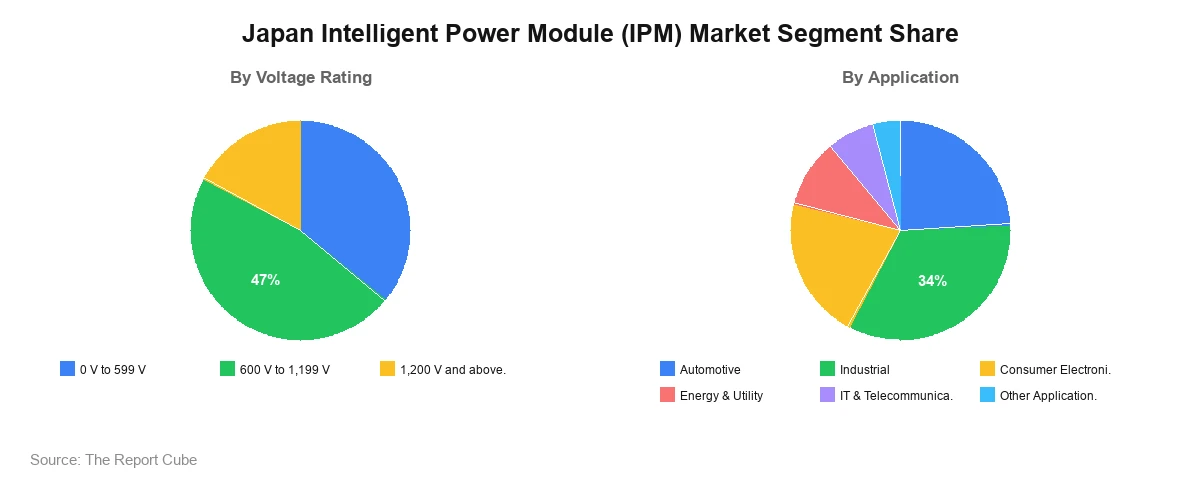
- The 600 V to 1,199 V class leads the voltage rating segment with an estimated 47% share.
- Industrial applications dominate end-use demand, holding an estimated 34% share in 2026.
- Automotive remains the fastest-growing application segment as electrified drivetrains adopt integrated power modules.
- Mitsubishi Electric, Fuji Electric, and Infineon Technologies lead intelligent power module supply in Japan.
- Silicon carbide adoption is reshaping module efficiency and domestic capacity investment plans.
- Kanto Region accounts for the largest regional demand share at approximately 36%.
Market Overview
The Japan Intelligent Power Module (IPM) Market is anticipated to register a 6.78% CAGR during 2026–2034, expanding from USD 147.24 million to USD 248.85 million. Inverter air conditioners, industrial drives, and electric vehicles anchor demand, while METI semiconductor subsidies support domestic suppliers including Mitsubishi Electric and Fuji Electric.
A Japan Intelligent Power Module (IPM) Market Analysis shows growing integration of silicon carbide devices, which cut switching losses in appliances and traction inverters. Japan's Top Runner efficiency standards, factory automation, and renewable installations reinforce adoption, while Infineon Technologies AG, STMicroelectronics NV, and ON Semiconductor Corp compete with local manufacturers.
Market Size & Forecast
|
Metric |
Details |
|---|---|
|
Market Size (2026) |
USD 147.24 Million |
|
Market Size (2034) |
USD 248.85 Million |
|
CAGR (2026–2034) |
6.78% |
|
Base Year |
2026 |
|
Historical Years |
2021–2025 |
|
Forecast Years |
2026–2034 |
The Japan Intelligent Power Module (IPM) Market Size reached USD 147.24 million in 2026 and is projected to hit USD 248.85 million by 2034, advancing at a 6.78% CAGR. Domestic silicon carbide capacity expansion by Mitsubishi Electric and Fuji Electric, combined with inverter-driven appliance efficiency mandates, differentiates Japan's growth trajectory from commodity-driven power semiconductor markets.
Market Dynamics
The Japan Intelligent Power Module (IPM) Market Growth reflects rising energy-efficiency requirements across appliances, factory automation, and electrified mobility. Domestic wafer investments, advanced packaging, and integrated gate-drive protection reduce design complexity for inverter makers, while volatile electric vehicle demand and silicon carbide cost premiums temper adoption timelines.
|
Factor |
Type |
Specific Impact on Market |
Magnitude |
|---|---|---|---|
|
Appliance inverterization and efficiency standards |
Driver |
Increases integrated module adoption in air conditioners, refrigerators, and motor drives |
High |
|
Government support for domestic SiC production |
Driver |
Expands local wafer and module capacity and improves supply security |
High |
|
Data center, renewable, and high-voltage industrial demand |
Opportunity |
Opens new demand for 1,200 V and above intelligent power modules |
Medium |
|
Slower-than-expected electric vehicle demand |
Challenge |
Delays capacity-linked investments and automotive module volume ramp-up |
Medium |
|
Shift from silicon IGBT to SiC-based modules |
Trend |
Improves power loss performance and enables compact inverter designs |
High |
- Growth Drivers - Energy-Efficiency Mandates and Inverterization: Japan's Top Runner standards and appliance inverterization push manufacturers toward IPMs that integrate gate drivers and protection. Mitsubishi Electric's SLIMDIP series and Fuji Electric's industrial modules shorten design cycles and reduce component counts for air conditioner and motor-drive makers.
- Market Restraints - SiC Cost and EV Demand Uncertainty: Silicon carbide devices carry cost premiums over silicon IGBT alternatives, and electric vehicle demand has grown slower than expected. Mitsubishi Electric postponed parts of its Kumamoto equipment plan, illustrating how demand uncertainty can delay capacity-linked module supply.
- Market Opportunities - Data Centers and Renewables: Data center power supplies, renewable inverters, and high-voltage industrial drives open demand for 1,200 V and above modules. Domestic SiC capacity backed by government subsidies can improve supply security for Japanese inverter manufacturers seeking local power module sources through 2034.
- Industry Challenges - Thermal Management and Competition: Thermal management, package reliability, and automotive qualification requirements raise development costs for new IPM designs. Substrate sourcing concentration adds supply risk, and global competitors from Europe and the United States pressure local suppliers on pricing and platform breadth.
Need Specific Data, Let’s Customize the Report for You
Request CustomizationMarket Trends
- Emerging Trends: Among the defining Japan Intelligent Power Module (IPM) Market Trends is the shift from silicon IGBT to full-SiC and hybrid-SiC modules, with appliance makers adopting compact packages that reduce power loss by as much as 79% versus silicon equivalents.
- Technology Trends: Eighth-generation IGBT designs, 8-inch SiC wafers, and integrated sensing and gate-drive functions are advancing module efficiency. Fuji Electric invests in 8-inch SiC line development, while Mitsubishi Electric targets mass production at its Kumamoto fab in 2027.
- Consumer / Buyer Trends: Appliance, automotive, and industrial buyers increasingly prefer pin-compatible, second-source module families that simplify qualification. Package-compatibility agreements such as the Fuji Electric and Bosch collaboration reflect rising demand for supply diversification across Japanese inverter platforms.
- Regulatory Trends: Top Runner efficiency standards, METI economic-security subsidies for SiC production, and Japan's 2050 carbon-neutrality commitments are shaping module specifications and capacity decisions. Automotive functional-safety standards continue to govern qualification timelines for traction inverter modules.
Japan Intelligent Power Module (IPM) Market Segment Analysis
The Japan Intelligent Power Module (IPM) Market Share is distributed across three voltage classes and six applications, reflecting different qualification cycles, switching frequencies, and power densities across appliance, automotive, and industrial inverter platforms.
By Voltage Rating
- 0 V to 599 V
- 600 V to 1,199 V
- 1,200 V and above
The 600 V to 1,199 V class leads the By Voltage Rating segment, commanding an estimated 47% share in 2026, serving inverter air conditioners, servo drives, and general industrial motor control. Mitsubishi Electric, Fuji Electric, Infineon Technologies AG, and ON Semiconductor Corp supply broad portfolios in this class. Modules rated 0 V to 599 V represent approximately 36%, supplied by STMicroelectronics NV, Alpha & Omega Semiconductor Ltd, and ON Semiconductor Corp for compact fans, pumps, and small drives. The 1,200 V and above class holds roughly 17% and is the faster-growing category as solar inverters, traction drives, and factory automation adopt SiC-based modules from Fuji Electric, Semikron International, and Sensitron Semiconductor.
By Application
- Automotive
- Industrial
- Consumer Electronics
- Energy & Utility
- IT & Telecommunication
- Other Application
Industrial applications represent the dominant segment at an estimated 34% share in 2026, covering servo drives, robotics, and factory automation supplied by Mitsubishi Electric, Fuji Electric, and Semikron International. Automotive, accounting for approximately 24%, is the fastest-growing application as traction inverters and on-board chargers adopt modules from Fuji Electric, Infineon Technologies AG, and CISSOID. Consumer electronics holds about 21%, led by inverter air conditioners using Mitsubishi Electric's SLIMDIP series and ON Semiconductor Corp modules. Energy & utility contributes roughly 10%, with Ideal Power Inc and Fuji Electric serving solar and storage inverters. IT & telecommunication represents 7% through Infineon Technologies AG and Alpha & Omega Semiconductor Ltd, while other applications hold 4%, served by Sensitron Semiconductor for high-reliability requirements.
Regional Analysis
|
Region |
Estimated Market Share |
Key Growth Factors |
Consumer Trends |
|---|---|---|---|
|
Kanto Region |
36% |
Corporate headquarters, power electronics R&D, automotive and data center demand |
High adoption of SiC-enabled modules and premium automation equipment |
|
Kansai/Kinki Region |
20% |
Appliance manufacturing base and industrial machinery clusters |
Inverter air conditioner and home appliance module demand |
|
Central/Chubu Region |
18% |
Automotive manufacturing cluster and machine tool industry |
Automotive-grade module qualification and traction inverter sourcing |
|
Kyushu-Okinawa Region |
9% |
Semiconductor manufacturing cluster and Kumamoto SiC fab |
Preference for locally produced, supply-secure power modules |
|
Tohoku Region |
6% |
Semiconductor production sites and renewable energy projects |
Industrial drive and renewable inverter module demand |
|
Chugoku Region |
5% |
Automotive and heavy industrial manufacturing |
Motor drive and factory automation module procurement |
|
Hokkaido Region |
3% |
Wind, solar, and data center development |
Energy conversion and power supply module adoption |
|
Shikoku Region |
3% |
Regional industrial machinery and electrical equipment manufacturing |
Steady replacement demand for industrial drive modules |
- Kanto Region - Accounting for approximately 36% of demand, Kanto concentrates corporate headquarters, power electronics design centers, and automotive and data center customers. Tokyo-headquartered Mitsubishi Electric and Fuji Electric anchor regional engagement.
- Kansai/Kinki Region - Holding roughly 20% share, Kansai benefits from a dense appliance and industrial machinery manufacturing base. Inverter air conditioner production sustains consistent demand for compact, integrated power modules.
- Central/Chubu Region - Representing about 18% share, Chubu is shaped by the automotive manufacturing cluster and machine tool producers. Electrified drivetrain programs increase demand for automotive-qualified, SiC-capable modules.
- Kyushu-Okinawa Region - With approximately 9% share, the region hosts Japan's semiconductor manufacturing cluster, including Mitsubishi Electric's Kumamoto SiC facility. Local production strengthens supply security for domestic inverter makers.
- Tohoku Region - Contributing about 6% share, Tohoku combines semiconductor production sites, including Fuji Electric's Tsugaru facility, with renewable energy deployment. Industrial and solar inverter applications drive module procurement.
- Chugoku, Hokkaido, and Shikoku Regions - Together representing about 11% share, these regions rely on heavy industry, renewable energy projects, and regional machinery manufacturing. Demand remains steady for industrial drive and energy conversion modules.
Market Share & Competitive Landscape
The Japan IPM competitive landscape combines domestic integrated device manufacturers with global power semiconductor suppliers. Competition centers on SiC capability, package compatibility, gate-drive integration, and automotive qualification. Local suppliers hold advantages in appliance and industrial channels, while European and American players compete on broad portfolios.
|
Company |
Competitive Strength |
Primary Segment Served |
|---|---|---|
|
Mitsubishi Electric Corp |
Full-SiC and hybrid-SiC modules, domestic SiC fab, SLIMDIP appliance series |
Consumer electronics, industrial, automotive |
|
ON Semiconductor Corp |
Broad IPM portfolio, automotive qualification, wide-bandgap devices |
Consumer electronics, industrial, automotive |
|
Infineon Technologies AG |
Extensive IGBT and SiC portfolio, integrated driver IPMs |
Industrial, automotive, IT & telecommunication |
|
Fuji Electric Co Ltd |
Vertically integrated SiC chips and modules, EV module packaging |
Automotive, industrial, energy & utility |
|
STMicroelectronics NV |
Compact motor-control IPMs, SiC technology |
Consumer electronics, industrial |
|
Ideal Power Inc |
Bidirectional switching technology for efficient power conversion |
Energy & utility, industrial |
|
Alpha & Omega Semiconductor Ltd |
Cost-efficient MOSFET and IPM solutions for motor drives |
Consumer electronics, IT & telecommunication |
|
Semikron International |
Power modules and stacks for high-power converters |
Industrial, energy & utility |
|
Sensitron Semiconductor |
High-reliability power modules for demanding environments |
Other applications, defense |
|
CISSOID |
High-temperature gate drivers and SiC intelligent power modules |
Automotive, other applications |
Key Companies in the Japan Intelligent Power Module (IPM) Market
Mitsubishi Electric Corp
Mitsubishi Electric Corporation, headquartered in Tokyo, Japan, is a diversified electrical and electronics group with a major power semiconductor business. In October 2025, it completed an 8-inch SiC fab in Kikuchi, Kumamoto, and in April 2025 began sampling Full SiC and Hybrid SiC SLIMDIP modules, strengthening its appliance and industrial leadership.
Fuji Electric Co Ltd
Fuji Electric Co., Ltd., headquartered in Tokyo, Japan, is an integrated power electronics and energy company with SiC production at its Matsumoto and Tsugaru facilities. In December 2025, it agreed with Robert Bosch GmbH on package-compatible EV SiC modules, and in 2024 secured METI backing for a joint SiC investment with DENSO.
Recent Developments
|
Year |
Company |
Development |
|---|---|---|
|
Dec 2025 |
Fuji Electric Co Ltd |
Signed agreement with Robert Bosch GmbH to collaborate on package-compatible SiC power semiconductor modules for electric vehicles |
|
Oct 2025 |
Mitsubishi Electric Corp |
Held completion ceremony for new 8-inch SiC power semiconductor facility in Kikuchi, Kumamoto Prefecture |
|
Apr 2025 |
Mitsubishi Electric Corp |
Began sample shipments of Full SiC and Hybrid SiC SLIMDIP modules for room air conditioners and home appliances |
|
Jan 2025 |
Mitsubishi Electric Corp |
Announced sample shipments of LV100-type 1.2 kV IGBT module for solar and renewable energy power systems, starting February 2025 |
Market Future Outlook
The Japan Intelligent Power Module (IPM) Market Forecast points to growth from USD 147.24 million in 2026 to USD 248.85 million by 2034 at a 6.78% CAGR. Automotive and energy applications will gain share through 2034, while Mitsubishi Electric, Fuji Electric, and Infineon Technologies AG expand SiC-enabled module portfolios.
Eight-inch SiC wafer production, advanced packaging, and embedded sensing will improve efficiency and thermal performance across the Japan Intelligent Power Module (IPM) Market. Energy-efficiency regulation, carbon-neutrality targets, and supply-security policies will favor locally qualified, package-compatible modules across automotive, industrial, and renewable platforms.
Japan Intelligent Power Module (IPM) Market Report Coverage
This Japan Intelligent Power Module (IPM) Market Report covers market sizing, segmentation, regional demand, and competitive profiling for the 2026–2034 forecast period.
|
Report Attribute |
Details |
|---|---|
|
Market Name |
Japan Intelligent Power Module (IPM) Market |
|
Market Size (2026) |
USD 147.24 Million |
|
Market Size (2034) |
USD 248.85 Million |
|
Forecast Period |
2026–2034 |
|
CAGR |
6.78% |
|
Base Year |
2026 |
|
Historical Years |
2021–2025 |
|
Forecast Years |
2026–2034 |
|
Segments Covered |
By Power Device, By Voltage Rating, By Application |
|
Regions Covered |
Kanto Region, Kansai/Kinki Region, Central/Chubu Region, Kyushu-Okinawa Region, Tohoku Region, Chugoku Region, Hokkaido Region, Shikoku Region |
|
Key Companies |
Mitsubishi Electric Corp, ON Semiconductor Corp, Infineon Technologies AG, Fuji Electric Co Ltd, STMicroelectronics NV, Ideal Power Inc, Alpha & Omega Semiconductor Ltd, Semikron International, Sensitron Semiconductor, CISSOID, Others |
|
Report Format |
PDF, Excel, PPT |
|
Customization |
Available as per client requirements |
Why Choose This Japan Intelligent Power Module (IPM) Market Report?
- Comprehensive coverage of Japan's intelligent power module ecosystem across voltage classes and applications.
- Accurate market sizing from USD 147.24 million in 2026 through the 2034 forecast.
- Detailed segmentation by voltage rating and eight application categories with share estimates.
- Regional insights covering all eight Japanese regions with demand share and growth factors.
- Competitive profiling of 10 leading power semiconductor suppliers and their strategic strengths.
- Analysis of SiC adoption, packaging innovation, and supply-security trends shaping module demand.
- Forecast data aligned with Japan's semiconductor revitalization and carbon-neutrality objectives.
Table of Contents
- Introduction
- Objective of the Study
- Product Definition
- Market Segmentation
- Study Variables
- Research Methodology
- Secondary Data Points
- Companies Interviewed
- Primary Data Points
- Breakdown of Primary Interviews
- Secondary Data Points
- Executive Summary
- Market Dynamics
- Drivers
- Challenges
- Opportunity Assessment
- Recent Trends and Developments
- Policy and Regulatory Landscape
- Japan Intelligent Power Module (IPM) Market Overview and Forecast Analysis (2021-2034)
- Market Size, By Value, By Growth Rate (CAGR/USD Millions)
- Demand – Supply Trends
- Market Share, By Power Device
- IGBT
- MOSFET
- Market Share, By Voltage Rating
- 0 V to 599 V
- 600 V to 1,199 V
- 1,200 V and above
- Market Share, By Application
- Automotive
- Industrial
- Consumer Electronics
- Energy & Utility
- IT & Telecommunication
- Other Application
- Market Share, By Region
- Kanto Region
- Kansai/Kinki Region
- Central/Chubu Region
- Kyushu-Okinawa Region
- Tohoku Region
- Chugoku Region
- Hokkaido Region
- Shikoku Region
- Market Share, By Competitors
- Competition Characteristics
- Revenue Shares
- IGBT Japan Intelligent Power Module (IPM) Market Overview, 2021-2034F
- By Value (USD Million)
- By Voltage Rating – Market Size & Forecast 2021-2034, USD Million
- 0 V to 599 V
- 600 V to 1,199 V
- 1,200 V and above
- MOSFET Japan Intelligent Power Module (IPM) Market Overview, 2021-2034F
- By Value (USD Million)
- By Voltage Rating – Market Size & Forecast 2021-2034, USD Million
- 0 V to 599 V
- 600 V to 1,199 V
- 1,200 V and above
- Competitive Outlook (Company Profile - Partial List)
- Mitsubishi Electric Corp
- Company Overview
- Business Segments
- Strategic Alliances/Partnerships
- Recent Developments
- ON Semiconductor Corp
- Company Overview
- Business Segments
- Strategic Alliances/Partnerships
- Recent Developments
- Infineon Technologies AG
- Company Overview
- Business Segments
- Strategic Alliances/Partnerships
- Recent Developments
- Fuji Electric Co Ltd
- Company Overview
- Business Segments
- Strategic Alliances/Partnerships
- Recent Developments
- STMicroelectronics NV
- Company Overview
- Business Segments
- Strategic Alliances/Partnerships
- Recent Developments
- Ideal Power Inc
- Company Overview
- Business Segments
- Strategic Alliances/Partnerships
- Recent Developments
- Alpha & Omega Semiconductor Ltd
- Company Overview
- Business Segments
- Strategic Alliances/Partnerships
- Recent Developments
- Semikron International
- Company Overview
- Business Segments
- Strategic Alliances/Partnerships
- Recent Developments
- Sensitron Semiconductor
- Company Overview
- Business Segments
- Strategic Alliances/Partnerships
- Recent Developments
- CISSOID
- Company Overview
- Business Segments
- Strategic Alliances/Partnerships
- Recent Developments
- Mitsubishi Electric Corp
- Contact Us & Disclaimer
Top Key Players & Market Share Outlook
- Mitsubishi Electric Corp
- ON Semiconductor Corp
- Infineon Technologies AG
- Fuji Electric Co Ltd
- STMicroelectronics NV
- Ideal Power Inc
- Alpha & Omega Semiconductor Ltd
- Semikron International
- Sensitron Semiconductor
- CISSOID
Frequently Asked Questions