



Build Your Custom Market Intelligence Report
Customize Your ReportJapan Battery Market Key Highlights
By Type:
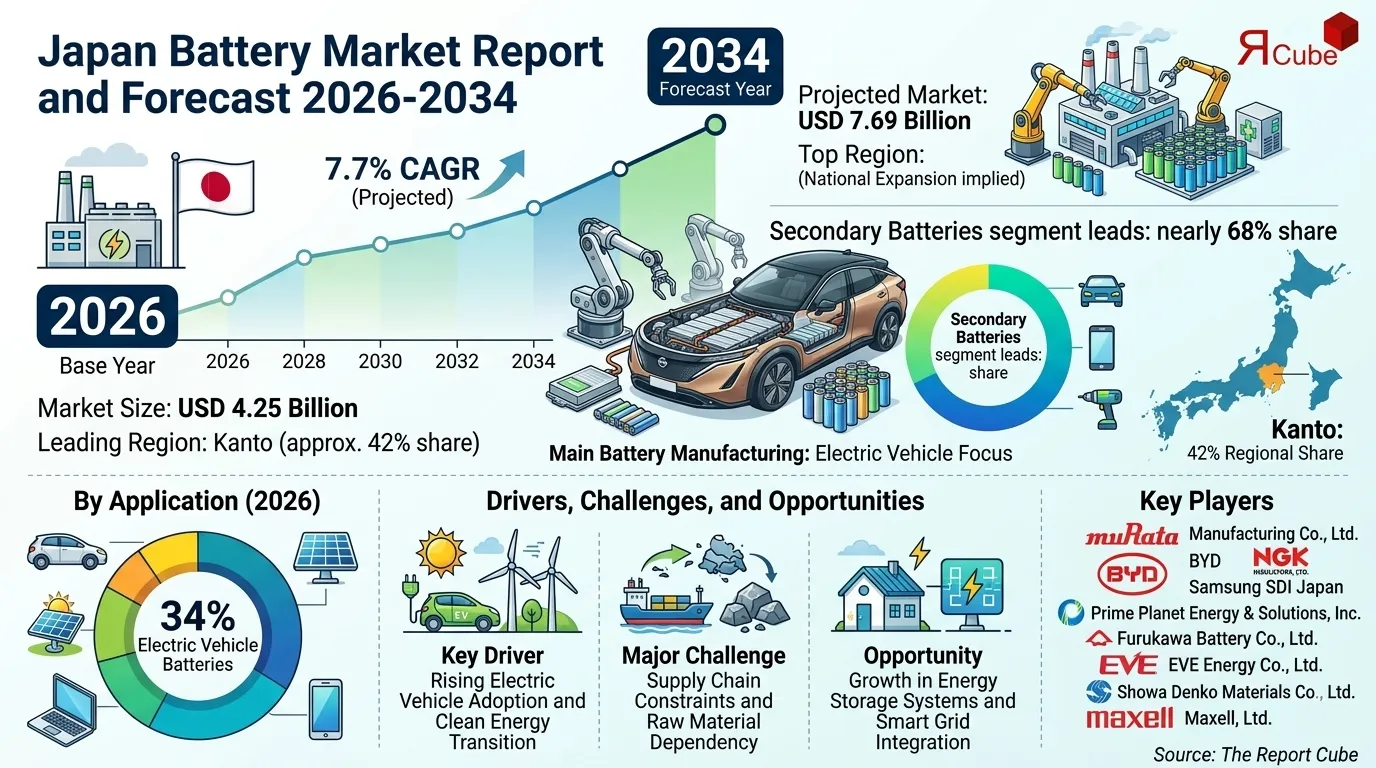
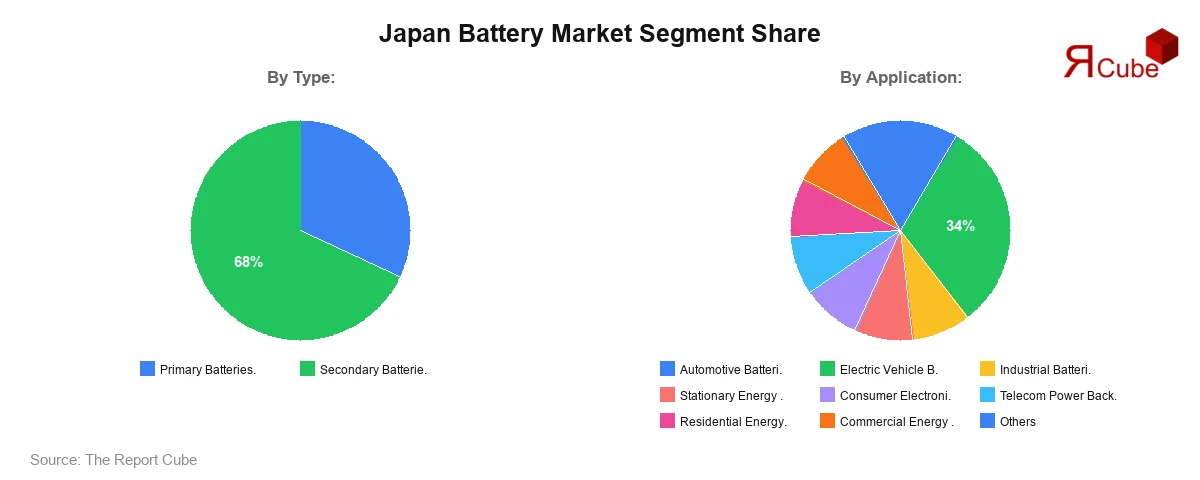
Secondary Batteries segment leads the market with nearly 68% share.
By Application:
Electric Vehicle Batteries segment dominates the market with around 34% of revenue.
Regional Outlook:
Kanto region dominates the Japan Battery market with approximately 42% share.
Japan Battery Market Insights & Analysis
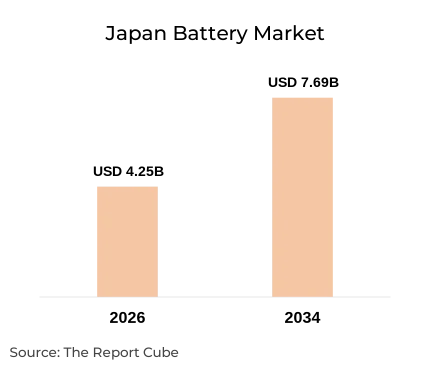
The Japan Battery Market is anticipated to register a CAGR of around 7.7% during the forecast period 2026-2034. The market size is valued at USD 4.25 billion and is projected to reach USD 7.69 billion by 2034. The growth trajectory reflects strong demand from electric mobility, renewable energy storage, and advanced electronics manufacturing. Japan remains a global leader in battery innovation, supported by companies such as Panasonic Holdings Corp., GS Yuasa Corp., and Toshiba Corp., which continue to invest in next-generation battery technologies including solid-state batteries.
The market is shaped by rapid electrification across transportation and energy sectors. Government-backed decarbonization targets and carbon neutrality commitments for 2050 are accelerating battery deployment across industries. Rising investments in lithium-ion and emerging chemistries are enhancing performance, safety, and lifecycle efficiency. In addition, Japan’s focus on energy security is driving the adoption of stationary energy storage systems, especially in regions with high renewable integration. Strong export demand and collaboration with global EV manufacturers further strengthen Japan’s position in the global battery ecosystem.
Japan Battery Market Dynamics
Key Driver: Rising Electric Vehicle Adoption and Clean Energy Transition
The increasing adoption of electric vehicles across Japan is a major factor supporting the Japan Battery market size, share, trends, and growth. With the government promoting zero-emission vehicles through subsidies and infrastructure investments, battery demand has surged significantly. Automotive manufacturers are shifting toward electrified models, which require high-performance lithium-ion batteries and advanced battery management systems.
At the same time, renewable energy expansion is creating a need for reliable storage solutions. Solar and wind installations require efficient batteries to stabilize power supply. This dual demand from transportation and energy sectors is pushing battery production and innovation, creating a strong growth foundation for the market.
Book your FREE 30-minute expert consultation today
Contact UsIndustry Trends: Shift Toward Solid-State and Advanced Battery Technologies
The transition toward solid-state batteries is emerging as a key trend in the Japan Battery market. These batteries offer higher energy density, improved safety, and faster charging compared to conventional lithium-ion batteries. Major companies are investing heavily in research and pilot production facilities to commercialize this technology.
Another trend is the integration of battery recycling and circular economy practices. Companies are focusing on recovering valuable materials such as lithium, cobalt, and nickel to reduce dependency on imports. This approach supports sustainability goals and improves supply chain resilience.
Major Challenge: Supply Chain Constraints and Raw Material Dependency
The Japan Battery market faces challenges related to raw material sourcing and supply chain disruptions. Lithium, cobalt, and nickel are critical components, and their availability is often subject to geopolitical and pricing fluctuations. This creates cost pressures for manufacturers and affects overall production planning.
In addition, establishing domestic supply chains remains complex due to limited natural resources. Companies are investing in overseas mining partnerships and recycling initiatives, but dependency on imports still poses a risk to long-term stability.
Opportunity: Growth in Energy Storage Systems and Smart Grid Integration
The expansion of grid-scale energy storage systems presents strong growth opportunities. Projects like battery energy storage systems (BESS) are gaining traction to manage renewable energy variability and improve grid reliability. These systems are increasingly deployed in regions such as Hokkaido and Tohoku.
Smart grid development is another opportunity area. Advanced batteries enable efficient energy distribution, load balancing, and demand response systems. As Japan modernizes its energy infrastructure, battery technologies will play a central role in enabling a flexible and resilient power network.
Japan Battery Market Segment-wise Analysis
By Type:
- Primary Batteries
- Secondary Batteries
Secondary batteries dominate the Japan Battery market, accounting for nearly 68% of the total market share. These rechargeable batteries are widely used in electric vehicles, consumer electronics, and energy storage systems due to their efficiency and long lifecycle. Lithium-ion batteries form the largest portion within this segment, driven by their high energy density and reliability.
The increasing penetration of EVs and renewable energy systems continues to strengthen the demand for secondary batteries. Primary batteries, while still relevant in niche applications such as medical devices and remote sensors, hold a smaller share due to their limited rechargeability. Continuous advancements in rechargeable battery technologies are further reinforcing the dominance of this segment.
By Application:
- Automotive Batteries
- Electric Vehicle Batteries
- Industrial Batteries
- Stationary Energy Storage
- Consumer Electronics Batteries
- Telecom Power Backup Batteries
- Residential Energy Storage Batteries
- Commercial Energy Storage Batteries
- Others
Electric vehicle batteries lead the application segment with approximately 34% market share, supported by Japan’s strong automotive sector and rising EV adoption. Leading automakers are collaborating with battery manufacturers to develop high-capacity and fast-charging battery systems.
Consumer electronics batteries follow closely, driven by consistent demand for smartphones, laptops, and wearable devices. Stationary energy storage is gaining momentum due to renewable energy expansion, while industrial batteries are used in manufacturing and logistics operations. The telecom sector relies on batteries for backup power solutions, ensuring network reliability. The diversification of applications highlights the broad utility of batteries across industries, contributing to steady market expansion.
Regional Projection of Japan Battery Industry
- Hokkaido
- Tohoku
- Kanto
- Shikoku
- Others
The Kanto region holds the leading position in the Japan Battery market with an estimated share of around 42%. This dominance is driven by the presence of major industrial hubs, advanced manufacturing facilities, and high demand for electric vehicles and consumer electronics. Tokyo, as a key economic center, plays a crucial role in driving battery innovation and adoption.
The region benefits from strong infrastructure, skilled workforce, and proximity to major automotive and electronics companies. Hokkaido and Tohoku are emerging as important regions for renewable energy storage projects, supported by favorable government policies and land availability. Shikoku and other regions contribute steadily through industrial and residential applications. The regional distribution reflects a balanced mix of innovation, production, and consumption across Japan.
Need insights for a specific region within this market?
Request Regional DataGovernment Initiatives & Policies
- Green Transformation (GX) Policy 2025: Japan’s Ministry of Economy, Trade and Industry promotes battery innovation and EV adoption through subsidies and R&D funding.
- Battery Industry Strategy 2026: Government initiative to strengthen domestic battery supply chains and recycling systems, aiming for global competitiveness.
Japan Battery Industry Recent Developments
- 2025: Eurus Energy Holdings Corp began construction of a 10-MW/27.42-MWh battery energy storage system in Hokkaido, using lithium-ion batteries, with commercial operations expected by October 2027, strengthening renewable energy integration.
- 2025: Mitsubishi Fuso Truck and Bus Corporation and partners launched a pilot for battery-swappable electric commercial vehicles with over 150 units and 14 swap stations planned in Tokyo, enhancing EV infrastructure efficiency.
- 2025: Japan Atomic Energy Agency developed a rechargeable uranium battery prototype, marking a breakthrough in nuclear battery technology with successful charge-discharge testing.
Why Choose This Report? Japan Battery Market
- Offers a holistic view of the market, including key trends, consumer insights, and risk analysis to enable strategic decision-making.
- Delivers reliable and current data on market size, segmentation, and growth opportunities to support risk reduction and value creation.
- Provides in-depth insights into customer behavior, preferences, and engagement channels for optimized marketing and product strategies.
- Equips businesses with competitive intelligence and benchmarking to assess market positioning effectively.
- Streamlines research through consolidated market intelligence, improving efficiency and clarity.
- Supports tailored segmentation and risk management strategies aligned with business goals.
- Identifies key challenges and untapped opportunities to drive sustained growth.
- Leverages real customer data and search insights for actionable outcomes.
Table of Contents
- Introduction
- Objective of the Study
- Product and Category Definition
- Market Segmentation
- Study Variables
- Research Methodology
- Secondary Data Points
- Breakdown of Secondary Sources
- Primary Data Points
- Breakdown of Primary Interviews
- Secondary Data Points
- Executive Summary
- Market Dynamics
- Drivers
- Challenges
- Opportunity Assessment
- Recent Trends and Developments
- Regulatory and Policy Landscape
- Japan Battery Market Overview (2021-2034)
- Market Size, By Value, By Growth Rate (CAGR / USD Billion)
- Market Share, By Type
- Primary Batteries
- Secondary Batteries
- Market Share, By Technology
- Lithium-Ion Batteries
- Lead-Acid Batteries
- Nickel-Metal Hydride Batteries
- Nickel-Cadmium Batteries
- Sodium-Sulfur Batteries
- Flow Batteries
- Solid-State Batteries
- Others
- Market Share, By Application
- Automotive Batteries
- Electric Vehicle Batteries
- Industrial Batteries
- Stationary Energy Storage
- Consumer Electronics Batteries
- Telecom Power Backup Batteries
- Residential Energy Storage Batteries
- Commercial Energy Storage Batteries
- Others
- Market Share, By State
- New Batteries
- Refurbished Batteries
- Recycled Batteries
- Market Share, By Region
- Hokkaido
- Tohoku
- Kanto
- Shikoku
- Others
- Market Share, By Company
- Revenue Shares and Analysis
- Competitive Landscape
- Hokkaido Battery Market
- Market Size, By Value, By Growth Rate (CAGR / USD Billion / Million)
- Market Share, By Type
- Market Share, By Technology
- Market Share, By Application
- Market Share, By State
- Tohoku Battery Market
- Market Size, By Value, By Growth Rate (CAGR / USD Billion / Million)
- Market Share, By Type
- Market Share, By Technology
- Market Share, By Application
- Market Share, By State
- Kanto Battery Market
- Market Size, By Value, By Growth Rate (CAGR / USD Billion / Million)
- Market Share, By Type
- Market Share, By Technology
- Market Share, By Application
- Market Share, By State
- Shikoku Battery Market
- Market Size, By Value, By Growth Rate (CAGR / USD Billion / Million)
- Market Share, By Type
- Market Share, By Technology
- Market Share, By Application
- Market Share, By State
- Competitive Outlook and Company Profiles
- Murata Manufacturing Co., Ltd.
- Company Overview
- Product Portfolio
- Strategic Alliances / Partnerships
- Recent Developments
- BYD
- Company Overview
- Product Portfolio
- Strategic Alliances / Partnerships
- Recent Developments
- NGK Insulators, Ltd.
- Company Overview
- Product Portfolio
- Strategic Alliances / Partnerships
- Recent Developments
- Samsung SDI Japan
- Company Overview
- Product Portfolio
- Strategic Alliances / Partnerships
- Recent Developments
- Prime Planet Energy & Solutions, Inc.
- Company Overview
- Product Portfolio
- Strategic Alliances / Partnerships
- Recent Developments
- Furukawa Battery Co., Ltd.
- Company Overview
- Product Portfolio
- Strategic Alliances / Partnerships
- Recent Developments
- EVE Energy Co., Ltd.
- Company Overview
- Product Portfolio
- Strategic Alliances / Partnerships
- Recent Developments
- Showa Denko Materials Co., Ltd.
- Company Overview
- Product Portfolio
- Strategic Alliances / Partnerships
- Recent Developments
- Maxell, Ltd.
- Company Overview
- Product Portfolio
- Strategic Alliances / Partnerships
- Recent Developments
- Exide Industries Ltd
- Company Overview
- Product Portfolio
- Strategic Alliances / Partnerships
- Recent Developments
- Hitachi Astemo, Ltd.
- Company Overview
- Product Portfolio
- Strategic Alliances / Partnerships
- Recent Developments
- Panasonic Holdings Corp.
- Company Overview
- Product Portfolio
- Strategic Alliances / Partnerships
- Recent Developments
- Nichicon Corp.
- Company Overview
- Product Portfolio
- Strategic Alliances / Partnerships
- Recent Developments
- LG Energy Solution Japan
- Company Overview
- Product Portfolio
- Strategic Alliances / Partnerships
- Recent Developments
- GS Yuasa Corp.
- Company Overview
- Product Portfolio
- Strategic Alliances / Partnerships
- Recent Developments
- SK Innovation
- Company Overview
- Product Portfolio
- Strategic Alliances / Partnerships
- Recent Developments
- Toshiba Corp.
- Company Overview
- Product Portfolio
- Strategic Alliances / Partnerships
- Recent Developments
- Envision AESC Group Ltd.
- Company Overview
- Product Portfolio
- Strategic Alliances / Partnerships
- Recent Developments
- Contemporary Amperex Technology Japan K.K.
- Company Overview
- Product Portfolio
- Strategic Alliances / Partnerships
- Recent Developments
- EEMB Battery
- Company Overview
- Product Portfolio
- Strategic Alliances / Partnerships
- Recent Developments
- B&B Battery Co., Ltd.
- Company Overview
- Product Portfolio
- Strategic Alliances / Partnerships
- Recent Developments
- NEC Energy Devices, Ltd.
- Company Overview
- Product Portfolio
- Strategic Alliances / Partnerships
- Recent Developments
- Sony Group Corp.
- Company Overview
- Product Portfolio
- Strategic Alliances / Partnerships
- Recent Developments
- Others
- Murata Manufacturing Co., Ltd.
- Contact Us and Disclaimer
Top Key Players & Market Share Outlook
- Murata Manufacturing Co., Ltd.
- BYD
- NGK Insulators, Ltd.
- Samsung SDI Japan
- Prime Planet Energy & Solutions, Inc.
- Furukawa Battery Co., Ltd.
- EVE Energy Co., Ltd.
- Showa Denko Materials Co., Ltd.
- Maxell, Ltd.
- Exide Industries Ltd
- Hitachi Astemo, Ltd.
- Panasonic Holdings Corp.
- Nichicon Corp.
- LG Energy Solution Japan
- GS Yuasa Corp.
- SK Innovation
- Toshiba Corp.
- Envision AESC Group Ltd.
- Contemporary Amperex Technology Japan K.K.
- EEMB Battery
- B&B Battery Co., Ltd.
- NEC Energy Devices, Ltd.
- Sony Group Corp.
- Others
Frequently Asked Questions






