



Build Your Custom Market Intelligence Report
Customize Your ReportJapan Cooling as a Service Market Key Highlights
By Technology:
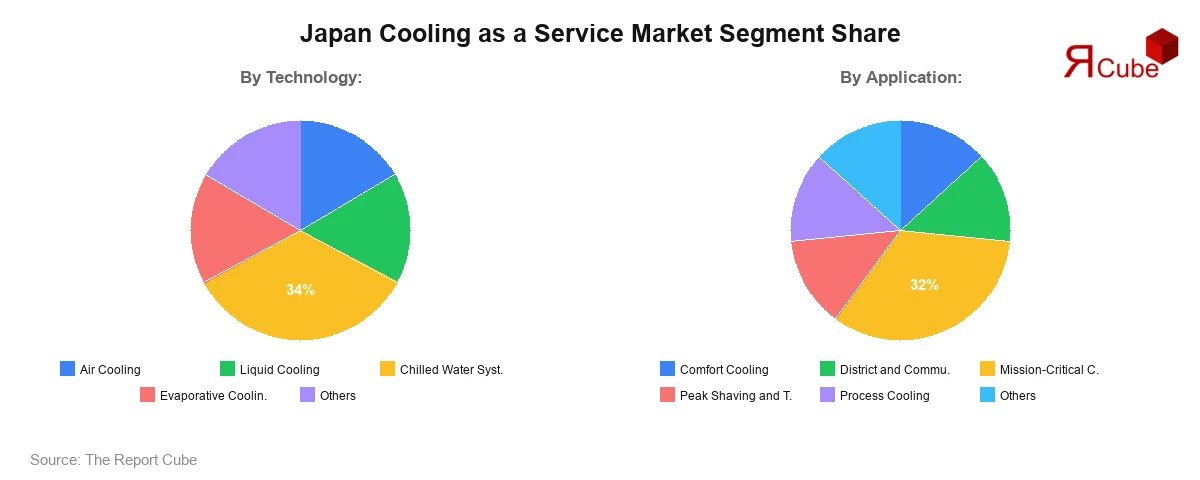
Chilled Water Systems segment leads the market with around 34% share.
By Application:
Mission-Critical Cooling segment dominates the market with nearly 32% of revenue.
Regional Outlook:
Honshu region dominates the Japan Cooling as a Service market with approximately 61% share.
Japan Cooling as a Service Market Insights & Analysis
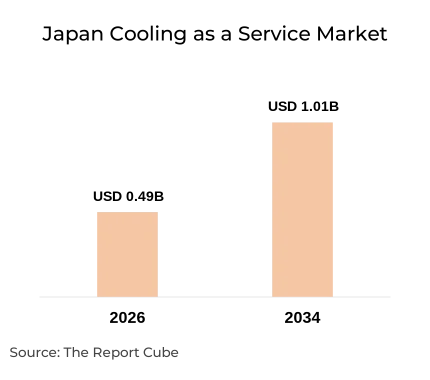
The Japan Cooling as a Service Market is anticipated to register a CAGR of around 9.5% during the forecast period 2026-2034. The market size is valued at USD 0.49 billion in 2026 and is projected to reach USD 1.01 billion by 2034. The Japan Cooling as a Service market size is expanding steadily as enterprises shift from capital-intensive cooling systems toward subscription-based service models. This transition is particularly visible in sectors such as data centers, manufacturing facilities, and commercial real estate, where operational efficiency and energy optimization have become top priorities. Increasing electricity costs and Japan’s strict energy efficiency norms are accelerating the adoption of service-based cooling solutions that reduce upfront investments while ensuring performance reliability.
Investment activity in the Japan Cooling as a Service market is rising as leading companies introduce integrated cooling solutions combining hardware, software, and lifecycle services. For instance, advancements in modular cooling systems and low-global-warming-potential refrigerants are supporting sustainability goals. Government-backed decarbonization initiatives and green building certifications are further influencing demand. The expansion of hyperscale data centers across Japan has also created consistent demand for advanced cooling infrastructure, supporting long-term Japan Cooling as a Service market growth. Additionally, partnerships between HVAC manufacturers and digital monitoring providers are enabling predictive maintenance and real-time performance tracking, strengthening the overall value proposition of service-based cooling models.
Japan Cooling as a Service Market Dynamics
Key Driver: Rising Demand for Energy-Efficient and Cost-Optimized Cooling Solutions
The primary driver of the Japan Cooling as a Service market growth is the increasing demand for energy-efficient cooling solutions across commercial and industrial sectors. Japan has one of the highest electricity costs among developed economies, prompting businesses to adopt energy-saving alternatives. Cooling as a Service models allow companies to shift from capital expenditure to operational expenditure, reducing financial burden while improving efficiency. Studies indicate that service-based cooling systems can reduce energy consumption by nearly 20-30% compared to conventional setups.
Moreover, sustainability commitments by corporations are encouraging the adoption of low-emission cooling systems. Companies are actively seeking solutions that align with carbon neutrality targets set for 2050. The integration of smart sensors and IoT-based monitoring systems is further enhancing system performance, making Cooling as a Service a preferred choice for large-scale facilities. This trend continues to strengthen the Japan Cooling as a Service market value.
Book your FREE 30-minute expert consultation today
Contact UsIndustry Trends: Integration of Digital Monitoring and Modular Cooling Technologies
A key trend shaping the Japan Cooling as a Service market is the growing integration of digital technologies such as remote monitoring, predictive analytics, and AI-driven optimization tools. These technologies enable service providers to monitor system performance in real time, detect inefficiencies, and perform preventive maintenance. This has significantly reduced downtime and operational risks, particularly in mission-critical environments such as data centers.
Another notable trend is the adoption of modular and scalable cooling systems. These systems are designed to adapt to fluctuating cooling demands, making them ideal for rapidly expanding sectors like IT infrastructure. Modular chillers and advanced air-cooled systems are gaining traction, contributing to improved system flexibility and reduced installation time. These advancements are driving new Japan Cooling as a Service market trends and enhancing overall service adoption.
Major Challenge: High Initial Integration Complexity and Long Contract Cycles
One of the major challenges in the Japan Cooling as a Service market is the complexity associated with integrating service-based cooling solutions into existing infrastructure. Many industrial and commercial facilities in Japan operate on legacy systems that require significant upgrades to accommodate modern service-based models. This increases implementation time and costs, slowing down adoption rates in certain sectors.
Additionally, long-term service contracts, which typically span 10-15 years, may discourage smaller enterprises from adopting these solutions. Businesses often hesitate due to concerns about vendor dependency and contractual obligations. The need for customized system design and regulatory compliance further adds to the complexity, which may hinder the Japan Cooling as a Service market growth in the short term.
Opportunity: Expansion of Data Centers and Smart Infrastructure Projects
The rapid expansion of data centers across Japan presents a significant opportunity for the Japan Cooling as a Service market. With increasing digitalization, cloud computing, and 5G deployment, the demand for efficient cooling solutions in data centers is growing rapidly. Cooling as a Service models offer scalable and energy-efficient solutions that align with the operational requirements of hyperscale facilities.
Furthermore, smart city initiatives and infrastructure modernization projects are creating new avenues for market expansion. These projects emphasize sustainability, energy efficiency, and advanced building management systems, all of which support the adoption of service-based cooling models. As urbanization continues, the Japan Cooling as a Service market revenue is expected to benefit from these large-scale developments.
Japan Cooling as a Service Market Segment-wise Analysis
By Technology:
- Air Cooling
- Liquid Cooling
- Chilled Water Systems
- Evaporative Cooling
- Others
The chilled water systems segment dominates the Japan Cooling as a Service market share, accounting for approximately 34% of the total market. This dominance is attributed to its high efficiency in large-scale applications such as commercial buildings and industrial facilities. Chilled water systems provide consistent cooling performance and are highly compatible with centralized cooling infrastructure. Their ability to support district cooling systems further strengthens their adoption.
Additionally, these systems offer better energy efficiency compared to traditional air cooling methods, especially in high-load environments. The integration of advanced control systems has enhanced their operational efficiency, reducing energy consumption by up to 25% in optimized settings. As industries continue to prioritize sustainability and cost efficiency, chilled water systems are expected to maintain their leadership in the Japan Cooling as a Service market growth.
By Application:
- Comfort Cooling
- District and Community Cooling
- Mission-Critical Cooling
- Peak Shaving and Temporary Cooling
- Process Cooling
- Others
Mission-critical cooling leads the application segment with an estimated 32% market share. This segment includes data centers, healthcare facilities, and telecommunications infrastructure where uninterrupted cooling is essential. The rapid expansion of data centers in Japan has significantly boosted demand for reliable and efficient cooling solutions.
Cooling as a Service models are particularly well-suited for mission-critical applications as they ensure continuous monitoring, predictive maintenance, and guaranteed performance levels. These systems minimize downtime risks and improve operational reliability. The increasing reliance on digital infrastructure is expected to further strengthen this segment’s contribution to the Japan Cooling as a Service market value.
Regional Projection of Japan Cooling as a Service Industry
- Hokkaido
- Honshu
- Shikoku
- Kyushu
Honshu dominates the Japan Cooling as a Service market with approximately 61% share, driven by its concentration of major metropolitan areas such as Tokyo and Osaka. The region hosts a significant number of commercial buildings, industrial facilities, and data centers, all of which require advanced cooling solutions. High population density and urban infrastructure development further contribute to the region’s dominance.
Moreover, Honshu benefits from strong government support for energy-efficient infrastructure and smart city initiatives. Investments in green buildings and sustainable urban development are accelerating the adoption of Cooling as a Service models. The presence of leading technology companies and industrial hubs also drives demand for high-performance cooling systems, reinforcing Honshu’s leadership in the Japan Cooling as a Service market share.
Government Initiatives & Policies
- Japan Green Growth Strategy: Promotes energy-efficient technologies and decarbonization across industries, encouraging adoption of advanced cooling systems.
- Top Runner Program Expansion 2025: Sets higher efficiency standards for HVAC systems, driving innovation in cooling technologies and service-based models.
Japan Cooling as a Service Industry Recent Developments
- 2025: Carrier Global Corporation introduced modular data center cooling solutions tailored for Japan, focusing on low-GWP refrigerants and energy-efficient service-based cooling deployment.
- 2026: Panasonic Holdings Corporation established Panasonic HVAC & CC Co., Ltd. to deliver integrated HVAC and cold-chain solutions supporting service-based cooling offerings.
- 2025: Hitachi Ltd. restructured its air-conditioning business, integrating AI-enabled digital services to enhance lifecycle-based cooling solutions.
- 2025: Daikin Industries Ltd. showcased advanced HVAC solutions emphasizing energy savings and prevention of overcooling for sustainable applications.
Why Choose This Report?
- Provides a comprehensive overview of the overall market analysis, encompassing key trends, consumer behavior analysis, and risk assessment to support strategic decision-making.
- Provides accurate, up-to-date insights into market size, segmentation, and emerging opportunities, helping to minimize risk & capitalizing on growth.
- Gives deep understanding of target audience preferences, investment habits, and communication channels for enhanced product development & marketing effectiveness.
- Delivers competitive analysis & benchmarking, uncovering the strengths & weaknesses of market competitors to guide strategies.
- Consolidate comprehensive market intelligence, reducing reasoning & streamlining research efforts.
- Facilitates customized market segmentation & risk mitigation strategies, fine-tuned to the business objectives.
- Aids in identifying both market challenges & untapped opportunities within the industry to drive long-term business growth.
- Provides valuable information based on actual customer data & search trends.
Table of Contents
- Introduction
- Objective of the Study
- Product and Category Definition
- Market Segmentation
- Study Variables
- Research Methodology
- Secondary Data Points
- Breakdown of Secondary Sources
- Primary Data Points
- Breakdown of Primary Interviews
- Secondary Data Points
- Executive Summary
- Market Dynamics
- Drivers
- Challenges
- Opportunity Assessment
- Recent Trends and Developments
- Regulatory and Policy Landscape
- Japan Cooling as a Service Market Overview (2021-2034)
- Market Size, By Value (USD Billion)
- Market Share, By Technology
- Air Cooling
- Liquid Cooling
- Chilled Water Systems
- Evaporative Cooling
- Others
- Market Share, By Service
- Installation
- Maintenance
- Corrective Maintenance
- Preventive Maintenance
- Monitoring
- Onsite Monitoring
- Remote Monitoring
- Support
- Market Share, By Application
- Comfort Cooling
- District and Community Cooling
- Mission-Critical Cooling
- Peak Shaving and Temporary Cooling
- Process Cooling
- Others
- Market Share, By End-User
- Residential
- Commercial
- Industrial
- Market Share, By Region
- Hokkaido
- Honshu
- Shikoku
- Kyushu
- Market Share, By Company
- Revenue Shares and Analysis
- Competitive Landscape
- Hokkaido Cooling as a Service Market
- Market Size, By Value (USD Billion/Million)
- Market Share, By Technology
- Market Share, By Service
- Market Share, By Application
- Market Share, By End-User
- Honshu Cooling as a Service Market
- Market Size, By Value (USD Billion/Million)
- Market Share, By Technology
- Market Share, By Service
- Market Share, By Application
- Market Share, By End-User
- Shikoku Cooling as a Service Market
- Market Size, By Value (USD Billion/Million)
- Market Share, By Technology
- Market Share, By Service
- Market Share, By Application
- Market Share, By End-User
- Kyushu Cooling as a Service Market
- Market Size, By Value (USD Billion/Million)
- Market Share, By Technology
- Market Share, By Service
- Market Share, By Application
- Market Share, By End-User
- Competitive Outlook and Company Profiles
- Trane Technologies
- Company Overview
- Product Portfolio
- Strategic Alliances/Partnerships
- Recent Developments
- Carrier Global Corporation
- Company Overview
- Product Portfolio
- Strategic Alliances/Partnerships
- Recent Developments
- Panasonic Holdings Corporation
- Company Overview
- Product Portfolio
- Strategic Alliances/Partnerships
- Recent Developments
- Johnson Controls International plc
- Company Overview
- Product Portfolio
- Strategic Alliances/Partnerships
- Recent Developments
- Hitachi Ltd.
- Company Overview
- Product Portfolio
- Strategic Alliances/Partnerships
- Recent Developments
- Daikin Industries Ltd.
- Company Overview
- Product Portfolio
- Strategic Alliances/Partnerships
- Recent Developments
- Mayekawa Mfg. Co. Ltd. (MYCOM)
- Company Overview
- Product Portfolio
- Strategic Alliances/Partnerships
- Recent Developments
- Mitsubishi Electric Corporation
- Company Overview
- Product Portfolio
- Strategic Alliances/Partnerships
- Recent Developments
- EBARA Corporation
- Company Overview
- Product Portfolio
- Strategic Alliances/Partnerships
- Recent Developments
- Others
- Trane Technologies
- Contact Us and Disclaimer
Top Key Players & Market Share Outlook
- Trane Technologies
- Carrier Global Corporation
- Panasonic Holdings Corporation
- Johnson Controls International plc
- Hitachi Ltd.
- Daikin Industries Ltd.
- Mayekawa Mfg. Co. Ltd. (MYCOM)
- Mitsubishi Electric Corporation
- EBARA Corporation
Frequently Asked Questions






