



Build Your Custom Market Intelligence Report
Customize Your ReportGlobal Iron Air Battery Market Key Highlights
By Battery System Type:
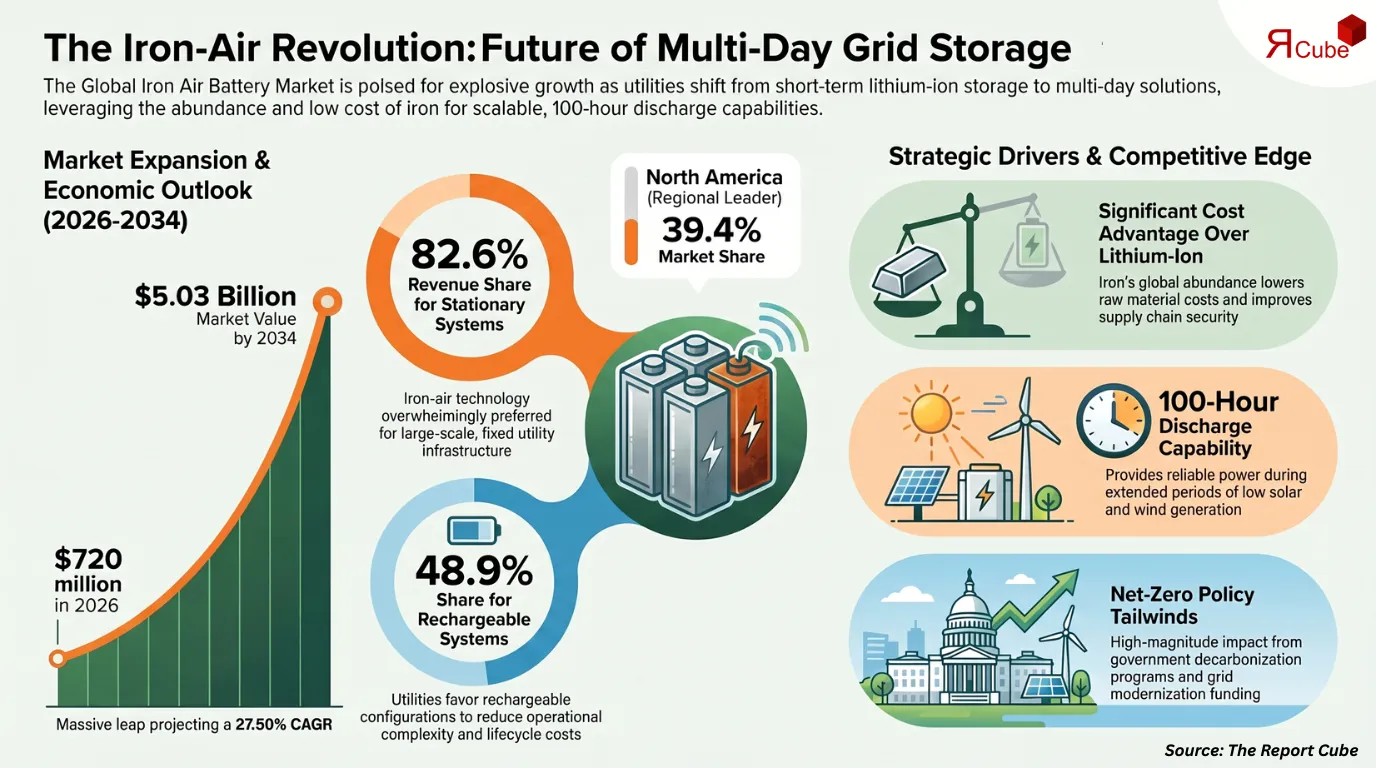
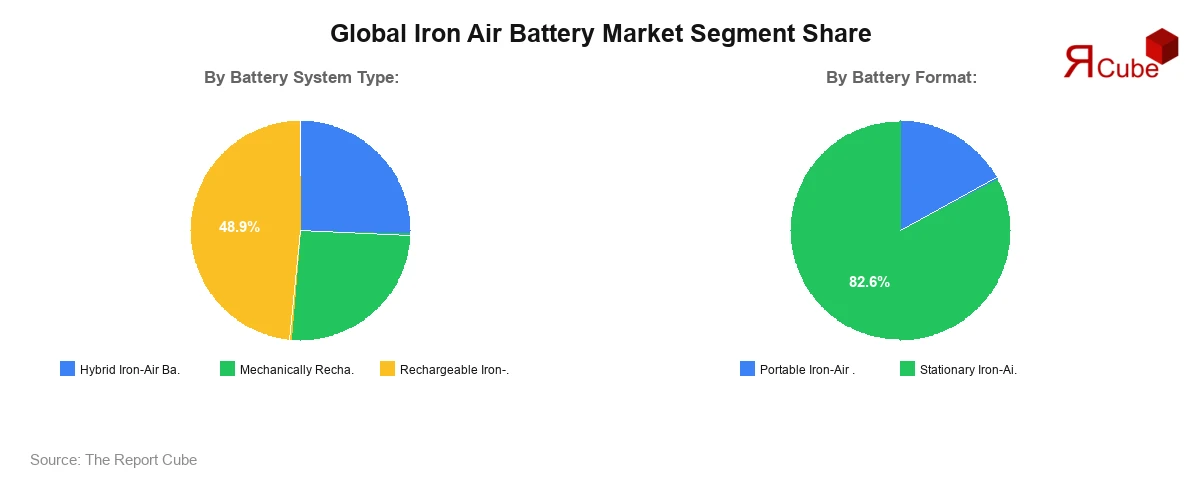
Rechargeable Iron-Air Battery Systems segment leads the market with nearly 48.9% share.
By Battery Format:
Stationary Iron-Air Battery Systems segment dominates the market with around 82.6% of total revenue.
Regional Outlook:
North America dominates the Global Iron Air Battery Market with approximately 39.4% market share.
Global Iron Air Battery Market Insights & Analysis
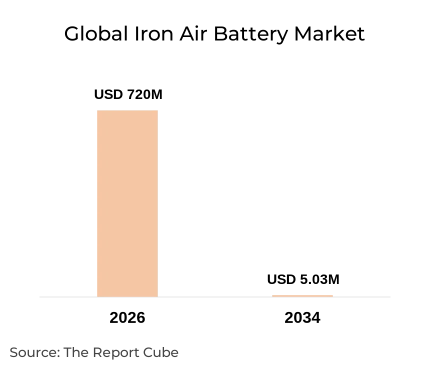
The Global Iron Air Battery Market is anticipated to register a CAGR of around 27.50% during the forecast period 2026-2034. The market size is valued at USD 720 million in 2026 and is projected to reach USD 5.03 billion by 2034. Market growth is being fueled by the rising demand for long-duration energy storage solutions that can support renewable electricity integration while reducing dependence on lithium-based technologies. Iron-air batteries are gaining attention because iron is one of the world's most abundant and inexpensive materials, enabling lower production costs and improved supply chain security. Utilities and independent power producers are increasingly evaluating multi-day storage technologies to stabilize power grids during periods of low solar and wind generation. Growing investments in decarbonization programs, expanding renewable energy installations, and modernization of electricity infrastructure continue to create favorable conditions for iron-air battery adoption across utility-scale energy storage projects.
Innovation across battery chemistry, electrode materials, air cathode technology, and manufacturing processes is further strengthening the commercial outlook of the Iron Air Battery Market. Governments and private investors are directing significant funding toward long-duration energy storage technologies to achieve carbon neutrality targets and improve grid resilience. Companies are expanding pilot projects, demonstration facilities, and strategic collaborations with utility operators to validate commercial performance under real operating conditions. The successful deployment of grid-connected demonstration projects across North America and Europe has increased confidence among energy developers regarding the reliability of iron-air systems for multi-day storage. Continuous improvements in cycle life, efficiency, and manufacturing scalability are expected to accelerate commercialization while supporting future market size expansion, revenue growth, technological innovation, and increasing global demand throughout the forecast period.
Global Iron Air Battery Market Impact Analysis
| Factor | Type | Specific Impact on Market | Magnitude | Business Implication |
|---|---|---|---|---|
| Long Duration Grid Storage Demand | Market | Utilities adopt iron air systems for multi hour renewable backup storage. | High | Accelerates utility scale projects and framework supply agreements globally. |
| Cost Advantage Versus Lithium Ion | Competitive | Low cost iron materials reduce storage cost per kilowatt hour delivered. | High | Improves competitiveness in price sensitive grid and industrial tenders worldwide. |
| Supportive Climate and Storage Policies | Regulatory | Net zero roadmaps and incentives encourage deployment of long storage assets. | High | Enables faster permitting and funding access for new iron air manufacturing plants. |
| Technology Maturity and Reliability Gaps | Technological | Unproven lifetime and cycling limits slow bankability for major investors. | Medium | Requires pilot projects with performance guarantees to build customer confidence. |
| Environmental and Sustainability Benefits | Environmental | Use of abundant iron lowers resource risk and lifecycle emissions footprint. | Medium | Strengthens positioning in ESG driven procurement and public utility mandates. |
| Rising Investment and Partnerships | Market | Capital inflows and utility alliances speed scale up of iron air factories. | High | Supports rapid capacity expansion and global project pipeline development. |
| Competition from Other Storage Chemistries | Competitive | Advanced lithium and flow batteries compete in overlapping grid segments. | Medium | Necessitates focus on niches needing ultra low cost long duration storage. |
Global Iron Air Battery Market Dynamics
Key Driver: Increasing renewable electricity deployment is accelerating demand for long-duration storage technologies
Power systems worldwide are undergoing structural transformation as renewable electricity replaces conventional fossil-fuel generation. Wind and solar facilities now account for a growing share of installed generation capacity, creating greater demand for storage systems capable of maintaining electricity supply during extended periods of low renewable output. While lithium-ion batteries remain suitable for short-duration applications, utilities increasingly require technologies capable of providing reliable power for multiple days without excessive capital expenditure. Iron-air batteries have emerged as an attractive solution because they combine low-cost raw materials with long discharge duration, making them particularly suitable for large-scale grid applications.
Electricity providers are incorporating long-duration storage into future transmission planning to improve renewable utilization, strengthen grid resilience, and reduce dependence on natural gas peaker plants. Energy regulators across several developed economies are also encouraging investments in resilient storage infrastructure to address weather-related grid disruptions. These developments are creating favorable commercial conditions for the Global Iron Air Battery Market, particularly as utilities continue evaluating technologies capable of delivering dependable multi-day energy storage at competitive lifecycle costs.
Industry Trends: Commercial validation projects are strengthening industry confidence and accelerating investment
Industry participants are shifting from laboratory-scale research toward commercial demonstration projects that validate operational performance under real grid conditions. Successful pilot installations have shown that iron-air battery systems can provide continuous electricity over extended durations while supporting renewable integration and transmission stability. Manufacturers are simultaneously expanding production capabilities through strategic investments in automated manufacturing, advanced electrode fabrication, and modular battery architecture designed for large utility installations.
Strategic collaborations have become increasingly common across the industry as battery developers work alongside utilities, engineering companies, renewable project developers, and research organizations. These partnerships reduce commercialization risks while generating operational data required for future procurement decisions. At the same time, improvements in electrolyte chemistry, air electrode design, corrosion resistance, and system efficiency continue enhancing product competitiveness. Collectively, these advancements are positioning iron-air batteries as a credible long-duration storage technology capable of supporting the next phase of global renewable energy expansion.
Book your FREE 30-minute expert consultation today
Contact UsMajor Challenge: Manufacturing scale-up and commercial maturity continue to influence market adoption
Although technical progress has accelerated, large-scale commercialization remains dependent on expanding manufacturing capacity and demonstrating long-term operational reliability. Most suppliers continue operating pilot production facilities while gradually increasing manufacturing output to meet anticipated utility demand. Building dedicated production plants requires significant capital investment, specialized engineering expertise, and reliable supply chains for critical battery components, which may extend commercialization schedules.
Utilities generally require extensive operational validation before deploying emerging storage technologies across transmission networks. Performance consistency, charging efficiency, maintenance requirements, and lifecycle economics remain important evaluation criteria during procurement decisions. Competition from established battery chemistries also creates additional commercial pressure, particularly in projects where shorter storage durations remain sufficient. Continued technology optimization, manufacturing expansion, and successful field deployments will be essential for overcoming these barriers and supporting broader market adoption.
Opportunity: Grid modernization programs are creating long-term commercial opportunities for iron-air batteries
Large-scale investments in electricity infrastructure present a significant opportunity for companies operating in the Global Iron Air Battery Market. Governments and transmission operators are upgrading aging power networks while integrating substantially higher levels of renewable electricity generation. These modernization programs increasingly require long-duration storage technologies capable of maintaining grid reliability during seasonal demand fluctuations and extended renewable generation gaps.
Commercial opportunities are expanding beyond traditional utility applications into industrial facilities, remote mining operations, military installations, data centers, and community microgrids seeking dependable backup power. Iron-air batteries offer competitive advantages through abundant raw material availability, relatively low manufacturing costs, and extended discharge capability, making them particularly attractive for stationary energy storage. As commercialization accelerates and manufacturing economies of scale improve, industry participants are expected to capture substantial investment opportunities across developed and emerging electricity markets through 2034.
Global Iron Air Battery Market Segment-wise Analysis
By Battery System Type:
- Hybrid Iron-Air Battery Systems
- Mechanically Rechargeable Iron-Air Battery Systems
- Rechargeable Iron-Air Battery Systems
Rechargeable Iron-Air Battery Systems captured approximately 48.9% of the Global Iron Air Battery Market in 2026 and continue to represent the most commercially advanced product category. Utilities and renewable energy developers increasingly prefer rechargeable configurations because they eliminate the operational complexity associated with mechanical replacement while supporting repeated charging cycles over extended service life. Continuous engineering improvements in air electrodes, electrolyte management, and iron oxidation processes have significantly enhanced system efficiency and durability.
Several pilot installations commissioned across North America and Europe have confirmed that rechargeable iron-air batteries can reliably deliver electricity for nearly 100 hours, making them suitable for renewable energy balancing and grid resilience applications. Growing utility investments in long-duration energy storage, combined with supportive clean energy funding programs and increasing renewable capacity additions, are expected to strengthen demand for rechargeable systems throughout the forecast period. Their ability to lower lifecycle costs while improving grid stability positions this segment as the primary contributor to future market revenue.
By Battery Format:
- Portable Iron-Air Battery Systems
- Stationary Iron-Air Battery Systems
Stationary Iron-Air Battery Systems accounted for nearly 82.6% of total market revenue in 2026, reflecting the technology's primary role in utility-scale and industrial energy storage. Iron-air batteries are engineered to provide multi-day electricity storage rather than compact portable power, making stationary installations the dominant commercial application. Electric utilities, independent power producers, industrial facilities, renewable energy parks, and transmission operators increasingly require storage solutions capable of balancing variable renewable generation while maintaining continuous electricity supply during prolonged weather-related generation gaps.
Compared with conventional battery technologies designed for shorter discharge durations, stationary iron-air systems offer lower material costs and improved economic performance for large-scale infrastructure projects. Expansion of renewable energy investments, transmission modernization programs, and national energy security initiatives is expected to sustain strong demand for stationary battery deployments across developed and emerging electricity markets through 2034.
Regional Projection of Global Iron Air Battery Industry
- North America
- Europe
- Asia Pacific
- Middle East and Africa
- South America
North America represented approximately 39.4% of the Global Iron Air Battery Market in 2026, supported by substantial investment in long-duration energy storage, advanced transmission infrastructure, and strong public-private collaboration. The United States continues to lead commercialization through utility demonstration projects, Department of Energy funding programs, and increasing deployment of renewable electricity generation. Several technology developers headquartered in the region are expanding manufacturing capacity while collaborating with transmission operators to validate commercial-scale battery installations.
Canada is also investing in grid modernization and clean electricity initiatives to strengthen energy reliability in remote communities and renewable-rich provinces. Strong venture capital activity, supportive regulatory frameworks, and increasing utility procurement of long-duration storage technologies continue to reinforce North America's leadership. As electricity demand rises alongside rapid renewable expansion, the region is expected to remain the largest revenue contributor to the Global Iron Air Battery Market throughout the forecast period.
Need insights for a specific region within this market?
Request Regional DataGlobal Iron Air Battery Market Regional Analysis
The iron air battery market shows varied regional growth, driven by policy, grid needs, and clean energy targets.
| Region | Demand Level | Key Areas | System Dominance | Core Demand Logic | Growth Nature |
|---|---|---|---|---|---|
| North America | Very High | US, Canada utility hubs | Grid-scale iron-air units | LDES for renewable-heavy grids | Policy-funded early scaling |
| Europe | High | Germany, UK, Nordics | Iron-air pilot plants | Net-zero and grid flexibility | Regulation-led steady rise |
| Asia Pacific | High | China, India, Australia | Hybrid metal-air systems | Renewables plus energy security | Fastest volume expansion |
| Middle East & Africa | Medium | GCC, South Africa | Off-grid storage arrays | Solar-backed remote supply | Project-based emerging growth |
| South America | Low to Medium | Brazil, Chile, Argentina | Industrial demo projects | Mining and renewables support | Niche but rising adoption |
Government Initiatives & Policies
- U.S. Department of Energy Long-Duration Energy Storage Program: The DOE continues expanding funding and commercialization support for long-duration energy storage technologies capable of delivering electricity for 10 hours or more, encouraging deployment of advanced battery chemistries including iron-air systems.
- European Union Battery Regulation Implementation (2025): The European Union is progressively implementing battery sustainability, carbon footprint, performance, and lifecycle requirements for industrial batteries, strengthening the regulatory framework supporting advanced energy storage technologies.
Global Iron Air Battery Industry Recent Developments
- 2026: Ore Energy B.V. completed its 100-hour iron-air long-duration energy storage pilot at EDF Lab Les Renardières in France. The successful demonstration validated multi-day storage performance under real operating conditions and strengthened the company's pathway toward commercial deployment across European utility markets.
- 2025: Ore Energy B.V. connected its pilot iron-air battery system to the Dutch electricity grid, representing one of Europe's first grid-connected iron-air battery deployments. The project demonstrated practical integration with renewable electricity infrastructure while supporting future commercial-scale installations.
Why Choose This Report?
-
Provides a comprehensive overview of the overall market analysis, encompassing key trends, consumer behavior analysis, and risk assessment to support strategic decision-making.
-
Provides accurate, up-to-date insights into market size, segmentation, and emerging opportunities, helping to minimize risk while capitalizing on growth.
-
Gives deep understanding of target audience preferences, investment habits, and communication channels for enhanced product development and marketing effectiveness.
-
Delivers competitive analysis and benchmarking, uncovering the strengths and weaknesses of market competitors to guide business strategies.
-
Consolidates comprehensive market intelligence, reducing research time and streamlining strategic planning efforts.
-
Facilitates customized market segmentation and risk mitigation strategies, fine-tuned to specific business objectives.
-
Aids in identifying both market challenges and untapped opportunities within the industry to drive long-term business growth.
-
Provides valuable information based on actual customer data, industry developments, and evolving search trends.
Table of Contents
- Introduction
- Objective of the Study
- Product and Category Definition
- Market Segmentation
- Study Variables
- Research Methodology
- Secondary Data Points
- Breakdown of Secondary Sources
- Primary Data Points
- Breakdown of Primary Interviews
- Secondary Data Points
- Executive Summary
- Market Dynamics
- Emerging Opportunities
- Adoption Trends
- Demand Drivers
- Disruption Analysis (Challenges)
- Industry Analysis and Strategic Insights
- Supply and Value Chain Analysis
- Pricing Analysis
- Go-to-Market Strategy
- BCG Matrix
- Recent Trends and Developments
- Import and Export Analysis
- Regulatory and Policy Landscape
- Region-wise Policies
- Government Initiatives
- Global Iron Air Battery Market Overview and Forecast Analysis (2021-2034)
- Market Size, by Value, by Growth Rate (CAGR / USD Billion)
- Market Share, by Battery System Type
- Hybrid Iron-Air Battery Systems
- Mechanically Rechargeable Iron-Air Battery Systems
- Rechargeable Iron-Air Battery Systems
- Market Share, by Battery Format
- Portable Iron-Air Battery Systems
- Stationary Iron-Air Battery Systems
- Market Share, by Storage Duration
- Below 10 Hours
- 10-24 Hours
- 24-48 Hours
- 48-72 Hours
- Above 72 Hours
- Market Share, by Electrode Architecture
- Monolithic Stack Iron-Air Battery
- Monolithic Bielectrode Iron-Air Battery
- Bielectrode Iron-Air Battery
- Market Share, by Capacity
- 10-100 kWh
- 100 kWh-1 MWh
- 1-10 MWh
- 10-100 MWh
- Above 100 MWh
- Market Share, by Application
- Peak Load Management
- Grid Resilience and Backup Power
- Microgrid and Remote Power Storage
- Transmission and Distribution Deferral
- Resource Adequacy
- Renewable Energy Firming
- Others
- Market Share, by End User
- Independent Power Producers
- Renewable Energy Developers
- Commercial and Industrial Users
- Grid Operators
- Mining
- Government and Defense Facilities
- Utilities
- Residential Users
- Market Share, by Region
- North America
- Europe
- Asia Pacific
- Middle East and Africa
- South America
- Market Share, by Company
- Revenue Shares and Analysis
- Competitive Landscape
- North America Iron Air Battery Market Overview and Forecast Analysis (2021-2034)
- Market Size, by Value, by Growth Rate (CAGR / USD Billion / Million)
- Market Share, by Battery System Type
- Market Share, by Battery Format
- Market Share, by Storage Duration
- Market Share, by Electrode Architecture
- Market Share, by Capacity
- Market Share, by Application
- Market Share, by End User
- Market Share, by Country
- United States
- Canada
- Mexico
- Rest of North America
- Europe Iron Air Battery Market Overview and Forecast Analysis (2021-2034)
- Market Size, by Value, by Growth Rate (CAGR / USD Billion / Million)
- Market Share, by Battery System Type
- Market Share, by Battery Format
- Market Share, by Storage Duration
- Market Share, by Electrode Architecture
- Market Share, by Capacity
- Market Share, by Application
- Market Share, by End User
- Market Share, by Country
- Germany
- United Kingdom
- France
- Italy
- Spain
- Netherlands
- Russia
- Poland
- Belgium
- Sweden
- Rest of Europe
- Asia Pacific Iron Air Battery Market Overview and Forecast Analysis (2021-2034)
- Market Size, by Value, by Growth Rate (CAGR / USD Billion / Million)
- Market Share, by Battery System Type
- Market Share, by Battery Format
- Market Share, by Storage Duration
- Market Share, by Electrode Architecture
- Market Share, by Capacity
- Market Share, by Application
- Market Share, by End User
- Market Share, by Country
- China
- India
- Japan
- South Korea
- Australia
- Indonesia
- Thailand
- Malaysia
- Vietnam
- Philippines
- Singapore
- New Zealand
- Rest of Asia Pacific
- Middle East and Africa Iron Air Battery Market Overview and Forecast Analysis (2021-2034)
- Market Size, by Value, by Growth Rate (CAGR / USD Billion / Million)
- Market Share, by Battery System Type
- Market Share, by Battery Format
- Market Share, by Storage Duration
- Market Share, by Electrode Architecture
- Market Share, by Capacity
- Market Share, by Application
- Market Share, by End User
- Market Share, by Country
- Saudi Arabia
- United Arab Emirates
- South Africa
- Egypt
- Nigeria
- Morocco
- Turkey
- Rest of Middle East and Africa
- South America Iron Air Battery Market Overview and Forecast Analysis (2021-2034)
- Market Size, by Value, by Growth Rate (CAGR / USD Billion / Million)
- Market Share, by Battery System Type
- Market Share, by Battery Format
- Market Share, by Storage Duration
- Market Share, by Electrode Architecture
- Market Share, by Capacity
- Market Share, by Application
- Market Share, by End User
- Market Share, by Country
- Brazil
- Argentina
- Chile
- Colombia
- Peru
- Rest of South America
- Competitive Analysis, 2026
- Market Share of Key Players
- Competitive Mapping for Each Battery System Type, Battery Format, Storage Duration, Electrode Architecture, Capacity, Application, and End User
- North America Iron Air Battery Companies Share and Competitive Analysis, 2026
- Europe Iron Air Battery Companies Share and Competitive Analysis, 2026
- Asia Pacific Iron Air Battery Companies Share and Competitive Analysis, 2026
- Middle East and Africa Iron Air Battery Companies Share and Competitive Analysis, 2026
- South America Iron Air Battery Companies Share and Competitive Analysis, 2026
- Company Profile (Partial List)
- ESS Tech, Inc.
- Company Overview
- Product Portfolio
- Strategic Alliances and Partnerships
- Recent Developments
- Phinergy Ltd.
- Company Overview
- Product Portfolio
- Strategic Alliances and Partnerships
- Recent Developments
- Fluidic Energy LLC
- Company Overview
- Product Portfolio
- Strategic Alliances and Partnerships
- Recent Developments
- Enzinc Inc.
- Company Overview
- Product Portfolio
- Strategic Alliances and Partnerships
- Recent Developments
- Fuji Pigment Co., Ltd.
- Company Overview
- Product Portfolio
- Strategic Alliances and Partnerships
- Recent Developments
- Abound Energy Inc.
- Company Overview
- Product Portfolio
- Strategic Alliances and Partnerships
- Recent Developments
- PolyPlus Battery Company, Inc.
- Company Overview
- Product Portfolio
- Strategic Alliances and Partnerships
- Recent Developments
- Ore Energy B.V.
- Company Overview
- Product Portfolio
- Strategic Alliances and Partnerships
- Recent Developments
- NantEnergy, Inc.
- Company Overview
- Product Portfolio
- Strategic Alliances and Partnerships
- Recent Developments
- Meine Electric Private Limited
- Company Overview
- Product Portfolio
- Strategic Alliances and Partnerships
- Recent Developments
- Form Energy, Inc.
- Company Overview
- Product Portfolio
- Strategic Alliances and Partnerships
- Recent Developments
- Eos Energy Enterprises, Inc.
- Company Overview
- Product Portfolio
- Strategic Alliances and Partnerships
- Recent Developments
- e-Zinc Inc.
- Company Overview
- Product Portfolio
- Strategic Alliances and Partnerships
- Recent Developments
- Others (Partial List)
- ESS Tech, Inc.
- Contact Us and Disclaimer
Top Key Players & Market Share Outlook
- ESS Tech, Inc.
- Phinergy Ltd.
- Fluidic Energy LLC
- Enzinc Inc.
- Fuji Pigment Co., Ltd.
- Abound Energy Inc.
- PolyPlus Battery Company, Inc.
- Ore Energy B.V.
- NantEnergy, Inc.
- Meine Electric Private Limited
- Form Energy, Inc.
- Eos Energy Enterprises, Inc.
- e-Zinc Inc.
- Others
Frequently Asked Questions






