




Build Your Custom Market Intelligence Report
Customize Your ReportItaly Micro Mobility Market Insights & Analysis
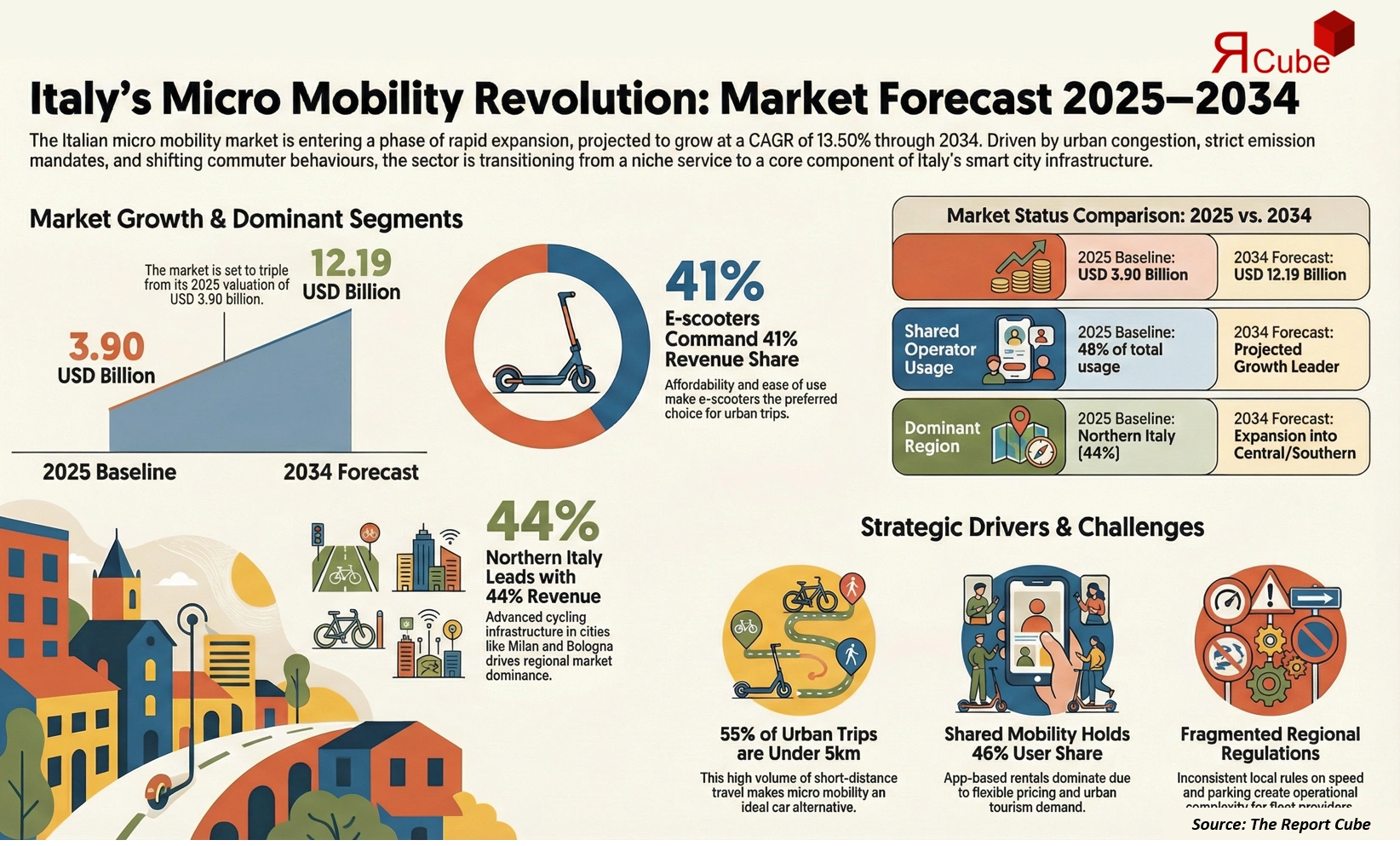
The Italy Micro Mobility Market is anticipated to register a CAGR of 13.50% during 2026-2034. The market size was valued at USD 3.90 billion in 2025 and is projected to reach USD 12.19 billion by 2034. The market is expanding rapidly as Italian cities prioritize sustainable urban transport, congestion reduction, and emission control. Micro mobility solutions such as e-scooters, electric bikes, and shared mobility fleets are increasingly integrated into daily commuting, tourism, and last-mile connectivity, particularly in densely populated urban centers.
This growth is closely linked to changing mobility behavior among younger demographics and working professionals who seek flexible, cost-effective alternatives to private cars. Rising fuel prices and strict low-emission zones across major Italian cities have further accelerated adoption. Municipal authorities are actively supporting micro mobility through dedicated bike lanes, parking zones, and multimodal transport integration, strengthening consumer confidence and usage frequency.
Additionally, the expansion of app-based shared mobility platforms is reshaping urban travel patterns. Operators are improving vehicle durability, safety features, and fleet optimization to ensure profitability and regulatory compliance. As Italy advances its climate goals and smart city initiatives, micro mobility is expected to play a central role in reshaping urban transportation through 2034.
Italy Micro Mobility Market Recent Developments
- 2025: Dott expanded its shared e-scooter fleet across Milan and Rome with upgraded battery efficiency.
- 2025: Helbiz introduced integrated subscription plans combining e-bikes and scooters for daily commuters.
Government Initiatives & Policies
- Italy National Sustainable Mobility Plan: Supports micro mobility adoption through urban infrastructure funding.
- Urban Emissions Reduction Incentive Program: Encourages electric micro mobility to reduce city pollution.
Italy Micro Mobility Market Dynamics
Key Driver: Urban Congestion and Emission Reduction Mandates
Escalating urban congestion and strict emission regulations are the primary drivers of the Italy Micro Mobility Market. Major cities such as Milan, Rome, and Turin face increasing traffic density, resulting in longer commute times and higher pollution levels. Micro mobility vehicles offer a compact, zero-emission solution for short-distance travel, addressing both congestion and environmental concerns. Over 55% of urban trips in Italy are under five kilometers, making micro mobility an ideal alternative to traditional vehicles. Government-backed low-emission zones and vehicle restrictions further incentivize residents and tourists to adopt electric scooters and bikes for daily travel.
Book your FREE 30-minute expert consultation today
Contact UsIndustry Trends: Growth of Shared Mobility Platforms
The rapid growth of shared micro mobility platforms represents a defining trend in the Italian market. App-based rentals provide convenient, pay-per-use access without ownership costs, attracting both residents and tourists. Operators are increasingly deploying data analytics to optimize fleet placement, reduce downtime, and enhance user experience. In 2025, shared operators accounted for nearly 48% of total micro mobility usage in urban Italy. Partnerships with municipalities to regulate parking and usage zones are also improving public acceptance and operational sustainability, strengthening long-term market viability.
Major Challenge: Regulatory Fragmentation Across Cities
Despite strong growth, regulatory inconsistency across Italian cities poses a major challenge. Local governments impose varying rules related to speed limits, parking, fleet size, and operating permits, increasing compliance complexity for operators. These fragmented regulations can slow expansion and raise operational costs, particularly for international players. Additionally, public concerns over pedestrian safety and sidewalk clutter have led to stricter enforcement in some regions, limiting deployment flexibility and affecting service availability.
Opportunity: Corporate and Public Sector Fleet Adoption
Corporate and public sector adoption of micro mobility fleets presents a significant growth opportunity. Businesses are increasingly using electric bikes and scooters for employee commuting, campus mobility, and last-mile logistics. Municipalities are also integrating micro mobility into public transport networks to improve first- and last-mile connectivity. With sustainability reporting becoming mandatory for many organizations, electric micro mobility solutions offer measurable carbon reduction benefits, positioning this segment for accelerated growth through the forecast period.
Italy Micro Mobility Market Segment-wise Analysis
By Vehicle Type:
- E-scooters
- Electric Bikes
- E-mopeds
- Cargo Bikes
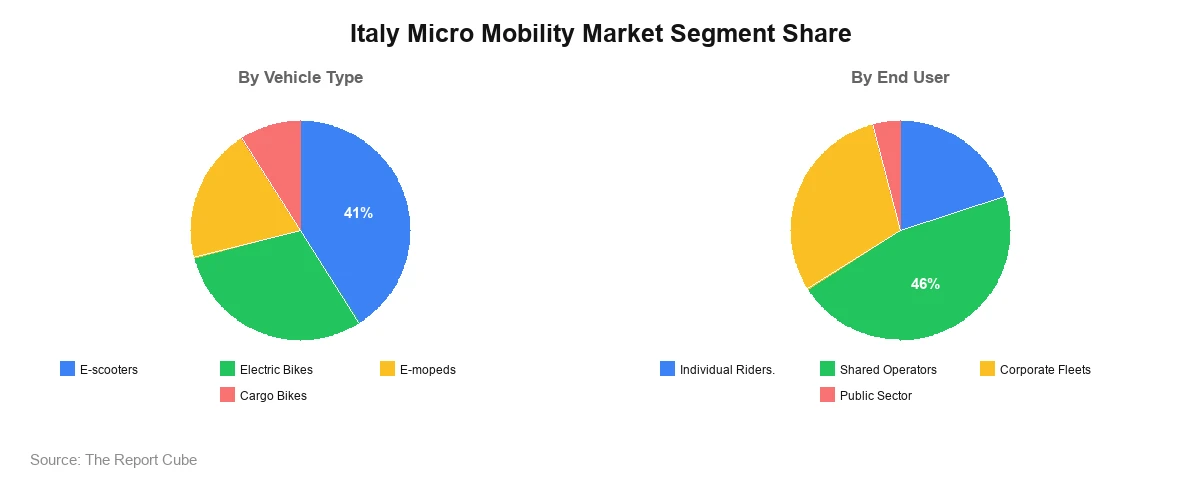
E-scooters lead the Italy Micro Mobility Market by vehicle type, accounting for approximately 41% of total market revenue in 2025. Their affordability, ease of use, and suitability for short urban trips make them the preferred option among commuters and tourists. Electric bikes follow closely, driven by longer travel range and suitability for varied terrain. Cargo bikes are gaining traction in urban logistics, particularly for last-mile deliveries, supporting sustainable supply chain initiatives.
By End User:
- Individual Riders
- Shared Operators
- Corporate Fleets
- Public Sector
Shared operators dominate the end-user segment, holding nearly 46% market share in 2025. Their growth is supported by urban tourism, flexible pricing models, and widespread smartphone adoption. Individual riders are increasingly purchasing electric bikes for daily commuting, while corporate fleets are emerging as a high-growth segment due to sustainability commitments and cost efficiency compared to traditional vehicles.
Regional Projection of Italy Micro Mobility Industry
- Northern
- Central
- Southern
- Islands
Northern Italy leads the micro mobility market, contributing approximately 44% of total revenue in 2025. Cities such as Milan and Bologna benefit from advanced cycling infrastructure, higher income levels, and strong environmental policies. The region also attracts the highest concentration of shared mobility operators. Central Italy follows, driven by tourism demand in Rome and Florence, while Southern regions and Islands are gradually adopting micro mobility as infrastructure investments improve.
Need insights for a specific region within this market?
Request Regional DataWhy Choose This Report?
- Provides a comprehensive overview of the overall market analysis, encompassing key trends, consumer behavior analysis, and risk assessment to support strategic decision-making.
- Provides accurate, up-to-date insights into market size, segmentation, and emerging opportunities, helping to minimize risk & capitalizing on growth.
- Gives deep understanding of target audience preferences, investment habits, and communication channels for enhanced product development & marketing effectiveness.
- Delivers competitive analysis & benchmarking, uncovering the strengths & weaknesses of market competitors to guide strategies.
- Consolidate comprehensive market intelligence, reducing reasoning & streamlining research efforts.
- Facilitates customized market segmentation & risk mitigation strategies, fine-tuned to the business objectives.
- Aids in identifying both market challenges & untapped opportunities within the industry to drive long-term business growth.
- Provides valuable information based on actual customer data & search trends.
Table of Contents
- Introduction
- Objective of the Study
- Product and Category Definition
- Market Segmentation
- Study Variables
- Research Methodology
- Secondary Data Points
- Breakdown of Secondary Sources
- Primary Data Points
- Breakdown of Primary Interviews
- Secondary Data Points
- Executive Summary
- Market Dynamics
- Drivers
- Challenges
- Opportunity Assessment
- Recent Trends and Developments
- Regulatory and Policy Landscape
- Italy Micro Mobility Market Overview (2020-2034)
- Market Size, By Value (EUR Billion)
- Market Share, By Vehicle Type
- E-scooters
- Electric Bikes
- E-mopeds
- Cargo Bikes
- Other Devices
- Market Share, By End User
- Individual Riders
- Shared Operators
- Corporate Fleets
- Public Sector
- Market Share, By Use Case
- First-mile/Last-mile
- Urban Commuting
- Tourism Leisure
- Delivery Logistics
- Market Share, By Drive Type
- Pure Electric
- Pedal Assist
- Throttle Assist
- Market Share, By Region
- Northern
- Central
- Southern
- Islands
- Market Share, By Company
- Revenue Shares
- Competitive Landscape
- Northern Italy Micro Mobility Market
- Market Size, By Value (EUR Billion)
- Market Share, By Vehicle Type
- Market Share, By End User
- Market Share, By Use Case
- Market Share, By Drive Type
- Market Share, By Sub‑Region (East, West)
- Market Share, By Key Cities
- Milan
- Turin
- Bergamo
- Verona
- Others
- Central Italy Micro Mobility Market
- Market Size, By Value (EUR Billion)
- Market Share, By Vehicle Type
- Market Share, By End User
- Market Share, By Use Case
- Market Share, By Drive Type
- Market Share, By Sub‑Region (East, West)
- Market Share, By Key Cities
- Rome
- Florence
- Arezzo
- Pisa
- Others
- Southern Italy Micro Mobility Market
- Market Size, By Value (EUR Billion)
- Market Share, By Vehicle Type
- Market Share, By End User
- Market Share, By Use Case
- Market Share, By Drive Type
- Market Share, By Sub‑Region (East, West)
- Market Share, By Key Cities
- Naples
- Bari
- Brindisi
- Taranto
- Others
- Islands Micro Mobility Market (Sicily & Sardinia)
- Market Size, By Value (EUR Billion)
- Market Share, By Vehicle Type
- Market Share, By End User
- Market Share, By Use Case
- Market Share, By Drive Type
- Market Share, By Sub‑Region (East, West)
- Market Share, By Key Cities
- Palermo
- Cagliari
- Messina
- Catania
- Others
- Competitive Outlook and Company Profiles
- Helbiz
- Company Overview
- Service Portfolio
- Strategic Alliances/Partnerships
- Recent Developments
- Bit Mobility
- Company Overview
- Service Portfolio
- Strategic Alliances/Partnerships
- Recent Developments
- Dott
- Company Overview
- Service Portfolio
- Strategic Alliances/Partnerships
- Recent Developments
- Tier Mobility
- Company Overview
- Service Portfolio
- Strategic Alliances/Partnerships
- Recent Developments
- Voi Technology
- Company Overview
- Service Portfolio
- Strategic Alliances/Partnerships
- Recent Developments
- Lime
- Company Overview
- Service Portfolio
- Strategic Alliances/Partnerships
- Recent Developments
- Bird
- Company Overview
- Service Portfolio
- Strategic Alliances/Partnerships
- Recent Developments
- Link Superpedestrian
- Company Overview
- Service Portfolio
- Strategic Alliances/Partnerships
- Recent Developments
- Reby
- Company Overview
- Service Portfolio
- Strategic Alliances/Partnerships
- Recent Developments
- RideMovi
- Company Overview
- Service Portfolio
- Strategic Alliances/Partnerships
- Recent Developments
- Others
- Helbiz
- Contact Us and Disclaimer
Top Key Players & Market Share Outlook
- Helbiz
- Bit Mobility
- Dott
- Tier Mobility
- Voi Technology
- Lime
- Bird
- Link Superpedestrian
- Reby
- RideMovi
- Others
Frequently Asked Questions






