



Build Your Custom Market Intelligence Report
Customize Your ReportGlobal Ladle Carrier Market Insights & Analysis
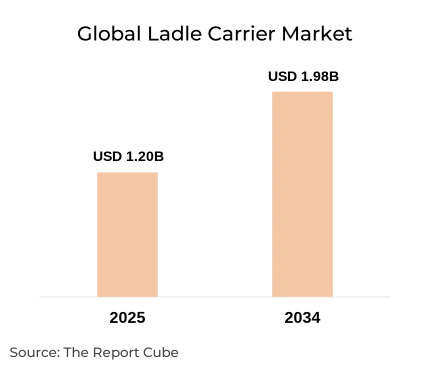
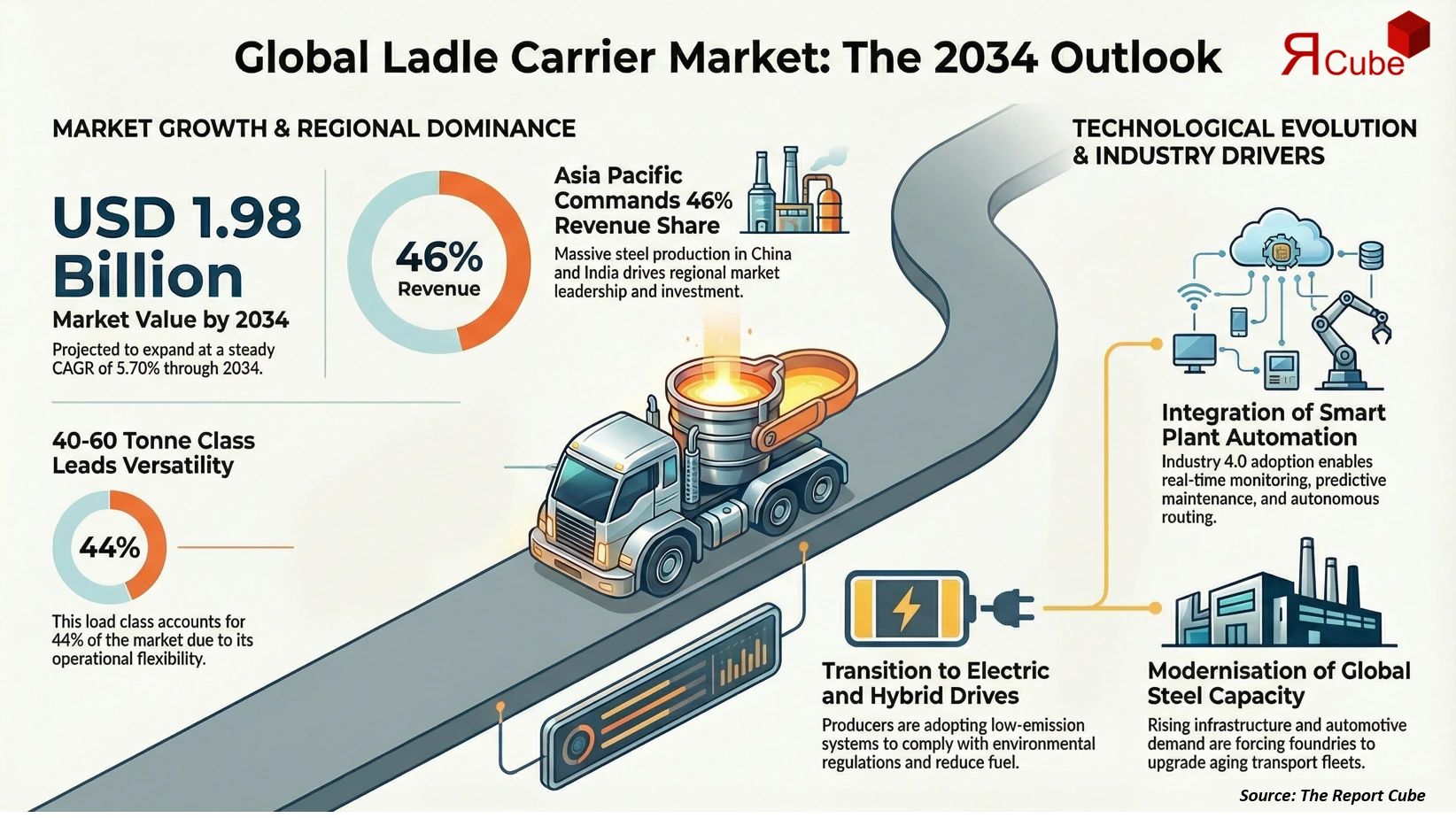
The Global Ladle Carrier Market is anticipated to register a CAGR of 5.70% during 2026-2034. The market size was valued at USD 1.2 billion in 2025 and is projected to reach USD 1.98 billion by 2034. The market plays a critical role within the metallurgical and steelmaking value chain, as ladle carriers ensure safe, efficient, and controlled transportation of molten metal inside steel plants. Rising steel production capacity, modernization of foundries, and increasing focus on workplace safety are collectively supporting steady demand for advanced ladle carrier systems worldwide.
As steelmakers prioritize operational efficiency and reduced downtime, ladle carriers are increasingly being integrated with automation, safety interlocks, and precision control systems. Emerging economies are investing heavily in infrastructure and manufacturing, which directly drives demand for steel and related material-handling equipment. Simultaneously, developed markets are upgrading aging steel facilities with energy-efficient and low-emission carrier technologies to comply with environmental regulations.
Moreover, technological improvements such as electric and hybrid drive systems are reshaping procurement decisions across steel plants. These advancements help reduce fuel consumption, operating costs, and emissions, while improving maneuverability in confined industrial environments. Collectively, these structural shifts position the global ladle carrier market for consistent and resilient growth through 2034.
Global Ladle Carrier Market Recent Developments
- 2025: TII KAMAG introduced upgraded ladle carriers with higher payloads and remote maintenance for steelworks efficiency.
- 2025: Kress Corporation enhanced ladle carrier lineup, offering 500-tonne capacity and improved maneuverability for global metallurgical customers.
Government Initiatives & Policies
- Industrial Decarbonization Programs: Government initiatives supporting low-emission industrial machinery adoption across steel plants.
- National Manufacturing Modernization Policies: Programs encouraging automation and equipment upgrades in heavy industries.
Global Ladle Carrier Market Dynamics
Key Driver: Expansion of Global Steel Production Capacity
The continuous expansion of steel production capacity remains the primary driver of the global ladle carrier market. Rapid urbanization, infrastructure development, and growth in automotive and construction sectors are increasing steel demand worldwide. Steel plants rely on ladle carriers to safely transport molten metal between furnaces and casting areas, making these systems indispensable. Emerging economies account for a significant share of new steel capacity additions, where modernization of material-handling equipment is prioritized to improve productivity and safety. As steelmakers seek to reduce operational bottlenecks and improve throughput, investments in high-capacity and reliable ladle carriers are steadily increasing.
Book your FREE 30-minute expert consultation today
Contact UsIndustry Trends: Shift Toward Electric and Hybrid Drive Systems
A notable trend reshaping the market is the growing adoption of electric and hybrid powered ladle carriers. These systems offer lower emissions, reduced noise levels, and improved energy efficiency compared to traditional diesel-powered units. Steel producers are increasingly aligning equipment procurement with sustainability targets and regulatory requirements. Electric ladle carriers also provide smoother operation and lower maintenance needs, enhancing long-term cost efficiency. As battery technology and charging infrastructure improve, electric-powered carriers are gaining acceptance even in high-load and continuous-operation environments.
Major Challenge: High Capital Investment and Maintenance Costs
The high initial cost associated with ladle carrier procurement and installation poses a key challenge for market growth. Advanced carriers equipped with automation, safety systems, and alternative drive technologies require significant capital investment. Additionally, maintenance of these heavy-duty machines demands skilled labor and specialized components, increasing lifecycle costs. Smaller steel plants and foundries often delay equipment upgrades due to budget constraints, limiting short-term market penetration in cost-sensitive regions.
Opportunity: Automation and Smart Steel Plant Integration
The increasing adoption of automation in steel plants presents a strong growth opportunity for ladle carrier manufacturers. Integration with smart plant systems enables real-time monitoring, predictive maintenance, and optimized routing of molten metal transport. Automated ladle carriers reduce human intervention, improving safety and operational consistency. As Industry 4.0 adoption accelerates across heavy industries, demand for technologically advanced ladle carriers is expected to rise significantly over the forecast period.
Global Ladle Carrier Market Segment-wise Analysis
By Drive Type:
- Diesel Powered
- Electric Powered
- Hybrid Powered
Diesel powered ladle carriers currently hold the largest market share, accounting for approximately 48% of total revenue in 2025. Their dominance is attributed to high load-handling capability, long operational range, and established reliability in harsh steel plant environments. However, electric powered carriers are gaining traction due to lower operating costs and emissions, while hybrid powered systems are emerging as a balanced solution offering fuel efficiency without compromising performance.
By Load Class:
- Below 40 Tons
- 40-60 Tons
- Above 60 Tons
The 40-60 tons load class leads the market with nearly 44% share, driven by its versatility across medium to large steel plants. This segment balances payload capacity with maneuverability, making it suitable for most integrated steel operations. Demand for above 60 tons carriers is growing steadily in high-capacity plants, while below 40 tons models remain relevant in smaller foundries and specialty metal facilities.
Regional Projection of Global Ladle Carrier Industry
- North America
- Europe
- Asia Pacific
- Middle East and Africa
- South America
Asia Pacific dominates the global ladle carrier market, contributing approximately 46% of total revenue in 2025. The region benefits from massive steel production capacity in countries such as China and India, along with continuous investments in plant modernization. Rapid industrialization and infrastructure expansion further strengthen demand. Europe and North America follow, driven by replacement demand and technological upgrades, while the Middle East and Africa and South America present emerging growth opportunities supported by expanding industrial bases.
Need insights for a specific region within this market?
Request Regional DataWhy Choose This Report?
- Provides a comprehensive overview of the overall market analysis, encompassing key trends, consumer behavior analysis, and risk assessment to support strategic decision-making.
- Provides accurate, up-to-date insights into market size, segmentation, and emerging opportunities, helping to minimize risk & capitalizing on growth.
- Gives deep understanding of target audience preferences, investment habits, and communication channels for enhanced product development & marketing effectiveness.
- Delivers competitive analysis & benchmarking, uncovering the strengths & weaknesses of market competitors to guide strategies.
- Consolidate comprehensive market intelligence, reducing reasoning & streamlining research efforts.
- Facilitates customized market segmentation & risk mitigation strategies, fine-tuned to the business objectives.
- Aids in identifying both market challenges & untapped opportunities within the industry to drive long-term business growth.
- Provides valuable information based on actual customer data & search trends.
Table of Contents
- Introduction
- Objective of the Study
- Product and Category Definition
- Market Segmentation
- Study Variables
- Scope and Limitations
- Research Methodology
- Secondary Data Points
- Breakdown of Secondary Sources
- Primary Data Points
- Breakdown of Primary Interviews
- Secondary Data Points
- Executive Summary
- Market Dynamics
- Key Drivers
- Restraints
- Opportunities
- Trends
- Regulatory and Policy Landscape
- Global Ladle Carrier Market Overview (2020-2034)
- Market Size, By Value (USD Million)
- Market Share, By Drive Type
- Diesel Powered
- Electric Powered
- Hybrid Powered
- Market Share, By Load Class
- Below 40 Tons
- 40-60 Tons
- Above 60 Tons
- Market Share, By Operation
- Manual Operation
- Semi-Automatic
- Fully Automatic
- Market Share, By Application
- Steel Plants
- Foundries
- Metallurgical Yards
- Other Industrial
- Market Share, By End User
- Integrated Steelmakers
- Mini Mills
- OEM Service Providers
- Others
- Market Share, By Region
- North America
- Europe
- Asia Pacific
- Middle East and Africa
- South America
- Market Share, By Company
- Competition Characteristics
- Revenue Shares & Analysis
- North America Ladle Carrier Market
- Market Size, By Value (USD Million)
- Market Share, By Drive Type
- Market Share, By Load Class
- Market Share, By Operation
- Market Share, By Application
- Market Share, By End User
- Market Share, By Country
- United States
- Canada
- Mexico
- Europe Ladle Carrier Market
- Market Size, By Value (USD Million)
- Market Share, By Drive Type
- Market Share, By Load Class
- Market Share, By Operation
- Market Share, By Application
- Market Share, By End User
- Market Share, By Country
- Germany
- France
- United Kingdom
- Italy
- Spain
- Rest of Europe
- Asia Pacific Ladle Carrier Market
- Market Size, By Value (USD Million)
- Market Share, By Drive Type
- Market Share, By Load Class
- Market Share, By Operation
- Market Share, By Application
- Market Share, By End User
- Market Share, By Country
- China
- India
- Japan
- South Korea
- Rest of Asia Pacific
- Middle East and Africa Ladle Carrier Market
- Market Size, By Value (USD Million)
- Market Share, By Drive Type
- Market Share, By Load Class
- Market Share, By Operation
- Market Share, By Application
- Market Share, By End User
- Market Share, By Country
- Gulf Cooperation Council
- South Africa
- Rest of Middle East and Africa
- South America Ladle Carrier Market
- Market Size, By Value (USD Million)
- Market Share, By Drive Type
- Market Share, By Load Class
- Market Share, By Operation
- Market Share, By Application
- Market Share, By End User
- Market Share, By Country
- Brazil
- Argentina
- Rest of South America
- Competitive Outlook and Company Profiles
- Kress Corporation
- Company Overview
- Product Portfolio
- Strategic Alliances Partnerships
- Recent Developments
- TII KAMAG
- Company Overview
- Product Portfolio
- Strategic Alliances Partnerships
- Recent Developments
- CNHTC
- Company Overview
- Product Portfolio
- Strategic Alliances Partnerships
- Recent Developments
- Shanghai Joolinn
- Company Overview
- Product Portfolio
- Strategic Alliances Partnerships
- Recent Developments
- Changsha Carrie Heavy Industry
- Company Overview
- Product Portfolio
- Strategic Alliances Partnerships
- Recent Developments
- MCC Baosteel
- Company Overview
- Product Portfolio
- Strategic Alliances Partnerships
- Recent Developments
- Zhengzhou Joda Technology
- Company Overview
- Product Portfolio
- Strategic Alliances Partnerships
- Recent Developments
- Jiangxi Chuangen Machinery
- Company Overview
- Product Portfolio
- Strategic Alliances Partnerships
- Recent Developments
- Wuhan Special Car Science and Tech
- Company Overview
- Product Portfolio
- Strategic Alliances Partnerships
- Recent Developments
- Other Regional Players
- Company Overview
- Product Portfolio
- Strategic Alliances Partnerships
- Recent Developments
- Kress Corporation
- Appendix, Contact Details, and Disclaimer
Top Key Players & Market Share Outlook
- Kress Corporation
- TII KAMAG
- CNHTC
- Shanghai Joolinn
- Changsha Carrie Heavy Industry
- MCC Baosteel
- Zhengzhou Joda Technology
- Jiangxi Chuangen Machinery
- Wuhan Special Car Science and Tech
- Other Regional Players
- Appendix, Contact Details, and Disclaimer
Frequently Asked Questions






