



Build Your Custom Market Intelligence Report
Customize Your ReportBrazil Lithium Carbonate Market Insights & Analysis
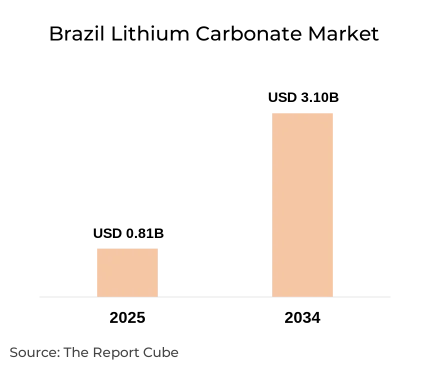
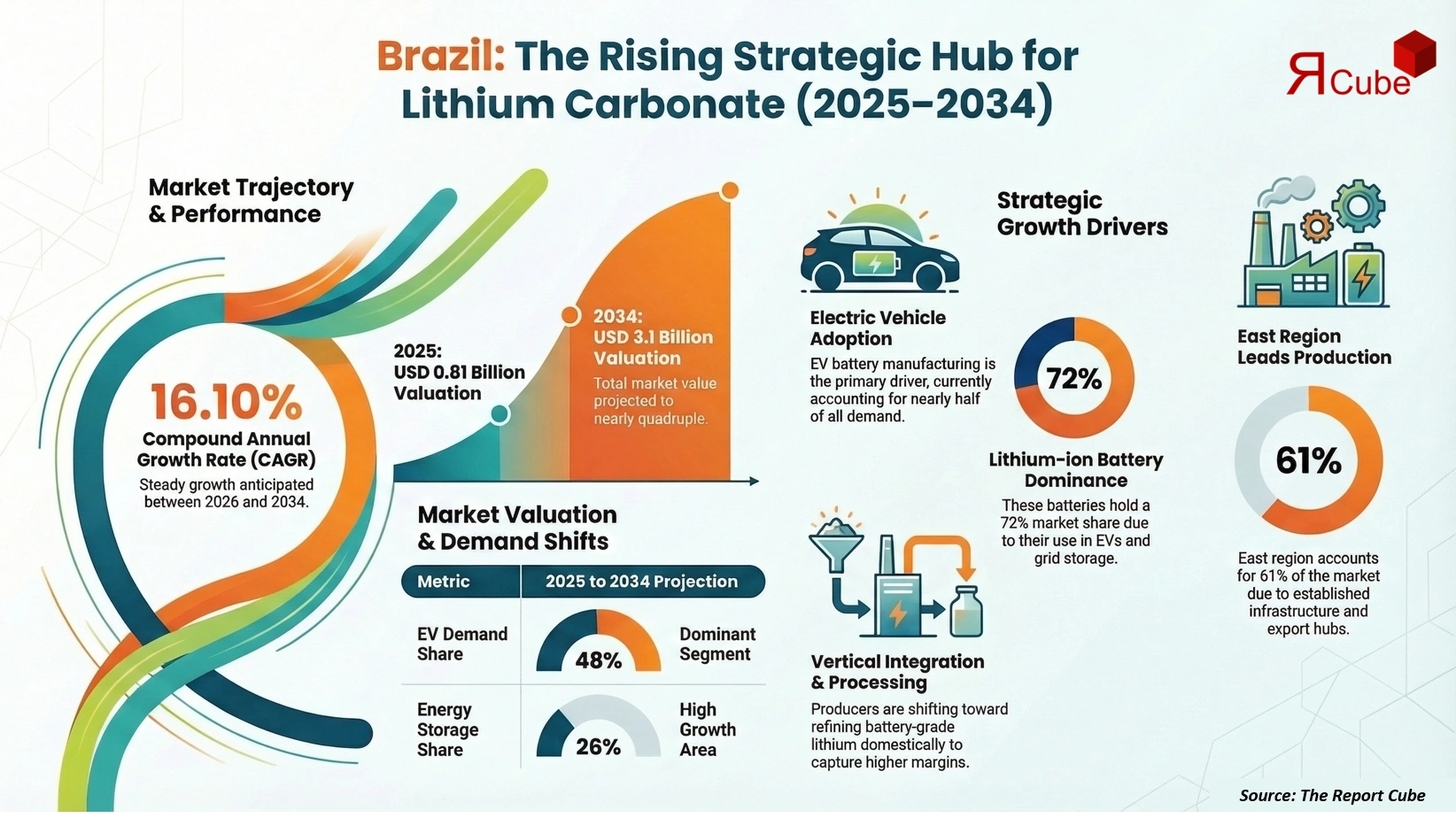
The Brazil Lithium Carbonate Market is anticipated to register a CAGR of 16.10% during the forecast period 2026-2034. The market size was valued at USD 0.81 billion in 2025 and is projected to reach USD 3.1 billion by 2034. This strong growth trajectory is closely linked to Brazil’s expanding role in the global lithium supply chain, supported by abundant hard-rock lithium reserves and rising downstream demand from battery manufacturing and clean energy sectors.
Brazil has emerged as a strategic lithium hub in Latin America, driven by accelerating electric vehicle adoption, renewable energy integration, and government support for mineral development. Lithium carbonate demand is rising rapidly as global battery manufacturers seek diversified supply sources beyond traditional markets. Brazil’s favorable mining regulations, improving infrastructure, and growing foreign investments are strengthening its position as a reliable supplier of battery-grade lithium carbonate. Additionally, partnerships between local miners and international battery producers are helping accelerate project development timelines.
Furthermore, the market benefits from increasing domestic consumption, particularly from energy storage systems supporting solar and wind power projects. As Brazil advances its decarbonization goals, lithium carbonate has become a critical input material, ensuring long-term demand stability. These interconnected factors collectively underpin sustained expansion of the Brazil Lithium Carbonate Market over the forecast period.
Brazil Lithium Carbonate Market Recent Developments
- 2025: Sigma Lithium expanded production capacity to support battery-grade lithium carbonate exports.
- 2025: AMG Brasil advanced downstream processing initiatives to improve lithium carbonate value addition.
Government Initiatives & Policies
- National Mining Development Program: Supports sustainable mineral extraction and foreign investment.
- Brazil Energy Transition Policy: Promotes battery storage and electric mobility adoption.
Brazil Lithium Carbonate Market Dynamics
Key Driver: Rapid Growth in Electric Vehicle and Battery Manufacturing Demand
The primary driver of the Brazil Lithium Carbonate Market is the accelerating global demand for electric vehicles and lithium-ion batteries. Automakers and battery manufacturers are scaling production to meet emissions regulations and consumer preference for clean mobility. Lithium carbonate remains a key raw material for cathode production, directly linking EV sales growth to lithium demand. In 2024, global EV sales grew by over 30%, significantly boosting lithium carbonate consumption. Brazil’s growing mining output and proximity to key export markets make it an attractive supply source. As EV penetration deepens across Latin America and export demand rises, lithium carbonate demand from Brazil is expected to remain robust throughout the forecast period.
Book your FREE 30-minute expert consultation today
Contact UsIndustry Trends: Vertical Integration and Battery-Grade Processing Expansion
A major trend shaping the market is the shift toward vertical integration and higher-purity battery-grade lithium carbonate production. Mining companies are increasingly investing in processing facilities to move beyond raw material exports and capture higher margins. This trend is driven by customer demand for consistent quality and supply reliability. Battery manufacturers prefer suppliers capable of delivering refined lithium products that meet stringent performance standards. In response, Brazilian producers are adopting advanced beneficiation and purification technologies. This integration not only enhances competitiveness but also reduces exposure to commodity price volatility, reinforcing long-term market stability.
Major Challenge: Price Volatility and Infrastructure Constraints
Despite strong growth prospects, lithium carbonate price volatility poses a significant challenge. Global lithium prices have experienced sharp fluctuations due to supply-demand imbalances and speculative trading. Such volatility impacts revenue predictability and investment planning for producers. Additionally, infrastructure limitations in certain mining regions can delay project execution and increase logistics costs. Transportation bottlenecks and energy supply reliability remain concerns for large-scale processing operations. These challenges may temporarily restrain market expansion, particularly for smaller players with limited financial resilience.
Opportunity: Energy Storage Systems and Renewable Integration
The expansion of energy storage systems presents a substantial opportunity for the Brazil Lithium Carbonate Market. As renewable energy capacity grows, grid-scale and distributed battery storage solutions are increasingly required to manage intermittency. Lithium-ion batteries dominate this segment due to their efficiency and declining costs. Brazil’s investments in solar and wind power have increased demand for stationary energy storage, directly supporting lithium carbonate consumption. This application diversifies demand beyond electric vehicles, providing a stable growth avenue and enhancing market resilience over the long term.
Brazil Lithium Carbonate Market Segment-wise Analysis
By Application:
- Electric Vehicles
- Energy Storage
- Consumer Electronics
- Industrial Uses
- Pharmaceuticals
The Electric Vehicles segment leads the market, accounting for approximately 48% of total lithium carbonate demand in 2025. This dominance reflects the rapid scaling of EV battery production globally. Energy Storage follows with nearly 26% share, driven by renewable integration projects. Consumer Electronics and Industrial Uses contribute moderate shares, supported by steady demand for portable devices and specialty chemicals. Pharmaceuticals represent a niche but stable segment. The strong performance of EV applications anchors overall market growth, while energy storage provides long-term demand diversification.
By Battery Type:
- Lithium-ion Batteries
- Lithium-metal Batteries
- Other Battery Types
Lithium-ion Batteries dominate this segment, holding close to 72% market share due to their widespread use in EVs and energy storage systems. Their high energy density, long cycle life, and improving safety profile drive sustained adoption. Lithium-metal Batteries account for a smaller but growing share as next-generation technologies advance. Other battery types serve specialized applications. The continued dominance of lithium-ion batteries ensures consistent lithium carbonate demand, reinforcing the segment’s leadership through 2034.
Regional Projection of Brazil Lithium Carbonate Industry
- East
- West
The East region leads the Brazil Lithium Carbonate Market, accounting for approximately 61% of total production and demand. This leadership is supported by established mining operations, better infrastructure, and proximity to export logistics hubs. The West region is gradually emerging as a growth area, driven by new exploration projects and supportive state-level policies. While the East will continue to dominate during the forecast period, increased investments in the West are expected to balance regional output over time.
Need insights for a specific region within this market?
Request Regional DataWhy Choose This Report?
- Provides a comprehensive overview of the overall market analysis, encompassing key trends, consumer behavior analysis, and risk assessment to support strategic decision-making.
- Provides accurate, up-to-date insights into market size, segmentation, and emerging opportunities, helping to minimize risk & capitalizing on growth.
- Gives deep understanding of target audience preferences, investment habits, and communication channels for enhanced product development & marketing effectiveness.
- Delivers competitive analysis & benchmarking, uncovering the strengths & weaknesses of market competitors to guide strategies.
- Consolidate comprehensive market intelligence, reducing reasoning & streamlining research efforts.
- Facilitates customized market segmentation & risk mitigation strategies, fine-tuned to the business objectives.
- Aids in identifying both market challenges & untapped opportunities within the industry to drive long-term business growth.
- Provides valuable information based on actual customer data & search trends.
Table of Contents
- Introduction
- Objective of the Study
- Product and Category Definition
- Market Segmentation
- Study Variables
- Research Methodology
- Secondary Data Points
- Breakdown of Secondary Sources
- Primary Data Points
- Breakdown of Primary Interviews
- Secondary Data Points
- Executive Summary
- Market Dynamics
- Drivers
- Challenges
- Opportunity Assessment
- Recent Trends and Developments
- Regulatory and Policy Landscape
- Brazil Lithium Carbonate Market Overview (2020-2034)
- Market Size, By Value (USD Million)
- Market Share, By Application
- Electric Vehicles
- Energy Storage
- Consumer Electronics
- Industrial Uses
- Pharmaceuticals
- Market Share, By Battery Type
- Lithium-ion Batteries
- Lithium-metal Batteries
- Other Battery Types
- Market Share, By Grade
- Battery Grade
- Technical Grade
- Pharma Grade
- Market Share, By End User
- Automotive OEMs
- Battery Makers
- Electronics Firms
- Chemical Producers
- Others
- Market Share, By Region
- East
- West
- Market Share, By Company
- Revenue Shares
- Competitive Landscape
- East Brazil Lithium Carbonate Market
- Market Size, By Value (USD Million)
- Market Share, By Application
- Market Share, By Battery Type
- Market Share, By Grade
- Market Share, By End User
- Market Share, By Key State
- Minas Gerais
- Bahia
- Espírito Santo
- Other Eastern States
- West Brazil Lithium Carbonate Market
- Market Size, By Value (USD Million)
- Market Share, By Application
- Market Share, By Battery Type
- Market Share, By Grade
- Market Share, By End User
- Market Share, By Key State
- Goiás
- Mato Grosso
- Mato Grosso do Sul
- Other Western States
- Competitive Outlook and Company Profiles
- Sigma Lithium
- Company Overview
- Project Portfolio
- Strategic Alliances/Partnerships
- Recent Developments
- CBL Lithium
- Company Overview
- Project Portfolio
- Strategic Alliances/Partnerships
- Recent Developments
- AMG Brasil
- Company Overview
- Project Portfolio
- Strategic Alliances/Partnerships
- Recent Developments
- Lithium Ionic
- Company Overview
- Project Portfolio
- Strategic Alliances/Partnerships
- Recent Developments
- Latin Resources
- Company Overview
- Project Portfolio
- Strategic Alliances/Partnerships
- Recent Developments
- Albemarle
- Company Overview
- Product Portfolio
- Strategic Alliances/Partnerships
- Recent Developments
- Ganfeng Lithium
- Company Overview
- Product Portfolio
- Strategic Alliances/Partnerships
- Recent Developments
- Livent Corporation
- Company Overview
- Product Portfolio
- Strategic Alliances/Partnerships
- Recent Developments
- SQM
- Company Overview
- Product Portfolio
- Strategic Alliances/Partnerships
- Recent Developments
- Tianqi Lithium
- Company Overview
- Product Portfolio
- Strategic Alliances/Partnerships
- Recent Developments
- Others
- Sigma Lithium
- Contact Us and Disclaimer
Top Key Players & Market Share Outlook
- Sigma Lithium
- CBL Lithium
- AMG Brasil
- Lithium Ionic
- Latin Resources
- Albemarle
- Ganfeng Lithium
- Livent Corporation
- SQM
- Tianqi Lithium
- Others
Frequently Asked Questions






