



Build Your Custom Market Intelligence Report
Customize Your ReportSouth Korea Machine Automation Controller Market Key Takeaways
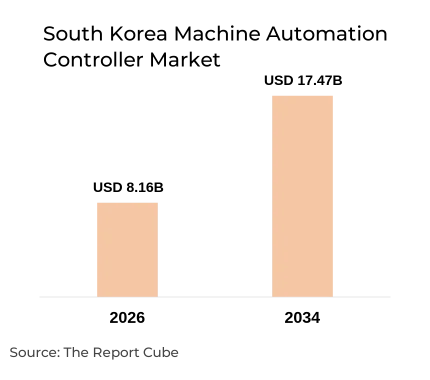
- Market valued at USD 8.16 billion in 2026, reflecting accelerating industrial automation investments nationwide.
- Industry projected to reach USD 17.47 billion by 2034, expanding at a 9.98% CAGR.
- Programmable Logic Controllers remain the dominant product segment owing to widespread manufacturing floor deployment.
- Hardware components continue leading revenue contribution across South Korea's industrial automation infrastructure.
- Seoul Capital region maintains leadership through concentrated smart manufacturing and industrial digitalization initiatives.
- Industrial robotics and variable frequency drives are witnessing accelerated adoption across automotive and electronics sectors.
- Leading companies include Yokogawa, Rockwell Automation, Honeywell, ABB, Schneider Electric, and Siemens AG.
- Expanding smart factory mandates and Industry 4.0 government programs continue driving automation controller adoption.
South Korea Machine Automation Controller Market Insights & Analysis
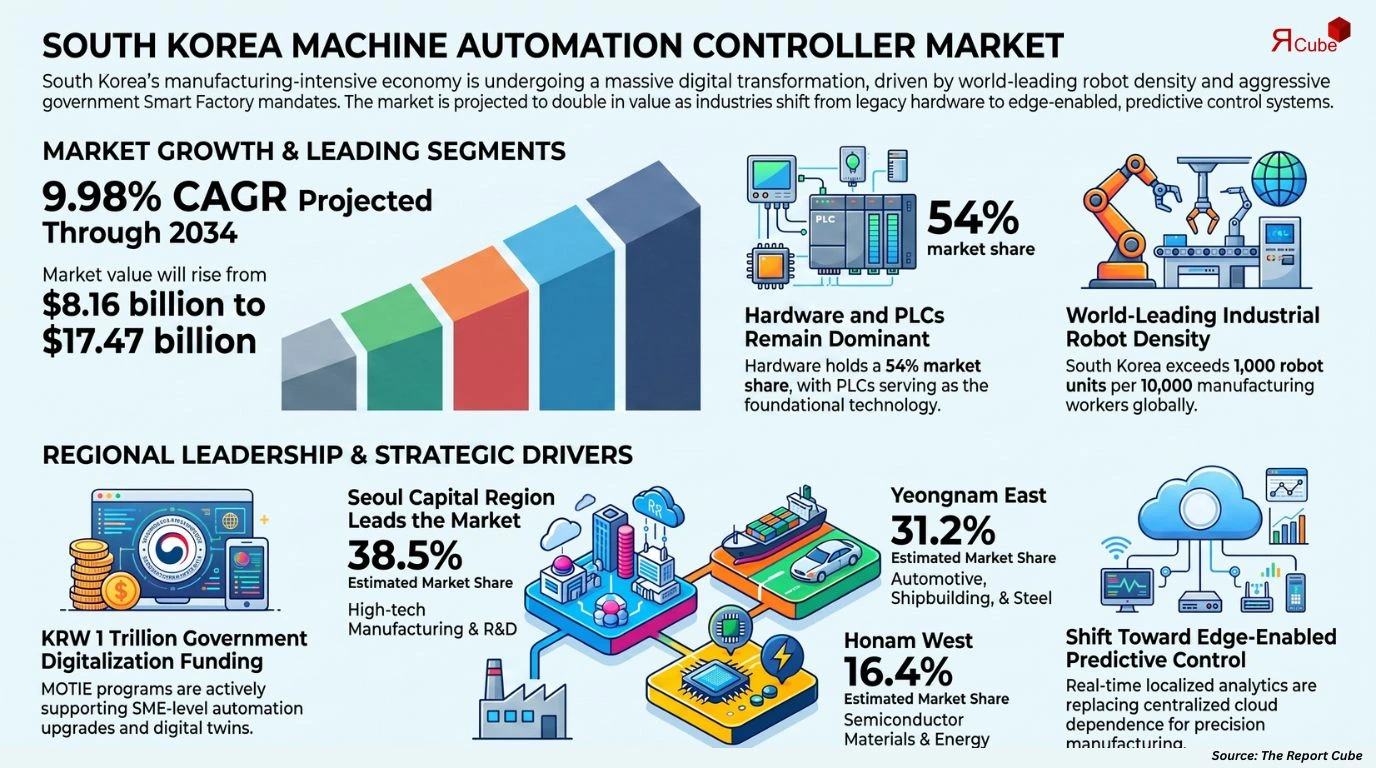
The South Korea Machine Automation Controller Market is anticipated to register a 9.98% CAGR during 2026–2034. The market size was valued at USD 8.16 billion in 2026 and is projected to reach USD 17.47 billion by 2034. South Korea's deeply integrated manufacturing base, spanning semiconductor fabrication, automotive production, petrochemical processing, and consumer electronics, continues generating substantial demand for advanced automation control technologies. The government's Korean New Deal and Smart Factory initiative - targeting 30,000 smart factories by 2025 - has channeled significant public and private funding into automation infrastructure upgrades, creating a sustained pipeline of procurement for PLCs, DCS, SCADA, and industrial robotics platforms.
South Korea ranks among Asia-Pacific's most automation-intensive economies, with robot density exceeding 1,000 units per 10,000 manufacturing workers, the highest globally as of recent industry benchmarks. This entrenched automation culture compels continuous investment in next-generation controllers, real-time monitoring systems, and industrial communication networks. Government-backed programs through the Ministry of Trade, Industry and Energy (MOTIE) have mobilized over KRW 1 trillion in manufacturing digitalization grants, reinforcing private sector adoption of advanced control and supervisory systems across high-value industrial verticals.
South Korea Machine Automation Controller Market Dynamics
South Korea's machine automation controller demand is expanding across semiconductor fabs, shipbuilding yards, chemical plants, automotive OEMs, and electronics assembly lines as manufacturers accelerate process optimization and digital twin integration. Investments in Industry 4.0 compliance, energy-efficient production, and export-competitiveness are elevating automation controller spending from operational necessity to strategic capital allocation across Korean industrial conglomerates and mid-tier manufacturers alike.
|
Factor |
Type |
Specific Impact on Market |
Magnitude |
|---|---|---|---|
|
Smart factory government mandates |
Driver |
Accelerates PLC and DCS procurement across manufacturing sectors |
Very High |
|
Semiconductor fab expansion |
Opportunity |
Increases demand for precision SCADA and process safety systems |
High |
|
Industrial robotics integration |
Driver |
Expands variable frequency drive and HMI deployment |
High |
|
Workforce aging and labor cost pressure |
Driver |
Boosts adoption of automated control and supervisory platforms |
High |
|
Edge computing and IIoT convergence |
Trend |
Enhances real-time controller performance and predictive maintenance |
Very High |
Key Market Driver: Smart Factory Government Investment Programs
South Korea's Ministry of Trade, Industry and Energy has consistently funded smart manufacturing transformation through its Smart Factory Supply Diffusion Program, which disbursed over KRW 400 billion between 2022 and 2025 to support SME-level automation upgrades. These programs have directly stimulated demand for programmable logic controllers, distributed control systems, and human machine interface platforms. Large conglomerates including Samsung, Hyundai, LG, and POSCO have additionally committed multi-billion dollar capex programs to integrate AI-enabled production automation, reinforcing continuous replacement cycles for legacy control infrastructure across their global manufacturing networks.
Major Industry Challenge: Interoperability Across Heterogeneous Control Systems
South Korean manufacturers frequently operate heterogeneous automation environments combining legacy PLCs from multiple vendors alongside newer DCS, SCADA, and IIoT-connected controllers running incompatible communication protocols. Achieving seamless interoperability across Profibus, Modbus, EtherNet/IP, and OPC-UA frameworks while maintaining real-time deterministic performance creates substantial integration complexity. Systems integrators and OEMs must invest significantly in middleware, protocol conversion hardware, and edge gateway solutions to unify these fragmented control architectures, adding deployment cost and timeline risk particularly for brownfield facilities operating critical production processes in semiconductor and petrochemical segments.
Emerging Trend Shaping Outlook: Edge-Enabled Predictive Control Intelligence
South Korean industrial operators are increasingly deploying edge computing nodes alongside traditional automation controllers to enable real-time predictive maintenance, adaptive process control, and localized analytics without full dependence on centralized cloud platforms. This convergence of edge intelligence with PLC, DCS, and SCADA architectures is enabling sub-millisecond response cycles for precision manufacturing in semiconductor lithography and automotive body welding. Vendors including Siemens, Rockwell Automation, and Mitsubishi Electric are introducing edge-ready controller platforms specifically optimized for South Korea's high-throughput electronics and automotive production environments.
Need Specific Data, Let’s Customize the Report for You
Request CustomizationSouth Korea Machine Automation Controller Market Segment-wise Analysis
South Korea's automation controller investments span a broad product and component landscape, driven by the country's diversified industrial base encompassing semiconductor manufacturing, automotive assembly, petrochemical refining, shipbuilding, and food processing. Procurement decisions increasingly reflect convergence between traditional automation hardware and digital software platforms enabling remote monitoring, predictive analytics, and cyber-physical integration.
By Product
- Programmable Logic Controllers (PLC)
- Distributed Control Systems (DCS)
- Supervisory Control and Data Acquisition Systems (SCADA)
- Human Machine Interface (HMI)
- Process Safety Systems
- Sensors and Transmitters
- Electric Motors
- Variable Frequency Drives
- Industrial Robotics
- Other Product Technologies
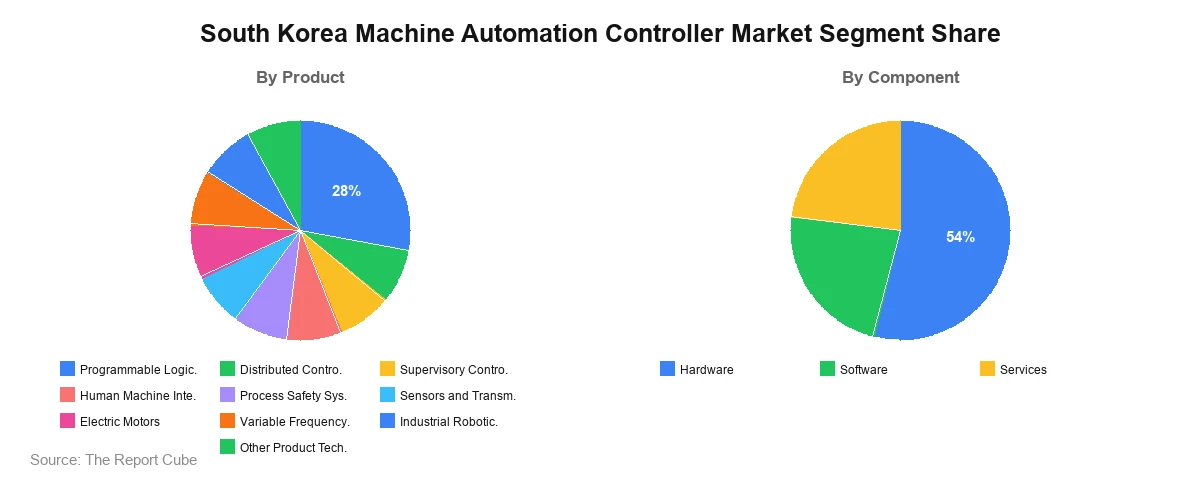
Programmable Logic Controllers dominate the South Korea Machine Automation Controller Market product segment, commanding an estimated 28% revenue share due to their foundational role across discrete manufacturing, automotive body assembly, electronics SMT lines, and food and beverage packaging operations. PLCs manufactured by Mitsubishi Electric, Siemens, and Rockwell Automation are deeply embedded across South Korea's industrial floor infrastructure, with high replacement and expansion cycles driven by productivity optimization mandates, energy efficiency requirements, and expanding Industry 4.0 integration programs across tier-1 and tier-2 suppliers serving major Korean conglomerates.
Distributed Control Systems and SCADA platforms collectively represent a substantial share of market value, particularly across petrochemical complexes, LNG terminals, and utility generation facilities in the Yeongnam East and Honam West regions. Industrial robotics is emerging as the fastest-growing product category, fueled by South Korea's global leadership in robot density and continuous automation of semiconductor wafer handling, precision welding, and battery cell assembly for the country's expanding EV manufacturing base. Variable frequency drives and sensors and transmitters are registering consistent incremental demand as energy efficiency regulations and predictive maintenance requirements intensify across process industries and smart manufacturing facilities nationwide.
By Component
- Hardware
- Software
- Services
Hardware components dominate the South Korea Machine Automation Controller Market by component, representing an estimated 54% market share owing to continuous capital expenditure on PLC panels, DCS field instruments, SCADA server infrastructure, HMI terminals, motor drives, and industrial robotic arms across the country's capital-intensive manufacturing sectors. Samsung Electronics, SK Hynix, and Hyundai Motor's ongoing semiconductor fab and smart factory expansion programs continue generating large-scale hardware procurement cycles, sustaining robust demand for automation controller physical infrastructure throughout the forecast period.
Software platforms and professional services are gaining progressive market importance as South Korean manufacturers transition beyond hardware-centric automation toward integrated digital operations. Industrial automation software encompassing SCADA visualization, MES integration, digital twin simulation, and IIoT connectivity middleware is experiencing accelerating adoption as manufacturers seek real-time production visibility and remote supervisory capabilities. Services - including commissioning, system integration, cybersecurity hardening, and lifecycle support - are expanding rapidly as complex multi-vendor automation environments require specialized expertise to maintain operational continuity, driving recurring revenue streams for major vendors and their Korean distribution and integration partners.
Regional Projection of South Korea Machine Automation Controller Market
South Korea's machine automation controller market exhibits distinct regional concentration patterns shaped by the country's geographic distribution of heavy industry, semiconductor fabrication clusters, automotive production hubs, and smart manufacturing corridors. Each regional zone demonstrates unique sectoral demand profiles, procurement scales, and technology adoption priorities.
|
Region |
Estimated Market Share |
Key Growth Factors |
Consumer Trends |
|---|---|---|---|
|
Seoul Capital |
38.5% |
High-tech manufacturing, R&D centers, smart factory programs |
Strong PLC, HMI, and industrial robotics adoption |
|
Yeongnam East |
31.2% |
Automotive, petrochemical, and shipbuilding industrial base |
DCS, SCADA, and process safety system investments |
|
Honam West |
16.4% |
Semiconductor materials, renewable energy, and food processing |
Sensors, transmitters, and variable frequency drive demand |
|
Hoseo Central |
13.9% |
Display manufacturing, logistics automation, and EV battery production |
Growing industrial robotics and edge controller deployment |
- Seoul Capital: Seoul Capital dominates the regional market with approximately 38.5% share, driven by the highest concentration of high-technology manufacturing, global OEM headquarters, and government-backed smart factory pilot programs supporting advanced automation controller deployment.
- Yeongnam East: Yeongnam East anchors South Korea's heavy industrial automation demand through Ulsan's automotive complexes, Pohang's steel facilities, and Busan's shipbuilding yards requiring extensive DCS, SCADA, and process safety system investments.
- Honam West: Honam West registers growing automation controller demand from semiconductor material producers, renewable energy facilities, and agri-food processing operations requiring precision sensors, transmitters, and variable frequency drive technologies.
- Hoseo Central: Hoseo Central is emerging as a fast-expanding automation hub driven by large-scale display panel manufacturing, EV battery gigafactories, and logistics automation facilities demanding modern industrial robotics and edge-enabled controller platforms.
South Korea Machine Automation Controller Market: Recent Development (2025)
- Yokogawa Electric expanded its OpreX process automation platform across South Korean petrochemical facilities in 2025.
- Rockwell Automation partnered with Hyundai Motor to deploy FactoryTalk smart manufacturing solutions across Korean EV plants.
- Siemens AG launched next-generation SIMATIC S7-1500 PLC controllers optimized for South Korea's semiconductor fabrication environments.
- ABB Ltd. secured a major contract supplying industrial robotics and variable frequency drives to POSCO's smart steel operations.
South Korea Machine Automation Controller Market Future Outlook (2034)
The South Korea Machine Automation Controller Market is projected to expand at a 9.98% CAGR, reaching USD 17.47 billion by 2034, underpinned by sustained government investment in smart manufacturing, accelerating semiconductor fab construction, and the country's strategic push to maintain global leadership in automation-intensive industries. Rising deployment of collaborative robots, AI-integrated SCADA platforms, and digital twin-enabled DCS architectures will progressively redefine operational productivity benchmarks across automotive, electronics, and process manufacturing sectors throughout the forecast horizon.
Long-term growth will be reinforced by South Korea's expanding EV battery supply chain, hydrogen energy infrastructure, and advanced display manufacturing sectors, all of which require high-precision automation controller technologies. Vendors investing in edge-intelligent PLCs, cybersecure SCADA solutions, and interoperable IIoT-ready control architectures will capture disproportionate market share as Korean manufacturers prioritize resilient, scalable, and data-driven automation ecosystems. Strategic partnerships between global automation leaders and Korean conglomerates will continue accelerating technology transfer, localization, and next-generation controller innovation through 2034.
South Korea Machine Automation Controller Market Report Coverage
|
Report Attribute |
Details |
|---|---|
|
Market Name |
South Korea Machine Automation Controller Market |
|
Market Size (2026) |
USD 8.16 Billion |
|
Market Size (2034) |
USD 17.47 Billion |
|
Forecast Period |
2026–2034 |
|
CAGR |
9.98% |
|
Base Year |
2026 |
|
Historical Years |
2021–2025 |
|
Forecast Years |
2026–2034 |
|
Segments Covered |
By Product, By Component, By End-user Industry, By Control Hierarchy Level |
|
Regions Covered |
Seoul Capital, Yeongnam East, Honam West, Hoseo Central |
|
Key Companies |
Yokogawa Electric Corporation, Rockwell Automation Inc., Honeywell International Inc., ABB Ltd., Schneider Electric SE, Emerson Electric Co., Mitsubishi Electric Corporation, Siemens AG, Yaskawa Electric Corporation, Others |
|
Report Format |
PDF, Excel, PPT |
|
Customization |
Available as per client requirements |
Why Choose This Report?
- Comprehensive analysis of South Korea's machine automation controller market landscape.
- Accurate market sizing with a reliable nine-year forecast through 2034.
- Detailed product and component segmentation identifying highest-revenue growth opportunities.
- Regional insights across all four major South Korean industrial zones.
- Competitive profiling of leading global and regional automation controller vendors.
- Analysis of smart factory government programs driving sustained automation investments.
- Forward-looking intelligence on edge computing and IIoT controller convergence trends.
- Data-driven research aligned with South Korea's Industry 4.0 strategic priorities.
Table of Contents
- Introduction
- Objective of the Study
- Product Definition
- Market Segmentation
- Study Variables
- Research Methodology
- Secondary Data Points
- Companies Interviewed
- Primary Data Points
- Breakdown of Primary Interviews
- Secondary Data Points
- Executive Summary
- Market Dynamics
- Drivers
- Challenges
- Opportunity Assessment
- Recent Trends and Developments
- Policy and Regulatory Landscape
- South Korea Machine Automation Controller Market Overview and Forecast Analysis (2021-2034)
- Market Size, By Value, By Growth Rate (CAGR/USD Billions)
- Demand – Supply Trends
- Market Share, By Product
- Programmable Logic Controllers (PLC)
- Distributed Control Systems (DCS)
- Supervisory Control and Data Acquisition Systems (SCADA)
- Human Machine Interface (HMI)
- Process Safety Systems
- Sensors and Transmitters
- Electric Motors
- Variable Frequency Drives
- Industrial Robotics
- Other Product Technologies
- Market Share, By Component
- Hardware
- Software
- Services
- Market Share, By End-user Industry
- Automotive
- Chemical and Petrochemical
- Semiconductor and Electronics
- Oil and Gas
- Power Generation
- Water and Wastewater
- Other End-user Industries
- Market Share, By Control Hierarchy Level
- Field Devices (Sensors, Actuators)
- Control Devices (PLC, DCS)
- Supervisory and SCADA Systems
- Manufacturing Execution, Analytics
- Others
- Market Share, By Region
- Seoul Capital
- Yeongnam East
- Honam West
- Hoseo Central
- Market Share, By Competitors
- Competition Characteristics
- Revenue Shares
- Programmable Logic Controllers (PLC) South Korea Machine Automation Controller Market Overview, 2021-2034F
- By Value (USD Million)
- By Component – Market Size & Forecast 2021-2034, USD Million
- Hardware
- Software
- Services
- Distributed Control Systems (DCS) South Korea Machine Automation Controller Market Overview, 2021-2034F
- By Value (USD Million)
- By Component – Market Size & Forecast 2021-2034, USD Million
- Hardware
- Software
- Services
- Supervisory Control and Data Acquisition Systems (SCADA) South Korea Machine Automation Controller Market Overview, 2021-2034F
- By Value (USD Million)
- By Component – Market Size & Forecast 2021-2034, USD Million
- Hardware
- Software
- Services
- Human Machine Interface (HMI) South Korea Machine Automation Controller Market Overview, 2021-2034F
- By Value (USD Million)
- By Component – Market Size & Forecast 2021-2034, USD Million
- Hardware
- Software
- Services
- Process Safety Systems South Korea Machine Automation Controller Market Overview, 2021-2034F
- By Value (USD Million)
- By Component – Market Size & Forecast 2021-2034, USD Million
- Hardware
- Software
- Services
- Sensors and Transmitters South Korea Machine Automation Controller Market Overview, 2021-2034F
- By Value (USD Million)
- By Component – Market Size & Forecast 2021-2034, USD Million
- Hardware
- Software
- Services
- Electric Motors South Korea Machine Automation Controller Market Overview, 2021-2034F
- By Value (USD Million)
- By Component – Market Size & Forecast 2021-2034, USD Million
- Hardware
- Software
- Services
- Variable Frequency Drives South Korea Machine Automation Controller Market Overview, 2021-2034F
- By Value (USD Million)
- By Component – Market Size & Forecast 2021-2034, USD Million
- Hardware
- Software
- Services
- Industrial Robotics South Korea Machine Automation Controller Market Overview, 2021-2034F
- By Value (USD Million)
- By Component – Market Size & Forecast 2021-2034, USD Million
- Hardware
- Software
- Services
- Other Product Technologies South Korea Machine Automation Controller Market Overview, 2021-2034F
- By Value (USD Million)
- By Component – Market Size & Forecast 2021-2034, USD Million
- Hardware
- Software
- Services
- Competitive Outlook (Company Profile – Partial List)
- Yokogawa Electric Corporation
- Company Overview
- Business Segments
- Strategic Alliances/Partnerships
- Recent Developments
- Rockwell Automation Inc.
- Company Overview
- Business Segments
- Strategic Alliances/Partnerships
- Recent Developments
- Honeywell International Inc.
- Company Overview
- Business Segments
- Strategic Alliances/Partnerships
- Recent Developments
- ABB Ltd.
- Company Overview
- Business Segments
- Strategic Alliances/Partnerships
- Recent Developments
- Schneider Electric SE
- Company Overview
- Business Segments
- Strategic Alliances/Partnerships
- Recent Developments
- Emerson Electric Co.
- Company Overview
- Business Segments
- Strategic Alliances/Partnerships
- Recent Developments
- Mitsubishi Electric Corporation
- Company Overview
- Business Segments
- Strategic Alliances/Partnerships
- Recent Developments
- Siemens AG
- Company Overview
- Business Segments
- Strategic Alliances/Partnerships
- Recent Developments
- Yaskawa Electric Corporation
- Company Overview
- Business Segments
- Strategic Alliances/Partnerships
- Recent Developments
- Others
- Yokogawa Electric Corporation
- Contact Us & Disclaimer
Top Key Players & Market Share Outlook
- Yokogawa Electric Corporation
- Rockwell Automation Inc.
- Honeywell International Inc.
- ABB Ltd.
- Schneider Electric SE
- Emerson Electric Co.
- Mitsubishi Electric Corporation
- Siemens AG
- Yaskawa Electric Corporation
- Others
Frequently Asked Questions






