



Build Your Custom Market Intelligence Report
Customize Your ReportSouth Korea Medical Aesthetics Market Key Takeaways
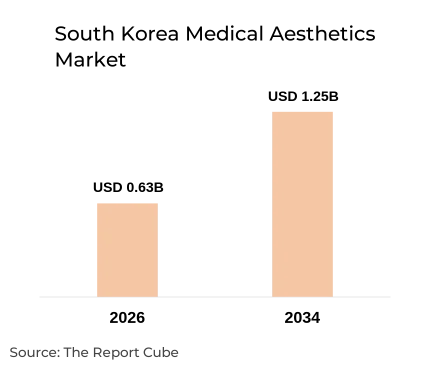
- Market valued at USD 0.63 billion in 2026, driven by expanding aesthetic procedure adoption.
- Industry projected to reach USD 1.25 billion by 2034, expanding at an 8.90% CAGR.
- Hospitals and clinics dominate end-use owing to broad procedural infrastructure and patient access.
- Facial aesthetics remains the leading product segment due to sustained injectables demand.
- South Korea commands the domestic market through globally recognized cosmetic dermatology expertise.
- Dermatology and cosmetic centers represent the fastest-growing end-use channel in the market.
- Leading companies include Allergan, Galderma, Hugel, Medytox, Revance Therapeutics, and Ipsen.
- Rising medical tourism, non-invasive technology adoption, and K-beauty influence accelerate market expansion.
South Korea Medical Aesthetics Market Insights & Analysis
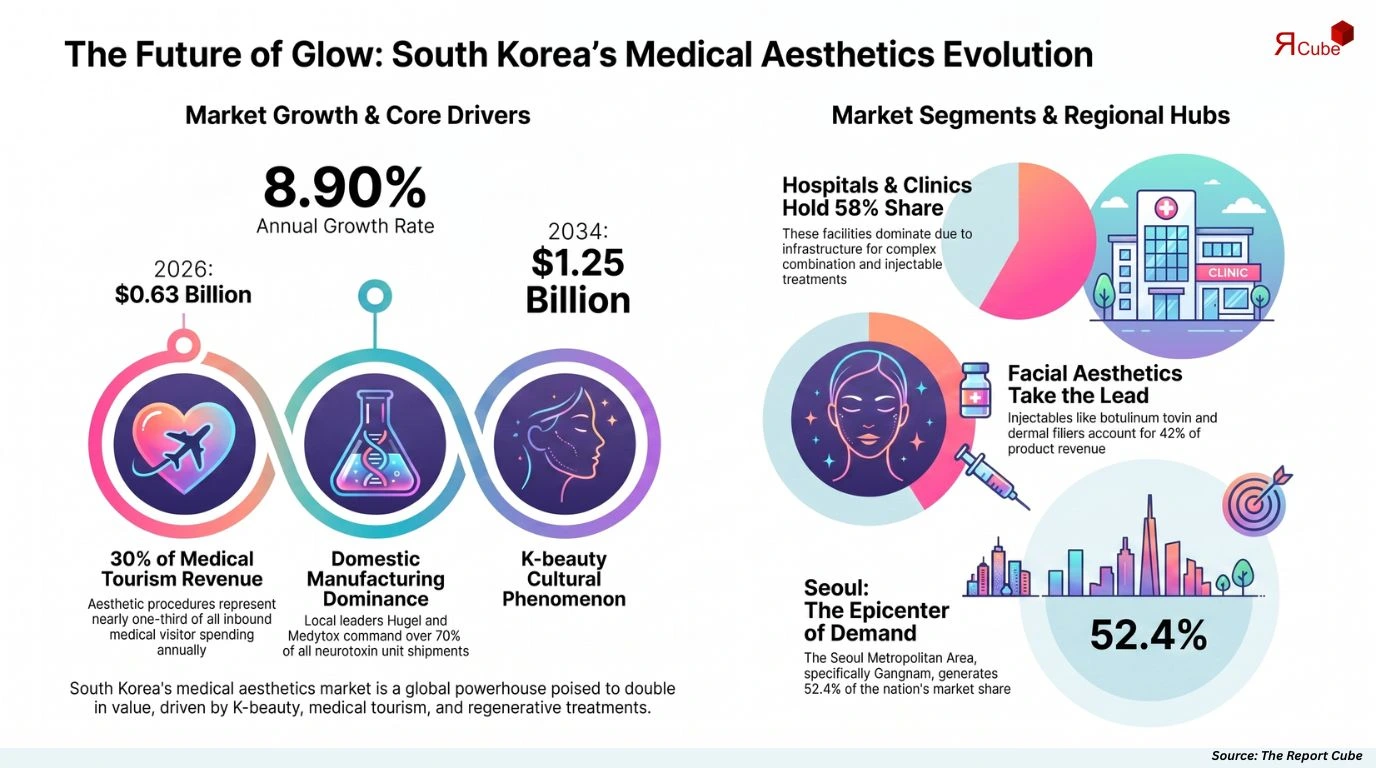
The South Korea Medical Aesthetics Market is anticipated to register an 8.90% CAGR during 2026–2034. The market size was valued at USD 0.63 billion in 2026 and is projected to reach USD 1.25 billion by 2034. Growth is underpinned by the country's globally recognized cosmetic dermatology expertise, robust domestic demand for minimally invasive procedures, and rapid expansion of medical aesthetic tourism. South Korea's Ministry of Health and Welfare has actively supported medical tourism infrastructure, with aesthetic procedures accounting for an estimated 30% of inbound medical visitor spending annually. Domestic producers including Hugel and Medytox collectively command over 70% of neurotoxin unit shipments, reinforcing South Korea's position as a globally competitive manufacturing hub.
Continued clinical innovation across injectable platforms, energy-based aesthetic devices, and regenerative skin treatments is reshaping the competitive landscape. Hugel's Letybo neurotoxin, now integrated across more than 9,000 practices internationally, exemplifies the global reach of South Korean aesthetic technologies. Government initiatives promoting K-beauty convergence with medical services, along with expanding private equity investment in aesthetic clinic chains, continue strengthening long-term market fundamentals. Rising consumer acceptance among younger demographics and a growing male aesthetics segment are creating additional demand layers that supplement the traditional anti-aging treatment base driving the South Korea Medical Aesthetics Market.
South Korea Medical Aesthetics Market Dynamics
Demand across the South Korea Medical Aesthetics Market continues accelerating as aesthetic procedures shift from niche offerings to mainstream personal care. Expanding cosmetic dermatology networks, rising disposable incomes among urban consumers, and surging medical tourism inflows are collectively supporting broader market momentum. Domestic technological leadership in neurotoxins, laser devices, and dermal fillers further strengthens the competitive ecosystem while attracting cross-border capital and partnership interest.
|
Factor |
Type |
Specific Impact on Market |
Magnitude |
|---|---|---|---|
|
Rising minimally invasive procedure demand |
Driver |
Accelerates neurotoxin and dermal filler adoption across clinics |
Very High |
|
Medical tourism expansion |
Opportunity |
Increases procedure volumes from international aesthetic patients |
High |
|
Aging population demographics |
Driver |
Boosts anti-aging treatment demand across hospital and clinic channels |
High |
|
MFDS regulatory innovation pathways |
Driver |
Compresses approval timelines for novel biostimulatory products |
High |
|
Regenerative aesthetics integration |
Trend |
Expands collagen and ECM-based injectable treatment portfolios |
High |
Key Market Driver: Medical Tourism and Inbound Patient Growth
South Korea has established itself as a leading global destination for aesthetic procedures, with Seoul's Gangnam district concentrating demand from affluent domestic consumers and medical tourists seeking premium treatments. The Korea Tourism Organization estimates aesthetic medicine accounts for a substantial proportion of the country's annual medical tourism revenue, with visitor volumes growing consistently. Government-backed medical tourism promotion campaigns, streamlined visa pathways for aesthetic travelers, and the country's internationally respected practitioner expertise continue reinforcing this structural demand driver, compelling clinics and hospitals to expand procedural capacity and upgrade treatment platforms to accommodate growing inbound patient flows.
Major Industry Challenge: Regulatory Complexity for Novel Biostimulatory Products
South Korea's Ministry of Food and Drug Safety (MFDS) maintains rigorous clinical substantiation standards for novel aesthetic injectables and energy-based devices, creating compliance complexity for manufacturers seeking accelerated market access. While MFDS approval pathways for biostimulatory fillers are progressively modernizing, companies must navigate multi-phase clinical validation requirements and post-market surveillance obligations that can extend commercialization timelines. This regulatory environment particularly challenges smaller domestic innovators seeking rapid product launches and international firms attempting to introduce next-generation technologies into the South Korean market ahead of established domestic competitors holding existing approval portfolios.
Emerging Trend Shaping Outlook: Regenerative and ECM-Based Injectable Platforms
The South Korea Medical Aesthetics Market is witnessing accelerating adoption of regenerative medicine applications including extracellular matrix (ECM)-based injectables, recombinant human collagen platforms, and biorevitalization treatments. Hugel's 2025 distribution agreement with Hans Biomed for CellREDM, an ECM-based injectable designed to reduce post-procedure downtime, reflects this broader shift toward biologics-integrated aesthetic medicine. Strategic partnerships between aesthetic companies and biotechnology firms are expanding the clinical toolkit available to South Korean practitioners, while growing consumer preference for treatments emphasizing tissue regeneration and long-term skin quality improvement over purely cosmetic outcomes is reshaping product development priorities across the competitive landscape.
Need Specific Data, Let’s Customize the Report for You
Request CustomizationSouth Korea Medical Aesthetics Market Segment-wise Analysis
South Korean aesthetic providers continue diversifying service portfolios across multiple product categories and end-use environments as consumer expectations evolve and technology platforms advance. Investment in energy-based devices, injectable biologics, and procedural dermatology infrastructure is reinforcing revenue expansion across all key market segments.
By End-Use
- Hospitals & Clinics
- Dermatology & Cosmetic Centers
- Others
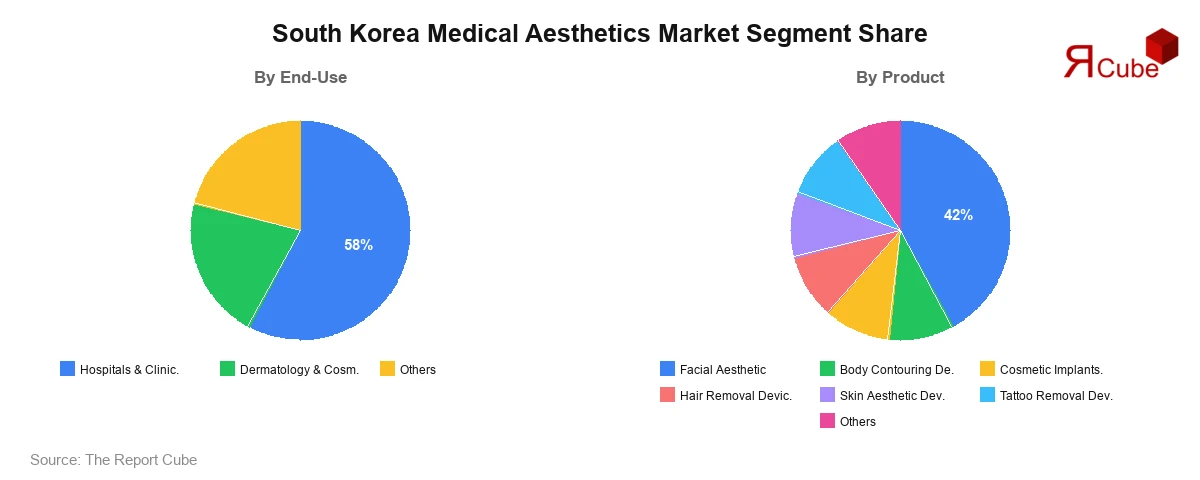
Hospitals and clinics dominate the end-use segment with an estimated 58% market share, driven by their comprehensive procedural infrastructure, multidisciplinary practitioner teams, and capacity to support complex combination aesthetic treatments involving both injectables and energy-based platforms. South Korea's densely networked hospital and clinic ecosystem, particularly concentrated in Seoul's Gangnam, Apgujeong, and Sinsa-dong districts, provides unrivaled patient access to licensed aesthetic physicians. Continued investment by hospital groups in advanced laser suites, thread-lift facilities, and injectable treatment rooms reinforces this segment's revenue leadership, supported by sustained international patient inflows seeking hospital-grade procedural safety standards unavailable in smaller clinic environments.
Dermatology and cosmetic centers represent the fastest-growing end-use channel, attracting consumers seeking physician-supervised aesthetic care with shorter appointment cycles and accessible pricing tiers compared to major hospital settings. Physician-owned dermatology chains are actively absorbing independent practices, consolidating patient bases and enabling bulk procurement of consumables and device platforms. The "Others" segment, encompassing medical spas and wellness centers, is also expanding through the growing integration of medical-grade aesthetic services with spa-like patient experiences, particularly appealing to younger demographics and male consumers seeking discreet, comfortable treatment environments across South Korea's urban centers.
By Product
- Facial Aesthetic
- Body Contouring Devices
- Cosmetic Implants
- Hair Removal Devices
- Skin Aesthetic Devices
- Tattoo Removal Devices
- Others
Facial aesthetics commands the dominant product revenue position with an estimated 42% market share, underpinned by strong and sustained demand for botulinum toxin injections, hyaluronic acid dermal fillers, biostimulatory collagen inducers, and skin-boosting biorevitalization treatments. South Korea is among the world's most competitive neuromodulator markets, with more than 15 approved botulinum toxin products competing for clinical adoption, according to Hugel market data. Domestic leaders Hugel and Medytox maintain commanding positions through extensive clinical evidence portfolios, established practitioner relationships, and cost-competitive manufacturing that continues to support premium injectable treatment accessibility across South Korean aesthetic practices.
Skin aesthetic devices represent the second most significant product category, driven by rapid innovation in fractional laser platforms, radiofrequency skin tightening, high-intensity focused ultrasound (HIFU), and photorejuvenation technologies. Domestic manufacturers including Classys and Lutronic command strong positions in energy-based device exports while simultaneously driving domestic clinic adoption. Body contouring devices are gaining momentum through expanding consumer awareness of non-surgical fat reduction and muscle toning procedures. Hair removal devices continue generating steady revenue through established laser and intense pulsed light platforms across dermatology centers. Tattoo removal devices represent an emerging opportunity segment as South Korea's younger demographics increasingly seek reversal of prior tattoo decisions through advanced picosecond laser technologies.
Regional Projection of South Korea Medical Aesthetics Market
As a country-level report, regional analysis focuses on South Korea's internal geographic distribution across major metropolitan hubs, secondary urban centers, and emerging provincial markets, reflecting variation in procedure adoption rates, clinic density, and consumer demographic profiles.
|
Region |
Estimated Market Share |
Key Growth Factors |
Consumer Trends |
|---|---|---|---|
|
Seoul Metropolitan Area |
52.4% |
High clinic density, Gangnam district premium demand, medical tourism hub |
Strong demand for premium injectables and regenerative treatments |
|
Gyeonggi Province |
18.6% |
Expanding suburban clinic networks, affluent residential consumer base |
Rising adoption of non-invasive skin aesthetic devices |
|
Busan & South Gyeongsang |
11.2% |
Secondary medical tourism gateway, growing cosmetic center expansion |
Increasing facial aesthetic and body contouring procedure demand |
|
Daegu & North Gyeongsang |
9.4% |
University hospital aesthetic department expansion, urban consumer growth |
Growing demand for dermatology-led aesthetic treatments |
|
Other Provinces |
8.4% |
Provincial aesthetic clinic growth, government rural healthcare improvement |
Emerging adoption of hair removal and tattoo removal technologies |
- Seoul Metropolitan Area: Seoul dominates the South Korea Medical Aesthetics Market with approximately 52.4% revenue share, driven by the world-renowned Gangnam district concentration of premium aesthetic clinics, hospitals offering comprehensive cosmetic procedures, and international medical tourist inflows. Gangnam alone hosts over 500 registered aesthetic clinics catering to both domestic consumers demanding cutting-edge injectable and device-based treatments and cross-border patients seeking South Korea's globally trusted cosmetic dermatology expertise at competitive price points relative to Western markets.
- Gyeonggi Province: Gyeonggi Province continues growing steadily as affluent suburban populations in cities like Seongnam, Suwon, and Goyang expand demand for accessible aesthetic services beyond central Seoul. Clinic groups are establishing satellite locations across Gyeonggi to capture this geographically proximate but underserved consumer base, with skin aesthetic devices and facial injectable treatments representing the primary growth drivers across provincial aesthetic centers.
- Busan & South Gyeongsang: Busan functions as South Korea's secondary medical aesthetic hub, attracting patients from across the southern peninsula and serving as a growing gateway for international medical tourists arriving through Gimhae International Airport. Expanding cosmetic center infrastructure and competitive pricing relative to Seoul are driving procedure volume growth across facial aesthetics and body contouring categories in this region.
- Daegu & North Gyeongsang: Daegu's established university hospital network supports a credible aesthetic medicine ecosystem, with dermatology departments expanding cosmetic procedure offerings to capture rising demand among the region's increasingly appearance-conscious urban consumer demographic. Energy-based skin treatments and dermal filler procedures are gaining adoption as practitioner training programs proliferate across Daegu's medical institutions.
- By Technology: Provincial markets including Incheon, Gwangju, Daejeon, and rural administrative areas represent an emerging growth frontier as national aesthetic clinic chains pursue geographic diversification strategies. Lower procedure costs, improving practitioner availability, and rising digital health consultation adoption are progressively lowering access barriers for aesthetic treatments across South Korea's less urbanized regions.
South Korea Medical Aesthetics Market: Recent Development (2025)
- Hugel launched Letybo neurotoxin commercially in the U.S. through strategic BENEV partnership in 2025.
- Hugel signed a distribution agreement with Hans Biomed to commercialize ECM-based CellREDM injectable.
- Hugel partnered with Jellatech advancing recombinant human collagen injectables for aesthetic skin applications.
- Galderma expanded its dermal filler and skin booster portfolio presence across South Korean aesthetic clinics.
South Korea Medical Aesthetics Market Future Outlook (2034)
The South Korea Medical Aesthetics Market is projected to expand at an 8.90% CAGR, reaching approximately USD 1.25 billion by 2034. Sustained growth will be driven by deepening consumer integration of aesthetic treatments into routine personal care, continued innovation in injectable biologics and energy-based device platforms, and expansion of South Korea's medical tourism ecosystem under government-supported K-beauty convergence initiatives. Regenerative medicine technologies including ECM-based injectables, cell-cultured collagen platforms, and exosome-based skin renewal treatments are expected to emerge as significant revenue contributors as clinical evidence bases strengthen and practitioner adoption accelerates across leading aesthetic centers.
Long-term market expansion will further be supported by demographic tailwinds, including South Korea's aging population exceeding 18% of citizens aged 65 or older, generating sustained structural demand for anti-aging injectable treatments, skin tightening procedures, and cosmetic implant applications. AI-driven aesthetic diagnostics, personalized treatment protocol optimization, and smart-device-linked procedural guidance systems will increasingly differentiate leading clinic and hospital operators. Provincial market penetration, the male aesthetics segment projected to grow at above-market rates through 2034, and home-use medical aesthetic device adoption will create additional addressable revenue layers that supplement core clinic and hospital channel growth across the South Korea Medical Aesthetics Market.
South Korea Medical Aesthetics Market Report Coverage
|
Report Attribute |
Details |
|---|---|
|
Market Name |
South Korea Medical Aesthetics Market |
|
Market Size (2026) |
USD 0.63 Billion |
|
Market Size (2034) |
USD 1.25 Billion |
|
Forecast Period |
2026–2034 |
|
CAGR |
8.90% |
|
Base Year |
2026 |
|
Historical Years |
2021–2025 |
|
Forecast Years |
2026–2034 |
|
Segments Covered |
By End-Use, By Product, By Technology |
|
Regions Covered |
Seoul Metropolitan Area, Gyeonggi Province, Busan & South Gyeongsang, Daegu & North Gyeongsang, Other Provinces |
|
Key Companies |
Allergan, Galderma, Revance Therapeutics, Medytox, Hugel, Ipsen, Sientra |
|
Report Format |
PDF, Excel, PPT |
|
Customization |
Available as per client requirements |
Why Choose This Report?
- Comprehensive analysis of South Korea's leading aesthetic procedure and product categories.
- Accurate market sizing with reliable 8.90% CAGR forecast through 2034.
- Detailed segmentation covering all key product and end-use revenue opportunities.
- Regional insights spanning Seoul, Gyeonggi, Busan, and provincial aesthetic markets.
- Competitive profiling of domestic leaders Hugel and Medytox alongside global players.
- Analysis of regenerative medicine and ECM-based injectable platform adoption trends.
- Medical tourism demand quantification supporting clinical investment and market entry decisions.
- Data-driven research aligned with MFDS regulatory frameworks and K-beauty market dynamics.
Table of Contents
- Introduction
- Objective of the Study
- Product Definition
- Market Segmentation
- Study Variables
- Research Methodology
- Secondary Data Points
- Companies Interviewed
- Primary Data Points
- Breakdown of Primary Interviews
- Secondary Data Points
- Executive Summary
- Market Dynamics
- Drivers
- Challenges
- Opportunity Assessment
- Recent Trends and Developments
- Policy and Regulatory Landscape
- South Korea Medical Aesthetics Market Overview and Forecast Analysis (2021-2034)
- Market Size, By Value, By Growth Rate (CAGR/USD Billions)
- Demand – Supply Trends
- Market Share, By End-Use
- Hospitals & Clinics
- Dermatology & Cosmetic Centers
- Others
- Market Share, By Product
- Facial Aesthetic
- Body Contouring Devices
- Cosmetic Implants
- Hair Removal Devices
- Skin Aesthetic Devices
- Tattoo Removal Devices
- Others
- Market Share, By Technology
- Invasive
- Non-Invasive
- Minimally Invasive
- Market Share, By Region
- Seoul Metropolitan Area
- Gyeonggi Province
- Busan & South Gyeongsang
- Daegu & North Gyeongsang
- Other Provinces
- Market Share, By Competitors
- Competition Characteristics
- Revenue Shares
- Hospitals & Clinics South Korea Medical Aesthetics Market Overview, 2021-2034F
- By Value (USD Million)
- By Product – Market Size & Forecast 2021-2034, USD Million
- Facial Aesthetic
- Body Contouring Devices
- Cosmetic Implants
- Hair Removal Devices
- Skin Aesthetic Devices
- Tattoo Removal Devices
- Others
- Dermatology & Cosmetic Centers South Korea Medical Aesthetics Market Overview, 2021-2034F
- By Value (USD Million)
- By Product – Market Size & Forecast 2021-2034, USD Million
- Facial Aesthetic
- Body Contouring Devices
- Cosmetic Implants
- Hair Removal Devices
- Skin Aesthetic Devices
- Tattoo Removal Devices
- Others
- Others South Korea Medical Aesthetics Market Overview, 2021-2034F
- By Value (USD Million)
- By Product – Market Size & Forecast 2021-2034, USD Million
- Facial Aesthetic
- Body Contouring Devices
- Cosmetic Implants
- Hair Removal Devices
- Skin Aesthetic Devices
- Tattoo Removal Devices
- Others
- Competitive Outlook (Company Profile – Partial List)
- Allergan
- Company Overview
- Business Segments
- Strategic Alliances/Partnerships
- Recent Developments
- Galderma
- Company Overview
- Business Segments
- Strategic Alliances/Partnerships
- Recent Developments
- Revance Therapeutics
- Company Overview
- Business Segments
- Strategic Alliances/Partnerships
- Recent Developments
- Medytox
- Company Overview
- Business Segments
- Strategic Alliances/Partnerships
- Recent Developments
- Hugel
- Company Overview
- Business Segments
- Strategic Alliances/Partnerships
- Recent Developments
- Ipsen
- Company Overview
- Business Segments
- Strategic Alliances/Partnerships
- Recent Developments
- Medytox
- Company Overview
- Business Segments
- Strategic Alliances/Partnerships
- Recent Developments
- Sientra
- Company Overview
- Business Segments
- Strategic Alliances/Partnerships
- Recent Developments
- Others
- Allergan
- Contact Us & Disclaimer
Top Key Players & Market Share Outlook
- Allergan
- Galderma
- Revance Therapeutics
- Medytox
- Hugel
- Ipsen
- Medytox
- Sientra
- Others
Frequently Asked Questions






