



Build Your Custom Market Intelligence Report
Customize Your ReportGlobal Medical Batteries Market Key Highlights
By Battery Type:
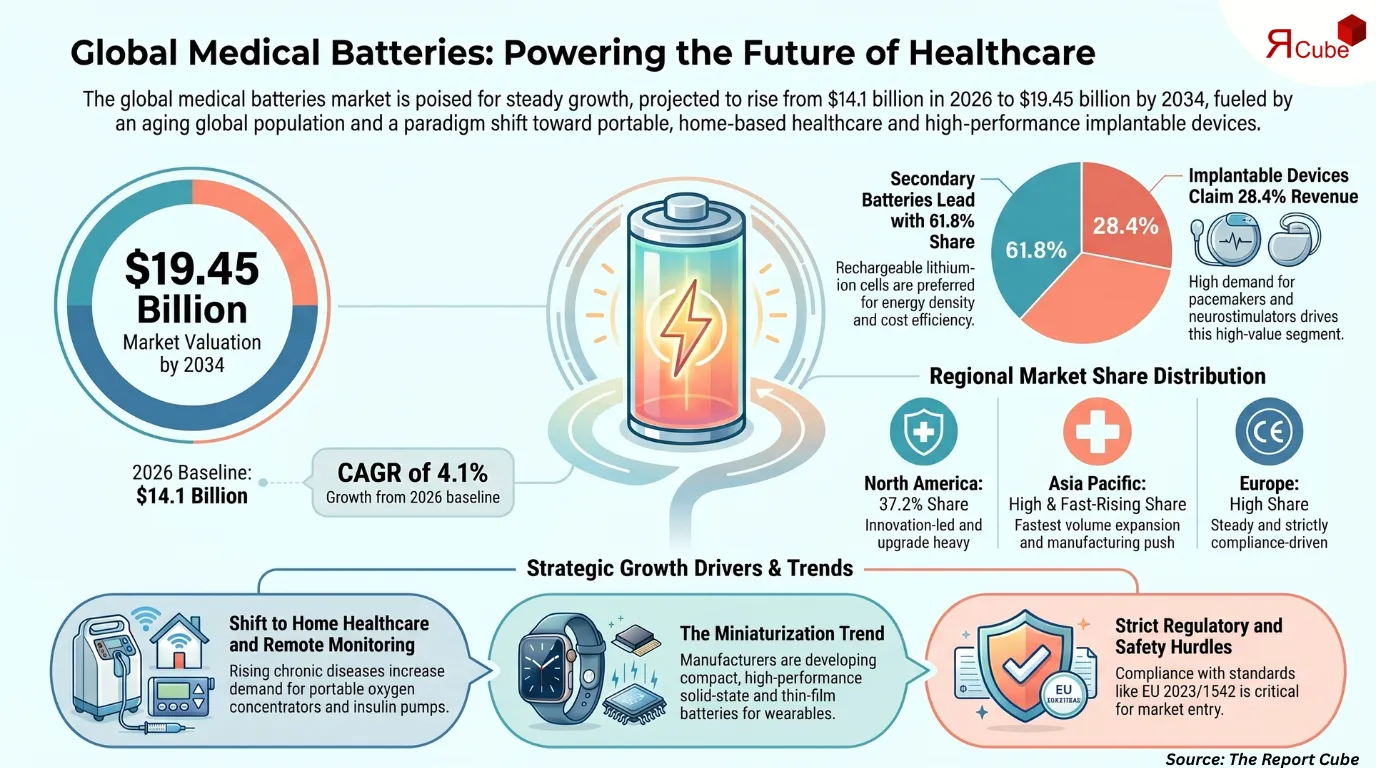
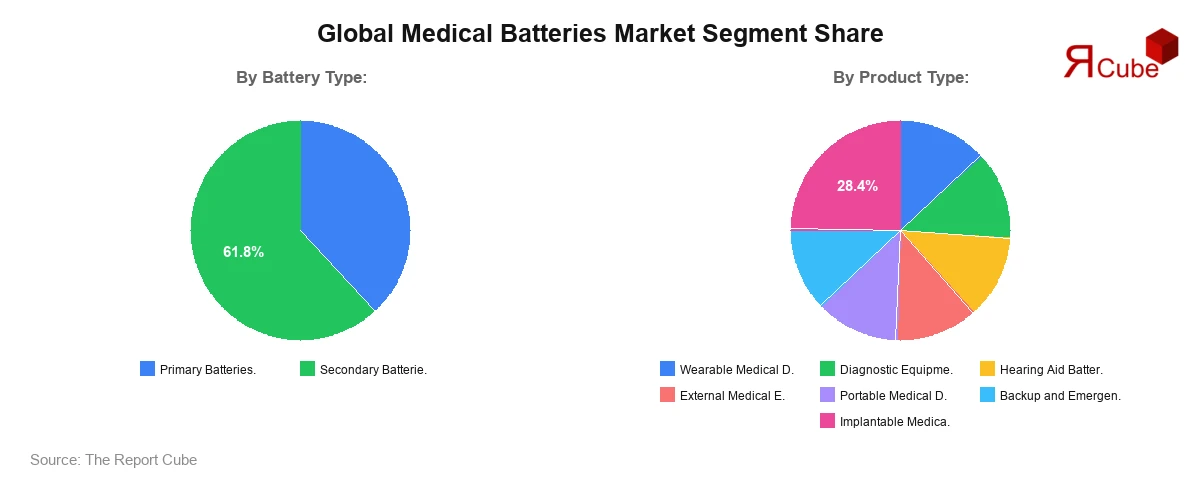
Secondary Batteries segment leads the market with approximately 61.8% share.
By Product Type:
Implantable Medical Batteries segment dominates the market with nearly 28.4% of total revenue.
Regional Outlook:
North America dominates the Global Medical Batteries Market with around 37.2% share.
Global Medical Batteries Market Insights & Analysis
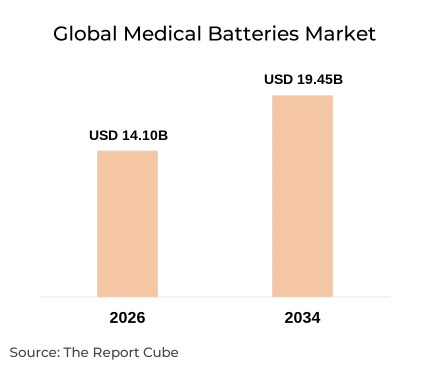
The Global Medical Batteries Market is anticipated to register a CAGR of around 4.1% during the forecast period 2026-2034. The market size is valued at USD 14.1 billion in 2026 and is projected to reach USD 19.45 billion by 2034. the growth of market driven by the increasing use of portable healthcare devices, the rapid expansion of home healthcare services, and the growing need for battery-powered diagnostic and monitoring equipment. As healthcare providers continue to invest in mobile and connected medical solutions, demand is rising for advanced rechargeable batteries that offer longer operating life, greater reliability, and enhanced safety. The shift toward patient-centric care, particularly remote monitoring and at-home treatment, is further strengthening the need for dependable power sources across a wide range of medical applications.
Technological advancements are also transforming the competitive landscape of the medical batteries industry. Manufacturers are developing compact and high-performance battery technologies, including lithium-ion, lithium-carbon monofluoride, and emerging solid-state solutions, to meet the requirements of modern implantable devices, wearable health trackers, neurostimulation systems, and hearing aids. Rising healthcare spending in both developed and developing regions is encouraging wider adoption of battery-operated infusion pumps, portable ultrasound systems, and emergency medical equipment. At the same time, companies are investing in sophisticated battery management systems, improved thermal safety mechanisms, and environmentally responsible recycling programs. With regulatory bodies placing greater emphasis on device reliability and patient safety, medical device manufacturers are increasingly choosing premium battery technologies that can deliver stable, consistent performance in critical healthcare settings.
Global Medical Batteries Market Impact Analysis
| Factor | Type | Specific Impact on Market | Magnitude | Business Implication |
|---|---|---|---|---|
| Rising Chronic Disease Burden | Market | More cardiac, diabetic and critical patients use battery devices | High | Supports sustained growth in implantable and monitoring battery demand |
| Aging Global Population | Consumer | Older patients need long term powered therapy and monitoring tools | High | Drives volume for reliable long life batteries across care settings |
| Growth in Wearable and Portable Devices | Technological | Increases use of compact high density batteries in wearables | High | Creates need for miniaturized cells with strong safety and cycle life |
| Shift to Lithium Ion and Rechargeable Chemistries | Technological | Enables longer runtime and smaller size for advanced devices | Medium | Firms must upgrade portfolios and processes to newer chemistries |
| Safety and Reliability Concerns | Regulatory | Thermal and leakage risks trigger strict safety compliance needs | High | Requires strong design controls and testing to secure approvals |
| Home Healthcare and Remote Monitoring Rise | Market | More devices used at home increase distributed battery usage | Medium | Opens growth in high reliability batteries for home care kits |
| Regional Manufacturing and Supply Constraints | Environmental | Trade shifts and material tariffs affect battery input costs | Medium | Encourages localized production and diversified sourcing plans |
Global Medical Batteries Market Dynamics
Key Driver: Rising Demand for Portable and Home Healthcare Devices
The transition from traditional hospital-based care to home-centered and remote healthcare models is playing a pivotal role in accelerating the growth of the medical batteries market. As global populations age and the incidence of chronic illnesses such as diabetes, cardiovascular disorders, and respiratory diseases continues to increase, healthcare providers are investing heavily in portable medical technologies that support continuous patient monitoring and treatment outside clinical settings. Devices such as portable oxygen concentrators, insulin pumps, wearable biosensors, infusion pumps, and cardiac monitoring systems rely on dependable battery solutions to ensure uninterrupted performance. Battery-powered medical equipment not only enhances patient convenience and mobility but also helps reduce hospital visits, lowering overall healthcare expenditures.
The demand for rechargeable lithium-ion batteries is particularly strong due to their high energy density, lightweight design, and extended operating life. In parallel, the widespread adoption of wearable healthcare devices and the growing acceptance of home healthcare services across North America, Europe, and the Asia-Pacific region are creating long-term growth opportunities for manufacturers focused on reliable and high-performance medical battery technologies.
Industry Trends: Miniaturization and Advanced Battery Technologies
A key trend shaping the medical batteries market is the increasing emphasis on miniaturization combined with enhanced energy efficiency. Medical device manufacturers are developing smaller, more sophisticated products that require compact batteries capable of delivering greater power without increasing device size or weight. This trend is especially evident in implantable medical devices such as pacemakers, neurostimulators, cochlear implants, and advanced drug delivery systems, where battery performance directly influences device longevity and patient outcomes. As a result, innovation in battery chemistry and design has become a major area of focus across the healthcare technology sector.
Research and development efforts are accelerating in areas such as solid-state batteries, thin-film batteries, flexible battery technologies, and next-generation lithium-based solutions. In addition, manufacturers are integrating advanced battery management systems (BMS) that enable real-time monitoring, predictive maintenance, and optimized performance. Another notable development is the adoption of modular battery configurations in portable diagnostic systems and medical carts, allowing healthcare facilities to improve operational efficiency, simplify maintenance, and minimize equipment downtime.
Book your FREE 30-minute expert consultation today
Contact UsMajor Challenge: Regulatory Compliance and Product Reliability Requirements
Ensuring compliance with stringent regulatory standards remains one of the most significant challenges facing the medical batteries market. Because battery performance is directly linked to patient safety and the reliability of medical devices, manufacturers must adhere to rigorous testing, validation, certification, and transportation requirements before products can enter the healthcare ecosystem. Meeting these regulatory expectations often requires substantial investments in quality assurance, product development, and documentation processes, which can increase production costs and prolong commercialization timelines. Furthermore, any battery-related failure, including overheating, leakage, reduced capacity, or unexpected malfunction, can have serious consequences for both patient safety and manufacturer reputation.
The industry also faces ongoing supply chain pressures related to the sourcing of critical raw materials such as lithium, nickel, and other specialty metals. Balancing product reliability, regulatory compliance, and cost efficiency while adapting to evolving safety standards continues to be a complex challenge for stakeholders across the medical batteries market.
Opportunity: Expansion of Implantable and Digital Health Technologies
The rapid advancement of digital healthcare and connected medical technologies is creating substantial opportunities for medical battery manufacturers. Increasing adoption of implantable cardiac devices, neurostimulation therapies, hearing implants, and remote patient monitoring systems is driving demand for highly specialized batteries that offer exceptional reliability, long operational life, and consistent performance. Healthcare digitalization initiatives across developed and emerging economies are accelerating the deployment of connected medical devices capable of providing continuous health monitoring and real-time data transmission. These innovations require advanced power solutions that can support uninterrupted functionality while maintaining patient comfort and device portability.
Emerging technologies such as wireless charging systems, biocompatible batteries, energy-harvesting solutions, and next-generation solid-state batteries are expected to unlock new growth avenues for industry participants. As healthcare providers increasingly focus on patient mobility, personalized care, and remote monitoring capabilities, manufacturers offering innovative and dependable battery technologies are positioned to benefit from expanding long-term opportunities within the medical batteries market.
Global Medical Batteries Market Segment-wise Analysis
By Battery Type:
- Primary Batteries
- Secondary Batteries
Secondary batteries hold the largest share of the global medical batteries market, accounting for nearly 61.8% of total revenue. Their market leadership is driven by the growing reliance on portable and battery-powered medical technologies, including patient monitoring systems, mobile diagnostic devices, medical carts, infusion pumps, and wearable healthcare equipment. Among rechargeable battery technologies, lithium-ion batteries have emerged as the preferred solution for healthcare providers due to their high energy density, extended service life, lightweight design, and cost efficiency over the long term. Compared with disposable alternatives, rechargeable batteries help reduce replacement frequency, lower maintenance requirements, and support operational continuity in critical healthcare environments.
The increasing focus on sustainability and waste reduction is also encouraging hospitals and healthcare facilities to transition toward rechargeable power systems. This shift aligns with broader environmental goals while helping organizations optimize lifecycle costs and resource utilization. Additionally, the rapid expansion of home healthcare services, remote patient monitoring, and connected wearable medical devices continues to create significant demand for advanced secondary battery solutions. Ongoing innovations in charging technology, thermal management systems, battery safety, and cycle-life performance are further enhancing reliability and supporting wider adoption across diverse medical applications. These advantages position secondary batteries as a critical power source for the next generation of healthcare technologies.
By Product Type:
- Wearable Medical Device Batteries
- Diagnostic Equipment Batteries
- Hearing Aid Batteries
- External Medical Equipment Batteries
- Portable Medical Device Batteries
- Backup and Emergency Power Batteries
- Implantable Medical Batteries
Implantable medical batteries continue to dominate the market, accounting for an estimated 28.4% share of total revenue. This strong position is largely driven by the growing incidence of cardiovascular diseases, neurological disorders, and hearing-related conditions worldwide, all of which have increased the adoption of implantable medical devices. Critical healthcare technologies such as pacemakers, implantable cardioverter defibrillators (ICDs), neurostimulators, and cochlear implants depend on highly dependable battery systems that can deliver consistent performance over extended periods without the need for frequent replacement procedures.
Advancements in lithium-based battery technologies have significantly enhanced energy density, operational lifespan, and device miniaturization, enabling manufacturers to develop smaller yet more powerful implantable solutions. From a clinical perspective, healthcare professionals increasingly favor implantable devices because they help minimize repeat surgeries, lower complication risks, and improve long-term patient outcomes. As healthcare systems continue to prioritize durable and patient-centric treatment approaches, demand for advanced implantable medical batteries is expected to remain strong, reinforcing the segment’s leadership position in the market.
Regional Projection of Global Medical Batteries Industry
- North America
- Europe
- Asia Pacific
- Middle East and Africa
- South America
North America continues to lead the global medical batteries market, representing nearly 37.2% of total revenue. The region's dominance is supported by a highly developed healthcare ecosystem, significant investments in medical technologies, and widespread adoption of battery-powered healthcare equipment across hospitals, clinics, and home-care settings. The United States remains the primary growth engine, driven by substantial healthcare expenditure, increasing demand for implantable medical devices, and the expanding use of remote patient monitoring solutions.
Market growth is further reinforced by the rising incidence of chronic health conditions, including cardiovascular disorders and diabetes, alongside a rapidly aging population that requires continuous and portable healthcare support. These demographic and healthcare trends are accelerating demand for wearable medical devices, portable diagnostic equipment, and advanced patient monitoring systems.
Another key advantage for the region is the strong presence of established medical device manufacturers and battery technology innovators, which fosters continuous product development and technological advancement. As healthcare providers increasingly integrate digital health platforms, smart implantable devices, and mobile hospital technologies into patient care, demand for reliable and high-performance medical batteries is expected to remain strong. Supported by ongoing innovation and favorable healthcare investments, North America is projected to maintain its leadership position in the global market throughout the forecast period.
Need insights for a specific region within this market?
Request Regional DataGlobal Medical Batteries Market Regional Analysis
The global medical batteries market shows varied growth by region, shaped by healthcare maturity, device adoption, and manufacturing depth.
| Region | Demand Level | Key Areas | System Dominance | Core Demand Logic | Growth Nature |
|---|---|---|---|---|---|
| North America | Very High | U.S., Canada hubs | Li-ion & advanced rechargeables | High device density and aging base | Innovation-led, upgrade heavy |
| Europe | High | Germany, U.K., France | Li-ion, NiMH, regulated packs | Strict safety and EU battery rules | Steady compliance-driven |
| Asia Pacific | High & Fast-rising | China, Japan, India | Li-ion, OEM-integrated packs | Device manufacturing and access push | Fastest volume expansion |
| Middle East & Africa | Moderate | GCC cities, South Africa | Primary and basic rechargeables | Hospital build-out and imports | Gradual, project-led |
| South America | Moderate | Brazil, Mexico, Argentina | Mix of primary and Li-ion | Public tenders and private clinics | Price-sensitive, improving |
Government Initiatives & Policies
- European Union Batteries Regulation (EU 2023/1542): The European Commission continues implementing battery sustainability, safety, recycling, traceability, and labeling requirements through 2025-2026. These measures directly influence medical battery manufacturing and lifecycle management.
- European Commission Battery Removability and Replaceability Consultation (2026): The Commission advanced implementation requirements governing battery removability and replacement across battery-powered products, including specific considerations applicable to certain medical devices and healthcare equipment.
Global Medical Batteries Industry Recent Developments
- 2026: RRC Power Solutions GmbH launched the POWERPAQ RRC3570-4 battery platform designed for medical and industrial applications. The product strengthens the company's position in patient monitoring carts, mobile healthcare workstations, and portable medical equipment requiring dependable power performance.
- 2026: Integer Holdings Corporation showcased advancements in neuromodulation and miniaturized active implantable device technologies at NANS 2026. The development highlights increasing demand for compact, long-life implantable battery systems supporting next-generation healthcare applications.
- 2026: Ultralife Corporation announced its participation at HIMSS 2026, featuring three-second hot-swap power solutions for medical carts. The innovation addresses healthcare providers' need for uninterrupted mobile workstation operation and enhanced clinical workflow efficiency.
- 2025: Ultralife Corporation expanded market positioning of its X5 Power System beyond traditional medical carts into broader mission-critical applications. The strategy reflects growing demand for modular, scalable, and hot-swappable battery architectures.
- 2025: Maxell, Ltd. strengthened its compact battery portfolio through the transfer of Murata's micro primary battery business. The acquisition enhances Maxell's presence in medical wearables, hearing aids, and compact healthcare electronics.
Why Choose This Report?
- Provides a comprehensive overview of the overall market analysis, encompassing key trends, consumer behavior analysis, and risk assessment to support strategic decision-making.
- Provides accurate, up-to-date insights into market size, segmentation, and emerging opportunities, helping to minimize risk and capitalizing on growth.
- Gives deep understanding of target audience preferences, investment habits, and communication channels for enhanced product development and marketing effectiveness.
- Delivers competitive analysis and benchmarking, uncovering the strengths and weaknesses of market competitors to guide strategies.
- Consolidates comprehensive market intelligence, reducing research complexity and streamlining decision-making efforts.
- Facilitates customized market segmentation and risk mitigation strategies, fine-tuned to business objectives.
- Aids in identifying both market challenges and untapped opportunities within the industry to drive long-term business growth.
- Provides valuable information based on actual customer data and evolving search trends.
Table of Contents
- Introduction
- Objective of the Study
- Product and Category Definition
- Market Segmentation
- Study Variables
- Research Methodology
- Secondary Data Points
- Breakdown of Secondary Sources
- Primary Data Points
- Breakdown of Primary Interviews
- Secondary Data Points
- Executive Summary
- Market Dynamics
- Emerging Opportunities
- Adoption Trends
- Demand Drivers
- Disruption Analysis (Challenges)
- Industry Analysis & Strategic Insights
- Supply/Value Chain Analysis
- Pricing Analysis
- Go-To-Market (GTM) Strategy
- BCG Matrix
- Recent Trends and Developments
- Import and Export Analysis
- Regulatory and Policy Landscape
- Region-wise Policies
- Government Initiatives
- Global Medical Batteries Market Overview and Forecast Analysis (2021-2034)
- Market Size, By Value, By Growth Rate (CAGR/USD Billion)
- Market Share, By Battery Chemistry
- Lithium-Based Batteries
- Lithium-Ion Batteries
- Lithium-Polymer Batteries
- Lithium-Thionyl Chloride Batteries
- Lithium-Manganese Dioxide Batteries
- Lithium-Iodine Batteries
- Lithium-Carbon Monofluoride Batteries
- Nickel-Based Batteries
- Nickel-Cadmium Batteries
- Nickel-Metal Hydride Batteries
- Silver-Based Batteries
- Silver Oxide Batteries
- Lead-Based Batteries
- Sealed Lead-Acid Batteries
- Valve-Regulated Lead-Acid Batteries
- Zinc-Based Batteries
- Zinc-Air Batteries
- Zinc-Manganese Dioxide Batteries
- Alkaline Batteries
- Others
- Lithium-Based Batteries
- Market Share, By Battery Type
- Primary Batteries
- Secondary Batteries
- Market Share, By Product Type
- Wearable Medical Device Batteries
- Diagnostic Equipment Batteries
- Hearing Aid Batteries
- External Medical Equipment Batteries
- Portable Medical Device Batteries
- Backup and Emergency Power Batteries
- Implantable Medical Batteries
- Market Share, By Battery Form Factor
- Pouch Cells
- Prismatic Cells
- Coin Cells
- Flexible Cells
- Button Cells
- Modular Battery Packs
- Thin-Film Cells
- Cylindrical Cells
- Custom Battery Packs
- Others
- Market Share, By Application / Use Cases
- Respiratory Care Devices
- CPAP Devices
- Portable Ventilators
- BiPAP Devices
- Oxygen Concentrators
- Drug Delivery Devices
- Insulin Pumps
- Infusion Pumps
- Ambulatory Drug Delivery Pumps
- Patient Monitoring Devices
- Blood Pressure Monitors
- Pulse Oximeters
- Portable ECG Monitors
- Glucose Monitoring Devices
- Multi-Parameter Monitors
- Hearing Care Devices
- Cochlear Implants
- Hearing Aids
- Neurostimulation Devices
- Vagus Nerve Stimulators
- Sacral Nerve Stimulators
- Deep Brain Stimulators
- Spinal Cord Stimulators
- Surgical and Emergency Care Devices
- Defibrillators
- Emergency Medical Equipment
- Surgical Power Tools
- Medical Carts and Mobile Workstations
- Mobile Diagnostic Workstations
- Procedure Carts
- Emergency Carts
- Medication Carts
- Powered Medical Carts
- Anesthesia Carts
- Mobile Computer Workstations
- Diagnostic and Imaging Devices
- Endoscopy Devices
- Portable Ultrasound Systems
- Diagnostic Testing Devices
- Home Healthcare and Wearable Devices
- Smart Medical Patches
- Connected Health Wearables
- Remote Patient Monitoring Devices
- Implantable Cardiac Devices
- Cardiac Resynchronization Therapy Devices
- Pacemakers
- Implantable Cardioverter Defibrillators
- Respiratory Care Devices
- Market Share, By End-User
- Hospitals and Clinics
- Diagnostic Centers
- Ambulatory Surgical Centers
- Home Healthcare Providers
- Retail and Hearing Care Centers
- Emergency Medical Services
- Medical Device OEMs
- Long-Term Care Facilities
- Others
- Market Share, By Sales Channel
- Direct Sales
- Online Sales
- Distributor Sales
- Aftermarket and Replacement Sales
- Others
- Market Share, By Region
- North America
- Europe
- Asia Pacific
- Middle East and Africa
- South America
- Market Share, By Company
- Revenue Shares and Analysis
- Competitive Landscape
- North America Medical Batteries Market Overview and Forecast Analysis (2021-2034)
- Market Size, By Value, By Growth Rate (CAGR/USD Billion/Million)
- Market Share, By Battery Chemistry
- Market Share, By Battery Type
- Market Share, By Product Type
- Market Share, By Battery Form Factor
- Market Share, By Application / Use Cases
- Market Share, By End-User
- Market Share, By Sales Channel
- Market Share, By Country
- The United States
- Canada
- Mexico
- Rest of North America
- Europe Medical Batteries Market Overview and Forecast Analysis (2021-2034)
- Market Size, By Value, By Growth Rate (CAGR/USD Billion/Million)
- Market Share, By Battery Chemistry
- Market Share, By Battery Type
- Market Share, By Product Type
- Market Share, By Battery Form Factor
- Market Share, By Application / Use Cases
- Market Share, By End-User
- Market Share, By Sales Channel
- Market Share, By Country
- Germany
- The United Kingdom
- France
- Italy
- Spain
- Netherlands
- Russia
- Poland
- Belgium
- Sweden
- Rest of Europe
- Asia Pacific Medical Batteries Market Overview and Forecast Analysis (2021-2034)
- Market Size, By Value, By Growth Rate (CAGR/USD Billion/Million)
- Market Share, By Battery Chemistry
- Market Share, By Battery Type
- Market Share, By Product Type
- Market Share, By Battery Form Factor
- Market Share, By Application / Use Cases
- Market Share, By End-User
- Market Share, By Sales Channel
- Market Share, By Country
- China
- India
- Japan
- South Korea
- Australia
- Indonesia
- Thailand
- Malaysia
- Vietnam
- Philippines
- Singapore
- New Zealand
- Rest of Asia Pacific
- Middle East and Africa Medical Batteries Market Overview and Forecast Analysis (2021-2034)
- Market Size, By Value, By Growth Rate (CAGR/USD Billion/Million)
- Market Share, By Battery Chemistry
- Market Share, By Battery Type
- Market Share, By Product Type
- Market Share, By Battery Form Factor
- Market Share, By Application / Use Cases
- Market Share, By End-User
- Market Share, By Sales Channel
- Market Share, By Country
- Saudi Arabia
- The United Arab Emirates
- South Africa
- Egypt
- Nigeria
- Morocco
- Turkey
- Rest of the Middle East and Africa
- South America Medical Batteries Market Overview and Forecast Analysis (2021-2034)
- Market Size, By Value, By Growth Rate (CAGR/USD Billion/Million)
- Market Share, By Battery Chemistry
- Market Share, By Battery Type
- Market Share, By Product Type
- Market Share, By Battery Form Factor
- Market Share, By Application / Use Cases
- Market Share, By End-User
- Market Share, By Sales Channel
- Market Share, By Country
- Brazil
- Argentina
- Chile
- Colombia
- Peru
- Rest of South America
- Competitive Analysis, 2026
- Market Share of Key Players
- Competitive Mapping for Each Segment and Companies Operating Regionally
- North America Medical Batteries Companies Share and Competitive Analysis, 2026
- Europe Medical Batteries Companies Share and Competitive Analysis, 2026
- Asia Pacific Medical Batteries Companies Share and Competitive Analysis, 2026
- Middle East and Africa Medical Batteries Companies Share and Competitive Analysis, 2026
- South America Medical Batteries Companies Share and Competitive Analysis, 2026
- Company Profile (Partial List)
- Ultralife Corporation
- Company Overview
- Product Portfolio
- Strategic Alliances/Partnerships
- Recent Developments
- Duracell Inc.
- Company Overview
- Product Portfolio
- Strategic Alliances/Partnerships
- Recent Developments
- RRC Power Solutions GmbH
- Company Overview
- Product Portfolio
- Strategic Alliances/Partnerships
- Recent Developments
- Inventus Power
- Company Overview
- Product Portfolio
- Strategic Alliances/Partnerships
- Recent Developments
- Maxell, Ltd.
- Company Overview
- Product Portfolio
- Strategic Alliances/Partnerships
- Recent Developments
- Saft Groupe SAS
- Company Overview
- Product Portfolio
- Strategic Alliances/Partnerships
- Recent Developments
- Panasonic Energy Co., Ltd.
- Company Overview
- Product Portfolio
- Strategic Alliances/Partnerships
- Recent Developments
- VARTA AG
- Company Overview
- Product Portfolio
- Strategic Alliances/Partnerships
- Recent Developments
- EnerSys
- Company Overview
- Product Portfolio
- Strategic Alliances/Partnerships
- Recent Developments
- Renata SA
- Company Overview
- Product Portfolio
- Strategic Alliances/Partnerships
- Recent Developments
- Tadiran Batteries
- Company Overview
- Product Portfolio
- Strategic Alliances/Partnerships
- Recent Developments
- Integer Holdings Corporation
- Company Overview
- Product Portfolio
- Strategic Alliances/Partnerships
- Recent Developments
- Accutronics Ltd
- Company Overview
- Product Portfolio
- Strategic Alliances/Partnerships
- Recent Developments
- Energizer Holdings, Inc.
- Company Overview
- Product Portfolio
- Strategic Alliances/Partnerships
- Recent Developments
- Resonetics
- Company Overview
- Product Portfolio
- Strategic Alliances/Partnerships
- Recent Developments
- Others (Partial List)
- Ultralife Corporation
- Contact Us and Disclaimer
Top Key Players & Market Share Outlook
- Ultralife Corporation
- Duracell Inc.
- RRC Power Solutions GmbH
- Inventus Power
- Maxell, Ltd.
- Saft Groupe SAS
- Panasonic Energy Co., Ltd.
- VARTA AG
- EnerSys
- Renata SA
- Tadiran Batteries
- Integer Holdings Corporation
- Accutronics Ltd
- Energizer Holdings, Inc.
- Resonetics
Frequently Asked Questions






