



Build Your Custom Market Intelligence Report
Customize Your ReportNorth America Medical Simulation Market Key Highlights
By Product & Services:
Patient simulators segment leads the market, accounting for nearly 34% of total revenue.
By Application:
Medical training dominates the market, representing around 38% share.
Regional Outlook:
The United States dominates the North America Medical Simulation Market with approximately 72% share.
Government Initiatives & Policies
- U.S. Agency for Healthcare Research and Quality (AHRQ) Patient Safety Programs: Federal initiatives promoting simulation-based training to reduce medical errors and improve clinical outcomes.
- Health Canada Simulation-Based Education Support: Supports integration of simulation into clinical training and continuing professional education.
North America Medical Simulation Market Insights & Analysis
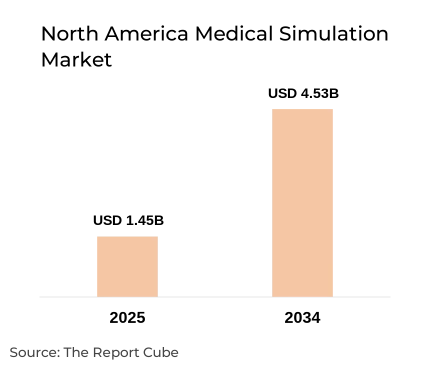
The North America Medical Simulation Market is anticipated to register a CAGR of 13.5% during 2026-2034. The market size was valued at USD 1.45 billion in 2025 and is projected to reach USD 4.53 billion by 2034. Medical simulation has become a foundational component of modern healthcare education, enabling risk-free clinical training, standardized skill assessment, and improved patient safety outcomes across healthcare systems.
Investment in simulation infrastructure across North America has intensified as healthcare systems respond to workforce shortages, increasing procedural complexity, and stricter patient safety mandates. Between 2021 and 2025, simulation-related capital expenditure by teaching hospitals increased by over 60%, reflecting a structural shift toward experiential learning. Simulation technologies now span high-fidelity mannequins, virtual reality environments, and AI-enabled scenario platforms that replicate real-world clinical stressors. Regulatory bodies and accreditation organizations increasingly mandate simulation hours within medical, nursing, and allied health curricula. This institutional validation has transformed simulation from an auxiliary tool into a core educational requirement, driving long-term, recurring demand across academic, clinical, and defense healthcare segments.
North America Medical Simulation Market Dynamics
Key Driver: Rising Focus on Patient Safety and Competency-Based Training
Growing emphasis on patient safety and measurable clinical competency is a primary growth driver for the North America Medical Simulation Market. Medical errors remain one of the leading causes of adverse healthcare outcomes, prompting hospitals and regulators to prioritize structured, repeatable training methods. Simulation-based education enables clinicians to practice rare, high-risk scenarios without patient exposure, improving procedural confidence and decision-making accuracy. Studies across North American teaching hospitals indicate simulation-trained clinicians demonstrate up to 29% lower error rates during complex procedures. Additionally, competency-based education frameworks require objective performance assessment, which simulation platforms deliver through data-driven analytics and standardized evaluation metrics. As healthcare systems shift from time-based to outcome-based training models, simulation adoption continues to accelerate across disciplines.
Book your FREE 30-minute expert consultation today
Contact UsIndustry Trend: Rapid Adoption of VR, AR, and Hybrid Simulation Models
The market is witnessing a strong transition toward immersive technologies such as virtual reality, augmented reality, and hybrid simulation environments. VR-based medical simulation adoption grew by nearly 48% between 2022 and 2025, driven by declining hardware costs and improved realism. These technologies enable scalable, remote training without physical lab constraints, addressing faculty shortages and geographic limitations. Hybrid simulation, combining physical mannequins with digital overlays, is gaining traction in surgical and emergency care training. Simulation software platforms now integrate learning management systems, real-time performance feedback, and multiplayer collaboration. This convergence of digital and physical simulation enhances learner engagement while reducing long-term operational costs for institutions.
Major Challenge: High Initial Capital Investment and Maintenance Costs
High upfront costs associated with advanced simulation systems remain a key challenge for market expansion. High-fidelity simulators, VR platforms, and integrated simulation labs require substantial capital investment, often exceeding USD 500,000 for comprehensive setups. Ongoing maintenance, software licensing, and faculty training add to total ownership costs. Smaller hospitals, community colleges, and ambulatory centers face budgetary constraints that limit adoption. Additionally, rapid technological evolution can shorten product lifecycles, creating concerns around obsolescence. While long-term benefits are well recognized, financial barriers continue to slow penetration in cost-sensitive segments of the healthcare ecosystem.
Opportunity: Expansion of Simulation in Continuing Education and Defense Healthcare
Expanding use of medical simulation beyond traditional education settings presents significant growth opportunities. Continuing medical education programs increasingly incorporate simulation to support skill refreshment and credentialing compliance. Military and defense organizations are also investing heavily in simulation to train combat medics and trauma teams under realistic conditions. Simulation-based disaster preparedness and mass casualty training programs are gaining institutional funding across North America. Furthermore, growing adoption of remote and cloud-based simulation platforms enables scalable deployment across distributed healthcare networks. These developments broaden the addressable market and create recurring revenue streams for solution providers.
North America Medical Simulation Market Segment-wise Analysis
By Product & Services:
- Healthcare Anatomical Models
- Interventional & Surgical Simulators
- Patient Simulators
- Task Trainers
- Web-based Simulation
- Simulation Software
- Simulation Training Services
- Others
Patient simulators lead the market with approximately 34% share in 2025, supported by widespread adoption across nursing, medical, and emergency response training programs. These systems replicate realistic physiological responses, enabling learners to practice diagnosis, intervention, and team-based care. Demand is particularly strong for high-fidelity trauma and critical care simulators, which improve clinical readiness and interdisciplinary coordination. Continuous upgrades in realism, sensor integration, and wireless connectivity reinforce this segment’s leadership.
By Application:
- Medical Training
- Surgical Training
- Emergency Care Training
- Patient Safety Training
- Education & Assessment
- Others
Medical training remains the largest application segment, accounting for nearly 38% of total market revenue. Expansion of medical schools, nursing programs, and allied health education drives sustained demand. Simulation-based assessment tools support standardized testing and accreditation compliance, making them indispensable to modern curricula. Growing enrollment in healthcare programs across the U.S. and Canada continues to strengthen this segment.
Regional Projection of North America Medical Simulation Industry
- United States
- Canada
- Mexico
The United States dominates the regional market with approximately 72% share, supported by strong funding, advanced academic institutions, and early adoption of innovative training technologies. Canada follows with steady growth driven by public healthcare investments and national training standards. Mexico represents an emerging growth market, supported by expanding private healthcare education and increasing adoption of cost-effective simulation solutions.
North America Medical Simulation Market Recent Developments
- January 2025: Laerdal Medical announced an exclusive global distribution agreement with Magic Ultrasound, expanding access to advanced ultrasound simulation and strengthening hands-on diagnostic training capabilities.
- June 2025: SimX released “SimX 2025 Release 1,” introducing enhanced VR safety features, multilingual support, and advanced burn care simulation tools to improve immersive medical training.
- 2025: SonoSim expanded its SonoSim Wave educational series, highlighting advancements in women’s health, abdominal ultrasound, and critical care ultrasound-guided procedures.
- 2025: At IMSH 2025, Gaumard Scientific showcased advanced high-fidelity trauma and multidisciplinary patient simulators emphasizing in situ and critical care training realism.
- 2025: Anatomage continued upgrading its 3D virtual cadaver platform, improving anatomical accuracy and procedural simulation to support advanced digital anatomy education.
Need insights for a specific region within this market?
Request Regional DataWhy Choose This Report?
- Provides a comprehensive overview of the overall market analysis, encompassing key trends, consumer behavior analysis, and risk assessment to support strategic decision-making.
- Provides accurate, up-to-date insights into market size, segmentation, and emerging opportunities, helping to minimize risk & capitalizing on growth.
- Gives deep understanding of target audience preferences, investment habits, and communication channels for enhanced product development & marketing effectiveness.
- Delivers competitive analysis & benchmarking, uncovering the strengths & weaknesses of market competitors to guide strategies.
- Consolidate comprehensive market intelligence, reducing reasoning & streamlining research efforts.
- Facilitates customized market segmentation & risk mitigation strategies, fine-tuned to the business objectives.
- Aids in identifying both market challenges & untapped opportunities within the industry to drive long-term business growth.
- Provides valuable information based on actual customer data & search trends.
Table of Contents
- Introduction
- Objective of the Study
- Product and Category Definition
- Market Segmentation
- Study Variables
- Research Methodology
- Secondary Data Points
- Breakdown of Secondary Sources
- Primary Data Points
- Breakdown of Primary Interviews
- Secondary Data Points
- Executive Summary
- Market Dynamics
- Drivers
- Challenges
- Opportunity Assessment
- Recent Trends and Developments
- Regulatory and Policy Landscape
- North America Medical Simulation Market Overview (2021-2034)
- Market Size, By Value (USD Billion)
- Market Share, By Product & Services
- Healthcare Anatomical Models
- Interventional & Surgical Simulators
- Patient Simulators
- Task Trainers
- Web-based Simulation
- Simulation Software
- Simulation Training Services
- Others
- Market Share, By Application
- Medical Training
- Surgical Training
- Emergency Care Training
- Patient Safety Training
- Education & Assessment
- Others
- Market Share, By End Use
- Academic & Research Institutes
- Hospitals & Clinics
- Military & Defense Organizations
- Ambulatory Care Centers
- Others
- Market Share, By Technology
- High-fidelity Simulators
- Medium-fidelity Simulators
- Low-fidelity Simulators
- Virtual Reality Simulation
- Augmented Reality Simulation
- 3D Printing-based Simulation
- Market Share, By Country
- United States
- Canada
- Mexico
- Market Share, By Company
- Revenue Shares & Analysis
- Competitive Landscape
- United States Medical Simulation Market
- Market Size, By Value (USD Billion/Million)
- Market Share, By Product & Services
- Market Share, By Application
- Market Share, By End Use
- Market Share, By Technology
- Canada Medical Simulation Market
- Market Size, By Value (USD Billion/Million)
- Market Share, By Product & Services
- Market Share, By Application
- Market Share, By End Use
- Market Share, By Technology
- Mexico Medical Simulation Market
- Market Size, By Value (USD Billion/Million)
- Market Share, By Product & Services
- Market Share, By Application
- Market Share, By End Use
- Market Share, By Technology
- Competitive Outlook and Company Profiles
- Elevate Healthcare
- Company Overview
- Product Portfolio
- Strategic Alliances/Partnerships
- Recent Developments
- Gaumard Scientific
- Company Overview
- Product Portfolio
- Strategic Alliances/Partnerships
- Recent Developments
- 3D Systems
- Company Overview
- Product Portfolio
- Strategic Alliances/Partnerships
- Recent Developments
- Simulab Corporation
- Company Overview
- Product Portfolio
- Strategic Alliances/Partnerships
- Recent Developments
- Laerdal Medical
- Company Overview
- Product Portfolio
- Strategic Alliances/Partnerships
- Recent Developments
- Simulaids
- Company Overview
- Product Portfolio
- Strategic Alliances/Partnerships
- Recent Developments
- IngMar Medical
- Company Overview
- Product Portfolio
- Strategic Alliances/Partnerships
- Recent Developments
- Operative Experience, Inc.
- Company Overview
- Product Portfolio
- Strategic Alliances/Partnerships
- Recent Developments
- SonoSim, Inc.
- Company Overview
- Product Portfolio
- Strategic Alliances/Partnerships
- Recent Developments
- Anatomage, Inc.
- Company Overview
- Product Portfolio
- Strategic Alliances/Partnerships
- Recent Developments
- Pocket Nurse
- Company Overview
- Product Portfolio
- Strategic Alliances/Partnerships
- Recent Developments
- Education Management Solutions (EMS)
- Company Overview
- Product Portfolio
- Strategic Alliances/Partnerships
- Recent Developments
- SimX
- Company Overview
- Product Portfolio
- Strategic Alliances/Partnerships
- Recent Developments
- KbPort LLC
- Company Overview
- Product Portfolio
- Strategic Alliances/Partnerships
- Recent Developments
- UbiSim
- Company Overview
- Product Portfolio
- Strategic Alliances/Partnerships
- Recent Developments
- Remedy Simulation Group
- Company Overview
- Product Portfolio
- Strategic Alliances/Partnerships
- Recent Developments
- SynDaver
- Company Overview
- Product Portfolio
- Strategic Alliances/Partnerships
- Recent Developments
- Others
- Elevate Healthcare
- Contact Us and Disclaimer
Top Key Players & Market Share Outlook
- Elevate Healthcare
- Gaumard Scientific
- 3D Systems
- Simulab Corporation
- Laerdal Medical
- Simulaids
- IngMar Medical
- Operative Experience, Inc.
- SonoSim, Inc.
- Anatomage, Inc.
- Pocket Nurse
- Education Management Solutions (EMS)
- SimX
- KbPort LLC
- UbiSim
- Remedy Simulation Group
- SynDaver
- Others
Frequently Asked Questions






