



Build Your Custom Market Intelligence Report
Customize Your ReportBrazil Menstrual Care Market Insights & Analysis
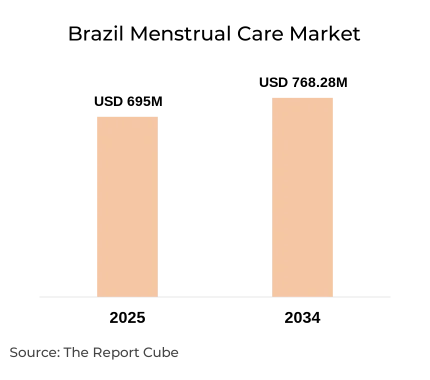
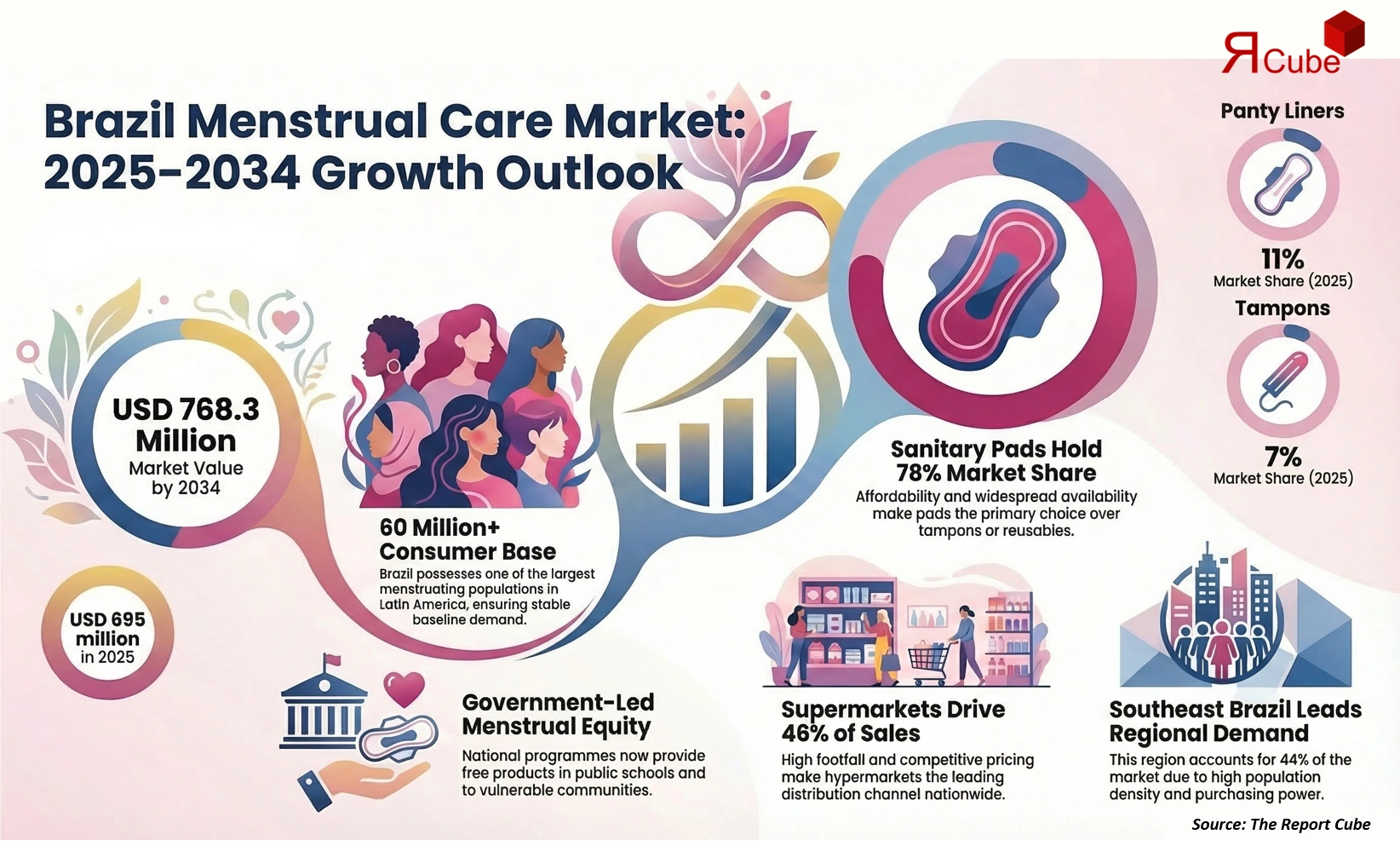
The Brazil Menstrual Care Market is anticipated to register a CAGR of 1.12% during 2026-2034. The market size was valued at USD 695 Million in 2025 and is projected to reach USD 768.28 Million by 2034. The Brazilian menstrual care market reflects a mature yet socially significant consumer healthcare segment, shaped by population size, urbanization, and evolving awareness around menstrual health and hygiene. Brazil has one of the largest menstruating populations in Latin America, with more than 60 million women of reproductive age, creating a stable base demand for menstrual hygiene products. Sanitary pads continue to dominate usage due to affordability, familiarity, and widespread availability across urban and semi-urban areas. However, purchasing behavior is increasingly influenced by income disparities, access to education, and cultural attitudes toward menstruation. While growth remains modest due to high product penetration in urban regions, sustained demand is supported by population growth, replacement consumption, and gradual improvements in access across lower-income and rural communities.
Market dynamics are also shaped by rising public discourse around menstrual equity and period poverty, which has brought menstrual care into broader health and social policy conversations. Government-backed initiatives, school distribution programs, and NGO-led awareness campaigns are improving product accessibility among underserved populations, particularly in the North and Northeast regions. At the same time, urban consumers are showing growing interest in alternative products such as menstrual cups and period underwear, driven by sustainability awareness and long-term cost considerations. Leading multinational brands maintain strong market presence through extensive retail networks and brand trust, while emerging players focus on reusable and organic products. Together, these factors support a stable but gradually evolving menstrual care market in Brazil over the forecast period.
Brazil Menstrual Care Market Recent Developments
- 2025: Procter & Gamble expanded Always product lines with enhanced absorbency options targeting tropical climate needs.
- 2025: Kimberly-Clark strengthened Intimus distribution in pharmacies and online channels across major urban centers.
Government Initiatives & Policies
- National Menstrual Health Program: Federal initiative supporting free menstrual product distribution in public schools and vulnerable communities.
- Brazil School Health Program (PSE): Program integrating menstrual hygiene education and access within public education systems.
Brazil Menstrual Care Market Dynamics
Key Driver: Population Scale and Basic Hygiene Demand
In Brazil, the menstrual care market is primarily driven by the country’s large female population and the essential nature of menstrual hygiene products. Menstrual care items are non-discretionary purchases, ensuring consistent baseline demand regardless of economic cycles. Urbanization and increased retail penetration have further improved product availability, particularly in supermarkets and pharmacies. Additionally, growing awareness around menstrual health as a public health issue has encouraged regular product usage among younger demographics. Educational initiatives and media campaigns are reducing stigma and improving hygiene practices, supporting steady consumption volumes. These structural drivers ensure market resilience even in periods of economic volatility.
Major Challenge: Income Inequality and Price Sensitivity
A significant challenge facing the Brazil menstrual care market is pronounced income inequality, which directly impacts product affordability and usage patterns. Premium and alternative products remain inaccessible to large segments of the population, particularly in rural and low-income urban areas. Price sensitivity is high, leading consumers to favor basic sanitary pads over higher-cost tampons or reusable options. Inflationary pressures and taxation on hygiene products further affect purchasing power. While government and NGO interventions help address access gaps, affordability remains a limiting factor for market expansion beyond essential product categories.
Industry Trends: Gradual Shift Toward Reusable and Sustainable Products
An emerging trend in Brazil’s menstrual care market is the slow but steady adoption of reusable and sustainable products such as menstrual cups and period underwear. This trend is most evident among urban, higher-income, and environmentally conscious consumers. Educational content on long-term cost savings and environmental benefits is driving interest, although adoption rates remain relatively low compared to disposable products. Brands offering organic cotton pads and chemical-free formulations are also gaining traction. While these trends do not yet drive large-scale market growth, they are reshaping product portfolios and innovation strategies.
Opportunity Ahead: Public Programs and Regional Market Expansion
Future opportunities lie in expanding access through public distribution programs and deepening penetration in underserved regions such as the North and Northeast. Partnerships between manufacturers, governments, and NGOs can help normalize product usage and expand volume demand. Additionally, growth in online retail and direct-to-consumer models offers opportunities to reach younger consumers and niche segments. Brands that balance affordability with innovation and invest in education-driven marketing are well positioned to capture incremental growth in Brazil’s evolving menstrual care landscape.
Brazil Menstrual Care Market Segment-wise Analysis
By Product Type:
- Sanitary Pads
- Tampons
- Menstrual Cups
- Period Underwear
- Panty Liners
- Others
Sanitary pads dominate the Brazil menstrual care market, accounting for approximately 78% of total market revenue in 2025. Their dominance is driven by affordability, cultural acceptance, and extensive availability across all retail formats. Panty liners follow with around 11% share, supported by daily hygiene use. Tampons account for nearly 7%, primarily concentrated in urban and higher-income consumer groups. Menstrual cups and period underwear together represent less than 4% of the market but show the fastest growth rates due to sustainability-driven adoption. These market shares reflect retail sales data, household usage patterns, and distribution reach across regions.
By Distribution Channel:
- Supermarkets & Hypermarkets
- Pharmacies & Drug Stores
- Online Retail
- Convenience Stores
- Specialty Health & Beauty Stores
- Others
Supermarkets and hypermarkets are the leading distribution channel, contributing approximately 46% of total sales in 2025 due to high footfall and price-driven purchasing. Pharmacies and drug stores follow with around 28% share, benefiting from consumer trust and accessibility. Online retail accounts for nearly 12% and is growing steadily, driven by subscription models and discreet purchasing preferences. Convenience stores and specialty health and beauty stores collectively represent about 14%, serving impulse and premium buyers. These channel shares are supported by retail audit data and consumer shopping behavior trends in Brazil.
Regional Projection of Brazil Menstrual Care Industry
- Southeast Brazil
- South Brazil
- Northeast Brazil
- Central-West Brazil
- North Brazil
Southeast Brazil leads the menstrual care market with an estimated 44% share in 2025, driven by high population density, stronger purchasing power, and advanced retail infrastructure in states such as São Paulo and Rio de Janeiro. South Brazil follows with approximately 19% share due to higher per-capita income and education levels. Northeast Brazil accounts for nearly 21%, supported by a large population base but constrained by affordability challenges. Central-West Brazil contributes around 9%, while North Brazil represents roughly 7%, reflecting lower access and distribution penetration. These regional shares are derived from population distribution, retail density, and consumption expenditure patterns.
Why Choose This Report?
- Provides a comprehensive overview of the overall market analysis, encompassing key trends, consumer behavior analysis, and risk assessment to support strategic decision-making.
- Provides accurate, up-to-date insights into market size, segmentation, and emerging opportunities, helping to minimize risk & capitalizing on growth.
- Gives deep understanding of target audience preferences, investment habits, and communication channels for enhanced product development & marketing effectiveness.
- Delivers competitive analysis & benchmarking, uncovering the strengths & weaknesses of market competitors to guide strategies.
- Consolidate comprehensive market intelligence, reducing reasoning & streamlining research efforts.
- Facilitates customized market segmentation & risk mitigation strategies, fine-tuned to the business objectives.
- Aids in identifying both market challenges & untapped opportunities within the industry to drive long-term business growth.
- Provides valuable information based on actual customer data & search trends.
Table of Contents
- Introduction
- Objective of the Study
- Product/Category Definition
- Market Segmentation
- Study Variables
- Research Methodology
- Secondary Data Points
- Breakdown of Secondary Sources
- Primary Data Points
- Breakdown of Primary Interviews
- Secondary Data Points
- Executive Summary
- Market Dynamics
- Drivers
- Challenges
- Opportunity Assessment
- Recent Trends and Developments
- Policy and Regulatory Landscape
- Brazil Menstrual Care Market Overview (2020–2034)
- Market Size, By Volume (Million Units) & Value (BRL Million / USD Million)
- Market Share, By Product Type
- Sanitary Pads
- Tampons
- Menstrual Cups
- Period Underwear
- Panty Liners
- Others
- Market Share, By Distribution Channel
- Supermarkets & Hypermarkets
- Pharmacies & Drug Stores
- Online Retail
- Convenience Stores
- Specialty Health & Beauty Stores
- Others
- Market Share, By End User
- Teens & Young Adults
- Adult Women
- Working Women
- Others
- Market Share, By Region
- Southeast Brazil
- South Brazil
- Northeast Brazil
- Central-West Brazil
- North Brazil
- Market Share, By Company
- Revenue Shares
- Competitive Landscape
- Segment-wise & Industry-wise Market Forecast (2026–2034)
- By Product Type
- By Distribution Channel
- By End User
- By Region
- Southeast Brazil Menstrual Care Market
- Market Size, By Volume & Value (BRL Million)
- Market Share, By Product Type
- Market Share, By Distribution Channel
- Market Share, By End User
- South Brazil Menstrual Care Market
- Market Size, By Volume & Value (BRL Million)
- Market Share, By Product Type
- Market Share, By Distribution Channel
- Market Share, By End User
- Northeast Brazil Menstrual Care Market
- Market Size, By Volume & Value (BRL Million)
- Market Share, By Product Type
- Market Share, By Distribution Channel
- Market Share, By End User
- Central-West Brazil Menstrual Care Market
- Market Size, By Volume & Value (BRL Million)
- Market Share, By Product Type
- Market Share, By Distribution Channel
- Market Share, By End User
- North Brazil Menstrual Care Market
- Market Size, By Volume & Value (BRL Million)
- Market Share, By Product Type
- Market Share, By Distribution Channel
- Market Share, By End User
- Competitive Outlook & Company Profiles
- Procter & Gamble (Always)
- Company Overview
- Product Portfolio
- Strategic Alliances/Partnerships
- Recent Developments
- Kimberly-Clark (Intimus)
- Company Overview
- Product Portfolio
- Strategic Alliances/Partnerships
- Recent Developments
- Essity (TENA & Bodyform)**
- Company Overview
- Product Portfolio
- Strategic Alliances/Partnerships
- Recent Developments
- Unicharm (Charm & Sofy)
- Company Overview
- Product Portfolio
- Strategic Alliances/Partnerships
- Recent Developments
- Organyc
- Company Overview
- Product Portfolio
- Strategic Alliances/Partnerships
- Recent Developments
- The Female Company
- Company Overview
- Product Portfolio
- Strategic Alliances/Partnerships
- Recent Developments
- Saalt
- Company Overview
- Product Portfolio
- Strategic Alliances/Partnerships
- Recent Developments
- Lintbells (Flexadin)**
- Company Overview
- Product Portfolio
- Strategic Alliances/Partnerships
- Recent Developments
- Ellas Products
- Company Overview
- Product Portfolio
- Strategic Alliances/Partnerships
- Recent Developments
- Others
- Procter & Gamble (Always)
- Contact Us / Disclaimer
Top Key Players & Market Share Outlook
- Procter & Gamble (Always)
- Kimberly-Clark (Intimus)
- Essity (TENA & Bodyform)
- Unicharm (Charm & Sofy)
- Organyc
- The Female Company
- Saalt
- Lintbells (Flexadin)
- Ellas Products
- Others
Frequently Asked Questions






