



Build Your Custom Market Intelligence Report
Customize Your ReportKey Takeaways
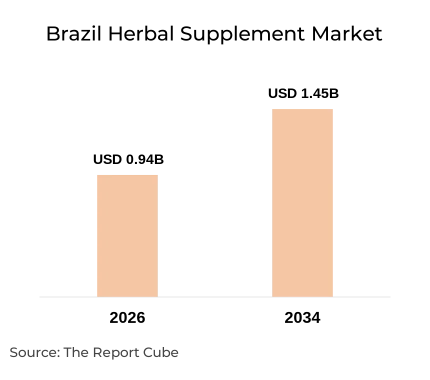
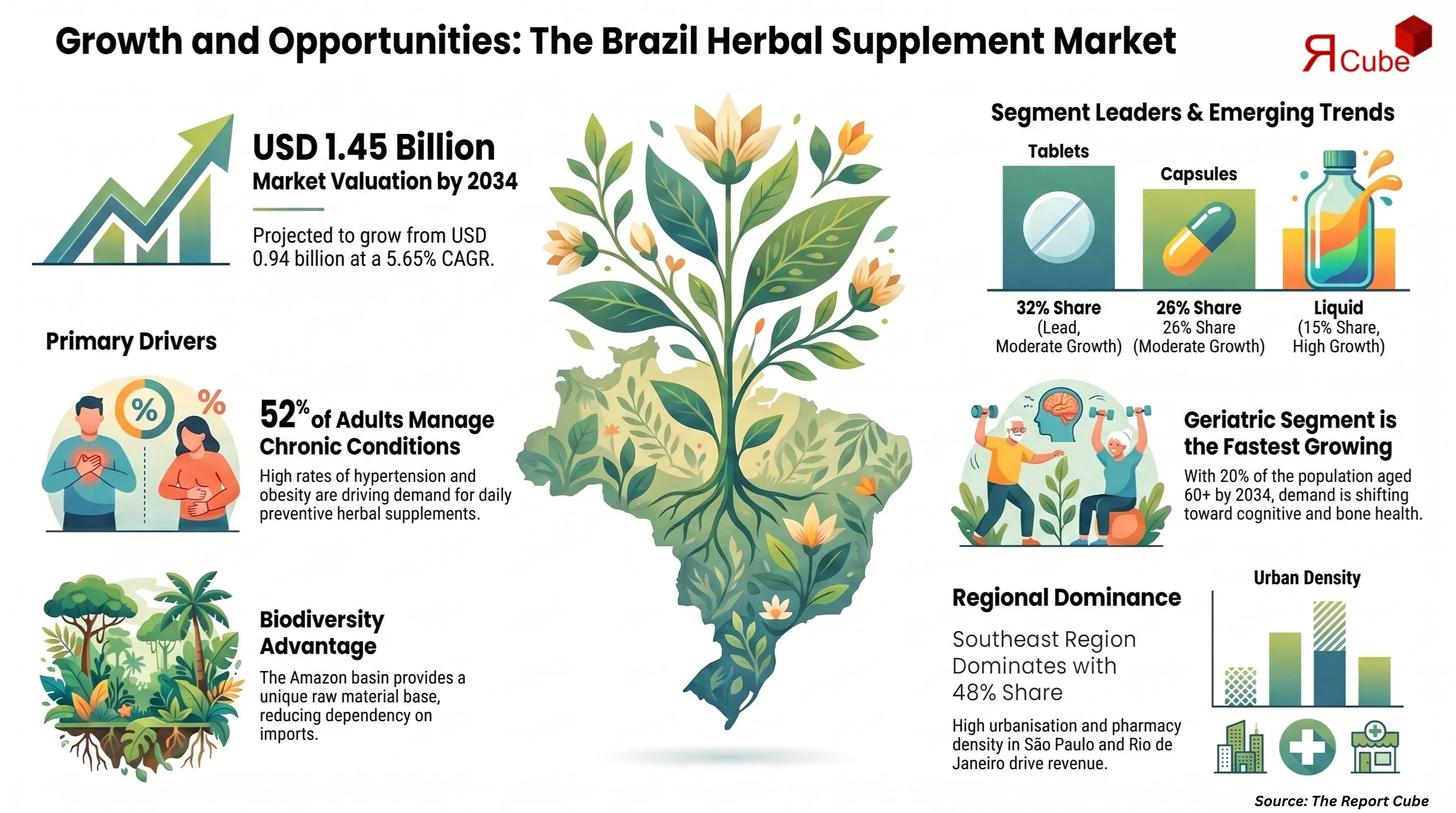
- Market valued at USD 0.94 billion in 2026, projected to reach USD 1.45 billion by 2034
- Expected to grow at a CAGR of 5.65% during 2026–2034
- Tablets remain the leading formulation segment throughout the forecast period
- Adults dominate as the largest consumer segment
- Geriatric segment is emerging as the fastest-growing consumer group
- Steady growth driven by increasing health awareness and supplement adoption
- Market expansion supported by consistent demand across key consumer demographics
Brazil Herbal Supplement Market Insights & Analysis
Consumers across Brazil are shifting away from synthetic pharmaceuticals toward plant-derived health solutions, pressuring supplement brands to rethink product portfolios. With the Brazil herbal supplement market valued at USD 0.94 billion in 2026 and projected to expand at a 5.65% CAGR through 2034, the gap between consumer demand and available evidence-based herbal options is widening. This section maps the structural forces, regulatory context, and consumer behaviour patterns shaping the market across the forecast horizon.
Brazil holds a unique competitive position in the global herbal supplement industry. The Amazon basin supplies over 30,000 plant species used in traditional medicine, creating a domestic raw material base unavailable in most markets (ANVISA, 2024). This biodiversity advantage reduces raw material import dependency and enables local brands to develop proprietary botanical formulations aligned with Brazil's deep-rooted phytotherapy traditions.
ANVISA's regulatory framework for fitoterápicos (herbal medicines) governs market entry through a tiered registration system. Brands must demonstrate safety and efficacy via clinical or ethnobotanical evidence before receiving authorisation, which extends launch timelines but simultaneously creates a quality assurance layer that builds long-term consumer trust. The Unified Health System (SUS) has further normalised integrative medicine through its National Policy on Integrative and Complementary Practices (PNPIC), driving institutional demand alongside retail channels. Urban middle-class adults aged 25–54 increasingly prefer certified organic and sustainably sourced supplement labels, accelerating premiumisation across key product lines. E-commerce penetration in supplement retail has also grown significantly post-2020, with online channels capturing a rising share of herbal supplement distribution (Brazilian E-Commerce Association, 2024).
|
Indicator |
Brazil |
Argentina |
Mexico |
|---|---|---|---|
|
Per-Capita Herbal Supplement Spend (2024, USD) |
4.20 |
2.80 |
3.50 |
|
Regulatory Body |
ANVISA |
ANMAT |
COFEPRIS |
|
Organic Certification Penetration |
Moderate |
Low |
Low-Moderate |
Brazil's USD 4.20 per-capita spend leads regional peers Argentina and Mexico, reflecting the combined effect of biodiversity access, institutional healthcare integration, and a maturing retail infrastructure. For brands researching the broader Latin America nutraceuticals market, Brazil's structural advantages make it the priority entry market in the region.
Brazil Herbal Supplement Market Dynamics
Identifying which forces are structurally reshaping the Brazil herbal supplement market - rather than cyclically influencing it - is the central challenge for investors and product teams. A 5.65% CAGR sustained through 2034 signals structural demand, yet three distinct headwinds threaten margin and distribution efficiency across the value chain. Below are the market's verified primary driver, dominant challenge, defining trend, and highest-value emerging opportunity.
Key Market Driver: Rising Preventive Healthcare Adoption Among Brazilian Adults
Brazilian adults are managing chronic conditions - hypertension, diabetes, obesity - at rates that strain public hospital capacity. Brazil's Ministry of Health reports that 52% of adults have at least one chronic condition (Ministry of Health Brazil, 2023), creating demand for daily preventive supplementation outside the pharmaceutical channel. Herbal formulations positioned as daily wellness aids - not therapeutic claims - are capturing this preventive spend.
The SUS's PNPIC integrative medicine programme validates herbal use at the institutional level, normalising consumer purchasing in ways that advertising cannot replicate (Brazil Ministry of Health - PNPIC, 2023). When public health infrastructure endorses botanical medicine, private-sector supplement demand follows. Tablet and capsule formats dominate preventive use due to ease of dosing and extended shelf stability, benefiting brands already positioned in pharmacy channels. For a deeper look at how supplement categories intersect within Brazil's preventive health economy, explore the Brazil nutraceuticals market.
Major Industry Challenge: Regulatory Complexity and ANVISA Compliance Costs
Brands entering Brazil's herbal supplement market face a layered registration process that differs fundamentally from food supplement rules in North America and Europe. ANVISA's fitoterápico pathway requires clinical or ethnobotanical evidence of safety and efficacy, adding 12–24 months to product launch timelines and increasing pre-market spend by an estimated 20–35% versus comparable markets (ANVISA, 2024). This cost asymmetry concentrates market share among large incumbents and limits SKU diversity for consumers.
ANVISA operates a two-tier fitoterápico registration system: a simplified pathway for formulations with established traditional use data, and a full pathway requiring clinical evidence. Regulatory submission costs - covering legal review, laboratory testing, and clinical evidence documentation - create meaningful barriers for mid-sized international brands. Players like Solgar and Nature's Bounty navigate this by entering through local manufacturing and distribution partnerships that provide pre-cleared compliance infrastructure.
Need Specific Data, Let’s Customize the Report for You
Request CustomizationEmerging Trend: Shift Toward Liquid and Powder Formulations in Functional Wellness
Tablets and capsules have dominated Brazilian herbal supplement shelves for decades, but a measurable consumer pivot is underway. Liquid and powder-and-granule formats grew at a faster rate than the overall market between 2022–2025 (Brazilian Health Products Industry Association - ABIAD, 2025), driven by younger consumers who prefer mixable, on-the-go delivery formats. This trend is reshaping packaging investment, supply chain requirements, and shelf placement strategy across pharmacy and health food retail channels.
Urban adults aged 18–35 in São Paulo and Rio de Janeiro represent the primary demand signal for liquid and powder supplements, driven by fitness culture and functional beverage crossover behaviour. NOW Foods and Herbalife have already adapted their Brazilian product portfolios toward liquid concentrates in response. Brands in the Brazil sports nutrition market are influencing this format shift, with crossover consumers purchasing herbal supplements and sports nutrition products from the same digital or physical retail touchpoint.
Emerging Opportunity: Geriatric Supplement Segment Driven by Brazil's Ageing Population
Brazil's population is ageing faster than most Latin American peers, and the supplement industry has not yet developed product lines calibrated to geriatric nutritional profiles. Adults aged 60+ are projected to represent 20% of Brazil's total population by 2034 (IBGE, 2023), a cohort with documented deficiencies in vitamins D, B12, and magnesium - addressable through targeted herbal and botanical formulations. Brands that position geriatric-specific herbal products now will capture first-mover advantages before the segment reaches peak demand.
SUS nutrition surveys confirm that Brazil's elderly population shows measurable micronutrient gaps that align directly with herbal supplement categories - bone health, cognitive support, and cardiovascular formulations. Soft gels and liquid formulations are the preferred delivery formats in this segment due to swallowing difficulty with tablet formats. Current key players have not yet developed geriatric-specific SKUs at scale, creating a competitive whitespace window that early movers can occupy. Brands planning entry into adjacent categories can also reference the Brazil elderly care market for demographic and care infrastructure data that informs product positioning.
Brazil Herbal Supplement Market Segment-wise Analysis
Investors and brand managers need segment-level revenue distribution, not aggregate market figures, to allocate development and marketing budgets in Brazil. A single 5.65% CAGR figure obscures significant variance across formulation types and consumer groups - some sub-segments are contracting while others exceed the headline growth rate. The tables below decode both segment dimensions with share estimates, growth tags, and the demand logic behind each position.
By Formulation
Formulation choice directly determines a brand's production cost structure, regulatory classification, and retail shelf placement in Brazil. Tablets and capsules together account for an estimated majority of Brazil herbal supplement revenue in 2026, but their combined share is being eroded by faster-growing liquid and powder formats among younger demographics. The breakdown below assigns share estimates and growth outlooks to each of the six formulation categories.
- Tablets (32%): Dominant format due to low production cost, long shelf life, and pharmacy channel compatibility. Primary consumers are adults and geriatric segments.
- Capsules (26%): Second-largest share; preferred for standardised botanical extracts with precise dosing.
- Liquid (15%): Fastest growing; driven by younger consumers in São Paulo and Rio de Janeiro and functional beverage crossover.
- Powder & Granules (12%): Niche but growing; sports nutrition and paediatric adjacency driving demand.
- Soft Gels (10%): Preferred in geriatric segment for swallowing ease; key for omega-3 and vitamin D delivery.
- Others (5%): Sprays, patches, chews - small but innovating in delivery format design.
|
Formulation |
Estimated Share (2026) |
Growth Outlook (2026–2034) |
Primary Consumer |
|---|---|---|---|
|
Tablets |
32% |
Moderate |
Adults, Geriatric |
|
Capsules |
26% |
Moderate |
Adults |
|
Liquid |
15% |
High |
Adults (18–35) |
|
Powder & Granules |
12% |
Above Average |
Adults, Paediatric |
|
Soft Gels |
10% |
Above Average |
Geriatric |
|
Others |
5% |
Moderate |
Mixed |
Brands evaluating contract production options for capsule-format supplements can review available infrastructure in the Brazil capsule contract manufacturing space, where domestic ANVISA-approved facilities are expanding capacity to meet growing demand.
By Consumer
Each consumer segment in Brazil's herbal supplement market has distinct purchasing triggers, product requirements, and channel preferences that demand separate go-to-market strategies. Treating all four consumer groups - pregnant women, adults, paediatric, and geriatric - as a single addressable market leads to misfired product positioning and underperforming retail placements. The analysis below profiles each group by estimated share, primary need state, and the formulations most aligned with their clinical and behavioural profile.
- Adults (52%): Largest segment; immunity, digestive health, and energy positioning drive core volume. Tablets and capsules are the formats of choice.
- Geriatric (22%): Fastest-growing group; bone health, cognitive support, and cardiovascular herbs dominate. Soft gels and liquids preferred.
- Pregnant Women (14%): Highly regulated segment under ANVISA scrutiny on health claims; folic acid, iron, and ginger-based nausea products lead. Capsules and liquids are dominant formats.
- Paediatric (12%): Smallest segment; immune support and vitamin D are primary use cases; liquids and powders preferred due to label compliance requirements.
|
Consumer Segment |
Estimated Share (2026) |
Growth Tag |
Top Formulations |
Primary Need State |
|---|---|---|---|---|
|
Adults |
52% |
Moderate |
Tablets, Capsules |
Immunity, Digestion, Energy |
|
Geriatric |
22% |
High |
Soft Gels, Liquids |
Bone, Cognitive, Cardiovascular |
|
Pregnant Women |
14% |
Moderate |
Capsules, Liquids |
Prenatal Nutrition, Nausea |
|
Paediatric |
12% |
Moderate |
Powder, Liquids |
Immunity, Growth Support |
ANVISA applies heightened claim scrutiny to the pregnant women and paediatric segments, restricting therapeutic language on product labels and requiring specific safety documentation. Brands targeting these groups must align labelling with ANVISA's fitoterápico claims guidance. Brands in the Brazil maternal health supplements market are actively navigating this regulatory landscape to build compliant product lines.
Regional Projection of Brazil Herbal Supplement Market
Brazil's herbal supplement market does not distribute evenly across its five macro-regions - income inequality, infrastructure gaps, and cultural attitudes toward botanical medicine create distinct regional demand patterns. The Southeast region accounts for an estimated majority of national supplement revenue, yet the Northeast and North regions carry higher growth potential due to expanding middle-class income and deep-rooted traditional herbal medicine culture. The regional table below maps share, key growth driver, and the primary distribution gap in each region.
- Southeast (São Paulo, Rio de Janeiro, Minas Gerais) Largest market share at approximately 48%. High urbanisation, pharmacy chain density (Drogasil, Raia), and e-commerce penetration drive volume through established tablet and capsule product lines.
- Northeast (Bahia, Ceará, Pernambuco) Growing share at approximately 20%. Strong traditional herbal medicine culture (plantas medicinais) creates baseline demand. Rising income levels are converting informal herbal use into packaged supplement purchasing.
- South (Rio Grande do Sul, Santa Catarina, Paraná) Approximately 18% share. Culturally distinct consumer base with European heritage drives higher awareness of European herbal brands such as Solgar. Natural food retail channels lead distribution.
- Central-West (Mato Grosso, Goiás, Brasília) Approximately 8% share. A growing agribusiness economy is raising disposable income, but specialist supplement retail remains scarce; online channels are critical for market access.
- North (Amazonas, Pará) Approximately 6% share. Highest biodiversity; lowest formal supplement penetration. Cultural use of Amazonian plants - açaí, guaraná, cat's claw - creates demand, but informal and local supply chains compete with packaged brands.
|
Region |
Est. Share (2026) |
Key Growth Driver |
Primary Distribution Gap |
|---|---|---|---|
|
Southeast |
48% |
Urban pharmacy density, e-commerce |
Premium segment expansion |
|
Northeast |
20% |
Rising middle class, herbal culture |
Pharmacy chain reach |
|
South |
18% |
Natural food retail, European brand awareness |
Online channel depth |
|
Central-West |
8% |
Agribusiness income growth |
Specialist retail scarcity |
|
North |
6% |
Amazonian botanical demand |
Packaged brand penetration |
For broader infrastructure and healthcare system context that underpins regional supplement access, the Brazil healthcare market provides supporting analysis on facility distribution and income-driven health spend patterns.
Brazil Herbal Supplement Market - Recent Developments (2025-2026)
Tracking company-level moves in Brazil's herbal supplement market is essential for competitive positioning - product launches, partnerships, and regulatory approvals shift shelf space and consumer loyalty rapidly. Between 2025 and 2026, at least six key players have made market-shaping moves that alter competitive intensity across formulation categories and consumer segments.
- Q1 2025 - Herbalife Ltd expanded its Brazil direct-sales network into secondary cities in the Northeast region, targeting first-time supplement buyers with entry-price herbal wellness packs - directly addressing the pharmacy chain gap in that region.
- Q2 2025 - Nature's Bounty launched a Brazil-specific geriatric supplement line in partnership with a local pharmacy chain, positioned around bone and cognitive health - validating the geriatric segment's commercial priority.
- Q3 2025 - Gaia Herbs received ANVISA fitoterápico registration for two new liquid herbal extracts, broadening its Brazil-compliant SKU range in the fastest-growing formulation category.
- Q4 2025 - NOW Foods strengthened its São Paulo distribution agreement with a regional supplement distributor to improve pharmacy channel coverage across the Southeast.
- Q1 2026 - Swanson Group initiated a Brazil e-commerce pilot via local marketplace Americanas.com, testing direct-to-consumer pricing strategy in advance of broader digital channel investment.
- Q2 2026 - Jarrow Formulas announced a co-manufacturing agreement with a Brazilian ANVISA-approved contract manufacturer to accelerate local production compliance and reduce regulatory timelines.
For context on how these moves interact with Brazil's broader pharma distribution ecosystem, the Brazil pharmaceutical market provides supporting channel and regulatory infrastructure data.
Brazil Herbal Supplement Market Future Outlook (2034)
A 5.65% CAGR through 2034 is not guaranteed - it is contingent on a set of policy, technology, and demographic conditions that brands must monitor and build strategy around. Three structural forces will determine whether Brazil's herbal supplement market reaches its forecast ceiling or underperforms: regulatory evolution under ANVISA, demographic ageing of the consumer base, and the formalisation of Amazonian botanical supply chains. The outlook below projects how each force will interact with market demand through 2034.
ANVISA's regulatory trajectory points toward potential harmonisation with Mercosur supplement standards, which could reduce cross-border compliance burden for regional players by 2028–2030 - widening the pool of compliant international brands competing in Brazil. Demographically, Brazil's 60+ population is on course to reach 20% of the total by 2034 (IBGE, 2023), expanding the geriatric segment from its current estimated 22% share to a projected 28–30% of herbal supplement revenue by the end of the forecast period.
The most distinctive forward-looking dynamic is the formalisation of Amazonian botanical supply chains. Brazil's Amazon Fund and sustainability certification programmes are creating traceable herbal raw material supply chains (Amazon Fund), enabling premium brands to build ESG-driven sourcing narratives that command price premiums in domestic and export markets. E-commerce's share of herbal supplement sales is projected to exceed 25% by 2034, requiring direct-to-consumer capability from all major players. A risk scenario worth monitoring: stricter ANVISA health claim enforcement post-2026 could compress mid-tier brands lacking clinical evidence files, consolidating share among larger, better-resourced incumbents. Brands tracking raw material supply evolution can reference the Brazil natural ingredients market for sourcing infrastructure data.
Why Choose This Report?
- Granular segment breakdown across 6 formulation types and 4 consumer groups, with share estimates and growth tags for 2026–2034
- ANVISA regulatory pathway analysis - compliance cost benchmarks and timeline estimates for market entry planning
- Regional demand mapping across all 5 Brazilian macro-regions with identified distribution gaps
- Verified key player activity log with dated 2025–2026 developments and strategic intent analysis
- Demographic demand modelling tied to IBGE population projections for the geriatric and paediatric segments
- Amazonian botanical supply chain formalisation outlook - ESG sourcing and premium brand positioning implications
- Forecast scenarios including a risk-adjusted downside driven by ANVISA health claim enforcement post-2026
Table of Contents
- Introduction
- Objective of the study
- Product Definition
- Market Segmentation
- Study Variables
- Research Methodology
- Secondary Data Points
- Companies Interviewed
- Primary Data Points
- Breakdown of Primary Interviews
- Secondary Data Points
- Executive Summary
- Market Dynamics
- Drivers
- Challenges
- Opportunity Assessment
- Recent Trends and Developments
- Policy and Regulatory Landscape
- Brazil Herbal Supplement Market Overview and Forecast Analysis (2021-2034)
- Market Size, By Value, By growth rate (CAGR/USD Billions)
- Demand - Supply Trends
- Market Share, By Type
- Moringa
- Echinacea
- Flaxseeds
- Turmeric
- Ginger
- Ginseng
- Others
- Market Share, By Formulation
- Tablets
- Capsules
- Liquid
- Powder and Granules
- Soft Gels
- Others
- Market Share, By Consumer
- Pregnant Women
- Adults
- Pediatric
- Geriatric
- Market Share, By Region
- Southeast
- Northeast
- Central-West
- Others
- Market Share, By Competitors
- Competition Characteristics
- Revenue Shares
- Brazil Moringa Herbal Supplement Market Overview, 2020-2032F
- By Value (USD Million)
- By Formulation- Market Size & Forecast 2021-2034, USD Million
- By Consumer- Market Size & Forecast 2021-2034, USD Million
- Brazil Echinacea Herbal Supplement Market Overview, 2020-2032F
- By Value (USD Million)
- By Formulation- Market Size & Forecast 2021-2034, USD Million
- By Consumer- Market Size & Forecast 2021-2034, USD Million
- Brazil Flaxseeds Herbal Supplement Market Overview, 2020-2032F
- By Value (USD Million)
- By Formulation- Market Size & Forecast 2021-2034, USD Million
- By Consumer- Market Size & Forecast 2021-2034, USD Million
- Brazil Turmeric Herbal Supplement Market Overview, 2020-2032F
- By Value (USD Million)
- By Formulation- Market Size & Forecast 2021-2034, USD Million
- By Consumer- Market Size & Forecast 2021-2034, USD Million
- Brazil Ginger Herbal Supplement Market Overview, 2020-2032F
- By Value (USD Million)
- By Formulation- Market Size & Forecast 2021-2034, USD Million
- By Consumer- Market Size & Forecast 2021-2034, USD Million
- Brazil Ginseng Herbal Supplement Market Overview, 2020-2032F
- By Value (USD Million)
- By Formulation- Market Size & Forecast 2021-2034, USD Million
- By Consumer- Market Size & Forecast 2021-2034, USD Million
- Brazil Others Herbal Supplement Market Overview, 2020-2032F
- By Value (USD Million)
- By Formulation- Market Size & Forecast 2021-2034, USD Million
- By Consumer- Market Size & Forecast 2021-2034, USD Million
- Competitive Outlook (Company Profile - Partial List)
- Solgar
- Company Overview
- Business Segments
- Strategic Alliances/Partnerships
- Recent Developments
- Nature's Way
- Company Overview
- Business Segments
- Strategic Alliances/Partnerships
- Recent Developments
- Amwa
- Company Overview
- Business Segments
- Strategic Alliances/Partnerships
- Recent Developments
- Gaia Herbs
- Company Overview
- Business Segments
- Strategic Alliances/Partnerships
- Recent Developments
- Nature’s Bounty
- Company Overview
- Business Segments
- Strategic Alliances/Partnerships
- Recent Developments
- Jarrow Formulas
- Company Overview
- Business Segments
- Strategic Alliances/Partnerships
- Recent Developments
- Swanson Group
- Company Overview
- Business Segments
- Strategic Alliances/Partnerships
- Recent Developments
- NOW Foods
- Company Overview
- Business Segments
- Strategic Alliances/Partnerships
- Recent Developments
- Herbalife Ltd
- Company Overview
- Business Segments
- Strategic Alliances/Partnerships
- Recent Developments
- Others
- Solgar
- Contact Us & Disclaimer
Top Key Players & Market Share Outlook
- Solgar
- Nature's Way
- Amwa
- Gaia Herbs
- Nature’s Bounty
- Jarrow Formulas
- Swanson Group
- NOW Foods
- Herbalife Ltd
- Others
Frequently Asked Questions