



Build Your Custom Market Intelligence Report
Customize Your ReportPhilippines Mining Environmental Remediation Market Key Highlights
By Remediation Technology:
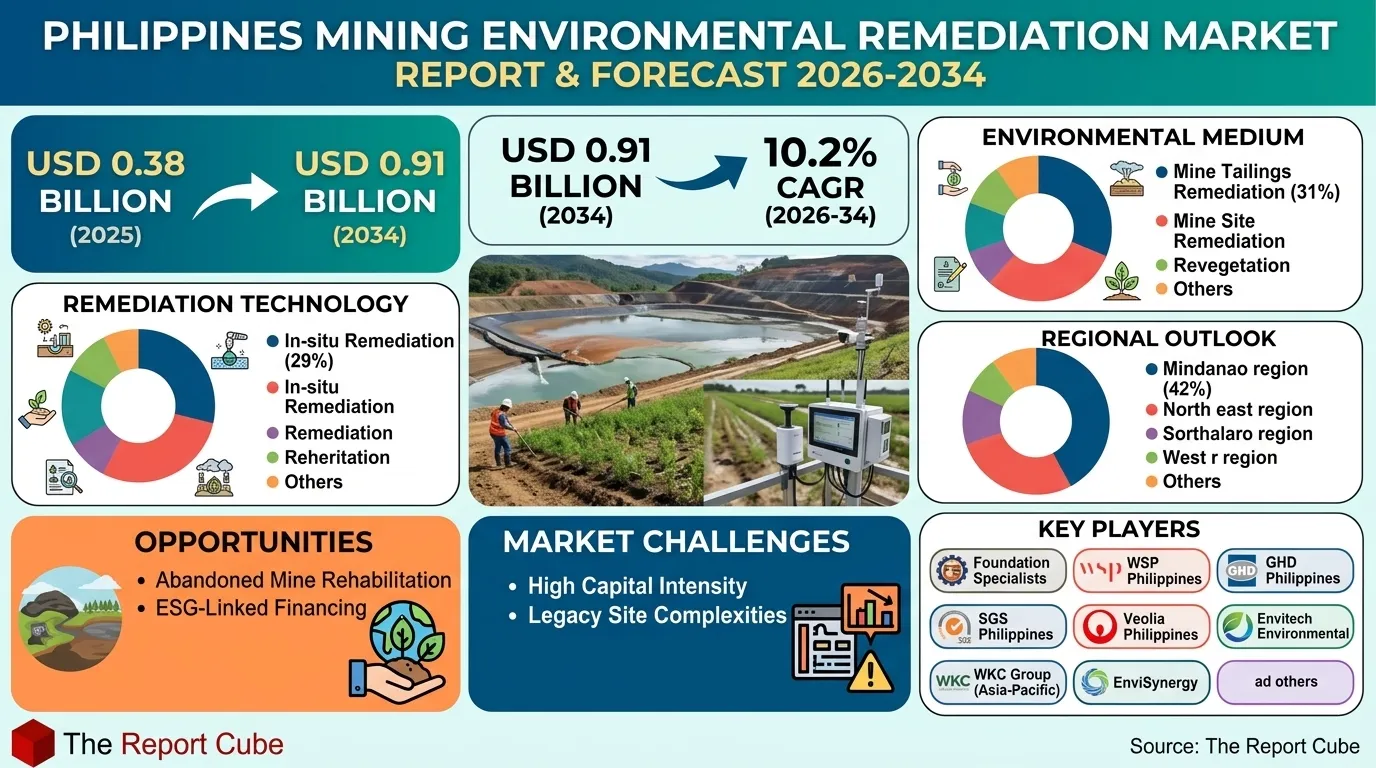
In-situ Remediation segment leads the market, with around 29% share.
By Environmental Medium:
Mine Tailings Remediation segment dominates the market, accounting for nearly 31% of total revenue.
Regional Outlook:
Mindanao region dominates the philippines mining environmental remediation market, with around 42% share.
Government Initiatives & Policies
- DENR Administrative Order (DAO) 2025-10 on Enhanced Environmental Compliance and Carbon Reporting: Strengthens mine rehabilitation bonds, greenhouse gas accounting, and post-mining land restoration mandates for operating and closed mines.
- Philippine Mine Rehabilitation Fund Program (Updated 2025 Guidelines under Mining Act RA 7942): Requires mining firms to allocate dedicated funds for progressive rehabilitation and abandoned mine site restoration.
Philippines Mining Environmental Remediation Market Insights & Analysis
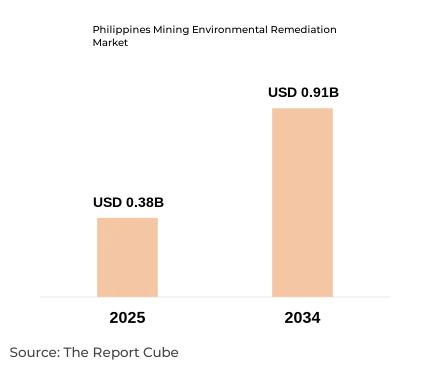
The Philippines Mining Environmental Remediation Market is anticipated to register a CAGR of 10.2% during 2026-34. The market size was valued at USD 0.38 billion in 2025 and is projected to reach USD 0.91 billion by 2034. Stronger environmental enforcement, growing pressure for mine closure accountability, and increasing ESG-linked financing are accelerating remediation investments across metallic and non-metallic mining operations.
The Philippines hosts significant reserves of nickel, copper, gold, and chromite, with Mindanao accounting for more than 50% of national mineral output. As mining activities expand, environmental liabilities related to acid mine drainage, tailings dam stability, and heavy metal contamination are gaining regulatory attention. By 2025, over 40 large-scale metallic mines were operating under stricter Environmental Compliance Certificate (ECC) conditions, requiring progressive rehabilitation planning even during active extraction stages. This shift is transforming remediation from a post-closure obligation into a continuous operational requirement.
Government oversight through the Department of Environment and Natural Resources (DENR) and the Mines and Geosciences Bureau (MGB) has intensified monitoring of abandoned and legacy mine sites. Estimates indicate that more than 20 high-risk abandoned mines require structured rehabilitation interventions, creating long-term service opportunities in soil stabilization, groundwater treatment, and revegetation. The enforcement of rehabilitation bonds and social development management programs is further ensuring that mining firms allocate defined budgets toward environmental restoration.
Private sector demand is also being shaped by global commodity buyers and investors requiring traceable sustainability performance. Mining firms seeking export contracts with European and East Asian buyers are increasingly aligning with international reporting standards, including climate and biodiversity metrics. As a result, consulting firms such as WSP Philippines, ERM Philippines, and AECOM Philippines are expanding integrated remediation design and monitoring services. This alignment between regulatory mandates and global ESG compliance is positioning remediation as a strategic investment rather than a compliance expense.
Philippines Mining Environmental Remediation Market Dynamics
Key Driver: Strengthening Environmental Regulations and Mine Closure Accountability
The enforcement of stricter rehabilitation policies is the primary growth catalyst. DENR inspections increased by approximately 18% in 2025 compared to the previous year, targeting tailings storage facilities and wastewater discharge compliance. Mining firms are now required to submit Final Mine Rehabilitation and Decommissioning Plans (FMRDP) with costed projections, which has expanded demand for engineering and environmental consultancy services. Progressive rehabilitation during active mining stages is gaining traction, reducing long-term liabilities. Moreover, carbon reporting requirements under DAO 2025-10 are pushing operators to integrate emissions reduction and land restoration strategies, directly supporting remediation spending growth across Luzon, Visayas, and Mindanao.
Book your FREE 30-minute expert consultation today
Contact UsIndustry Trends: Integration of Advanced Treatment Technologies and Digital Monitoring
Technological upgrades are reshaping remediation efficiency. In-situ bioremediation and phytoremediation techniques are increasingly used to stabilize heavy metal contamination in soil and tailings. Pump-and-treat systems combined with membrane filtration technologies are improving groundwater remediation outcomes. Digital monitoring using remote sensing and drone-based topographic surveys allows continuous tailings dam assessment, reducing risk exposure. The adoption of GIS mapping and predictive hydrogeological modeling enhances remediation design accuracy. Market participants are also incorporating nature-based solutions such as constructed wetlands, which reduce chemical treatment dependency and improve long-term ecological recovery indicators.
Major Challenge: High Capital Intensity and Legacy Site Complexities
Remediation projects require significant upfront capital, particularly for large tailings facilities and contaminated groundwater plumes. Costs for comprehensive mine closure remediation can range between USD 5-20 million per site depending on scale and contamination severity. Legacy abandoned mines often lack baseline environmental data, complicating site assessment and liability allocation. Legal disputes regarding responsibility between previous operators and government entities can delay project execution. Additionally, challenging terrain in remote Mindanao and mountainous Luzon regions increases logistics and monitoring expenses, impacting project timelines and profitability margins.
Opportunity: Abandoned Mine Rehabilitation and ESG-Linked Financing
Abandoned mine site remediation presents a substantial growth opportunity. International development agencies and green financing institutions are increasingly supporting rehabilitation projects aligned with biodiversity restoration and climate resilience goals. Blended financing models combining government rehabilitation funds and private ESG investments are emerging. Mining companies improving remediation performance gain access to sustainability-linked loans with preferential interest rates. Furthermore, rehabilitation-driven land conversion into agroforestry or eco-tourism zones offers long-term economic value creation. These financial and environmental incentives are expected to accelerate remediation investments through 2034.
Philippines Mining Environmental Remediation Market Segment-wise Analysis
By Remediation Technology:
- In-situ Remediation
- Ex-situ Remediation
- Pump and Treat
- Solidification and Stabilization
- Soil Washing
- Phytoremediation
- Bioremediation
- Chemical Oxidation and Reduction
In-situ remediation holds approximately 29% of total market share in 2025 due to its cost-effectiveness and reduced soil disturbance. Techniques such as bioremediation and chemical stabilization are widely adopted for treating contaminated mine tailings and groundwater without excavation. These methods minimize transportation costs and environmental disruption, making them suitable for remote mining areas in Mindanao and Luzon. Mining operators favor in-situ approaches for progressive rehabilitation programs during active extraction phases. The technology’s adaptability to varying contamination levels supports its leadership position.
By Environmental Medium:
- Soil Remediation
- Groundwater Remediation
- Surface Water Remediation
- Mine Tailings Remediation
- Waste Rock Remediation
- Air and Dust Emissions Control
Mine tailings remediation accounts for nearly 31% of total revenue, reflecting the Philippines’ extensive metallic mining footprint. Tailings dam management and acid mine drainage treatment are priority regulatory areas. Operators are investing in geotechnical reinforcement, water treatment plants, and revegetation systems to stabilize tailings facilities. High rainfall intensity in tropical regions increases tailings management risks, further strengthening demand for remediation services. Tailings rehabilitation projects often involve multi-year engineering contracts, providing sustained revenue streams for service providers.
Regional Projection of Philippines Mining Environmental Remediation Industry
- Luzon
- Visayas
- Mindanao
Mindanao leads with around 42% market share, driven by its concentration of nickel and gold mining operations. Large-scale metallic mines require structured remediation programs aligned with stricter environmental enforcement. Luzon follows due to regulatory oversight intensity and industrial mining projects. Visayas contributes moderately, supported by smaller-scale mining and quarry operations. Regional growth is directly correlated with commodity output volumes and regulatory compliance monitoring levels.
Philippines Mining Environmental Remediation Market Recent Developments
- 2025: Veolia Water Philippines, Inc. introduced advanced membrane filtration and reverse osmosis systems for high-spec industrial clients, strengthening wastewater treatment capabilities that support mining and industrial remediation compliance.
- 2025: Veolia Water Philippines, Inc. expanded deployment of membrane-based treatment solutions for high-strength industrial effluents, improving regulatory adherence and boosting capacity for mine-adjacent wastewater remediation services.
- 2025: SGS Philippines, Inc. highlighted new carbon-accounting directives aligned with DENR DAO 2025-10, reinforcing consulting and verification services to support sustainability reporting and long-term mine environmental performance.
Need insights for a specific region within this market?
Request Regional DataWhy Choose This Report?
- Provides a comprehensive overview of the overall market analysis, encompassing key trends, consumer behavior analysis, and risk assessment to support strategic decision-making.
- Provides accurate, up-to-date insights into market size, segmentation, and emerging opportunities, helping to minimize risk & capitalizing on growth.
- Gives deep understanding of target audience preferences, investment habits, and communication channels for enhanced product development & marketing effectiveness.
- Delivers competitive analysis & benchmarking, uncovering the strengths & weaknesses of market competitors to guide strategies.
- Consolidate comprehensive market intelligence, reducing reasoning & streamlining research efforts.
- Facilitates customized market segmentation & risk mitigation strategies, fine-tuned to the business objectives.
- Aids in identifying both market challenges & untapped opportunities within the industry to drive long-term business growth.
- Provides valuable information based on actual customer data & search trends.
Table of Contents
- Introduction
- Objective of the Study
- Product and Category Definition
- Market Segmentation
- Study Variables
- Research Methodology
- Secondary Data Points
- Breakdown of Secondary Sources
- Primary Data Points
- Breakdown of Primary Interviews
- Secondary Data Points
- Executive Summary
- Market Dynamics
- Drivers
- Challenges
- Opportunity Assessment
- Recent Trends and Developments
- Regulatory and Policy Landscape
- Philippines Mining Environmental Remediation Market Overview (2021-2034)
- Market Size, By Value (USD Billion)
- Market Share, By Remediation Technology
- In-situ Remediation
- Ex-situ Remediation
- Pump and Treat
- Solidification and Stabilization
- Soil Washing
- Phytoremediation
- Bioremediation
- Chemical Oxidation and Reduction
- Market Share, By Environmental Medium
- Soil Remediation
- Groundwater Remediation
- Surface Water Remediation
- Mine Tailings Remediation
- Waste Rock Remediation
- Air and Dust Emissions Control
- Market Share, By Service Type
- Site Assessment and Investigation
- Environmental Impact Assessment
- Remediation Design and Engineering
- Remediation Implementation
- Monitoring and Maintenance
- Regulatory Compliance and Permitting
- Environmental Auditing and Due Diligence
- Market Share, By Mining Stage
- Active Mine Remediation
- Mine Closure Remediation
- Abandoned Mine Site Remediation
- Post-Closure Monitoring
- Market Share, By Mining Commodity
- Metallic Mining
- Non-metallic Mining
- Coal Mining
- Quarrying and Aggregates
- Market Share, By Region
- Luzon
- Visayas
- Mindanao
- Market Share, By Company
- Revenue Shares and Analysis
- Competitive Landscape
- Luzon Mining Environmental Remediation Market
- Market Size, By Value (USD Billion/Million)
- Market Share, By Remediation Technology
- Market Share, By Environmental Medium
- Market Share, By Service Type
- Market Share, By Mining Stage
- Market Share, By Mining Commodity
- Visayas Mining Environmental Remediation Market
- Market Size, By Value (USD Billion/Million)
- Market Share, By Remediation Technology
- Market Share, By Environmental Medium
- Market Share, By Service Type
- Market Share, By Mining Stage
- Market Share, By Mining Commodity
- Mindanao Mining Environmental Remediation Market
- Market Size, By Value (USD Billion/Million)
- Market Share, By Remediation Technology
- Market Share, By Environmental Medium
- Market Share, By Service Type
- Market Share, By Mining Stage
- Market Share, By Mining Commodity
- Competitive Outlook and Company Profiles
- Foundation Specialists (FS-Mining)
- Company Overview
- Product and Service Portfolio
- Strategic Alliances/Partnerships
- Recent Developments
- WSP Philippines
- Company Overview
- Product and Service Portfolio
- Strategic Alliances/Partnerships
- Recent Developments
- GHD Philippines
- Company Overview
- Product and Service Portfolio
- Strategic Alliances/Partnerships
- Recent Developments
- SGS Philippines
- Company Overview
- Product and Service Portfolio
- Strategic Alliances/Partnerships
- Recent Developments
- Veolia Philippines
- Company Overview
- Product and Service Portfolio
- Strategic Alliances/Partnerships
- Recent Developments
- Envitech Environmental
- Company Overview
- Product and Service Portfolio
- Strategic Alliances/Partnerships
- Recent Developments
- WKC Group (Asia-Pacific)
- Company Overview
- Product and Service Portfolio
- Strategic Alliances/Partnerships
- Recent Developments
- EnviSynergy
- Company Overview
- Product and Service Portfolio
- Strategic Alliances/Partnerships
- Recent Developments
- YCP Group (YCP Solidiance)
- Company Overview
- Product and Service Portfolio
- Strategic Alliances/Partnerships
- Recent Developments
- Reyes Tacandong & Co. (RSM)
- Company Overview
- Product and Service Portfolio
- Strategic Alliances/Partnerships
- Recent Developments
- AECOM Philippines
- Company Overview
- Product and Service Portfolio
- Strategic Alliances/Partnerships
- Recent Developments
- Wood (formerly AMEC Foster Wheeler)
- Company Overview
- Product and Service Portfolio
- Strategic Alliances/Partnerships
- Recent Developments
- Stantec
- Company Overview
- Product and Service Portfolio
- Strategic Alliances/Partnerships
- Recent Developments
- ERM Philippines
- Company Overview
- Product and Service Portfolio
- Strategic Alliances/Partnerships
- Recent Developments
- Philippine Mining Development Corporation
- Company Overview
- Product and Service Portfolio
- Strategic Alliances/Partnerships
- Recent Developments
- Jacobs Philippines
- Company Overview
- Product and Service Portfolio
- Strategic Alliances/Partnerships
- Recent Developments
- Others
- Foundation Specialists (FS-Mining)
- Contact Us and Disclaimer
Top Key Players & Market Share Outlook
- Foundation Specialists (FS-Mining)
- WSP Philippines
- GHD Philippines
- SGS Philippines
- Veolia Philippines
- Envitech Environmental
- WKC Group (Asia-Pacific)
- EnviSynergy
- YCP Group (YCP Solidiance)
- Reyes Tacandong & Co. (RSM)
- AECOM Philippines
- Wood (formerly AMEC Foster Wheeler)
- Stantec
- ERM Philippines
- Philippine Mining Development Corporation
- Jacobs Philippines
Frequently Asked Questions






