




Build Your Custom Market Intelligence Report
Customize Your ReportGlobal Mobility as a Service (MaaS) Market Insights & Analysis
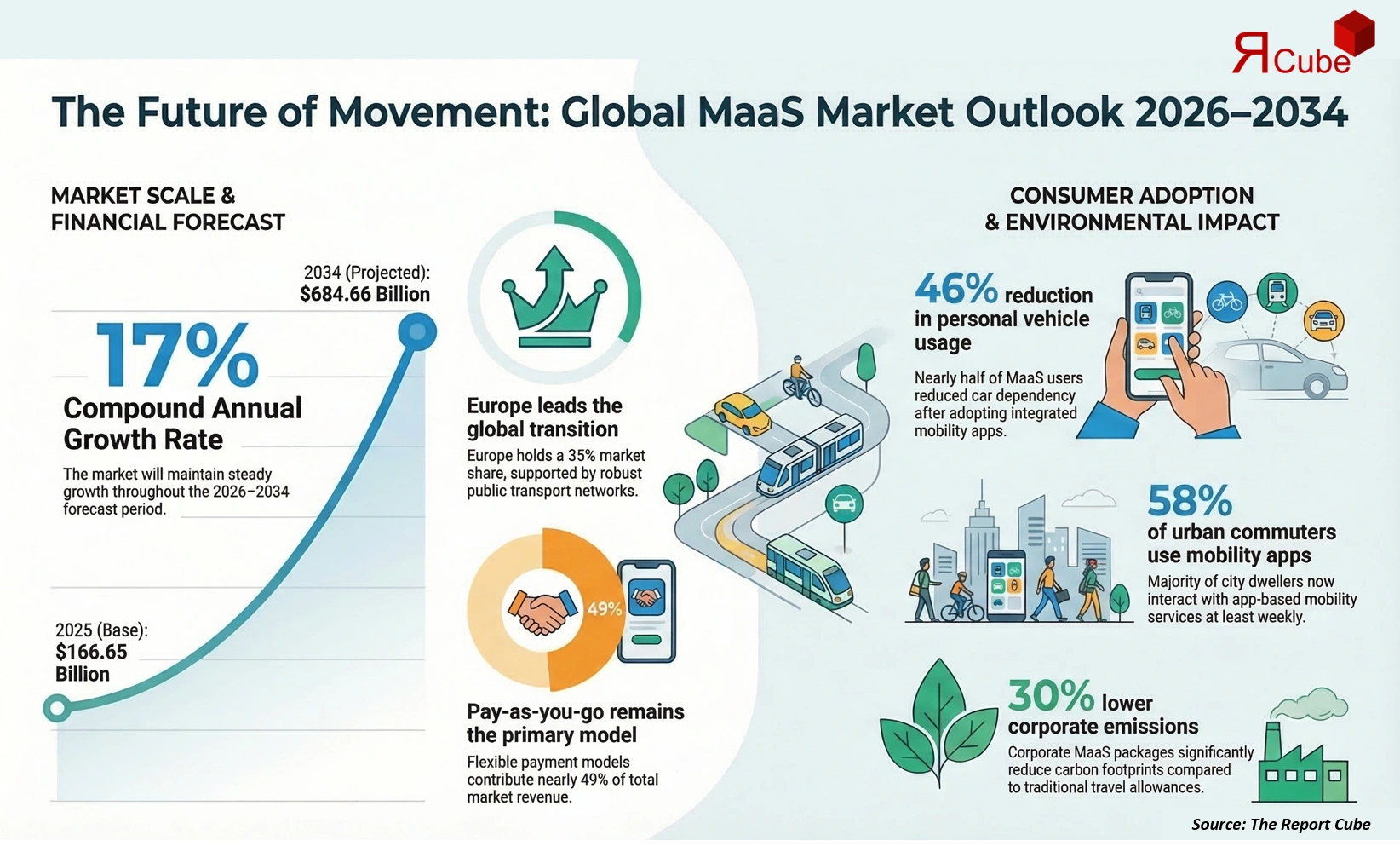
The Global Mobility as a Service (MaaS) Market is anticipated to register a CAGR of 17% during 2026-2034. The market size was valued at USD 166.65 Billion in 2025 and is projected to reach USD 684.66 Billion by 2034. This rapid growth reflects a structural shift in how people access transportation, moving away from private vehicle ownership toward integrated, on-demand mobility solutions. Urban congestion, rising fuel costs, and sustainability concerns are pushing governments, enterprises, and consumers to embrace MaaS platforms that combine multiple transport modes into a single digital interface.
Mobility ecosystems are increasingly centered on convenience, cost efficiency, and flexibility. MaaS platforms integrate ride-hailing, car sharing, public transit, micromobility, and subscription-based transport services, offering users seamless journey planning and payment. In 2024, more than 58% of urban commuters in major global cities used at least one app-based mobility service weekly. The proliferation of smartphones, digital payments, and real-time data analytics continues to support MaaS adoption. As cities invest in smart transportation infrastructure and low-emission mobility zones, MaaS is emerging as a cornerstone of future urban transportation systems.
Global Mobility as a Service (MaaS) Market Recent Developments
- 2025: Uber expanded multimodal integration by adding public transit ticketing in select European cities.
- 2025: MaaS Global enhanced its subscription-based mobility bundles for corporate users.
Government Initiatives & Policies
- EU Urban Mobility Framework: Promotes integrated, sustainable, and digital urban transport solutions. https://transport.ec.europa.eu
- U.S. Smart City Transportation Grants: Supports MaaS pilots and multimodal mobility platforms. https://www.transportation.gov
Global Mobility as a Service (MaaS) Market Dynamics
Key Driver: Urbanization and Demand for Integrated Transportation
The primary driver of the MaaS market is accelerating urbanization combined with the need for efficient, integrated transportation systems. Urban populations are expected to exceed 60% of the global total by 2030, intensifying pressure on existing transport infrastructure. MaaS platforms reduce congestion by optimizing shared mobility usage and encouraging multimodal travel. Surveys in 2024 revealed that nearly 46% of MaaS users reduced personal vehicle usage after adopting integrated mobility apps. The ability to plan, book, and pay for multiple transport modes through a single interface significantly enhances user convenience and adoption.
Major Challenge: Data Integration and Regulatory Complexity
Despite strong growth prospects, MaaS adoption faces challenges related to data integration and regulatory fragmentation. Successful MaaS platforms require seamless data sharing between public transport authorities, private operators, and technology providers. However, inconsistent data standards and regulatory frameworks across cities and countries hinder interoperability. In addition, issues related to data privacy, pricing transparency, and competition regulations create compliance burdens. These challenges can slow platform expansion, particularly in regions with fragmented transport governance structures.
Industry Trends: Subscription-Based Mobility and Micromobility Growth
A key industry trend is the rise of subscription-based mobility packages that offer bundled access to multiple transport services. These models provide predictable monthly costs and encourage frequent usage. In 2025, subscription-based MaaS users accounted for approximately 28% of total platform revenue. Additionally, micromobility services such as bike sharing and electric scooter sharing are being increasingly integrated into MaaS ecosystems. These services address first- and last-mile connectivity, improving overall network efficiency and user satisfaction.
Opportunity Ahead: Corporate Mobility and Smart City Integration
Corporate and enterprise mobility solutions represent a major growth opportunity for MaaS providers. Companies are adopting MaaS platforms to manage employee commuting, reduce travel costs, and meet sustainability targets. Corporate MaaS packages can lower commuting-related emissions by up to 30% compared to traditional travel allowances. Furthermore, integration with smart city platforms, traffic management systems, and urban planning initiatives positions MaaS as a critical enabler of intelligent transportation networks.
Global Mobility as a Service (MaaS) Market Segment-wise Analysis
By Service Type:
- Ride-hailing or Ride-sourcing
- Car Sharing (Round-trip, One-way or Free-floating)
- Micro-mobility Services (Bike Sharing, Electric Scooter Sharing, Other)
- Public Transport Integration
- Corporate or Shuttle Services
- Other MaaS Services
Ride-hailing and ride-sourcing services dominate the service type segment, accounting for approximately 41% of market revenue in 2025. These services benefit from widespread consumer familiarity, extensive driver networks, and flexible pricing models. Public transport integration is the fastest-growing sub-segment, driven by city-led initiatives to improve multimodal connectivity. Car sharing and micromobility services continue to expand as urban users seek short-distance, cost-effective alternatives.
By Business Model:
- Pay-as-you-go
- Subscription-based Bundles
- Corporate or Enterprise Packages
- Other Business Models
The pay-as-you-go model remains dominant, contributing nearly 49% of total market revenue in 2025 due to its flexibility and low entry barriers. However, subscription-based bundles are gaining traction among frequent commuters and urban residents, offering cost predictability and convenience. Corporate and enterprise packages are expanding steadily as organizations adopt MaaS to streamline employee mobility and reduce operational expenses.
Regional Projection of Global Mobility as a Service (MaaS) Industry
- North America
- Europe
- Asia Pacific
- Middle East or Africa
- South America
Europe leads the MaaS market with an estimated 35% share in 2025, supported by strong public transport networks, regulatory support, and early MaaS adoption. Asia Pacific follows closely, driven by rapid urbanization, high smartphone penetration, and large-scale ride-hailing usage in countries such as China and India. North America shows strong growth through corporate mobility and ride-hailing platforms, while the Middle East, Africa, and South America are emerging markets supported by smart city investments.
Why Choose This Report?
- Provides a comprehensive overview of the overall market analysis, encompassing key trends, consumer behavior analysis, and risk assessment to support strategic decision-making.
- Provides accurate, up-to-date insights into market size, segmentation, and emerging opportunities, helping to minimize risk & capitalizing on growth.
- Gives deep understanding of target audience preferences, investment habits, and communication channels for enhanced product development & marketing effectiveness.
- Delivers competitive analysis & benchmarking, uncovering the strengths & weaknesses of market competitors to guide strategies.
- Consolidate comprehensive market intelligence, reducing reasoning & streamlining research efforts.
- Facilitates customized market segmentation & risk mitigation strategies, fine-tuned to the business objectives.
- Aids in identifying both market challenges & untapped opportunities within the industry to drive long-term business growth.
- Provides valuable information based on actual customer data & search trends.
Table of Contents
- Introduction
- Objective of the Study
- Product or Category Definition
- Market Segmentation
- Study Variables
- Research Methodology
- Secondary Data Points
- Breakdown of Secondary Sources
- Primary Data Points
- Breakdown of Primary Interviews
- Secondary Data Points
- Executive Summary
- Market Dynamics
- Drivers
- Challenges
- Opportunity Assessment
- Recent Trends or Developments
- Regulatory or Policy Landscape
- Global Mobility as a Service (MaaS) Market Overview (2020-2034)
- Market Size, By Value (USD Billion)
- Market Share, By Service Type
- Ride-hailing or Ride-sourcing
- Car Sharing
- Round-trip Car Sharing
- One-way or Free-floating Car Sharing
- Micro-mobility Services
- Bike Sharing
- Electric Scooter Sharing
- Other Micro-mobility
- Public Transport Integration
- Corporate or Shuttle Services
- Other MaaS Services
- Market Share, By Business Model
- Pay-as-you-go
- Subscription-based Bundles
- Corporate or Enterprise Packages
- Other Business Models
- Market Share, By Solution or Platform Component
- Technology Platforms or Mobility Aggregators
- Payment Engines or Billing Solutions
- Navigation or Journey Planning Solutions
- Ticketing or Booking Solutions
- Insurance or Ancillary Services
- Market Share, By Application
- Personal Mobility
- Corporate or Enterprise Mobility
- Tourism or Leisure Mobility
- Logistics or Last-mile Delivery
- Other Applications
- Market Share, By End User
- Individual Consumers
- Enterprises
- Government or Public Sector
- Market Share, By Vehicle Type
- Passenger Cars
- Buses or Coaches
- Two-wheelers or Micro-mobility Vehicles
- Other Vehicle Types
- Market Share, By Region
- North America
- Europe
- Asia Pacific
- Middle East or Africa
- South America
- Market Share, By Company
- Revenue Shares
- Competitive Landscape
- North America Mobility as a Service (MaaS) Market
- Market Size, By Value (USD Billion)
- Market Share, By Service Type
- Market Share, By Business Model
- Market Share, By Solution or Platform Component
- Market Share, By Application
- Market Share, By End User
- Market Share, By Vehicle Type
- Market Share, By Region/Country Group
- Market Share, By Country
- United States
- Canada
- Mexico
- Europe Mobility as a Service (MaaS) Market
- Market Size, By Value (USD Billion)
- Market Share, By Service Type
- Market Share, By Business Model
- Market Share, By Solution or Platform Component
- Market Share, By Application
- Market Share, By End User
- Market Share, By Vehicle Type
- Market Share, By Region/Country Group
- Market Share, By Country
- Germany
- France
- United Kingdom
- Italy
- Spain
- Northern or Nordic Countries
- Rest of Europe
- Asia Pacific Mobility as a Service (MaaS) Market
- Market Size, By Value (USD Billion)
- Market Share, By Service Type
- Market Share, By Business Model
- Market Share, By Solution or Platform Component
- Market Share, By Application
- Market Share, By End User
- Market Share, By Vehicle Type
- Market Share, By Region/Country Group
- Market Share, By Country
- China
- Japan
- India
- South Korea
- Australia
- Rest of Asia Pacific
- Middle East or Africa Mobility as a Service (MaaS) Market
- Market Size, By Value (USD Billion)
- Market Share, By Service Type
- Market Share, By Business Model
- Market Share, By Solution or Platform Component
- Market Share, By Application
- Market Share, By End User
- Market Share, By Vehicle Type
- Market Share, By Region/Country Group
- Market Share, By Country
- Saudi Arabia
- United Arab Emirates
- South Africa
- Rest of Middle East or Africa
- South America Mobility as a Service (MaaS) Market
- Market Size, By Value (USD Billion)
- Market Share, By Service Type
- Market Share, By Business Model
- Market Share, By Solution or Platform Component
- Market Share, By Application
- Market Share, By End User
- Market Share, By Vehicle Type
- Market Share, By Region/Country Group
- Market Share, By Country
- Brazil
- Argentina
- Chile
- Rest of South America
- Competitive Outlook or Company Profiles
- Uber
- Company Overview
- Product Portfolio
- Strategic Alliances/Partnerships
- Recent Developments
- Lyft
- Company Overview
- Product Portfolio
- Strategic Alliances/Partnerships
- Recent Developments
- DiDi Chuxing
- Company Overview
- Product Portfolio
- Strategic Alliances/Partnerships
- Recent Developments
- Grab
- Company Overview
- Product Portfolio
- Strategic Alliances/Partnerships
- Recent Developments
- Ola
- Company Overview
- Product Portfolio
- Strategic Alliances/Partnerships
- Recent Developments
- Moovit
- Company Overview
- Product Portfolio
- Strategic Alliances/Partnerships
- Recent Developments
- MaaS Global
- Company Overview
- Product Portfolio
- Strategic Alliances/Partnerships
- Recent Developments
- Citymapper
- Company Overview
- Product Portfolio
- Strategic Alliances/Partnerships
- Recent Developments
- BlaBlaCar
- Company Overview
- Product Portfolio
- Strategic Alliances/Partnerships
- Recent Developments
- Free Now
- Company Overview
- Product Portfolio
- Strategic Alliances/Partnerships
- Recent Developments
- Others
- Uber
- Contact Us or Disclaimer
Top Key Players & Market Share Outlook
- Uber
- Lyft
- DiDi Chuxing
- Grab
- Ola
- Moovit
- MaaS Global
- Citymapper
- BlaBlaCar
- Free Now
- Others
- Contact Us or Disclaimer
Frequently Asked Questions






