




Build Your Custom Market Intelligence Report
Customize Your ReportAustralia Muffin Market Key Takeaways
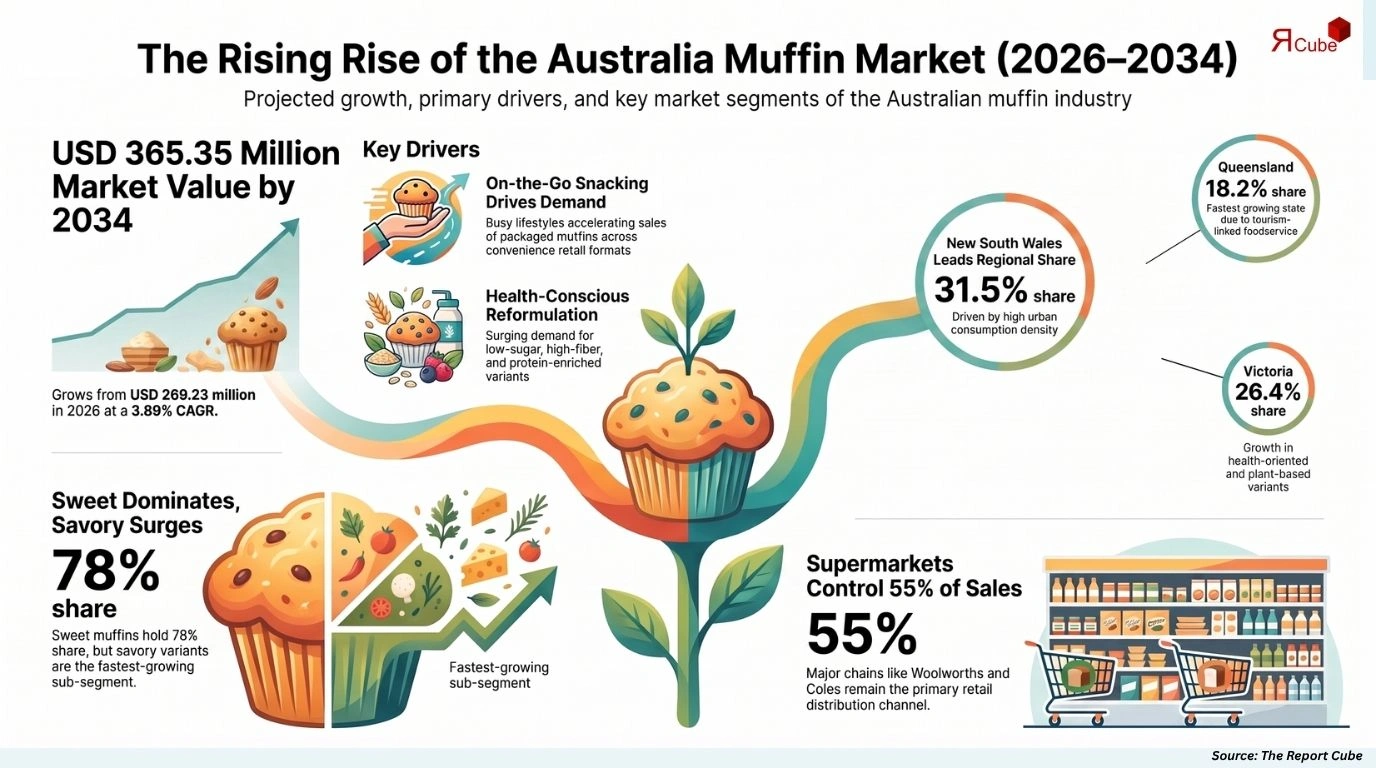
- Australia Muffin Market was valued at USD 269.23 million in 2026.
- The market is projected to reach USD 365.35 million by 2034.
- The market is expected to expand at a steady 3.89% CAGR through 2034.
- Sweet muffins dominate the flavor segment, led by fruit and chocolate variants.
- Hypermarkets and supermarkets remain the leading sales channel by revenue share.
- New South Wales holds the largest regional share driven by urban consumption density.
- Queensland emerges as the fastest-growing state supported by tourism and foodservice demand.
- Rising demand for premium, clean-label, and health-oriented muffin products accelerates growth.
Australia Muffin Market Insights & Analysis
The Australia Muffin Market is anticipated to register a 3.89% CAGR during 2026–2034. The market size was valued at USD 269.23 million in 2026 and is projected to reach USD 365.35 million by 2034. The sector is benefiting from rising consumer interest in convenient, on-the-go bakery products, increased retail shelf expansion by major supermarket chains, and growing demand for premium and specialty muffin formats. Manufacturers are responding with reformulated recipes that reduce added sugars, use whole grains, and incorporate functional ingredients such as protein, fiber, and probiotics to align with evolving dietary preferences.
Investment activity across the Australian bakery sector continues strengthening the muffin category. George Weston Foods and Allied Pinnacle have directed capital toward upgraded production lines and ingredient sourcing partnerships to improve product quality and throughput. State-level food manufacturing support programs, particularly in New South Wales and Victoria, have incentivized bakery companies to expand domestic production capacity. Growing institutional foodservice demand from hospitals, schools, and corporate catering contracts is further broadening the distribution base and supporting steady, long-term revenue growth across the Australia Muffin Market.
Australia Muffin Market Dynamics
The Australia Muffin Market continues expanding as consumer lifestyles shift toward convenient, portable food formats consumed across breakfast, snack, and dessert occasions. Retail channel diversification, product premiumization, and growing awareness of cleaner ingredient profiles are reshaping purchasing behavior and encouraging both incumbent manufacturers and specialty producers to innovate at pace.
|
Factor |
Type |
Specific Impact on Market |
Magnitude |
|---|---|---|---|
|
On-the-go snacking culture |
Driver |
Accelerates packaged muffin sales across convenience formats |
High |
|
Health-conscious reformulation |
Opportunity |
Drives demand for low-sugar, high-fiber, and protein-enriched variants |
High |
|
Specialty and artisan channel growth |
Driver |
Expands revenue contribution of premium SKUs and independent bakeries |
Medium |
|
Private label expansion by supermarkets |
Challenge |
Compresses branded manufacturer margins across mass-market segments |
Medium |
|
Foodservice and institutional purchasing |
Trend |
Increases bulk muffin consumption through schools, hospitals, and workplaces |
High |
Key Market Driver: On-the-Go Snacking Culture Accelerates Demand
Shifting Australian consumer routines continue driving consistent demand for packaged and freshly baked muffins as a portable meal and snack solution. Convenience store operators including 7-Eleven and On the Run have expanded ambient and chilled bakery ranges, creating new shelf opportunities for muffin producers. Morning commute consumption habits, corporate workplace catering programs, and school canteen procurement agreements are collectively reinforcing the category's position as an accessible, affordable, and satisfying food-on-the-go option across both metropolitan and regional Australian markets.
Major Industry Challenge: Private Label Pressure Compresses Branded Margins
Woolworths and Coles continue aggressively expanding their private label bakery portfolios, offering competitively priced muffin products that directly compete with branded manufacturers on shelf. Private label muffins now occupy prominent gondola-end and promotional placements in major supermarkets, making it increasingly difficult for mid-tier branded producers to defend price premiums without clear product differentiation. This structural shift is compelling branded players to invest in specialty ingredients, clean-label certifications, and distinctive packaging to sustain consumer preference and protect long-term revenue share.
Emerging Trend Shaping Outlook: Functional and Better-for-You Muffin Innovation
Australian consumers increasingly seek bakery products that deliver nutritional benefits without sacrificing convenience or taste. Better-for-you muffins formulated with oats, chia seeds, plant-based proteins, reduced sugar content, and high-fiber flours are gaining meaningful traction in specialty retail and online channels. Manufacturers including Priestley's Gourmet Delights and Great Temptations are reformulating core product lines to incorporate these functional ingredients while pursuing accreditation from the Health Star Rating system, enabling them to position premium muffin variants as smart snacking choices for health-conscious Australian households.
Need Specific Data, Let’s Customize the Report for You
Request CustomizationAustralia Muffin Market Segment-wise Analysis
Australian consumers purchase muffins across a wide range of flavor preferences and retail environments, creating distinct revenue dynamics across each segment. Understanding performance across flavor and sales channel dimensions is essential for identifying where volume growth and margin expansion opportunities are most concentrated.
By Flavor
- Sweet
- Savory
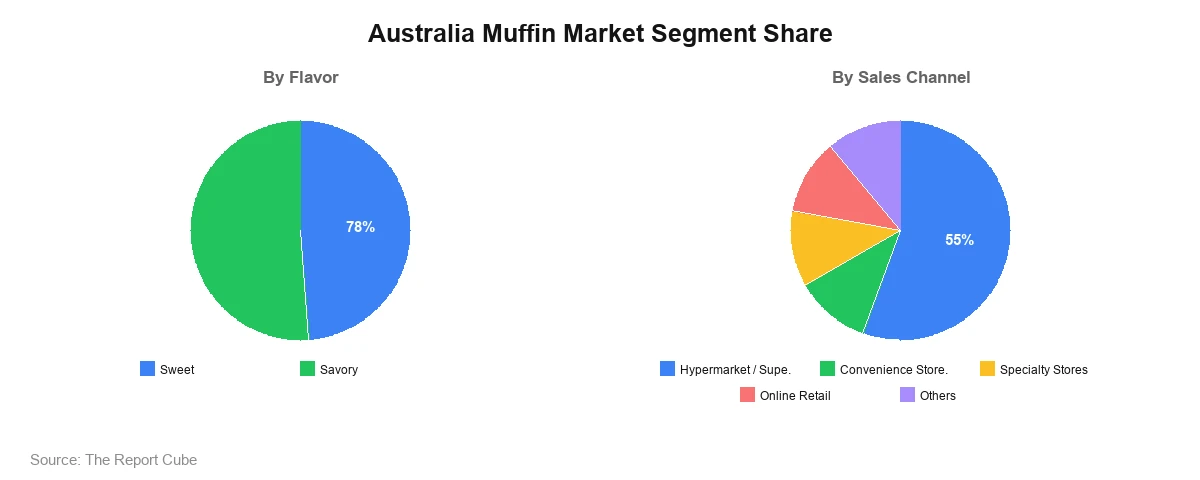
Sweet muffins dominate the flavor segment with an estimated 78% market share, driven by sustained consumer preference for fruit, chocolate chip, blueberry, banana, and double chocolate variants available across supermarkets, convenience stores, and specialty bakeries. Fruit-based sweet muffins continue to lead individual SKU performance as they appeal across household demographics - from children's lunchboxes to adult workplace snacking - and align with ongoing clean-label reformulation trends that allow manufacturers to use real fruit pieces as a natural sweetener replacement.
Savory muffins represent the faster-growing flavor sub-segment as Australian consumers increasingly seek savory on-the-go breakfast alternatives to traditional sweet formats. Cheese and chive, bacon and spinach, and sun-dried tomato and feta variants are expanding through foodservice channels, specialty bakery networks, and premium grocery retailers. Hospitality venues, café chains, and corporate catering operators are incorporating savory muffins into hot breakfast menus, providing manufacturers a growing institutional volume channel that complements their retail distribution and supports more stable year-round sales performance.
By Sales Channel
- Hypermarket / Supermarket
- Convenience Store
- Specialty Stores
- Online Retail
- Others
Hypermarkets and supermarkets dominate the sales channel segment with an estimated 55% market share, reflecting the central role that Woolworths, Coles, and ALDI play in packaged and in-store bakery muffin distribution across Australia. These retailers provide manufacturers with unmatched national reach, promotional shelf space, and multi-format product placement - spanning ambient packaged muffins, individually wrapped grab-and-go units, and fresh bakery sections - that collectively generate the highest absolute volume across all sales channels within the category.
Specialty stores and online retail are the fastest-growing sales channels as consumers seek premium artisan muffins and direct-to-door delivery of freshly baked bakery products. Independent patisseries and boutique café chains offer limited-edition and seasonal muffin varieties that command higher price points and generate strong social media engagement among urban consumers. Online grocery platforms operated by Woolworths and Coles, alongside specialty food delivery services, have meaningfully expanded muffin accessibility in regional areas previously underserved by physical specialty bakery retail infrastructure, supporting broader category growth.
Regional Projection of Australia Muffin Market
The Australia Muffin Market demonstrates clear regional variation based on population concentration, urbanization levels, foodservice density, and consumer income profiles. Eastern seaboard states collectively generate the majority of national revenue, while Queensland and Western Australia are emerging as important growth markets.
|
Region |
Estimated Market Share |
Key Growth Factors |
Consumer Trends |
|---|---|---|---|
|
New South Wales |
31.5% |
Urban density, café culture, strong retail infrastructure |
Premium and specialty muffin demand |
|
Victoria |
26.4% |
Melbourne foodservice growth, artisan bakery expansion |
Health-oriented and plant-based variants |
|
Queensland |
18.2% |
Tourism, regional population growth, foodservice expansion |
Convenience and on-the-go format preference |
|
Western Australia |
10.8% |
Mining sector workforce catering, Perth retail growth |
Packaged ambient muffin sales |
|
Australian Capital Territory |
5.1% |
Government precinct foodservice, institutional procurement |
Premium and specialty channel adoption |
|
Others |
8.0% |
South Australia and Tasmania regional retail expansion |
Everyday value-tier muffin consumption |
- New South Wales: New South Wales leads the Australia Muffin Market with approximately 31.5% revenue share, supported by Sydney's dense café culture, high supermarket footfall, and strong specialty bakery presence.
- Victoria: Victoria maintains the second-largest share, underpinned by Melbourne's established artisan bakery and café ecosystem that continuously drives premium muffin innovation and adoption.
- Queensland: Queensland is the fastest-growing state market, benefiting from tourism-linked foodservice demand across the Gold Coast and Cairns, alongside sustained population growth in South East Queensland.
- Western Australia: Western Australia shows steady demand driven by Perth's growing retail sector and large-scale catering contracts serving remote mining and construction workforce accommodation camps.
- Australian Capital Territory: The ACT generates consistent muffin revenue through government workplace cafeterias, university campus catering programs, and a concentration of premium specialty bakery operators.
- Others: South Australia, Tasmania, Northern Territory, and other regions collectively contribute through everyday retail consumption, regional supermarket channels, and emerging artisan bakery activity.
Australia Muffin Market: Recent Development (2025)
- Allied Pinnacle launched a new high-fiber muffin range targeting health-conscious Australian retail consumers nationwide.
- Priestley's Gourmet Delights expanded its savory muffin portfolio with three new café-channel flavors this year.
- George Weston Foods secured a major institutional supply contract covering muffin products for Queensland school canteens.
- Danish Patisserie partnered with a leading national foodservice distributor to expand premium muffin reach significantly.
Australia Muffin Market Future Outlook (2034)
The Australia Muffin Market is projected to expand at a 3.89% CAGR, reaching approximately USD 365.35 million by 2034. Growth will be sustained by the ongoing premiumization of the bakery category, increasing consumer willingness to pay for clean-label and functional ingredients, and expanding foodservice procurement from institutional buyers. Digital retail channels are expected to capture a growing share of muffin purchases as subscription meal kit services and online grocery platforms integrate fresh and ambient bakery products more effectively into their weekly delivery offerings.
Long-term market expansion will be shaped by investment in sustainable packaging, reduced-sugar reformulations, and plant-based ingredient adoption across both sweet and savory muffin segments. Manufacturers that successfully build Health Star Rating credentials and obtain relevant allergen-free or vegan certifications will gain competitive advantage in retail and institutional channels. Automation upgrades at domestic production facilities operated by key players including Great Temptations and Allied Pinnacle will further support margin resilience while enabling faster new product development cycles to meet evolving consumer demand across Australian states.
Australia Muffin Market Report Coverage
|
Report Attribute |
Details |
|---|---|
|
Market Name |
Australia Muffin Market |
|
Market Size (2026) |
USD 269.23 Million |
|
Market Size (2034) |
USD 365.35 Million |
|
Forecast Period |
2026–2034 |
|
CAGR |
3.89% |
|
Base Year |
2026 |
|
Historical Years |
2021–2025 |
|
Forecast Years |
2026–2034 |
|
Segments Covered |
By Flavor, By Sales Channel, By Type |
|
Regions Covered |
New South Wales, Victoria, Queensland, Australian Capital Territory, Western Australia, Others |
|
Key Companies |
Allied Pinnacle, Priestley's Gourmet Delights, Danish Patisserie, George Weston Foods, Great Temptations, Others |
|
Report Format |
PDF, Excel, PPT |
|
Customization |
Available as per client requirements |
Why Choose This Report?
- Comprehensive analysis covering all major flavor and sales channel segments.
- Accurate market sizing with a reliable 2026 to 2034 forecast period.
- State-level regional breakdown identifying Australia's fastest-growing markets.
- Competitive profiling of leading Australian muffin manufacturers and producers.
- Insights into private label dynamics and branded manufacturer positioning strategies.
- Data-backed analysis of functional and better-for-you muffin product trends.
- Strategic intelligence supporting investment, expansion, and product development decisions.
- Research aligned with EEAT standards and current Australian bakery industry trends.
Table of Contents
- Introduction
- Objective of the Study
- Product Definition
- Market Segmentation
- Study Variables
- Research Methodology
- Secondary Data Points
- Companies Interviewed
- Primary Data Points
- Breakdown of Primary Interviews
- Secondary Data Points
- Executive Summary
- Market Dynamics
- Drivers
- Challenges
- Opportunity Assessment
- Recent Trends and Developments
- Policy and Regulatory Landscape
- Australia Muffin Market Overview and Forecast Analysis (2021-2034)
- Market Size, By Value, By Growth Rate (CAGR/USD Millions)
- Demand – Supply Trends
- Market Share, By Type
- Packaged
- In-Store
- Market Share, By Flavor
- Sweet
- Savory
- Market Share, By Sales Channel
- Hypermarket/ Supermarket
- Convenience Store
- Specialty Stores
- Online Retail
- Others
- Market Share, By Region
- New South Wales
- Victoria
- Queensland
- Australian Capital Territory
- Western Australia
- Others
- Market Share, By Competitors
- Competition Characteristics
- Revenue Shares
- Packaged Australia Muffin Market Overview, 2021-2034F
- By Value (USD Million)
- By Flavor – Market Size & Forecast 2021-2034, USD Million
- Sweet
- Savory
- In-Store Australia Muffin Market Overview, 2021-2034F
- By Value (USD Million)
- By Flavor – Market Size & Forecast 2021-2034, USD Million
- Sweet
- Savory
- Competitive Outlook (Company Profile – Partial List)
- Allied Pinnacle
- Company Overview
- Business Segments
- Strategic Alliances/Partnerships
- Recent Developments
- Priestley’s Gourmet Delights
- Company Overview
- Business Segments
- Strategic Alliances/Partnerships
- Recent Developments
- Danish Patisserie
- Company Overview
- Business Segments
- Strategic Alliances/Partnerships
- Recent Developments
- George Weston Foods
- Company Overview
- Business Segments
- Strategic Alliances/Partnerships
- Recent Developments
- Great Temptations
- Company Overview
- Business Segments
- Strategic Alliances/Partnerships
- Recent Developments
- Others
- Allied Pinnacle
- Contact Us & Disclaimer
Top Key Players & Market Share Outlook
- Allied Pinnacle
- Priestley’s Gourmet Delights
- Danish Patisserie
- George Weston Foods
- Great Temptations
- Others
Frequently Asked Questions






