



Build Your Custom Market Intelligence Report
Customize Your ReportGlobal Neurology Devices Market Key Takeaways
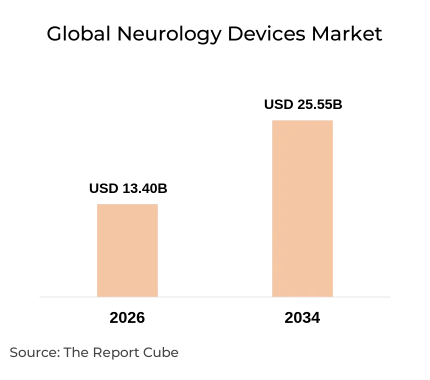
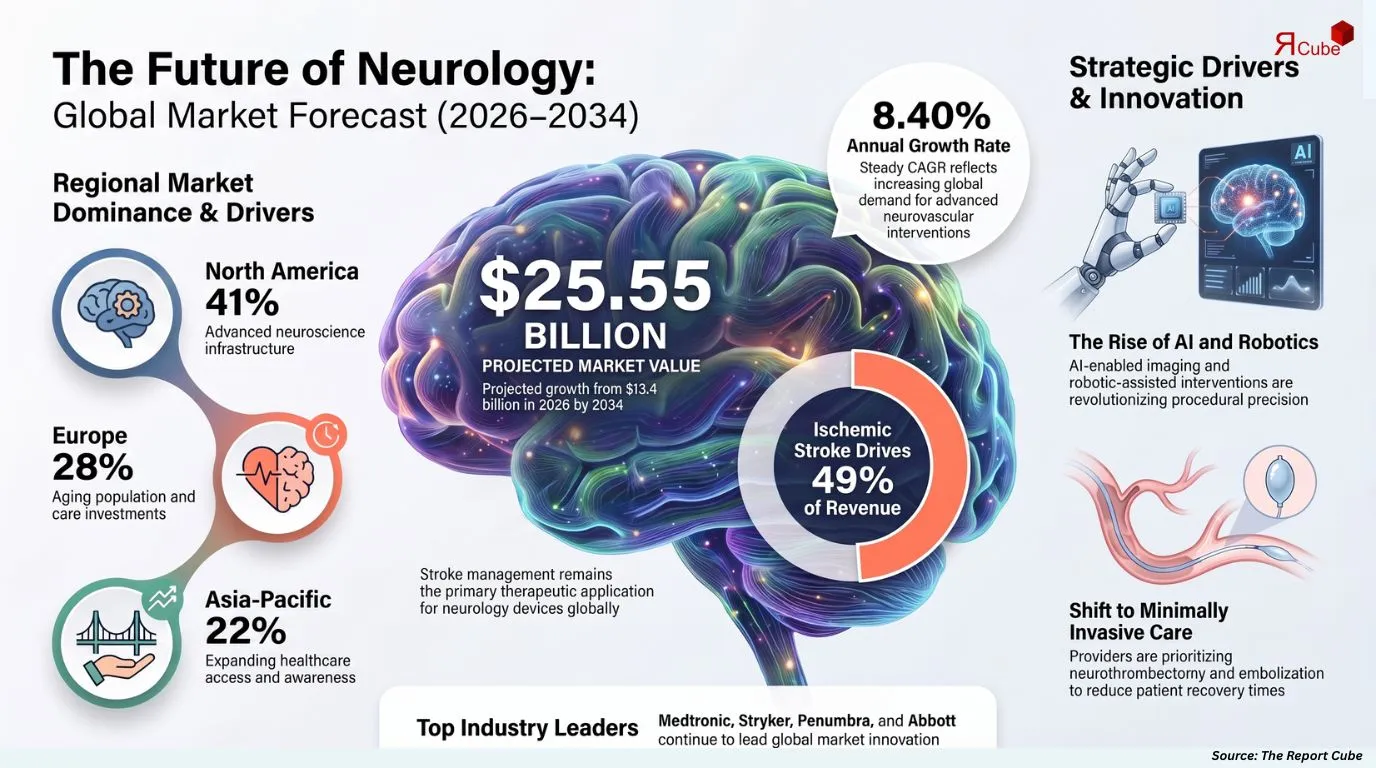
- Market size reached USD 13.4 billion during 2026 assessment year.
- Industry projected to attain USD 25.55 billion by 2034.
- Market forecast indicates a CAGR of 8.40% through 2034.
- Medtronic, Stryker, Penumbra, and Abbott remain leading market participants.
- Neurothrombectomy Devices dominate the device type segment globally.
- Ischemic Stroke accounts for the highest therapeutic application revenue.
- North America remains the leading regional neurology devices market.
- Rising neurological disorder prevalence continues supporting market expansion.
Global Neurology Devices Market Insights & Analysis
The Global Neurology Devices Market is anticipated to register a 8.40% CAGR during 2026-2034. The market size was valued at USD 13.4 billion in 2026 and is projected to reach USD 25.55 billion by 2034. The market is witnessing significant growth due to the increasing prevalence of neurological disorders, rising incidence of stroke, and expanding adoption of minimally invasive neurovascular procedures. Healthcare providers are increasingly utilizing advanced neurology devices to improve treatment precision, enhance patient outcomes, and reduce recovery periods. Growing investments in neuroscience research, specialized stroke centers, and healthcare infrastructure are further contributing to market development.
Investments in artificial intelligence-enabled imaging systems, robotic-assisted neurovascular interventions, and advanced catheter technologies continue strengthening the market landscape. Medical device manufacturers are focusing on innovative product development, enhanced procedural efficiency, and improved clinical outcomes. Additionally, increasing awareness regarding early diagnosis and rapid neurological intervention is expected to support long-term market growth throughout the forecast period.
Global Neurology Devices Market Dynamics
The global neurology devices market is experiencing rapid transformation driven by technological innovation, expanding neurological healthcare services, and increasing demand for minimally invasive treatment options. Healthcare providers are adopting advanced neurovascular technologies that improve procedural accuracy, treatment efficiency, and long-term patient outcomes. These evolving market dynamics are creating substantial opportunities across hospitals and specialized neuroscience centers.
Growing demand for early diagnosis, improved neurological interventions, and better patient survival rates is strengthening market development. Technological advancements in catheter systems, embolization devices, imaging technologies, and robotic-assisted procedures are improving clinical performance and procedural safety. These developments are expected to reinforce market competitiveness and support future industry expansion.
|
Factor |
Type |
Specific Impact on Market |
Magnitude |
|---|---|---|---|
|
Rising prevalence of neurological disorders |
Driver |
Increases demand for neurology devices |
High |
|
Growing incidence of ischemic stroke |
Driver |
Expands neurovascular intervention procedures |
High |
|
AI-assisted neuroimaging technologies |
Trend |
Enhances diagnostic precision and treatment planning |
High |
|
Complex neurovascular procedures |
Challenge |
Requires specialized clinical expertise |
Medium |
|
Expansion of stroke care centers |
Opportunity |
Creates broader market demand |
High |
Key Market Driver: Increasing Burden of Neurological Disorders
The growing burden of neurological disorders remains a major factor driving the global neurology devices market. Rising cases of ischemic stroke, cerebral aneurysms, stenosis, and vascular malformations are increasing demand for advanced neurovascular intervention technologies. Healthcare professionals increasingly prefer minimally invasive treatment approaches because they improve procedural precision while reducing patient recovery times. Continuous expansion of specialized stroke care programs and neurological treatment centers is further supporting market growth. Growing awareness regarding timely neurological intervention continues strengthening global adoption.
Major Industry Challenge: Managing Complex Neurovascular Procedures
Managing complex neurovascular procedures remains a significant challenge within the neurology devices industry. Successful interventions require highly specialized clinical expertise, advanced imaging systems, and coordinated multidisciplinary healthcare teams. Variations in vascular anatomy and procedural complexity demand continuous professional training and technological improvements. Manufacturers are focusing on improving device precision, procedural reliability, and clinical usability while supporting physician education initiatives. These efforts are helping address operational challenges across healthcare facilities.
Emerging Trend Shaping Outlook: Artificial Intelligence Neurovascular Innovation
Artificial intelligence integration into neurovascular technologies is emerging as a major trend shaping the future outlook of the market. AI-powered imaging platforms assist physicians in identifying vascular abnormalities, optimizing treatment planning, and improving procedural decision-making. Advanced analytics, real-time visualization, and robotic-assisted interventions are enhancing treatment efficiency and patient outcomes. Continuous innovation in smart neurological devices is expected to accelerate adoption across healthcare institutions and create substantial opportunities for market growth through 2034.
The market continues benefiting from increasing healthcare investments, aging populations, and expanding neurological disease awareness. Industry participants are focusing on innovation, clinical effectiveness, and patient safety to strengthen competitive positioning. These developments are supporting long-term market growth prospects. Strategic collaborations among medical device manufacturers, neuroscience research organizations, and healthcare providers are accelerating product development and commercialization. Organizations emphasizing minimally invasive technologies, AI integration, and advanced neurovascular solutions are expected to maintain strong competitive positions throughout the forecast period.
Need Specific Data, Let’s Customize the Report for You
Request CustomizationGlobal Neurology Devices Market Segment-wise Analysis
The global neurology devices market demonstrates a diversified segmentation structure based on device type and therapeutic application. Growing demand for advanced neurovascular interventions, minimally invasive procedures, and precision neurological treatment continues influencing segment performance. Expanding investments in stroke management and neuroscience innovation are creating substantial opportunities across multiple market segments.
By Type of Device
- Neurothrombectomy Devices
- Embolization Devices
- Angioplasty Devices
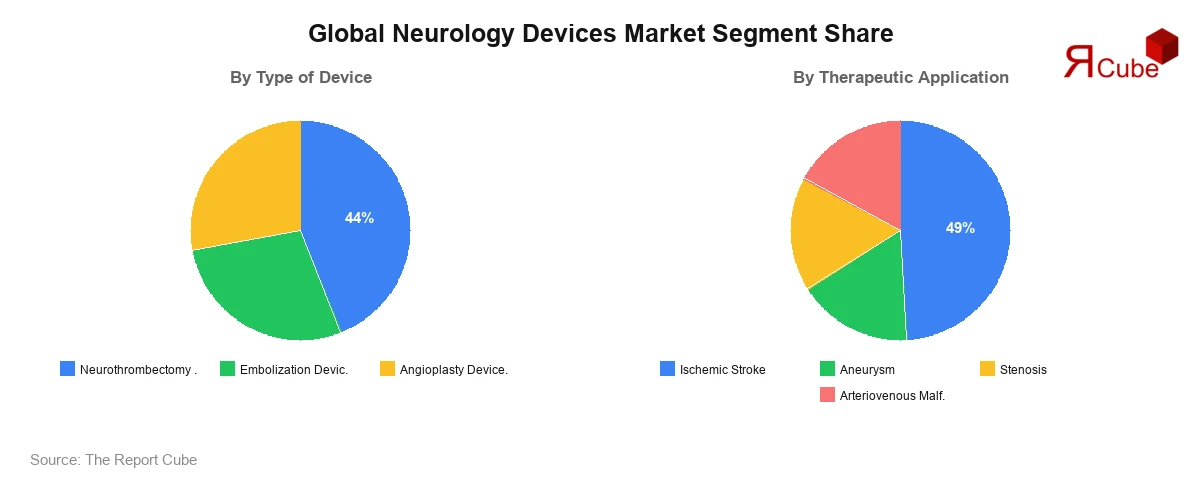
Neurothrombectomy Devices dominate the device type segment with an estimated market share of approximately 44%. Growth is supported by increasing incidence of acute ischemic stroke and expanding adoption of minimally invasive thrombectomy procedures worldwide. These devices significantly improve blood flow restoration and clinical outcomes while reducing disability risks. Continuous technological advancements in catheter design and retrieval systems continue reinforcing segment leadership.
Embolization Devices also represent a significant market segment due to increasing treatment of cerebral aneurysms and vascular abnormalities. Angioplasty Devices continue contributing substantially to market expansion through growing utilization in neurovascular stenosis management.
By Therapeutic Application
- Ischemic Stroke
- Aneurysm
- Stenosis
- Arteriovenous Malformations (AVMs)
Ischemic Stroke accounts for approximately 49% market share, making it the dominant therapeutic application segment within the global neurology devices market. Growth is driven by increasing global stroke incidence, expanding emergency stroke care infrastructure, and rising adoption of neurothrombectomy technologies. Early intervention using advanced neurology devices significantly improves treatment outcomes and patient recovery.
Aneurysm also represents a major application area due to increasing utilization of embolization devices and minimally invasive neurovascular procedures. Stenosis and Arteriovenous Malformations (AVMs) continue contributing substantially to overall market growth.
Regional Projection of Global Neurology Devices Market
The regional landscape of the global neurology devices market reflects differences in healthcare infrastructure, neurological disease management, and technology adoption. Demand remains concentrated in regions with advanced neuroscience centers and established medical device industries. Continued investments in stroke care infrastructure and minimally invasive technologies are expected to support market growth across major regions.
|
Region |
Estimated Market Share |
Key Growth Factors |
Consumer Trends |
|---|---|---|---|
|
North America |
41% |
Advanced neuroscience infrastructure and stroke care |
High minimally invasive procedure adoption |
|
Europe |
28% |
Growing aging population and neurological care investments |
Increasing neurovascular interventions |
|
Asia-Pacific |
22% |
Expanding healthcare access and stroke awareness |
Rising adoption of advanced neurological devices |
|
Rest of World |
9% |
Improving healthcare infrastructure |
Growing neurological treatment demand |
- North America
- Europe
- Asia-Pacific
- Rest of World
North America leads the market with an estimated 41% share due to its advanced healthcare infrastructure, specialized neuroscience centers, and widespread adoption of innovative neurovascular technologies. The region serves as a major hub for clinical research, medical device innovation, and advanced neurological interventions.
The region also benefits from increasing healthcare expenditure, favorable reimbursement systems, and strong awareness regarding stroke management. Growing utilization of AI-assisted neurovascular technologies is expected to reinforce North America's leadership position throughout the forecast period.
Global Neurology Devices Market: Recent Development (2025)
- Medtronic introduced advanced neurovascular thrombectomy technologies improving acute stroke treatment outcomes globally.
- Penumbra expanded innovative aspiration systems enhancing minimally invasive neurovascular intervention capabilities worldwide.
- Stryker strengthened neurovascular portfolio supporting advanced aneurysm and ischemic stroke treatment solutions.
- Boston Scientific expanded neurological research initiatives accelerating next-generation neurovascular device innovation globally.
Global Neurology Devices Market Future Outlook (2034)
The Global Neurology Devices Market is expected to reach USD 25.55 billion by 2034 while expanding at a CAGR of 8.40% throughout the forecast period. Rising neurological disease prevalence, increasing stroke incidence, and expanding demand for minimally invasive neurovascular procedures are expected to create substantial opportunities for medical device manufacturers and healthcare providers.
Technological advancements in AI-driven neuroimaging, robotic-assisted interventions, intelligent catheter systems, and advanced embolization technologies are expected to improve procedural precision and patient outcomes. Expanding investments in neuroscience research, digital healthcare, and specialized stroke care infrastructure will support long-term market growth and innovation through 2034.
Global Neurology Devices Market Report Coverage
|
Report Attribute |
Details |
|---|---|
|
Market Name |
Global Neurology Devices Market |
|
Market Size (2026) |
USD 13.4 billion |
|
Market Size (2034) |
USD 25.55 billion |
|
Forecast Period |
2026-2034 |
|
CAGR |
8.40% |
|
Customization |
Available Upon Request |
|
Segments Covered |
By Type of Device, By Therapeutic Application, By End User |
|
Regions Covered |
North America, Europe, Asia-Pacific, Rest of World |
|
Key Companies |
Medtronic, Johnson and Johnson Services Inc., Penumbra, Inc., Microport Scientific Corporation, Stryker, Microvention Inc. (Terumo Corporation), Codman Neuro (Integra Lifesciences), Abbott, Boston Scientific Corporation, Others |
|
Report Format |
PDF, Excel, PPT |
Why Choose This Report?
- Comprehensive assessment of market size, forecasts, and growth opportunities.
- Detailed evaluation of device type and therapeutic application trends.
- In-depth regional analysis highlighting neurological healthcare developments.
- Competitive intelligence covering major companies and strategic innovations.
- Insights into AI-enabled neurovascular technologies and minimally invasive procedures.
- Reliable forecasting framework supporting investment and strategic business decisions.
Table of Contents
- Introduction
- Objective of the study
- Product Definition
- Market Segmentation
- Study Variables
- Research Methodology
- Secondary Data Points
- Companies Interviewed
- Primary Data Points
- Breakdown of Primary Interviews
- Secondary Data Points
- Executive Summary
- Market Dynamics
- Drivers
- Challenges
- Opportunity Assessment
- Recent Trends and Developments
- Policy and Regulatory Landscape
- Global Neurology Devices Market Overview and Forecast Analysis (2021-2034)
- Market Size, By Value, By growth rate (CAGR/USD Billions)
- Demand - Supply Trends
- Market Share, By Type of Device
- Neurothrombectomy Devices
- Embolization Devices
- Angioplasty Devices
- Market Share, By Therapeutic Application
- Ischemic Stroke
- Aneurysm
- Stenosis
- Arteriovenous Malformations (AVMs)
- Market Share, By End User
- Hospitals and Specialty Clinics
- Ambulatory Care Centers
- Other End Users
- Market Share, By Region
- North America
- Europe
- Asia-Pacific
- Rest of World
- Market Share, By Competitors
- Competition Characteristics
- Revenue Shares
- Global Neurothrombectomy Devices Neurology Devices Market Overview, 2021-2034F
- By Value (USD Million)
- By Therapeutic Application- Market Size & Forecast 2021-2034, USD Million
- By End User- Market Size & Forecast 2021-2034, USD Million
- Global Embolization Devices Neurology Devices Market Overview, 2021-2034F
- By Value (USD Million)
- By Therapeutic Application- Market Size & Forecast 2021-2034, USD Million
- By End User- Market Size & Forecast 2021-2034, USD Million
- Global Angioplasty Devices Neurology Devices Market Overview, 2021-2034F
- By Value (USD Million)
- By Therapeutic Application- Market Size & Forecast 2021-2034, USD Million
- By End User- Market Size & Forecast 2021-2034, USD Million
- Competitive Outlook (Company Profile - Partial List)
- Medtronic
- Company Overview
- Business Segments
- Strategic Alliances/Partnerships
- Recent Developments
- Johnson and Johnson Services Inc.
- Company Overview
- Business Segments
- Strategic Alliances/Partnerships
- Recent Developments
- Penumbra, Inc.
- Company Overview
- Business Segments
- Strategic Alliances/Partnerships
- Recent Developments
- Microport Scientific Corporation
- Company Overview
- Business Segments
- Strategic Alliances/Partnerships
- Recent Developments
- Stryker
- Company Overview
- Business Segments
- Strategic Alliances/Partnerships
- Recent Developments
- Microvention Inc (Terumo Corporation)
- Company Overview
- Business Segments
- Strategic Alliances/Partnerships
- Recent Developments
- Codman Neuro (Integra Lifesciences)
- Company Overview
- Business Segments
- Strategic Alliances/Partnerships
- Recent Developments
- Abbott
- Company Overview
- Business Segments
- Strategic Alliances/Partnerships
- Recent Developments
- Boston Scientific Corporation
- Company Overview
- Business Segments
- Strategic Alliances/Partnerships
- Recent Developments
- Others
- Medtronic
- Contact Us & Disclaimer
Top Key Players & Market Share Outlook
- Medtronic
- Johnson and Johnson Services Inc.
- Penumbra, Inc.
- Microport Scientific Corporation
- Stryker
- Microvention Inc (Terumo Corporation)
- Codman Neuro (Integra Lifesciences)
- Abbott
- Boston Scientific Corporation
- Others
Frequently Asked Questions






