



Build Your Custom Market Intelligence Report
Customize Your ReportKey Takeaways
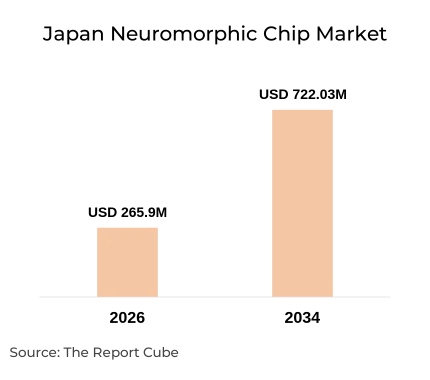
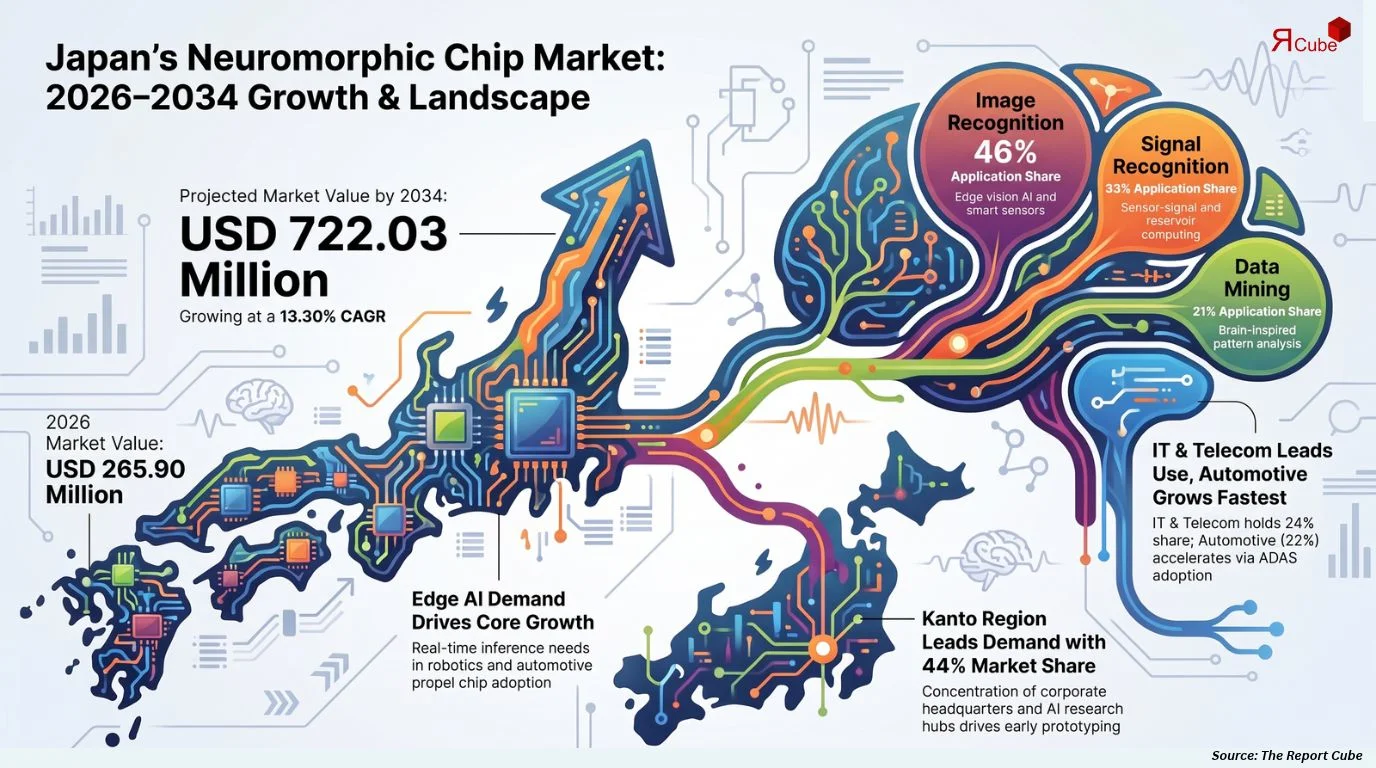
- Japan neuromorphic chip market valued at USD 265.90 million in 2026, reflecting early commercial adoption.
- Industry projected to reach USD 722.03 million by 2034 at 13.30% CAGR.
- Image recognition leads the application segment, supported by expanding edge vision AI deployment.
- IT and telecom dominates Japan's end-user landscape with the largest procurement share.
- Automotive remains the fastest-growing end-user segment across advanced driver assistance deployments.
- Sony, TDK, Renesas Electronics, Intel, and IBM lead neuromorphic chip development and supply in Japan.
- Ultra-low-power edge AI and spintronic memristor research are reshaping neuromorphic chip design priorities.
Market Overview
This Japan Neuromorphic Chip Market Analysis shows the market valued at USD 265.90 million in 2026, advancing at a 13.30% CAGR toward 2034. Demand rises with edge AI deployment, while Japan's Moonshot R&D and semiconductor revitalization funding support research. Sony Corporation, TDK Corporation, and Renesas Electronics lead supply.
Japan's robotics, automotive, and factory automation industries generate demand for low-power, real-time inference silicon. Japan's precision electronics base supports domestic design capability. Intel Corporation and IBM Corporation advance neuromorphic platforms that Japanese researchers and system integrators evaluate, while energy efficiency goals encourage sustainable AI hardware adoption.
Market Size & Forecast
|
Metric |
Details |
|---|---|
|
Market Size (2026) |
USD 265.90 Million |
|
Market Size (2034) |
USD 722.03 Million |
|
CAGR (2026–2034) |
13.30% |
|
Base Year |
2026 |
|
Historical Years |
2021–2025 |
|
Forecast Years |
2026–2034 |
The Japan Neuromorphic Chip Market Size was valued at USD 265.90 million in 2026 and is projected to touch USD 722.03 million by 2034, growing at a 13.30% CAGR. Growth is differentiated by Japan's strength in sensors, spintronics, and automotive semiconductors, which allows domestic suppliers to integrate brain-inspired processing directly into edge devices.
Market Dynamics
Japan Neuromorphic Chip Market Growth reflects converging forces: rising edge AI workloads, power-efficiency pressure on conventional processors, and strong public research funding. Commercial adoption remains early, so maturing toolchains, automotive qualification, and cost reduction will determine how quickly pilot deployments convert into volume procurement across Japanese industries.
|
Factor |
Type |
Specific Impact on Market |
Magnitude |
|---|---|---|---|
|
Edge AI and low-power inference demand |
Driver |
Increases adoption of event-driven chips in sensors, robots, and wearables |
High |
|
Government semiconductor and AI R&D funding |
Driver |
Strengthens domestic research on spintronic and memristive devices |
High |
|
Automotive ADAS and autonomous driving |
Opportunity |
Opens real-time sensor processing applications for low-latency chips |
High |
|
Immature software ecosystems and tooling |
Challenge |
Slows developer adoption and commercial integration |
Medium |
|
Physical reservoir computing and in-sensor AI |
Trend |
Shifts design toward analog and sensor-integrated architectures |
Medium |
- Growth Drivers: Edge AI Proliferation: Japanese robotics, automotive, and consumer device makers need real-time inference within tight power budgets. Chip development programs at Sony Corporation, TDK Corporation, and Renesas Electronics Corporation address this requirement, supported by national semiconductor and AI research funding.
- Market Opportunities: Automotive and industrial automation present the largest openings. Sensor-adjacent chips that process vision and vibration data on-device can lower latency and energy use in advanced driver assistance, predictive maintenance, and robotics, aligning with Japan's manufacturing strengths and its aging-workforce automation needs.
- Industry Challenges: Competition from established GPU and NPU accelerators, whose software stacks are mature, narrows the neuromorphic value proposition. High design costs, qualification requirements for automotive and aerospace applications, and dependence on advanced fabrication capacity add investment risk for Japanese chip developers.
Need Specific Data, Let’s Customize the Report for You
Request CustomizationMarket Trends
Japan Neuromorphic Chip Market Trends center on ultra-low-power edge intelligence, physical computing approaches, and growing automotive and industrial pilots.
- Emerging Trends: Reservoir computing and spintronic memristors are moving from laboratories toward prototypes, with TDK Corporation and Hokkaido University demonstrating an analog reservoir AI chip in 2025. Developers increasingly target time-series workloads such as motion, vibration, and audio signals where brain-inspired processing offers clear efficiency advantages.
- Technology Trends: Event-driven spiking architectures, in-sensor processing, and analog in-memory computing are converging in chip design. Intel's Loihi 2 platform and IBM's NorthPole research set architecture benchmarks, while Japanese firms increasingly integrate neuromorphic functions alongside image sensors, microcontrollers, and magnetic memory devices.
- Consumer / Buyer Trends: Buyers in automotive, industrial, and electronics sectors prioritize energy per inference, latency, and ease of integration over raw performance. Procurement teams increasingly request development kits and software support, and favor suppliers offering sensor-plus-processor bundles that shorten evaluation cycles for edge AI products.
- Regulatory Trends: Japan's AI governance guidelines, functional safety standards such as ISO 26262 for automotive systems, and export control rules for advanced semiconductors shape product design and commercialization. Government support under national semiconductor strategies encourages domestic research, while privacy rules favor on-device processing.
Japan Neuromorphic Chip Market Segment Analysis
Japan Neuromorphic Chip Market Share is distributed across application workloads and end-use industries, each shaped by distinct latency, power, and reliability requirements. Image recognition anchors current demand, while automotive and industrial users drive the strongest adoption momentum.
By Application
- Image Recognition
- Signal Recognition
- Data Mining
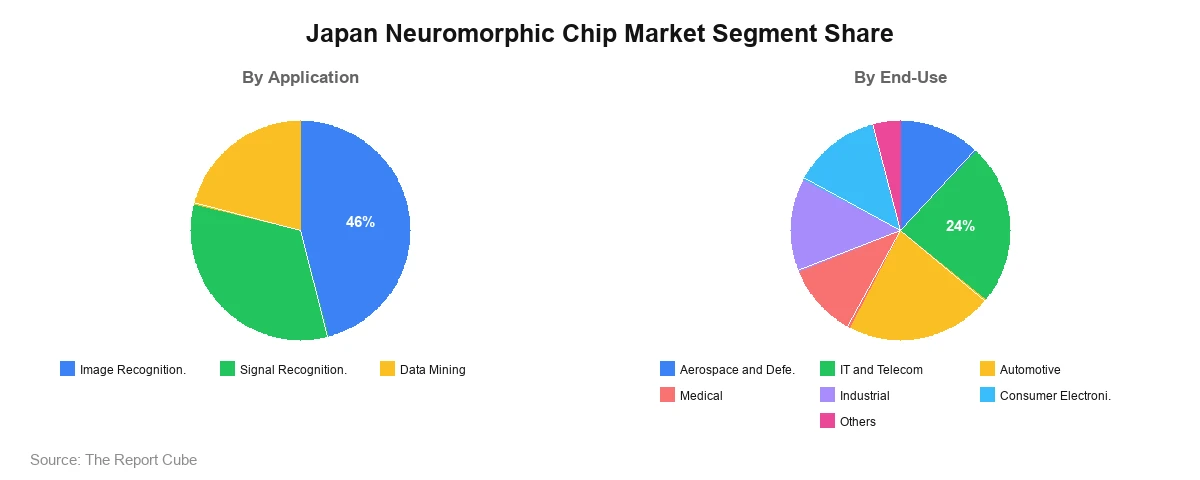
Image recognition leads the By Application segment with an estimated 46% share in 2026, supported by Sony Corporation's vision sensor expertise and Intel Corporation's Loihi research platform. Signal recognition accounts for approximately 33%, with TDK Corporation advancing sensor-signal and reservoir computing devices. Data mining holds about 21%, where IBM Corporation's NorthPole architecture supports large-scale pattern analysis.
By End-Use
- Aerospace and Defense
- IT and Telecom
- Automotive
- Medical
- Industrial
- Consumer Electronics
- Others
IT and telecom leads the By End-Use segment with an estimated 24% share in 2026, with Intel Corporation and IBM Corporation supplying platforms for pilots. Automotive follows at 22% and is the fastest-growing category as Renesas Electronics Corporation supplies driver assistance silicon. Industrial holds 14%, where TDK Corporation targets sensing; consumer electronics 13%, led by Sony Corporation; aerospace and defense 12%; medical 11%; and others 4%.
Regional Analysis
Demand for the Japan Neuromorphic Chip Market is concentrated in regions combining corporate research, electronics manufacturing, and automotive or semiconductor clusters.
|
Region |
Estimated Market Share |
Key Growth Factors |
Consumer Trends |
|---|---|---|---|
|
Kanto Region |
44% |
Corporate headquarters, national research institutes, dense IT and startup ecosystem |
Early adoption of edge AI, robotics, and data analytics applications |
|
Kansai/Kinki Region |
26% |
Electronic component and sensor manufacturing, university research in Osaka, Kyoto, and Kobe |
Demand for sensor-integrated chips in industrial and medical devices |
|
Central/Chubu Region |
20% |
Automotive manufacturing cluster around Aichi and Nagoya, precision machinery base |
Growing evaluation of ADAS and factory automation chips |
|
Kyushu-Okinawa Region |
10% |
Semiconductor fabrication cluster in Kumamoto and Fukuoka, expanding supply chain |
Image sensor and manufacturing-linked AI chip demand |
- Kanto Region - Accounting for approximately 44% of total demand, Kanto hosts corporate headquarters, research institutes, and AI startups in Tokyo and Yokohama. This concentration drives early neuromorphic prototyping, evaluation, and partnership activity.
- Kansai/Kinki Region - Osaka, Kyoto, and Kobe combine component makers, sensor specialists, and leading universities. This base supports neuromorphic research and industrial and medical sensing deployments.
- Central/Chubu Region - Aichi's automotive cluster creates strong pull for low-latency, low-power processing in driver assistance and factory automation, positioning Chubu as the key automotive demand center.
- Kyushu-Okinawa Region - Kumamoto's expanding semiconductor manufacturing cluster and supporting supplier network strengthen local capability in image sensors and edge AI chips, increasing regional manufacturing-linked demand.
Market Share & Competitive Landscape
The Japan Neuromorphic Chip Market is characterized by a mix of domestic electronics leaders and global research-led platform developers. Competition centers on power efficiency, sensor integration, software tooling, and the ability to move from prototypes to qualified commercial products.
|
Company |
Competitive Strength |
Primary Segment Served |
|---|---|---|
|
Sony Corporation |
Intelligent vision sensors with on-sensor AI processing, imaging leadership |
Image recognition, consumer electronics, automotive |
|
TDK Corporation |
Spin-memristor and reservoir computing devices, broad sensor portfolio |
Signal recognition, industrial, automotive |
|
Renesas Electronics Corporation |
Microcontroller and automotive SoC leadership, embedded AI acceleration |
Automotive, industrial |
|
Intel Corporation |
Loihi 2 processor and Hala Point large-scale neuromorphic system |
IT and telecom, data mining |
|
IBM Corporation |
NorthPole brain-inspired architecture, deep research capability |
Image recognition, data mining, IT and telecom |
Key Companies in the Japan Neuromorphic Chip Market
TDK Corporation
TDK Corporation, headquartered in Tokyo, Japan, was founded in 1935 and operates as a global electronic components and sensor manufacturer. In 2025, TDK and Hokkaido University exhibited an analog reservoir AI chip demonstrator at CEATEC 2025, extending its spin-memristor program. Its spintronics expertise and sensor portfolio form its core competitive strength.
Intel Corporation
Intel Corporation, headquartered in Santa Clara, California, USA, is a global semiconductor leader and developer of the Loihi 2 neuromorphic processor. In 2024, Intel introduced Hala Point, a 1.15 billion-neuron system, expanding research access to large-scale neuromorphic hardware. Its Loihi 2 platform and research community ecosystem anchor its competitive strength.
Recent Developments
|
Year |
Company |
Development |
|---|---|---|
|
Oct 2025 |
TDK Corporation |
Exhibited analog reservoir AI chip prototype, developed with Hokkaido University, at CEATEC 2025, where it received an Innovation Award |
Future Outlook
The Japan Neuromorphic Chip Market Forecast indicates expansion from USD 265.90 million in 2026 to USD 722.03 million by 2034 at a 13.30% CAGR. Automotive, industrial, and IT and telecom users will broaden deployments, while Sony Corporation, TDK Corporation, and Renesas Electronics Corporation commercialize sensor-integrated, low-power neuromorphic solutions through 2034.
Advances in spintronic memristors, analog reservoir computing, and spiking software toolchains will lower integration barriers for Japanese developers. Energy-efficiency targets and functional safety standards will guide product design, while government semiconductor strategies and international platforms from Intel Corporation and IBM Corporation support research toward broader commercial adoption.
Japan Neuromorphic Chip Market Report Coverage
This Japan Neuromorphic Chip Market Report provides segmented, region-wise, and company-level coverage for strategic planning.
|
Report Attribute |
Details |
|---|---|
|
Market Name |
Japan Neuromorphic Chip Market |
|
Market Size (2026) |
USD 265.90 Million |
|
Market Size (2034) |
USD 722.03 Million |
|
Forecast Period |
2026–2034 |
|
CAGR |
13.30% |
|
Base Year |
2026 |
|
Historical Years |
2021–2025 |
|
Forecast Years |
2026–2034 |
|
Segments Covered |
By Offering, By Application, By End-Use |
|
Regions Covered |
Kanto Region, Kansai/Kinki Region, Central/Chubu Region, Kyushu-Okinawa Region |
|
Key Companies |
Sony Corporation, TDK Corporation, Renesas Electronics Corporation, Intel Corporation, IBM Corporation, Others |
|
Report Format |
PDF, Excel, PPT |
|
Customization |
Available as per client requirements |
Why Choose This Japan Neuromorphic Chip Market Report?
- Comprehensive coverage of Japan's emerging brain-inspired processor and neuromorphic chip landscape.
- Accurate market sizing from USD 265.90 million in 2026 through the 2034 forecast.
- Detailed segmentation by application and seven end-use industry categories.
- Regional insights covering four Japanese regions with share estimates and demand drivers.
- Competitive profiling of leading suppliers including Sony, TDK, Renesas, Intel, and IBM.
- Analysis of spintronic, reservoir computing, and edge AI trends supporting investment and partnership planning.
- Research aligned with Japan's semiconductor revitalization and AI strategy objectives.
Table of Contents
- Introduction
- Objective of the Study
- Product Definition
- Market Segmentation
- Study Variables
- Research Methodology
- Secondary Data Points
- Companies Interviewed
- Primary Data Points
- Breakdown of Primary Interviews
- Secondary Data Points
- Executive Summary
- Market Dynamics
- Drivers
- Challenges
- Opportunity Assessment
- Recent Trends and Developments
- Policy and Regulatory Landscape
- Japan Neuromorphic Chip Market Overview and Forecast Analysis (2021-2034)
- Market Size, By Value, By Growth Rate (CAGR/USD Millions)
- Demand – Supply Trends
- Market Share, By Offering
- Hardware
- Software
- Market Share, By Application
- Image Recognition
- Signal Recognition
- Data Mining
- Market Share, By End-Use
- Aerospace and Defense
- IT and Telecom
- Automotive
- Medical
- Industrial
- Consumer Electronics
- Others
- Market Share, By Region
- Kanto Region
- Kansai/Kinki Region
- Central/Chubu Region
- Kyushu-Okinawa Region
- Market Share, By Competitors
- Competition Characteristics
- Revenue Shares
- Hardware Japan Neuromorphic Chip Market Overview, 2021-2034F
- By Value (USD Million)
- By Application – Market Size & Forecast 2021-2034, USD Million
- Image Recognition
- Signal Recognition
- Data Mining
- Software Japan Neuromorphic Chip Market Overview, 2021-2034F
- By Value (USD Million)
- By Application – Market Size & Forecast 2021-2034, USD Million
- Image Recognition
- Signal Recognition
- Data Mining
- Competitive Outlook (Company Profile - Partial List)
- Sony Corporation
- Company Overview
- Business Segments
- Strategic Alliances/Partnerships
- Recent Developments
- TDK Corporation
- Company Overview
- Business Segments
- Strategic Alliances/Partnerships
- Recent Developments
- Renesas Electronics Corporation
- Company Overview
- Business Segments
- Strategic Alliances/Partnerships
- Recent Developments
- Intel Corporation
- Company Overview
- Business Segments
- Strategic Alliances/Partnerships
- Recent Developments
- IBM Corporation
- Company Overview
- Business Segments
- Strategic Alliances/Partnerships
- Recent Developments
- Others
- Sony Corporation
- Contact Us & Disclaimer
Top Key Players & Market Share Outlook
- Sony Corporation
- TDK Corporation
- Renesas Electronics Corporation
- Intel Corporation
- IBM Corporation
- Others
Frequently Asked Questions






