



Build Your Custom Market Intelligence Report
Customize Your ReportGlobal Neurostimulator Devices Market Key Highlights
By Product Type:
Implantable pacemakers segment leads the market, accounting for nearly 68% of total revenue.
By Technology:
Dual-chamber neurostimulator devices dominate the market, representing around 41% share.
Regional Outlook:
Kanto region leads the market with approximately 36% share.
Government Initiatives & Policies
- Japan AMED Brain Science Program: National funding initiative accelerating neurotechnology and neuromodulation research.
- Japan Ministry of Health Advanced Medical Care System: Supports early adoption of innovative neurostimulation therapies.
Global Neurostimulator Devices Market Insights & Analysis
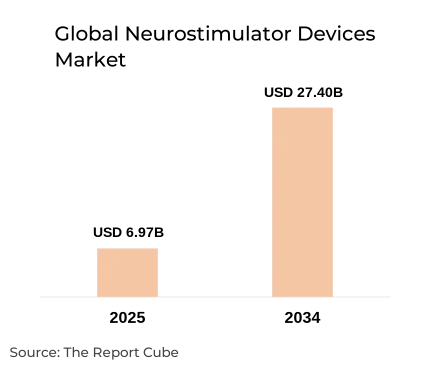
The Global Neurostimulator Devices Market is anticipated to register a CAGR of 16.43% during 2026-2034. The market size was valued at USD 6.97 billion in 2025 and is projected to reach USD 27.4 billion by 2034. Neurostimulator devices have transitioned from niche neurological tools into mainstream therapeutic systems addressing chronic pain, movement disorders, epilepsy, psychiatric disorders, and cardiac rhythm management.
Rapid technological evolution remains the backbone of market expansion. Over the past five years, more than 240 neurostimulation-related patents were filed globally, highlighting strong innovation momentum. Miniaturization of implantable systems, wireless programming, and adaptive stimulation algorithms are reshaping clinical outcomes. Hospitals increasingly prioritize neurostimulators due to reduced pharmacological dependency and long-term cost efficiency. At the same time, payer acceptance has improved, with reimbursement coverage for deep brain stimulation, spinal cord stimulation, and vagus nerve stimulation expanding across developed healthcare systems. Investment inflows from venture capital and strategic acquisitions further validate the long-term growth trajectory of this market.
Global Neurostimulator Devices Market Dynamics
Key Driver: Rising Prevalence of Chronic Neurological and Cardiac Disorders
An increasing global burden of neurological and cardiac rhythm disorders is driving sustained demand for neurostimulator devices. More than 50 million people worldwide live with epilepsy, while Parkinson’s disease affects over 10 million individuals, many of whom require device-based symptom management. Cardiac rhythm disorders such as bradyarrhythmias and heart failure continue to rise alongside aging populations. Neurostimulators offer durable symptom control, reducing hospital readmissions by nearly 23% in chronic patients. Clinicians increasingly favor device-based interventions as they deliver predictable outcomes, personalized programming, and reduced systemic side effects compared to long-term drug therapy. This clinical confidence directly supports market volume growth.
Book your FREE 30-minute expert consultation today
Contact UsIndustry Trends: Integration of Smart Algorithms and MRI-Compatible Platforms
A defining trend in the neurostimulator devices market is the integration of smart sensing and closed-loop stimulation technologies. Devices now adjust stimulation parameters in real time based on patient neural signals, improving efficacy by up to 30% in movement disorder management. MRI-compatible platforms are also gaining rapid traction, addressing a long-standing clinical limitation. Nearly 65% of new neurostimulator models launched since 2023 feature full-body MRI compatibility. These innovations increase patient safety, extend device usability, and strengthen physician adoption across neurology and cardiology specialties.
Major Challenge: High Device Cost and Surgical Complexity
High upfront costs remain a limiting factor for neurostimulator adoption, particularly in cost-sensitive healthcare systems. Implantable neurostimulators can range between USD 15,000 and USD 35,000 per procedure, excluding post-operative care. Surgical complexity and the need for specialized training further restrict access in smaller hospitals. Device programming and follow-up adjustments require skilled clinicians, adding operational burden. Although long-term benefits offset costs, initial expenditure continues to slow adoption in emerging healthcare settings and smaller regional centers.
Opportunity: Expansion of Indications and Outpatient Neurostimulation
Expanding clinical indications present a major opportunity for sustained market growth. Neurostimulation is increasingly evaluated for depression, stroke rehabilitation, tinnitus, and gastrointestinal disorders. Outpatient neurostimulation procedures are also gaining acceptance, reducing hospitalization costs and procedure times by nearly 40%. External and non-invasive neurostimulators are opening new consumer-facing treatment pathways, particularly for migraine and psychiatric conditions. These developments broaden addressable patient populations and diversify revenue streams for manufacturers.
Global Neurostimulator Devices Market Segment-wise Analysis
By Product Type:
- External Pacemakers
- Implantable Pacemakers
Implantable pacemakers dominate the global neurostimulator devices market, holding approximately 68% share in 2025. Their leadership stems from long-term therapeutic reliability and broader application across neurological and cardiac disorders. Implantable systems deliver continuous stimulation, improving patient adherence and reducing symptom relapse. Replacement cycles every 7-10 years generate recurring revenue streams for manufacturers. Growing acceptance of leadless and MRI-compatible implantable platforms further strengthens this segment’s position within hospitals and cardiac centers.
By Technology:
- Single-Chamber
- Dual-Chamber
- Biventricular Pacemakers
Dual-chamber neurostimulators account for nearly 41% market share due to their ability to coordinate atrial and ventricular pacing more effectively. Clinical studies show dual-chamber systems reduce atrial fibrillation risk by nearly 18% compared to single-chamber alternatives. These devices are widely adopted in heart block and sick sinus syndrome cases, where synchronized pacing improves hemodynamic stability. Continuous improvements in battery longevity and lead durability reinforce physician preference for dual-chamber platforms.
Regional Projection of Global Neurostimulator Devices Industry
- Chubu
- Hokkaido
- Kanto
- Tohoku
- Others
The Kanto region leads the global neurostimulator devices market with approximately 36% share, supported by dense hospital networks, advanced neurology centers, and higher procedure volumes. Tokyo alone accounts for nearly one-fourth of national neurostimulation procedures. Strong government support for advanced medical technologies and early adoption of innovative devices further enhances regional dominance. Chubu follows with steady growth driven by industrial healthcare investments, while Hokkaido and Tohoku show gradual adoption supported by expanding access to specialized care facilities.
Global Neurostimulator Devices Market Recent Developments
- 2025: Boston Scientific received FDA approval for its Vercise Neural HF system, a neuromodulation implant aimed at alleviating symptoms of advanced heart failure by stimulating cardiac-related nerves. This approval enhances the company's neuromodulation portfolio, extending its reach beyond movement disorders and pain management.
- 2025: Medtronic expanded its Percept RC/PC adaptive deep brain stimulation platform introducing additional movement-disorder indications across Europe. The brain-signal-responsive stimulation aims to improve symptom control and prolong device lifespan, solidifying Medtronic’s position as a leader in implantable neurostimulator technologies.
- 2025: Abbott unveiled an upgrade to its Proclaim spinal cord stimulation system featuring new burst stimulation patterns, remote programming options, and enhanced MRI compatibility. These improvements are designed to increase patient comfort and optimize the effectiveness of chronic pain relief.
- 2025: BrainsWay reported further adoption of its Deep TMS H7 coil system for treating obsessive-compulsive disorder (OCD), with a focus on real-world outcomes and operational improvements. These advancements are making non-invasive neuromodulation more accessible to psychiatric clinics globally.
- 2025: electroCore broadened the commercial availability and indications for its non-invasive vagus nerve stimulation device, gammaCore. The expansion is supported by new reimbursement agreements and clinical publications, reinforcing the company’s role in portable neurostimulation treatments.
Need insights for a specific region within this market?
Request Regional DataWhy Choose This Report?
- Provides a comprehensive overview of the overall market analysis, encompassing key trends, consumer behavior analysis, and risk assessment to support strategic decision-making.
- Provides accurate, up-to-date insights into market size, segmentation, and emerging opportunities, helping to minimize risk & capitalizing on growth.
- Gives deep understanding of target audience preferences, investment habits, and communication channels for enhanced product development & marketing effectiveness.
- Delivers competitive analysis & benchmarking, uncovering the strengths & weaknesses of market competitors to guide strategies.
- Consolidate comprehensive market intelligence, reducing reasoning & streamlining research efforts.
- Facilitates customized market segmentation & risk mitigation strategies, fine-tuned to the business objectives.
- Aids in identifying both market challenges & untapped opportunities within the industry to drive long-term business growth.
- Provides valuable information based on actual customer data & search trends.
Table of Contents
- Introduction
- Objective of the Study
- Product and Category Definition
- Market Segmentation
- Study Variables
- Research Methodology
- Secondary Data Points
- Breakdown of Secondary Sources
- Primary Data Points
- Breakdown of Primary Interviews
- Secondary Data Points
- Executive Summary
- Market Dynamics
- Drivers
- Challenges
- Opportunity Assessment
- Recent Trends and Developments
- Regulatory and Policy Landscape
- Global Neurostimulator Devices Market Overview (2021-2034)
- Market Size, By Value (USD Billion)
- Market Share, By Device Type
- External Devices
- Transcranial Magnetic Stimulation (TMS)
- Transcutaneous Electrical Nerve Stimulation (TENS)
- Others
- Implantable Devices
- Gastric Electric Stimulator (GES)
- Spinal Cord Stimulators (SCS)
- Sacral Nerve Stimulators (SNS)
- Deep Brain Stimulators (DBS)
- Vagus Nerve Stimulators (VNS)
- Others
- External Devices
- Market Share, By Technology Type
- Support Devices
- Guidewires
- Microcatheters
- Cerebral Balloon Angioplasty and Stenting Systems
- Balloon Catheters
- Embolic Protection Devices
- Carotid Artery Stents
- Aneurysm Coiling and Embolization Devices
- Flow Diversion Devices
- Bare Detachable Coils
- Liquid Embolic Agents
- Embolic Coils
- Coated Detachable Coils
- Neurothrombectomy Devices
- Clot Retrievals
- Suction and Aspiration Devices
- Snares
- Support Devices
- Market Share, By Disease Pathology
- Carotid Artery Stenosis
- Cerebral Aneurysms
- Arteriovenous Malformations and Fistulas
- Ischemic Strokes
- Others
- Market Share, By Application
- Gastroparesis
- Dystonia
- Psychiatric Disorders
- Pain Management
- Parkinson’s Disease
- Urinary and Fecal Incontinence
- Epilepsy
- Others
- Market Share, By End User
- Research and Academic Institutes
- Ambulatory Surgery Centers
- Hospitals
- Others
- Market Share, By Region
- North America
- Europe
- Asia-Pacific
- Middle East and Africa
- South America
- Market Share, By Company
- Revenue Shares and Analysis
- Competitive Landscape
- North America Neurostimulator Devices Market
- Market Size, By Value (USD Billion)
- Market Share, By Device Type
- Market Share, By Technology Type
- Market Share, By Disease Pathology
- Market Share, By Application
- Market Share, By End User
- Market Share, By Country
- United States
- Canada
- Mexico
- Europe Neurostimulator Devices Market
- Market Size, By Value (USD Billion)
- Market Share, By Device Type
- Market Share, By Technology Type
- Market Share, By Disease Pathology
- Market Share, By Application
- Market Share, By End User
- Market Share, By Country
- Germany
- France
- United Kingdom
- Italy
- Spain
- Northern and Nordic Countries
- BENELUX
- Rest of Europe
- Asia-Pacific Neurostimulator Devices Market
- Market Size, By Value (USD Billion)
- Market Share, By Device Type
- Market Share, By Technology Type
- Market Share, By Disease Pathology
- Market Share, By Application
- Market Share, By End User
- Market Share, By Country
- China
- India
- Japan
- South Korea
- Australia
- Rest of Asia-Pacific
- Middle East and Africa Neurostimulator Devices Market
- Market Size, By Value (USD Billion)
- Market Share, By Device Type
- Market Share, By Technology Type
- Market Share, By Disease Pathology
- Market Share, By Application
- Market Share, By End User
- Market Share, By Country
- Saudi Arabia
- United Arab Emirates
- Turkey
- South Africa
- Rest of Middle East and Africa
- South America Neurostimulator Devices Market
- Market Size, By Value (USD Billion)
- Market Share, By Device Type
- Market Share, By Technology Type
- Market Share, By Disease Pathology
- Market Share, By Application
- Market Share, By End User
- Market Share, By Country
- Brazil
- Argentina
- Chile
- Rest of South America
- Competitive Outlook and Company Profiles
- NeuroPace, Inc.
- Company Overview
- Product Portfolio
- Strategic Alliances/Partnerships
- Recent Developments
- Synapse Biomedical Inc.
- Company Overview
- Product Portfolio
- Strategic Alliances/Partnerships
- Recent Developments
- Boston Scientific Corporation
- Company Overview
- Product Portfolio
- Strategic Alliances/Partnerships
- Recent Developments
- LivaNova PLC
- Company Overview
- Product Portfolio
- Strategic Alliances/Partnerships
- Recent Developments
- Medtronic plc
- Company Overview
- Product Portfolio
- Strategic Alliances/Partnerships
- Recent Developments
- BIOTRONIK SE & Co. KG
- Company Overview
- Product Portfolio
- Strategic Alliances/Partnerships
- Recent Developments
- BrainsWay Ltd.
- Company Overview
- Product Portfolio
- Strategic Alliances/Partnerships
- Recent Developments
- Aleva Neurotherapeutics SA
- Company Overview
- Product Portfolio
- Strategic Alliances/Partnerships
- Recent Developments
- MicroTransponder, Inc.
- Company Overview
- Product Portfolio
- Strategic Alliances/Partnerships
- Recent Developments
- Soterix Medical Inc.
- Company Overview
- Product Portfolio
- Strategic Alliances/Partnerships
- Recent Developments
- The Magstim Company Limited
- Company Overview
- Product Portfolio
- Strategic Alliances/Partnerships
- Recent Developments
- Abbott Laboratories
- Company Overview
- Product Portfolio
- Strategic Alliances/Partnerships
- Recent Developments
- electroCore, Inc.
- Company Overview
- Product Portfolio
- Strategic Alliances/Partnerships
- Recent Developments
- Others
- NeuroPace, Inc.
- Contact Us and Disclaimer
Top Key Players & Market Share Outlook
- NeuroPace, Inc.
- Synapse Biomedical Inc.
- Boston Scientific Corporation
- LivaNova PLC
- Medtronic plc
- BIOTRONIK SE & Co. KG
- BrainsWay Ltd.
- Aleva Neurotherapeutics SA
- MicroTransponder, Inc.
- Soterix Medical Inc.
- The Magstim Company Limited
- Abbott Laboratories
- electroCore, Inc.
- Others
Frequently Asked Questions






