


Build Your Custom Market Intelligence Report
Customize Your ReportNorth America Biochar Market Overview
The North America biochar market is expanding as agricultural producers, environmental technology companies, biomass processors, and carbon removal developers explore the commercial potential of converting organic waste into stable carbon-rich materials. Biochar is produced through the thermal conversion of biomass under limited or oxygen-free conditions, primarily through pyrolysis. Its applications include soil improvement, nutrient management, water filtration, environmental remediation, and carbon sequestration. Increasing interest in sustainable agriculture, forest residue management, and durable carbon removal is creating opportunities for biochar producers and technology providers across the United States and Canada. Mexico also represents a potential market as agricultural residue utilization and sustainable soil management gain attention.
The United States represents the most commercially developed market in the region, supported by an established producer base, agricultural demand, research institutions, and emerging carbon removal procurement mechanisms. The American Biochar Institute's 2025 U.S. Biochar Market Report estimates that the economic value of the U.S. biochar industry increased from USD 53.6 million in 2023 to approximately USD 157 million in 2025. Agriculture remains the largest application, while water filtration, environmental remediation, and carbon sequestration are developing additional demand opportunities. Canada has a smaller and comparatively nascent production industry, although federal carbon dioxide removal procurement is creating a potential route for biochar project development.
Key Highlights of the North America Biochar Market
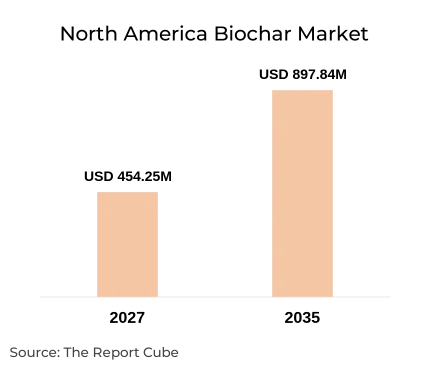
- The North America biochar market is projected to increase from USD 454.25 million in 2027 to USD 897.84 million by 2035, registering a CAGR of 8.89% during the forecast period.
- Pyrolysis is the dominant production technology because it converts biomass into carbon-rich biochar and can generate useful energy and other co-products.
- Agriculture represents the leading application area, supported by demand for soil improvement, water retention, nutrient management, and soil restoration.
- Increasing commercial interest in durable carbon dioxide removal is creating additional revenue opportunities for biochar manufacturers and project developers.
- Forest residues, agricultural waste, and other biomass feedstocks provide opportunities to establish regional production facilities and circular biomass supply chains.
- The United States is expected to remain the leading national market due to its comparatively developed producer ecosystem, agricultural demand, and carbon removal initiatives.
- Water filtration, environmental remediation, stormwater management, and industrial applications are expanding the potential customer base beyond conventional agricultural users.
- Feedstock consistency, production economics, product quality, emissions management, and carbon removal verification remain important challenges for market participants.
North America Biochar Market Outlook
The North America biochar market is entering a period of commercial development as producers move beyond small-scale agricultural applications toward industrial production, environmental services, and carbon removal projects. The availability of forestry residues, agricultural by-products, and other biomass resources creates opportunities to establish production facilities close to feedstock sources and end-use markets.
Agriculture is expected to remain an important demand center because biochar can improve selected soil properties, including water retention, nutrient retention, and soil structure. However, its effectiveness varies according to feedstock, production conditions, soil characteristics, and application methods. This creates opportunities for manufacturers offering application-specific biochar products and blends.
Carbon removal markets are also expected to influence the industry's commercial structure. Verified biochar carbon removal credits can provide an additional revenue stream alongside physical product sales. The development of recognized measurement, reporting, and verification methodologies is therefore becoming increasingly important for producers seeking participation in carbon markets.
Government Regulations in the North America Biochar Market
Biochar production and commercialization are influenced by environmental, agricultural input, waste management, air emissions, and carbon accounting requirements across North America. In the United States, the U.S. Department of Agriculture's Natural Resources Conservation Service provides guidance for soil carbon amendments through Conservation Practice Standard 336, while its technical guidance highlights considerations surrounding feedstock quality and potential contaminants.
The U.S. Environmental Protection Agency regulates relevant environmental activities under applicable air, water, and waste management frameworks, with additional requirements potentially applying when producers process biosolids or other regulated materials. In Canada, the federal government has advanced carbon dioxide removal procurement, including biochar as an eligible technology stream, while provincial requirements can influence waste processing and soil amendment use. The Climate Action Reserve's U.S. and Canada Biochar Protocol provides a methodology for accounting, reporting, and verifying carbon removals associated with biochar production and application. Regulatory requirements vary according to feedstock, facility operations, intended application, and jurisdiction.
North America Biochar Market Dynamics
The North America biochar market is influenced by agricultural demand, biomass waste utilization, carbon removal opportunities, and increasing interest in sustainable production systems. However, the commercial adoption of biochar depends on production costs, consistent product specifications, feedstock availability, and environmental compliance. The following factors outline the major forces influencing market development.
| Factor | Type | Specific Impact on Market | Magnitude |
|---|---|---|---|
| Growing Demand for Sustainable Soil Amendments | Driver | Increasing interest in soil health, water retention, nutrient management, and agricultural productivity is supporting demand for biochar-based soil amendments. | High |
| Expansion of Carbon Removal Markets | Driver | Carbon removal procurement and verification frameworks are creating additional revenue opportunities for biochar producers and project developers. | High |
| Biomass Feedstock Availability | Opportunity | Forestry residues, agricultural by-products, and organic waste provide opportunities for regional production facilities and waste-to-value business models. | High |
| Growing Demand for Environmental Applications | Opportunity | Water filtration, stormwater management, and contaminated soil remediation are expanding the potential customer base beyond agriculture. | Medium |
| Production Cost and Capital Requirements | Restraint | Equipment investment, feedstock preparation, energy requirements, transportation, and facility operations can increase the cost of commercially produced biochar. | High |
| Product Quality and Feedstock Variability | Challenge | Differences in biomass type and thermal processing conditions can affect carbon content, contaminants, porosity, and product performance, complicating standardization. | High |
Growth Drivers: Increasing Adoption of Biochar in Sustainable Agriculture
Agricultural demand is an important growth driver for the North America biochar market as farmers, horticultural businesses, and soil management companies explore alternatives to conventional soil improvement products. Biochar can improve soil structure, water-holding capacity, nutrient retention, and selected biological properties, depending on the soil and biochar characteristics. These properties create opportunities for its use in agricultural soils, horticulture, landscaping, and land restoration projects. USDA research and technical resources identify biochar as a potential soil amendment for improving soil health and supporting restoration activities. Increasing interest in soil resilience and efficient resource utilization is expected to support demand for agricultural-grade biochar products.
Market Opportunities: Conversion of Agricultural and Forestry Residues into Commercial Biochar
North America has opportunities to expand biochar production through the utilization of forestry residues, agricultural by-products, and other suitable biomass feedstocks. Forestry operations generate residual materials that may otherwise require transportation, disposal, or other management activities. Agricultural residues and organic biomass can also provide feedstock for decentralized production facilities. Converting these materials into biochar creates opportunities for biomass processors, agricultural cooperatives, equipment manufacturers, and regional project developers. Production facilities located near feedstock sources can potentially reduce transportation requirements while supporting local circular-economy activities and creating additional value from underutilized biomass.
Industry Challenges: High Capital Investment and Production Economics
Commercial biochar production requires investment in thermal conversion equipment, feedstock handling, drying, processing, emissions control, and product packaging infrastructure. The economics of production depend on the cost and availability of biomass, facility capacity, energy recovery, transportation distance, and the selling price of biochar and co-products. Smaller producers may face difficulties achieving economies of scale, while larger facilities require reliable feedstock contracts and sufficient customer demand to maintain utilization rates. The cost of establishing production infrastructure can therefore restrict new market entrants and slow capacity expansion, particularly in regions where supply chains and distribution networks remain underdeveloped.
Need Specific Data, Let’s Customize the Report for You
Request CustomizationMarket Trends: Increasing Commercialization of Industrial-Scale Pyrolysis Systems
Biochar manufacturers are increasingly focusing on production systems capable of processing larger quantities of biomass while improving process efficiency and product consistency. Industrial pyrolysis systems can convert woody biomass, forestry residues, and agricultural feedstocks into biochar under controlled thermal conditions. Equipment developers are working on continuous-feed systems, improved heat recovery, process monitoring, and emissions management to strengthen production economics. Industrial-scale facilities can also create opportunities to recover useful energy and co-products, improving the overall value proposition of biomass conversion. The development of more reliable production systems is expected to support the transition from small-scale production toward larger commercial operations.
North America Biochar Market Segment Analysis
The North America biochar market is segmented by technology, application, and country. Pyrolysis represents the dominant production pathway because it enables the conversion of biomass into carbon-rich material under controlled oxygen-limited conditions. Agriculture is the leading application area due to the use of biochar in soil improvement and agricultural resource management. The United States, Canada, and Mexico represent the key national markets, with differences in production capacity, commercial adoption, agricultural demand, and policy support.
By Technology
- Pyrolysis
- Gasification
- Others
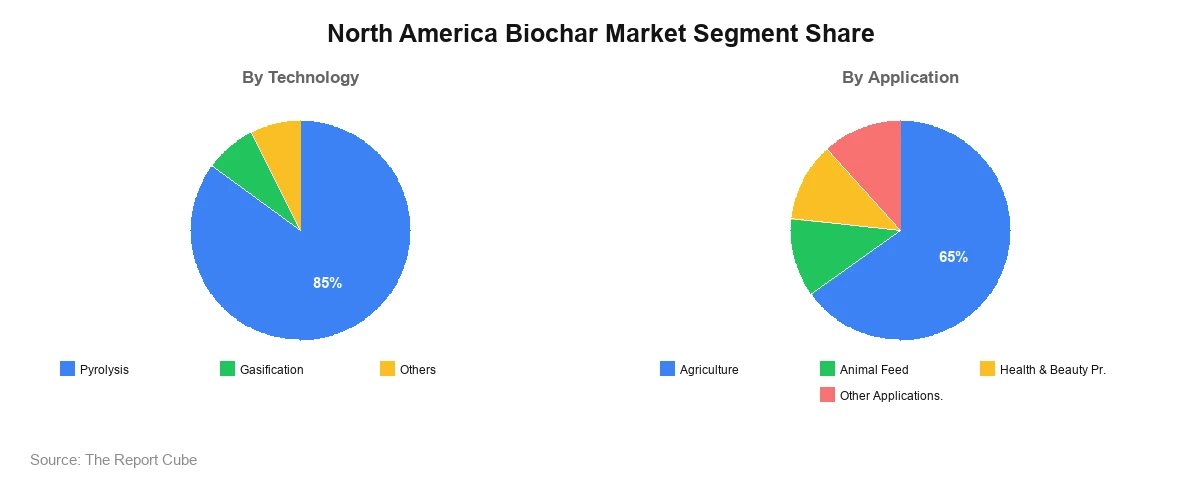
Pyrolysis leads the category with an approx. 85% share in 2026. This is an analyst estimate for North America; biochar industry sources identify pyrolysis as the dominant production pathway but do not provide a directly comparable North American revenue percentage. Pyrolysis is widely used because it thermally converts biomass under limited oxygen conditions, producing biochar alongside gases and potentially recoverable liquid or energy co-products. Its established commercial applications and availability of different reactor configurations support its position in the regional production landscape. Gasification also produces carbon-rich solid residues in certain systems, although its primary commercial objective is generally the production of combustible gas and energy.
By Application
- Agriculture
- Animal Feed
- Health & Beauty Products
- Other Applications
Agriculture leads the category with an approx. 65% share in 2026. This is an analyst estimate for North America; industry sources identify agriculture among the main uses, but exact North American application revenue shares are not publicly reported. Agricultural demand is supported by the use of biochar as a soil amendment to improve selected soil properties, support nutrient retention, and increase water-holding capacity. Commercial applications include crop production, horticulture, landscaping, and soil restoration. Animal feed, health and beauty products, filtration, environmental remediation, and industrial materials represent additional application opportunities, although their market adoption and product requirements differ.
North America Biochar Market Regional Analysis
The North America biochar market is supported by differences in biomass availability, agricultural production, environmental priorities, and carbon removal policy development across the United States, Canada, and Mexico. The United States has the most established commercial ecosystem, while Canada is developing its production and carbon removal market. Mexico presents opportunities for agricultural applications and biomass resource utilization as awareness and market infrastructure continue to develop.
| Region | Key Growth Factors | Industry Trends |
|---|---|---|
| U.S. | Established biochar producers, agricultural demand, forestry and agricultural biomass resources, and carbon removal market development. | Expansion of commercial production facilities, agricultural soil amendment adoption, environmental filtration applications, and verified carbon removal projects. |
| Canada | Forestry residue availability, interest in low-carbon technologies, agricultural soil management, and federal carbon dioxide removal procurement. | Development of biochar production projects, growing interest in carbon removal verification, and exploration of biomass-to-value supply chains. |
| Mexico | Agricultural biomass availability, soil management requirements, and opportunities to utilize agricultural residues. | Potential growth in agricultural biochar applications, localized biomass conversion, and sustainable agricultural practices. |
North America Biochar Market Competitive Landscape
The North America biochar market includes specialized biochar manufacturers, biomass conversion technology providers, product developers, and companies supplying biochar-based agricultural and environmental solutions. Competition is influenced by production capacity, feedstock access, processing technology, product consistency, distribution networks, and the ability to serve application-specific requirements. Some participants focus on manufacturing and selling finished biochar, while others develop production systems, convert biosolids into carbon-rich by-products, or supply specialized products for soil improvement and environmental remediation. The competitive landscape therefore includes companies with different positions across the biochar value chain.
| Company | Competitive Strength | Primary Segment Served |
|---|---|---|
| Black Owl Biochar | Application-specific biochar products, organic-use listings, and product development for agricultural and environmental applications. | Agriculture, horticulture, and environmental remediation |
| Karr Group | Biochar and soil product development under its Karrchar and related product offerings. | Agriculture and soil amendments |
| Aries Clean Technologies | Patented fluidized-bed gasification systems that process biosolids and generate Bio-Fly-Ash by-products. | Biosolids conversion and industrial applications |
| Pacific Biochar Benefit Corporation | Biochar manufacturing and distribution, with an emphasis on agricultural products and carbon removal services. | Agriculture and carbon removal |
| Advance Renewable Technology International (ARTI) | Development of pyrolysis reactors, biochar products, activated carbon, and biomass conversion technologies. | Biochar manufacturing, equipment, and environmental applications |
| Soil Reef LLC | Biochar product development, marketing, distribution, and application-oriented soil amendment solutions. | Agriculture, soil restoration, and environmental applications |
| Biochar Now | Large-scale biochar manufacturing capabilities, product sizing, and patented production and emissions-related technologies. | Agriculture, industrial, and environmental applications |
| Oregon Biochar Solutions | Industrial-volume biochar manufacturing using wood-based feedstock from the Pacific Northwest. | Agriculture, water filtration, and environmental remediation |
| New England Biochar | Small- and community-scale biochar production systems, consulting, equipment, and biochar blends. | Agriculture, horticulture, and production equipment |
| Others | Regional producers, equipment manufacturers, distributors, carbon removal project developers, and specialized biochar suppliers. | Multiple applications and value-chain activities |
- Biochar Now: Biochar Now is a U.S.-based biochar manufacturer with a focus on large-scale production and product commercialization. The company supplies biochar in different particle sizes and packaging formats for agricultural, industrial, and environmental uses. Its product portfolio and manufacturing activities support applications including soil improvement and environmental remediation. The company also highlights its engineering and manufacturing capabilities, patented technologies, and efforts to scale production across North America. Its ability to serve different customer requirements through product sizing and manufacturing infrastructure provides a competitive position in the regional market.
- Pacific Biochar Benefit Corporation: Pacific Biochar is a biochar manufacturer and distributor operating from facilities in California and Hawaii. The company focuses on agricultural biochar products and the use of sustainably sourced forestry and agricultural residues. Its business model also includes carbon removal services, with project information and carbon removal credits supported through digital measurement and verification systems. The combination of physical biochar products, biomass utilization, and carbon removal services gives the company exposure to both agricultural demand and the developing carbon dioxide removal market.
Recent Developments and Updates
- November 15, 2026: The American Biochar Institute announced the launch of its Biochar Industry Directory. The directory is designed to connect biochar producers, equipment providers, consultants, researchers, and other service providers, supporting industry visibility and commercial networking.
- Fall 2026: The Government of Canada awarded its first carbon dioxide removal standing offers following its procurement process launched in March 2026. Biochar was included among the eligible technology streams, providing a potential institutional demand mechanism for qualifying projects.
- July 2026: The American Biochar Institute released its 2025 United States Biochar Market Report. The report estimated that the economic value of the U.S. biochar industry increased to approximately USD 157 million in 2025, compared with USD 53.6 million in 2023.
- June 2026: The International Biochar Initiative released its 2025 Global Biochar Market Report, reporting estimated global biochar production of 520,810 metric tonnes in 2025, compared with 180,150 metric tonnes in 2023. The report highlighted increasing production and expanding industry participation.
- April 2026: Aries Clean Technologies announced the appointment of Kari Mueller as Chief Executive Officer, reflecting a leadership development at a company active in biosolids conversion and gasification technology.
North America Biochar Market Report Coverage
The North America biochar market report provides an assessment of market size, growth trends, technology developments, application areas, and the competitive environment across the United States, Canada, and Mexico. It evaluates the principal market drivers, restraints, opportunities, and industry challenges influencing market development. The report also examines key companies operating across biochar production, biomass conversion technology, product distribution, agricultural applications, and environmental solutions.
| Parameter | Details |
|---|---|
| Market Name | North America Biochar Market |
| Market Size (Base Year) | USD 454.25 million (2027) |
| Market Size (Forecast Year) | USD 897.84 million (2035) |
| CAGR | 8.89% (2027–2035) |
| Base Year | 2026 |
| Historical Period | 2022–2026 |
| Forecast Period | 2027–2035 |
| Geographic Scope | North America |
| Segmentation | By Technology, By Application, and By Country |
| Regions Covered | U.S., Canada, and Mexico |
| Key Companies | Black Owl Biochar, Karr Group, Aries Clean Technologies, Pacific Biochar Benefit Corporation, Advance Renewable Technology International (ARTI), Soil Reef LLC, Biochar Now, Oregon Biochar Solutions, New England Biochar, and Others |
| Customization | Available as per specific client requirements |
Why Choose This North America Biochar Market Report?
- Provides market size estimates and growth projections for the North America biochar market from 2027 to 2035.
- Examines key production technologies, including pyrolysis and gasification, and their commercial applications.
- Evaluates agricultural demand and emerging opportunities in environmental remediation, filtration, and carbon removal.
- Analyzes market drivers, restraints, opportunities, and challenges affecting regional industry development.
- Reviews the competitive landscape and the positioning of major biochar manufacturers and technology providers.
- Provides country-level analysis covering the United States, Canada, and Mexico.
- Assesses regulatory developments, carbon removal verification frameworks, and industry developments relevant to market participants.
Table of Contents
- Introduction
- Objective of the Study
- Product Definition
- Market Segmentation
- Study Variables
- Research Methodology
- Secondary Data Points
- Companies Interviewed
- Primary Data Points
- Breakdown of Primary Interviews
- Secondary Data Points
- Executive Summary
- Market Dynamics
- Drivers
- Challenges
- Opportunity Assessment
- Recent Trends and Developments
- Policy and Regulatory Landscape
- North America Biochar Market Overview and Forecast Analysis (2022-2035)
- Market Size, By Value, By Growth Rate (CAGR/USD Millions)
- Demand – Supply Trends
- Market Share, By Technology
- Pyrolysis
- Gasification
- Others
- Market Share, By Application
- Agriculture
- Animal Feed
- Health & Beauty Products
- Other Applications
- Market Share, By Country
- U.S.
- Canada
- Mexico
- Market Share, By Competitors
- Competition Characteristics
- Revenue Shares
- Pyrolysis North America Biochar Market Overview, 2022-2035F
- By Value (USD Million)
- By Application – Market Size & Forecast 2022-2035, USD Million
- Agriculture
- Animal Feed
- Health & Beauty Products
- Other Applications
- Gasification North America Biochar Market Overview, 2022-2035F
- By Value (USD Million)
- By Application – Market Size & Forecast 2022-2035, USD Million
- Agriculture
- Animal Feed
- Health & Beauty Products
- Other Applications
- Others North America Biochar Market Overview, 2022-2035F
- By Value (USD Million)
- By Application – Market Size & Forecast 2022-2035, USD Million
- Agriculture
- Animal Feed
- Health & Beauty Products
- Other Applications
- Competitive Outlook (Company Profile – Partial List)
- Black Owl Biochar
- Company Overview
- Business Segments
- Strategic Alliances/Partnerships
- Recent Developments
- Karr Group
- Company Overview
- Business Segments
- Strategic Alliances/Partnerships
- Recent Developments
- Aries Clean Technologies
- Company Overview
- Business Segments
- Strategic Alliances/Partnerships
- Recent Developments
- Pacific Biochar Benefit Corporation
- Company Overview
- Business Segments
- Strategic Alliances/Partnerships
- Recent Developments
- Advance Renewable Technology International (ARTI)
- Company Overview
- Business Segments
- Strategic Alliances/Partnerships
- Recent Developments
- Soil Reef LLC
- Company Overview
- Business Segments
- Strategic Alliances/Partnerships
- Recent Developments
- Biochar Now
- Company Overview
- Business Segments
- Strategic Alliances/Partnerships
- Recent Developments
- Oregon Biochar Solutions
- Company Overview
- Business Segments
- Strategic Alliances/Partnerships
- Recent Developments
- New England Biochar
- Company Overview
- Business Segments
- Strategic Alliances/Partnerships
- Recent Developments
- Others
- Black Owl Biochar
- Contact Us & Disclaimer
Top Key Players & Market Share Outlook
- Black Owl Biochar
- Karr Group
- Aries Clean Technologies
- Pacific Biochar Benefit Corporation
- Advance Renewable Technology International (ARTI)
- Soil Reef LLC
- Biochar Now
- Oregon Biochar Solutions
- New England Biochar
- Others
Frequently Asked Questions