


Build Your Custom Market Intelligence Report
Customize Your ReportNorth America Biodegradable Plastic Market Overview
The North America biodegradable plastic market is expanding as packaging manufacturers, food and beverage companies, agricultural businesses, and consumer goods producers explore alternatives to conventional petroleum-based plastics. Biodegradable plastics are designed to break down through biological processes under specified environmental conditions, with performance depending on polymer composition, product design, temperature, moisture, and the disposal environment. Major materials include polylactic acid (PLA), starch-based polymers, polybutylene succinate (PBS), polybutylene adipate terephthalate (PBAT), and polyhydroxyalkanoates (PHA). Increasing attention to plastic waste reduction, packaging sustainability, and circular material development is encouraging manufacturers to invest in biodegradable polymer technologies and application-specific products.
The United States represents the most developed commercial market in North America, supported by polymer producers, packaging converters, food service businesses, and research institutions. Canada is advancing plastic waste reduction policies and sustainable material adoption, while Mexico offers opportunities through packaging manufacturing, agricultural applications, and cross-border supply chains. Packaging remains an important application because biodegradable materials can be used in selected food packaging, bags, films, and disposable products. However, commercial adoption depends on product performance, price competitiveness, composting infrastructure, certification requirements, and the availability of suitable end-of-life processing facilities.
Key Highlights of the North America Biodegradable Plastic Market
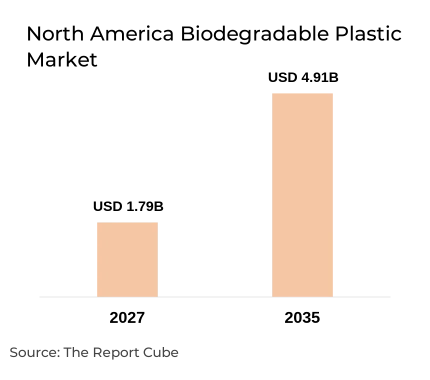
- The North America biodegradable plastic market is projected to increase from USD 1.79 billion in 2027 to USD 4.91 billion by 2035, registering a CAGR of 13.43% during the forecast period.
- Polylactic Acid (PLA) is a leading biodegradable polymer because of its established commercial production, processing versatility, and applications in packaging and consumer products.
- Packaging represents a major application area, supported by demand for alternative materials in food packaging, flexible films, bags, and selected disposable products.
- Increasing regulatory attention to plastic waste, packaging recovery, and environmental marketing claims is influencing material selection and product development.
- Starch-based polymers, PBAT, PBS, and PHA are expanding the range of biodegradable materials available for applications requiring different flexibility, durability, and degradation characteristics.
- Food service, agriculture, consumer goods, and textile manufacturers are exploring biodegradable polymer solutions for selected product categories.
- Composting infrastructure, product certification, and clear disposal instructions are becoming important factors influencing the commercial adoption of biodegradable plastics.
- Material cost, performance limitations in certain applications, and competition from conventional recyclable plastics remain important challenges for market participants.
North America Biodegradable Plastic Market Outlook
The North America biodegradable plastic market is expected to experience increasing commercial adoption as packaging producers and consumer goods manufacturers seek materials that can meet product performance requirements while supporting waste reduction objectives. PLA is expected to remain an important polymer because of its established manufacturing ecosystem and suitability for selected rigid packaging, food service products, and other molded applications. PBAT and starch-based blends provide alternatives for flexible packaging and film applications, while PHA and PBS offer additional material options for specialized products.
Packaging is expected to remain a major demand center as businesses evaluate biodegradable materials for food service packaging, bags, containers, films, and selected disposable products. However, the suitability of biodegradable plastics depends on the intended disposal route. Industrially compostable products generally require appropriate composting conditions and collection infrastructure, while products designed for soil or other environments must meet the relevant performance requirements. This distinction is likely to influence product development, certification, and purchasing decisions.
Government Regulations in the North America Biodegradable Plastic Market
The North American biodegradable plastic market is influenced by regulations covering plastic waste reduction, packaging producer responsibility, compostable product labeling, and environmental marketing claims. In the United States, the Federal Trade Commission's Guides for the Use of Environmental Marketing Claims, particularly 16 CFR Section 260.8, establish guidance for biodegradable and degradable claims and require appropriate scientific substantiation.
California has introduced specific requirements for compostable product labeling, including applicable standards such as ASTM D6400 for compostable plastics, while its SB 54 packaging producer responsibility regulations became effective on May 1, 2026. In Canada, the Single-use Plastics Prohibition Regulations remain in force and prohibit the manufacture, import, and sale of specified single-use plastic products. These regulations do not automatically prohibit all biodegradable plastics; requirements depend on the product category, material composition, claims, and applicable jurisdiction. The USDA BioPreferred Program also provides a framework for measuring biobased content, although biobased content certification should not be interpreted as proof of biodegradability.
North America Biodegradable Plastic Market Dynamics
The North America biodegradable plastic market is influenced by packaging sustainability initiatives, developments in polymer manufacturing, regulatory changes, and increasing interest in alternative materials. However, the commercial adoption of biodegradable plastics depends on material performance, production costs, product certification, and suitable end-of-life infrastructure. The following factors outline the major forces influencing market development.
| Factor | Type | Specific Impact on Market | Magnitude |
|---|---|---|---|
| Increasing Demand for Sustainable Packaging Materials | Driver | Packaging manufacturers and consumer brands are evaluating biodegradable polymers for selected food packaging, bags, films, and disposable products. | High |
| Regulatory Pressure to Reduce Conventional Plastic Waste | Driver | Packaging producer responsibility, restrictions on selected single-use plastics, and compostable labeling requirements are influencing material selection and product development. | High |
| Development of Advanced Biodegradable Polymers | Opportunity | Innovations in PHA, PBAT, PBS, and PLA blends create opportunities to develop materials with application-specific flexibility, durability, and processing properties. | High |
| Expansion of Composting and Organic Waste Processing | Opportunity | Improved collection and industrial composting infrastructure can support the recovery of suitable compostable products and strengthen adoption in selected applications. | Medium |
| High Material Costs and Manufacturing Constraints | Restraint | Production costs, feedstock prices, processing requirements, and limited economies of scale can make biodegradable plastics less competitive than conventional polymers. | High |
| Limited End-of-Life Infrastructure and Material Confusion | Challenge | Inadequate composting access, contamination of recycling streams, and confusion between biodegradable, biobased, and compostable materials can restrict adoption. | High |
Growth Drivers: Rising Demand for Sustainable Packaging Materials
Growing demand for sustainable packaging is supporting the adoption of biodegradable plastics across the North American packaging industry. Food and beverage manufacturers, retailers, and consumer goods companies are evaluating alternative materials for selected applications, including food containers, flexible films, bags, trays, and disposable food service products. PLA is used in rigid packaging and molded products, while PBAT and starch-based blends are relevant to selected flexible packaging applications. Material selection depends on mechanical strength, heat resistance, barrier performance, processing compatibility, and the required disposal pathway. As companies review packaging specifications and sustainability commitments, suppliers offering reliable biodegradable polymer formulations and application-specific technical support can benefit from additional commercial opportunities.
Market Opportunities: Commercial Expansion of PHA, PBAT, and Advanced Polymer Blends
Advances in biodegradable polymer technologies are creating opportunities for manufacturers to develop materials for applications that require different combinations of flexibility, strength, heat resistance, and biodegradation characteristics. PHA is attracting interest because of its potential use in selected packaging, agricultural, and consumer product applications. PBAT is used in flexible and film applications, often in combination with starch or other polymers, while PBS can provide additional processing and performance options. The development of improved formulations and production processes can help reduce material limitations and expand the range of commercially viable products. Companies investing in polymer research, compounding, and application testing can strengthen their position in specialized biodegradable plastic markets.
Industry Challenges: Higher Production Costs and Price Competitiveness
Biodegradable plastics can face cost disadvantages compared with established petroleum-based polymers because of feedstock expenses, production technology requirements, processing limitations, and differences in manufacturing scale. Certain polymers also require specialized equipment settings or formulation adjustments to achieve the desired mechanical and thermal properties. Packaging manufacturers operating in price-sensitive markets may be reluctant to switch materials if the alternative significantly increases packaging costs without delivering sufficient operational or regulatory benefits. Producers must therefore improve process efficiency, expand manufacturing capacity, secure reliable raw material supply, and develop formulations that meet customer requirements at commercially competitive prices.
Need Specific Data, Let’s Customize the Report for You
Request CustomizationMarket Trends: Increasing Commercial Development of PLA and PHA Materials
PLA and PHA are receiving increasing attention from biodegradable polymer manufacturers because of their potential use across packaging, consumer goods, and specialized applications. PLA benefits from an established commercial production base and is used in selected rigid packaging, disposable food service products, and molded applications. PHA is attracting investment and research interest because of its potential biodegradation characteristics and application versatility, although commercial production costs and scale remain important considerations. Global capacity data published by European Bioplastics in 2024 identified PLA as the largest individual biodegradable bioplastic material category. The development of new production facilities, polymer formulations, and processing technologies is expected to influence the competitive landscape as manufacturers seek to improve material performance and supply reliability.
North America Biodegradable Plastic Market Segment Analysis
The North America biodegradable plastic market is segmented by product, application, and country. Product segmentation includes starch-based polymers, polylactic acid, polybutylene succinate, polybutylene adipate terephthalate, and polyhydroxyalkanoates. PLA represents a major commercial polymer category due to its established production capacity and use in packaging and consumer products. By application, packaging is a major demand area, supported by the development of biodegradable films, containers, bags, and selected food service products. The United States, Canada, and Mexico represent the principal national markets, with differences in polymer manufacturing, packaging demand, regulatory requirements, and waste management infrastructure.
By Product
- Starch-based
- Polylactic Acid (PLA)
- Polybutylene Succinate (PBS)
- Polybutylene Adipate Terephthalate (PBAT)
- Polyhydroxyalkanoates (PHA)
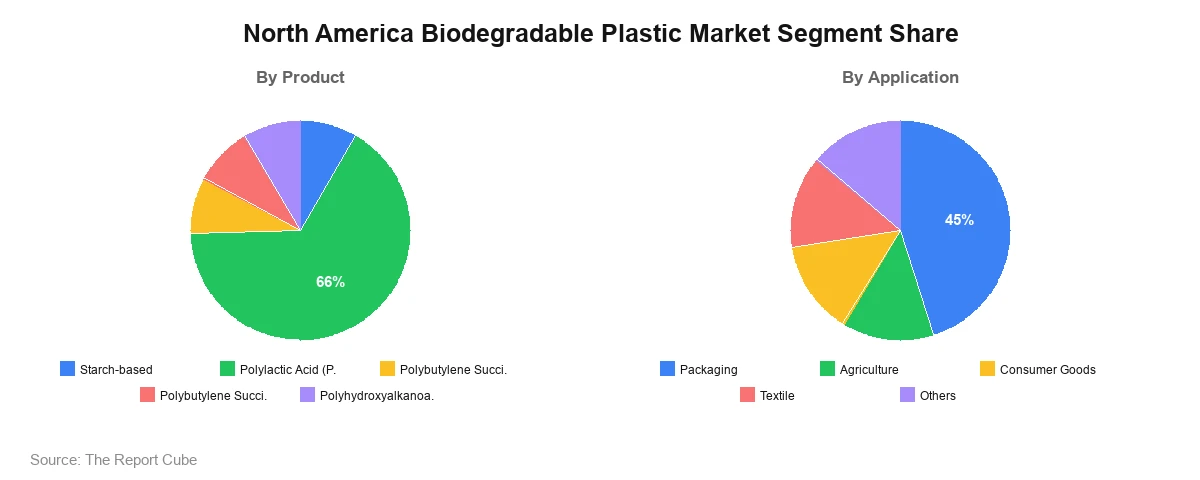
Polylactic Acid (PLA) leads the category with an approx. 66% share in 2026. This is a directional estimate derived from global bioplastics production capacity data, not a published North American biodegradable-plastics revenue share. European Bioplastics' 2024 market data identifies PLA as 37.1% of total global bioplastics production capacity, while biodegradable materials represented 56.3% of total capacity. Dividing these figures produces an indicative PLA share of approximately 66% within the global biodegradable capacity pool. PLA benefits from an established commercial supply chain and applications in rigid packaging, food service products, and molded consumer goods. Starch-based polymers, PBAT, PBS, and PHA provide additional options for applications requiring different flexibility, processing, and biodegradation characteristics.
By Application
- Packaging
- Agriculture
- Consumer Goods
- Textile
- Others
Packaging leads the category with an approx. 45% share in 2026. This is a directional estimate based on published 2024 global bioplastics application capacity data, not a North American biodegradable-plastics revenue share. European Bioplastics reported that packaging accounted for approximately 45% of total global bioplastics production capacity in 2024. The figure includes both biodegradable and non-biodegradable bioplastics, so it should not be interpreted as a directly measured biodegradable-plastics application share. Packaging remains an important application because PLA, PBAT, and starch-based materials can be used in selected films, bags, containers, and food service products. Agriculture, consumer goods, and textiles provide additional opportunities for specialized biodegradable polymer formulations.
North America Biodegradable Plastic Market Regional Analysis
The North America biodegradable plastic market is influenced by the scale of packaging manufacturing, polymer production capabilities, environmental policies, and waste management infrastructure across the United States, Canada, and Mexico. The United States has a comparatively developed polymer and packaging ecosystem, while Canada is advancing plastic waste reduction policies. Mexico offers opportunities through manufacturing supply chains and demand for alternative packaging materials, although the availability of dedicated composting infrastructure remains an important consideration.
| Region | Key Growth Factors | Industry Trends |
|---|---|---|
| U.S. | Established polymer and packaging manufacturers, demand from food service and consumer goods companies, research capabilities, and state-level packaging regulations. | Development of PLA, PHA, and PBAT applications, growth in sustainable packaging initiatives, and increasing attention to compostable product certification and labeling. |
| Canada | Plastic waste reduction policies, packaging sustainability initiatives, and demand from food service, retail, and consumer goods sectors. | Evaluation of alternative packaging materials, development of circular economy initiatives, and greater attention to product recovery and disposal requirements. |
| Mexico | Packaging manufacturing, export-oriented production, agricultural applications, and demand from food and consumer goods industries. | Potential adoption of biodegradable packaging materials, development of polymer supply chains, and increasing evaluation of sustainable packaging alternatives. |
North America Biodegradable Plastic Market Competitive Landscape
The North America biodegradable plastic market includes polymer manufacturers, biotechnology companies, chemical producers, and specialized material developers. Competition is influenced by polymer production capacity, raw material sourcing, material performance, product certification, customer relationships, and the ability to supply application-specific formulations. NatureWorks and Danimer Scientific have identifiable positions in PLA and PHA technologies, respectively, while Green Dot Bioplastics develops biodegradable and compostable polymer compounds. BASF has a portfolio that includes biodegradable and compostable plastic materials, while Cargill has an important role in the PLA value chain through its joint venture with NatureWorks. Other companies, including Eastman, SABIC, and Dow, have broader advanced materials, circular polymers, or packaging portfolios; their relevance to biodegradable plastics should be assessed at the specific product level rather than assuming that all their sustainable or circular materials are biodegradable.
| Company | Competitive Strength | Primary Segment Served |
|---|---|---|
| BASF SE | Biodegradable and compostable polymer portfolio, including ecovio materials for selected packaging and agricultural applications. | Compostable packaging, bags, and agricultural films |
| Eastman Chemical Company | Specialty materials and polymer technologies, with broader sustainable material and circular economy solutions; direct biodegradable polymer exposure is product-specific. | Specialty materials and packaging-related applications |
| Cargill Incorporated | Renewable feedstock and lactic acid expertise, alongside its joint venture participation in NatureWorks. | PLA feedstock and biopolymer value chain |
| SABIC | Advanced materials and certified circular and renewable polymer offerings; biodegradable product exposure should be assessed at individual product level. | Advanced materials and sustainable packaging |
| Dow Inc. | Polymer science, packaging materials, and circular plastics development; its broader sustainable plastics portfolio is not equivalent to a biodegradable polymer portfolio. | Packaging materials and polymer solutions |
| Danimer Scientific | PHA-based biodegradable polymer technology and Nodax materials for selected packaging and consumer product applications. | PHA resins, packaging, and consumer goods |
| Yield10 Bioscience Inc. | Historically associated with agricultural biotechnology and crop trait development; current direct biodegradable polymer manufacturing exposure requires verification. | Biotechnology and agricultural technology; not established as a direct major resin supplier |
| NatureWorks LLC | Established PLA producer with Ingeo biopolymer technology and a broad range of packaging, fiber, and molded product applications. | PLA resins, packaging, fibers, and consumer goods |
| ENSO Plastics | Biodegradation additive and plastics technology offerings; product claims and biodegradation conditions require application-specific assessment. | Plastic additives and biodegradable material solutions |
| Green Dot Bioplastics Inc. | Development of bioplastic compounds and materials using PLA, PBAT, PBS, and starch-based polymer combinations. | Biodegradable compounds, packaging, and consumer products |
- NatureWorks LLC: NatureWorks is a major producer of Ingeo PLA biopolymers and operates across the lactic acid and polylactic acid value chain. Its materials are used in a variety of applications, including packaging, fibers, food service products, and consumer goods. The company's commercial position is supported by its established PLA technology, polymer production expertise, and relationships with packaging converters and material processors. NatureWorks is jointly owned by Cargill and GC, and its PLA portfolio makes it an important participant in the development of renewable and biodegradable polymer applications. The suitability of individual products depends on the required processing conditions and end-of-life infrastructure.
- Danimer Scientific: Danimer Scientific develops biodegradable PHA-based materials under its Nodax technology platform. PHA materials are being developed for applications such as flexible packaging, films, straws, and other consumer products. The company's technology focus provides exposure to demand for biodegradable polymers that offer alternatives to selected conventional plastic applications. PHA commercialization is influenced by production costs, material performance, processing compatibility, and the availability of suitable biodegradation and composting conditions. Danimer's position in the market is therefore associated with the development and commercialization of specialized biodegradable resin technologies rather than the entire biodegradable plastics value chain.
Recent Developments and Updates
- May 1, 2026: California's SB 54 permanent regulations became effective following approval by the Office of Administrative Law. The regulations implement the state's packaging producer responsibility framework and establish compliance requirements for covered producers. The development is relevant to packaging manufacturers and material suppliers serving the California market.
- 2026: California's compostable product labeling framework continues to require specified standards and conditions for products marketed as compostable. Requirements include ASTM D6400-19 for compostable plastic products and additional product labeling and composition provisions. These requirements influence product certification and packaging claims.
- January 30, 2026: Canada's Federal Court of Appeal upheld the listing of plastic manufactured items under Schedule 1 of the Canadian Environmental Protection Act, 1999, supporting the legal basis for the Single-use Plastics Prohibition Regulations. The regulations remain in force and apply to specified single-use plastic product categories.
North America Biodegradable Plastic Market Report Coverage
The North America biodegradable plastic market report provides an assessment of market size, growth trends, polymer technologies, application areas, regulatory developments, and the competitive environment across the United States, Canada, and Mexico. It evaluates the key market drivers, restraints, opportunities, and industry challenges influencing the adoption of biodegradable plastics. The report also examines major companies involved in PLA, PHA, PBAT, starch-based polymers, and other sustainable material technologies, while distinguishing biodegradable polymer manufacturers from broader advanced materials and circular plastics suppliers.
| Parameter | Details |
|---|---|
| Market Name | North America Biodegradable Plastic Market |
| Market Size (Base Year) | USD 1.79 billion (2027) |
| Market Size (Forecast Year) | USD 4.91 billion (2035) |
| CAGR | 13.43% (2027–2035) |
| Base Year | 2026 |
| Historical Period | 2022–2026 |
| Forecast Period | 2027–2035 |
| Geographic Scope | North America |
| Segmentation | By Product, By Application, and By Country |
| Regions Covered | U.S., Canada, and Mexico |
| Key Companies | BASF SE, Eastman Chemical Company, Cargill Incorporated, SABIC, Dow Inc., Danimer Scientific, Yield10 Bioscience Inc., NatureWorks LLC, ENSO Plastics, Green Dot Bioplastics Inc. |
| Customization | Available as per specific client requirements |
Why Choose This North America Biodegradable Plastic Market Report?
- Provides market size estimates and growth projections for the North America biodegradable plastic market from 2027 to 2035.
- Examines key biodegradable polymer categories, including PLA, PBAT, PBS, PHA, and starch-based materials.
- Evaluates demand across packaging, agriculture, consumer goods, textiles, and other applications.
- Analyzes market drivers, restraints, opportunities, and challenges affecting regional industry development.
- Reviews the competitive landscape and the positioning of major polymer manufacturers and material technology providers.
- Provides country-level analysis covering the United States, Canada, and Mexico.
- Assesses regulatory developments, compostability standards, product labeling requirements, and environmental marketing claims relevant to market participants.
Table of Contents
- Introduction
- Objective of the Study
- Product Definition
- Market Segmentation
- Study Variables
- Research Methodology
- Secondary Data Points
- Companies Interviewed
- Primary Data Points
- Breakdown of Primary Interviews
- Secondary Data Points
- Executive Summary
- Market Dynamics
- Drivers
- Challenges
- Opportunity Assessment
- Recent Trends and Developments
- Policy and Regulatory Landscape
- North America Biodegradable Plastic Market Overview and Forecast Analysis (2022-2035)
- Market Size, By Value, By Growth Rate (CAGR/USD Billions)
- Demand – Supply Trends
- Market Share, By Product
- Starch-based
- Polylactic Acid (PLA)
- Polybutylene Succinate (PBS)
- Polybutylene Adipate Terephthalate (PBAT)
- Polyhydroxyalkanoates (PHA)
- Market Share, By Application
- Packaging
- Agriculture
- Consumer Goods
- Textile
- Others
- Market Share, By Country
- U.S.
- Canada
- Mexico
- Market Share, By Competitors
- Competition Characteristics
- Revenue Shares
- Starch-based North America Biodegradable Plastic Market Overview, 2022-2035F
- By Value (USD Million)
- By Application – Market Size & Forecast 2022-2035, USD Million
- Packaging
- Agriculture
- Consumer Goods
- Textile
- Others
- Polylactic Acid (PLA) North America Biodegradable Plastic Market Overview, 2022-2035F
- By Value (USD Million)
- By Application – Market Size & Forecast 2022-2035, USD Million
- Packaging
- Agriculture
- Consumer Goods
- Textile
- Others
- Polybutylene Succinate (PBS) North America Biodegradable Plastic Market Overview, 2022-2035F
- By Value (USD Million)
- By Application – Market Size & Forecast 2022-2035, USD Million
- Packaging
- Agriculture
- Consumer Goods
- Textile
- Others
- Polybutylene Adipate Terephthalate (PBAT) North America Biodegradable Plastic Market Overview, 2022-2035F
- By Value (USD Million)
- By Application – Market Size & Forecast 2022-2035, USD Million
- Packaging
- Agriculture
- Consumer Goods
- Textile
- Others
- Polyhydroxyalkanoates (PHA) North America Biodegradable Plastic Market Overview, 2022-2035F
- By Value (USD Million)
- By Application – Market Size & Forecast 2022-2035, USD Million
- Packaging
- Agriculture
- Consumer Goods
- Textile
- Others
- Competitive Outlook (Company Profile – Partial List)
- BASF SE
- Company Overview
- Business Segments
- Strategic Alliances/Partnerships
- Recent Developments
- Eastman Chemical Company
- Company Overview
- Business Segments
- Strategic Alliances/Partnerships
- Recent Developments
- Cargill Incorporated
- Company Overview
- Business Segments
- Strategic Alliances/Partnerships
- Recent Developments
- SABIC
- Company Overview
- Business Segments
- Strategic Alliances/Partnerships
- Recent Developments
- Dow Inc.
- Company Overview
- Business Segments
- Strategic Alliances/Partnerships
- Recent Developments
- Danimer Scientific
- Company Overview
- Business Segments
- Strategic Alliances/Partnerships
- Recent Developments
- Yield10 Bioscience Inc.
- Company Overview
- Business Segments
- Strategic Alliances/Partnerships
- Recent Developments
- Nature Works LLC
- Company Overview
- Business Segments
- Strategic Alliances/Partnerships
- Recent Developments
- ENSO Plastics
- Company Overview
- Business Segments
- Strategic Alliances/Partnerships
- Recent Developments
- Green Dot Bioplastics Inc.
- Company Overview
- Business Segments
- Strategic Alliances/Partnerships
- Recent Developments
- BASF SE
- Contact Us & Disclaimer
Top Key Players & Market Share Outlook
- BASF SE
- Eastman Chemical Company
- Cargill Incorporated
- SABIC
- Dow Inc
- Danimer Scientific
- Yield10 Bioscience Inc
- Nature Works LLC
- ENSO Plastics
- Green Dot Bioplastics Inc
Frequently Asked Questions