



Build Your Custom Market Intelligence Report
Customize Your ReportKey Takeaways
- India Organic Personal Care Market valued at USD 1.22 billion in 2026, reflecting robust consumer-driven demand growth.
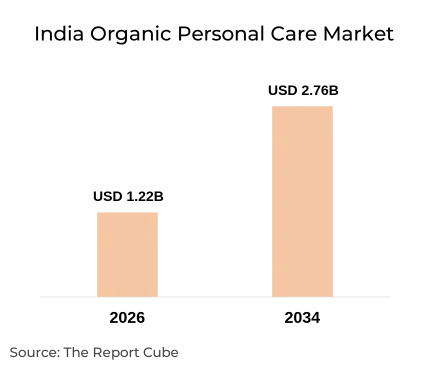
- Market projected to reach USD 2.76 billion by 2034 at a CAGR of 10.76%.
- Skincare leads the product category segment driven by rising consumer preference for natural ingredient formulations.
- E-Commerce and D2C channels dominate distribution, accelerating brand reach across urban and tier-2 markets.
- Haircare is the fastest-growing product category, fueled by ingredient-conscious purchasing and Ayurvedic formulation adoption.
- Forest Essentials, Kama Ayurveda, and Honasa Consumer (Mamaearth) are among the leading players in this market.
- Premiumization, clean-label positioning, and sustainability certifications are reshaping organic personal care procurement decisions.
- South India and West India represent the highest-concentration regional demand zones for organic personal care products.
Market Overview
The India Organic Personal Care Market is anticipated to register a 10.76% CAGR during 2026–2034, expanding from USD 1.22 billion in 2026 to USD 2.76 billion by 2034. A thorough India Organic Personal Care Market Analysis reveals that rising health consciousness, increasing disposable incomes, and heightened consumer awareness of synthetic ingredient risks are collectively sustaining category growth. Government initiatives under Ayush promotion programs and FSSAI regulatory upgrades are strengthening organic certification infrastructure and enabling mainstream adoption across retail channels. Established domestic brands including Forest Essentials and Kama Ayurveda have anchored premium positioning, while newer entrants such as Juicy Chemistry and SoulTree serve ingredient-transparent buyer segments.
Consumer demand for ethically sourced, plant-derived personal care formulations continues gaining momentum across India's rapidly urbanizing population. The country's deep-rooted Ayurvedic tradition provides a culturally credible foundation for organic product positioning, differentiating the market from Western counterparts. Honasa Consumer's Mamaearth brand has demonstrated that D2C scaling models can achieve mass organic product penetration across India's diverse geographic and demographic segments. Sustainability certifications, biodegradable packaging commitments, and transparent supply chain communication are increasingly becoming standard competitive requirements across the product landscape.
Market Size & Forecast
|
Metric |
Details |
|---|---|
|
Market Size (2026) |
USD 1.22 Billion |
|
Market Size (2034) |
USD 2.76 Billion |
|
CAGR (2026–2034) |
10.76% |
|
Base Year |
2026 |
|
Historical Years |
2021–2025 |
|
Forecast Years |
2026–2034 |
The India Organic Personal Care Market size stood at USD 1.22 billion in 2026 and is projected to reach USD 2.76 billion by 2034, advancing at a 10.76% CAGR over the forecast period. This trajectory outpaces the broader Asia Pacific personal care average, propelled by India's unique convergence of Ayurvedic heritage, a digitally empowered millennial consumer base, and expanding D2C distribution infrastructure enabling organic brand penetration into tier-2 and tier-3 cities.
Market Dynamics
India's organic personal care sector is experiencing structural transformation as shifting consumer values, digital retail infrastructure, and regulatory developments collectively reshape ingredient sourcing priorities and brand positioning strategies. Rising disposable incomes, growing awareness of synthetic chemical risks, and an increasing preference for Ayurvedic and botanically certified formulations are reinforcing the India Organic Personal Care Market growth trajectory across all major product and distribution categories through the forecast period.
|
Factor |
Type |
Specific Impact on Market |
Magnitude |
|---|---|---|---|
|
Rising consumer health and ingredient awareness |
Driver |
Accelerates shift from conventional to certified organic personal care formulations |
High |
|
Expanding D2C and e-commerce channels |
Driver |
Enables organic brands to reach tier-2 and tier-3 cities cost-effectively |
High |
|
Premium price positioning of certified organic products |
Restraint |
Limits mass-market penetration among price-sensitive consumer segments |
Medium |
|
Export opportunity to global organic markets |
Opportunity |
Opens revenue channels for domestic brands with international certification compliance |
High |
|
Fragmented and inconsistent organic certification standards |
Challenge |
Creates consumer confusion and regulatory compliance complexity for smaller brands |
Medium |
|
Growth of Ayurvedic and plant-based formulation demand |
Trend |
Drives product innovation and ingredient sourcing partnerships with organic farms |
High |
Growth Drivers - Rising Health Consciousness and Digital Retail Expansion
India's increasingly health-conscious urban population is driving sustained substitution of conventional personal care products with certified organic alternatives. D2C platforms and social commerce channels have significantly reduced brand-building costs, enabling specialist organic brands such as Juicy Chemistry and SoulTree to scale national distribution without traditional retail dependency, reaching informed consumers who prioritize ingredient transparency and sustainability certifications across all product categories.
Market Restraints - Premium Pricing and Mass-Market Accessibility Constraints
Certified organic personal care products typically command a 30–60% price premium over conventional equivalents, creating a structural barrier to adoption among India's large price-sensitive consumer base. Supply chain complexity in sourcing certified organic botanical ingredients, maintaining cold-chain integrity for natural formulations, and absorbing certification compliance costs further compress margins for smaller organic brands competing against established conventional product manufacturers.
Market Opportunities - Export Markets and Ayurvedic Formulation Positioning
India's organic personal care manufacturers benefit from growing global demand for Ayurvedic-certified and botanical ingredient-based products across the US, EU, and Southeast Asian markets. Government-backed export promotion schemes and the international credibility of India's ancient herbal formulation traditions create meaningful differentiation for domestic brands pursuing cross-border growth strategies. Expanding ECOCERT and COSMOS certification adoption among Indian producers is unlocking new premium export distribution partnerships.
Industry Challenges - Certification Fragmentation and Greenwashing Concerns
The absence of a single unified national organic certification standard for personal care products creates market confusion, with multiple overlapping frameworks - including BIS organic cosmetics standards, USDA NOP, COSMOS, and ECOCERT - operating simultaneously. Consumer skepticism around greenwashing claims has intensified, requiring brands to invest significantly in third-party certification, supply chain transparency, and ingredient traceability communication to maintain credible organic market positioning.
Need Specific Data, Let’s Customize the Report for You
Request CustomizationMarket Trends
- Emerging Trends: India Organic Personal Care Market trends reflect a pronounced shift toward multifunctional products combining skincare efficacy with Ayurvedic ingredient credentials. Waterless beauty formulations, solid shampoo bars, and refillable packaging formats are gaining traction among environmentally conscious urban consumers seeking reduced ecological footprints alongside certified organic ingredient assurances.
- Technology Trends: AI-powered skin diagnostic tools integrated into D2C brand websites and apps are enabling personalized organic product recommendation engines for individual skin and hair type requirements. Cold-press extraction, biotechnology-derived plant actives, and nano-encapsulation technologies are advancing the efficacy and shelf-life of natural formulations without compromising organic certification compliance requirements across product categories.
- Consumer / Buyer Trends: India's millennial and Gen Z consumer segments are demonstrating elevated ingredient literacy, actively scrutinizing INCI lists and demanding full botanical ingredient sourcing disclosure from personal care brands. Over 70% of urban organic personal care buyers report sustainability and ethical sourcing credentials as purchase decision factors, driving brands to develop transparent farm-to-shelf supply chain narratives and third-party verified certification credentials.
- Regulatory Trends: The Bureau of Indian Standards (BIS) has advanced development of IS 17519 standards for organic cosmetics, providing a structured domestic certification pathway for the first time. Increasing alignment with COSMOS and ECOCERT international standards among Indian manufacturers is supporting export competitiveness. Mandatory ingredient disclosure requirements under updated Drugs and Cosmetics Act provisions are reinforcing consumer trust and raising baseline transparency obligations across all personal care market participants.
India Organic Personal Care Market Segment Analysis
India's organic personal care market encompasses distinct product categories and distribution channel classifications, each driven by unique consumer demand patterns, brand positioning strategies, and growth dynamics that reflect the country's diverse demographic landscape and evolving retail infrastructure.
By Product Category
- Skincare
- Haircare
- Cosmetics / Makeup
- Oral Care
- Bath, Body & Baby Care
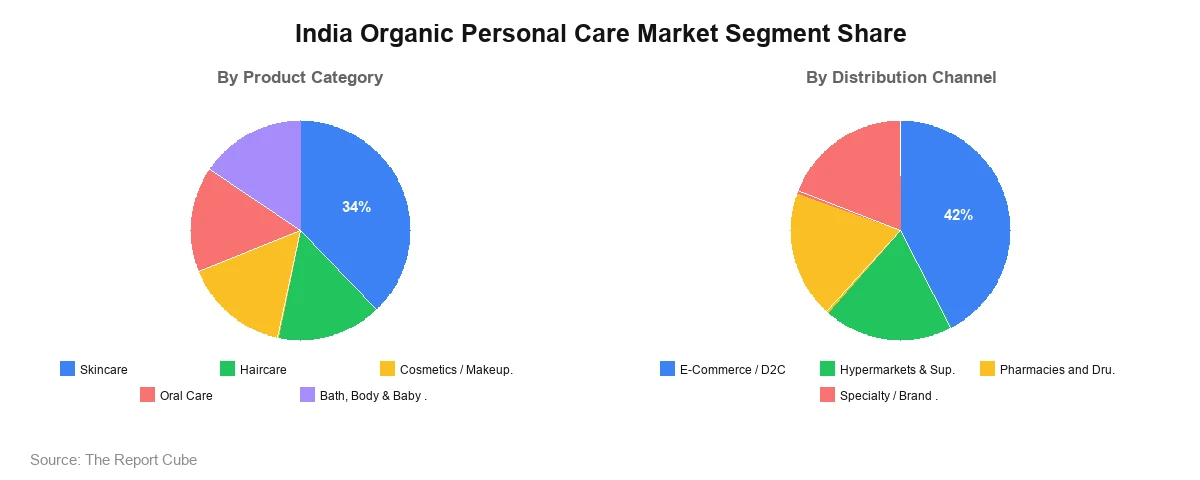
Skincare commands the leading position by product category, accounting for an estimated 34% of India Organic Personal Care Market share in 2026. Forest Essentials and Kama Ayurveda dominate the premium skincare segment with Ayurvedic formulations targeting urban consumers seeking certified natural alternatives. Haircare represents approximately 28% of category demand, with Honasa Consumer's Mamaearth and SoulTree competing across shampoo, conditioner, and treatment segments. Cosmetics and makeup accounts for approximately 16%, supported by Juicy Chemistry's mineral-based certified organic color cosmetic offerings. Oral care holds an estimated 10% share, led by herbal and neem-based formulations. Bath, body, and baby care contributes approximately 12%, driven by parental preference for chemical-free, organic-certified infant personal care products from specialist brands.
By Distribution Channel
- E-Commerce / D2C
- Hypermarkets & Supermarkets
- Pharmacies and Drug Stores
- Specialty / Brand Outlets
E-Commerce and D2C channels lead distribution with an estimated 42% share, driven by the digital-first scaling strategies of brands including Honasa Consumer (Mamaearth) and Juicy Chemistry, which have built significant consumer bases through Amazon, Nykaa, and proprietary brand websites. Hypermarkets and supermarkets account for approximately 26%, with Forest Essentials and Kama Ayurveda products available in premium retail formats including Sephora India and health-focused grocery chains. Pharmacies and drug stores hold an estimated 18% share, gaining relevance as organic oral care and baby care products expand into medical retail channels. Specialty and brand outlets represent approximately 14%, encompassing dedicated Forest Essentials and Kama Ayurveda boutiques across metro and premium tier-2 city retail corridors.
Regional Analysis
|
Region |
Estimated Market Share |
Key Growth Factors |
Consumer Trends |
|---|---|---|---|
|
North India |
28% |
Large urban population, premium brand penetration in Delhi-NCR, growing wellness awareness |
High skincare and premium Ayurvedic product adoption, rising D2C consumer base |
|
South India |
32% |
Established Ayurvedic tradition, strong retail infrastructure, high per-capita beauty spend |
Ingredient-conscious buying behavior, strong haircare and skincare organic demand |
|
West India |
25% |
Mumbai and Pune premium retail concentration, fashion-conscious consumer base |
Organic cosmetics and premium skincare adoption, high e-commerce penetration |
|
East India |
15% |
Emerging organic awareness, expanding e-commerce logistics reach into tier-2 markets |
Growing demand for bath, body, and baby organic care categories |
- South India accounts for approximately 32% of total India Organic Personal Care Market demand, supported by the region's deep Ayurvedic cultural heritage, strong consumer ingredient literacy, and well-developed specialty retail infrastructure concentrated across Bengaluru, Chennai, Hyderabad, and Kochi. Demand is particularly strong for organic haircare and skincare formulations incorporating traditional South Indian botanical ingredients.
- North India represents approximately 28% of market demand, led by Delhi-NCR's concentration of premium retail outlets, high-income urban consumers, and strong D2C brand penetration. Forest Essentials and Kama Ayurveda maintain significant brand salience in this region through flagship stores and selective luxury retail presence within premium shopping destinations.
- West India contributes approximately 25%, driven by Mumbai's position as India's financial and fashion capital and Pune's growing wellness-oriented millennial consumer base. Organic cosmetics and premium skincare categories register the highest growth rates in this region, with e-commerce and beauty specialty platforms capturing the majority of purchase volumes.
- East India holds an estimated 15% market share, representing the fastest-growing regional opportunity as expanding e-commerce logistics networks improve organic personal care product accessibility across Kolkata, Bhubaneswar, and emerging tier-2 city markets. Bath, body, and baby care organic categories are gaining earliest traction as entry-level organic product segments for new consumers.
Market Share & Competitive Landscape
The India Organic Personal Care Market's competitive landscape features a mix of heritage Ayurvedic premium brands, digitally native D2C challengers, and ingredient-focused specialist labels competing across distinct product category and consumer positioning strategies. Competition centers on organic certification credentials, ingredient transparency, brand storytelling authenticity, and distribution channel effectiveness.
|
Company |
Competitive Strength |
Primary Segment Served |
|---|---|---|
|
Forest Essentials |
Premium Ayurvedic positioning, luxury retail presence, heritage brand equity |
Skincare, haircare, premium gifting |
|
Kama Ayurveda |
Certified organic Ayurvedic formulations, international distribution |
Skincare, haircare, body care |
|
SoulTree |
COSMOS-certified organic range, affordability positioning |
Skincare, haircare, cosmetics |
|
Honasa Consumer (Mamaearth) |
D2C scaling model, mass organic market penetration, certified toxin-free range |
Haircare, skincare, baby care |
|
Juicy Chemistry |
Cold-pressed certified organic formulations, ingredient transparency |
Skincare, cosmetics, haircare |
|
Others |
Regional brands, private label organic, niche botanicals |
Varies by segment and geography |
Key Companies in the India Organic Personal Care Market
Forest Essentials
Forest Essentials, headquartered in New Delhi, India, was founded in 2000 and is widely regarded as the pioneer of luxury Ayurvedic personal care in the country. In 2025, the brand expanded its international retail presence and strengthened its certified organic ingredient sourcing network across Himalayan and Ayurvedic herb-producing regions. Its premium positioning, distinctive packaging, and authentic classical Ayurvedic formulation philosophy remain core competitive differentiators in the Indian and global organic personal care markets.
Honasa Consumer (Mamaearth)
Honasa Consumer, headquartered in Gurugram, India, operates the Mamaearth brand alongside sister brands including The Derma Co., Aqualogica, and Ayuga. In 2025, Honasa Consumer continued expanding its certified toxin-free and organic product portfolio while strengthening offline retail distribution across modern trade and pharmacy channels. Its data-driven D2C model, social media-led brand building, and competitive price positioning have made it the highest-volume organic personal care brand in the Indian market.
Recent Developments
|
Year |
Company |
Development |
|---|---|---|
|
2025 |
Forest Essentials |
Expanded international retail presence and strengthened certified organic ingredient sourcing from Himalayan herb-producing regions |
|
2025 |
Honasa Consumer (Mamaearth) |
Extended toxin-free and organic product portfolio; scaled offline distribution across pharmacy and modern trade retail channels |
|
2025 |
Juicy Chemistry |
Received COSMOS Organic certification renewal and launched new cold-pressed certified organic skincare range targeting premium urban consumers |
Market Future Outlook
The India Organic Personal Care Market forecast points to sustained expansion, reaching USD 2.76 billion by 2034 at a 10.76% CAGR through the forecast period. Continued premiumization of skincare and haircare categories, rising e-commerce penetration into tier-2 and tier-3 cities, and increasing consumer demand for certified organic baby care products will collectively reinforce market momentum. Forest Essentials, Kama Ayurveda, and Honasa Consumer are expected to lead category growth through new product innovation, expanded distribution networks, and deepened Ayurvedic certification credibility through the decade ahead.
Technological advancement in botanical extraction, AI-personalized skincare diagnostics, and sustainable packaging innovation will progressively redefine competitive benchmarks across the India Organic Personal Care Market. Strengthening domestic organic certification frameworks under BIS IS 17519 standards and increasing alignment with COSMOS and ECOCERT international protocols will raise baseline quality standards, support export expansion, and build systemic consumer trust in organic product claims across all distribution channels through 2034.
India Organic Personal Care Market Report Coverage
The India Organic Personal Care Market report provides comprehensive coverage of market sizing, segmentation, competitive dynamics, regional analysis, and forecast projections through 2034.
|
Report Attribute |
Details |
|---|---|
|
Market Name |
India Organic Personal Care Market |
|
Market Size (2026) |
USD 1.22 Billion |
|
Market Size (2034) |
USD 2.76 Billion |
|
Forecast Period |
2026–2034 |
|
CAGR |
10.76% |
|
Base Year |
2026 |
|
Historical Years |
2021–2025 |
|
Forecast Years |
2026–2034 |
|
Segments Covered |
By Product Category, By Distribution Channel |
|
Regions Covered |
North India, South India, West India, East India |
|
Key Companies |
Forest Essentials, Kama Ayurveda, SoulTree, Honasa Consumer (Mamaearth), Juicy Chemistry, Others |
|
Report Format |
PDF, Excel, PPT |
|
Customization |
Available as per client requirements |
Why Choose This India Organic Personal Care Market Report?
- Comprehensive coverage of India's fast-growing certified organic personal care product landscape across all major categories.
- Accurate market sizing from USD 1.22 billion in 2026 with a validated 10.76% CAGR through 2034.
- Detailed segmentation by product category and distribution channel with estimated market share percentages.
- Regional demand analysis covering North, South, West, and East India with distinct growth factor breakdowns.
- Competitive profiling of leading domestic organic personal care brands including Forest Essentials, Mamaearth, and Juicy Chemistry.
- In-depth trend analysis covering Ayurvedic formulation innovation, D2C scaling models, and sustainable packaging adoption.
- Forecast data supporting brand investment decisions, channel strategy planning, and market entry assessment.
- Research aligned with India's Ayush promotion programs and emerging BIS organic cosmetics certification standards.
Table of Contents
- Introduction
- Objective of the Study
- Product Definition
- Market Segmentation
- Study Variables
- Research Methodology
- Secondary Data Points
- Companies Interviewed
- Primary Data Points
- Breakdown of Primary Interviews
- Secondary Data Points
- Executive Summary
- Market Dynamics
- Drivers
- Challenges
- Opportunity Assessment
- Recent Trends and Developments
- Policy and Regulatory Landscape
- India Organic Personal Care Market Overview and Forecast Analysis (2021-2034)
- Market Size, By Value, By Growth Rate (CAGR/USD Billions)
- Demand – Supply Trends
- Market Share, By Product Category
- Skincare
- Haircare
- Cosmetics / Makeup
- Oral Care
- Bath, Body & Baby Care
- Market Share, By Distribution Channel
- E-Commerce / D2C
- Hypermarkets & Supermarkets
- Pharmacies and Drug Stores
- Specialty / Brand Outlets
- Market Share, By Region
- North India
- South India
- East India
- West India
- Market Share, By Competitors
- Competition Characteristics
- Revenue Shares
- Skincare India Organic Personal Care Market Overview, 2021-2034F
- By Value (USD Million)
- By Distribution Channel – Market Size & Forecast 2021-2034, USD Million
- E-Commerce / D2C
- Hypermarkets & Supermarkets
- Pharmacies and Drug Stores
- Specialty / Brand Outlets
- Haircare India Organic Personal Care Market Overview, 2021-2034F
- By Value (USD Million)
- By Distribution Channel – Market Size & Forecast 2021-2034, USD Million
- E-Commerce / D2C
- Hypermarkets & Supermarkets
- Pharmacies and Drug Stores
- Specialty / Brand Outlets
- Cosmetics / Makeup India Organic Personal Care Market Overview, 2021-2034F
- By Value (USD Million)
- By Distribution Channel – Market Size & Forecast 2021-2034, USD Million
- E-Commerce / D2C
- Hypermarkets & Supermarkets
- Pharmacies and Drug Stores
- Specialty / Brand Outlets
- Oral Care India Organic Personal Care Market Overview, 2021-2034F
- By Value (USD Million)
- By Distribution Channel – Market Size & Forecast 2021-2034, USD Million
- E-Commerce / D2C
- Hypermarkets & Supermarkets
- Pharmacies and Drug Stores
- Specialty / Brand Outlets
- Bath, Body & Baby Care India Organic Personal Care Market Overview, 2021-2034F
- By Value (USD Million)
- By Distribution Channel – Market Size & Forecast 2021-2034, USD Million
- E-Commerce / D2C
- Hypermarkets & Supermarkets
- Pharmacies and Drug Stores
- Specialty / Brand Outlets
- Competitive Outlook (Company Profile - Partial List)
- Forest Essentials
- Company Overview
- Business Segments
- Strategic Alliances/Partnerships
- Recent Developments
- Kama Ayurveda
- Company Overview
- Business Segments
- Strategic Alliances/Partnerships
- Recent Developments
- SoulTree
- Company Overview
- Business Segments
- Strategic Alliances/Partnerships
- Recent Developments
- Honasa Consumer (Mamaearth)
- Company Overview
- Business Segments
- Strategic Alliances/Partnerships
- Recent Developments
- Juicy Chemistry
- Company Overview
- Business Segments
- Strategic Alliances/Partnerships
- Recent Developments
- Others
- Forest Essentials
- Contact Us & Disclaimer
Top Key Players & Market Share Outlook
- Forest Essentials
- Kama Ayurveda
- SoulTree
- Honasa Consumer (Mamaearth)
- Juicy Chemistry
- Others
Frequently Asked Questions






