



Build Your Custom Market Intelligence Report
Customize Your ReportGlobal Palm Payment Technology Market Key Takeaways
- Market valued at USD 108.76 million in 2026, reflecting rising contactless payment adoption.
- Industry projected to reach USD 730.95 million by 2034, expanding at 26.89% CAGR.
- Multi-Factor Authentication dominates security segment due to stricter enterprise compliance mandates.
- Retail and e-commerce leads end-use adoption owing to frictionless checkout integration demand.
- North America maintains regional leadership through early biometric infrastructure and regulatory support.
- Asia Pacific emerges as the fastest-growing region driven by digital payment ecosystem expansion.
- Key players include Amazon.com Inc., Fujitsu, NEC Corporation, ZKTECO, and Hangzhou Hikvision.
- Growing identity fraud incidents and contactless payment mandates are accelerating palm biometric deployment.
Global Palm Payment Technology Market Insights & Analysis
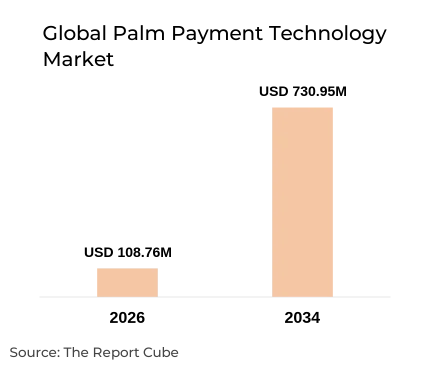
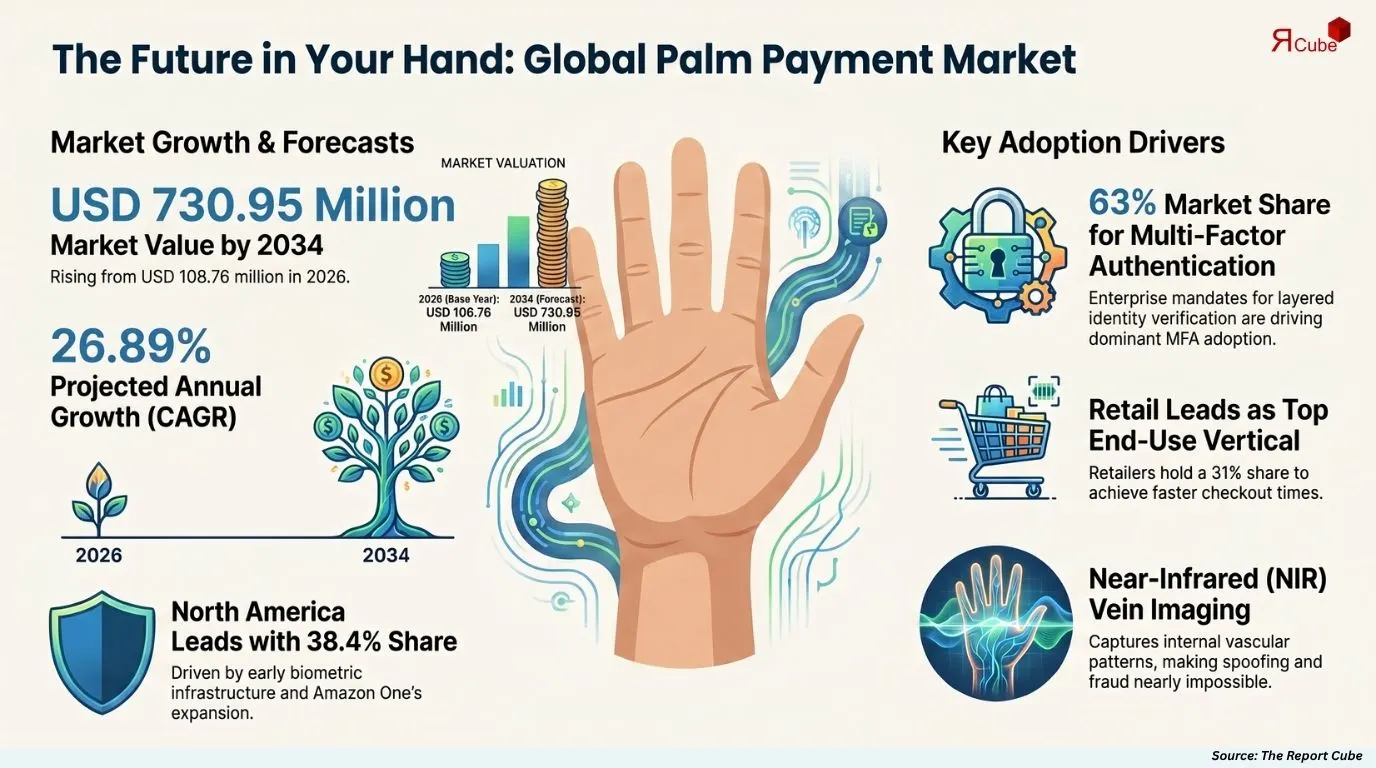
The Global Palm Payment Technology Market is anticipated to register a 26.89% CAGR during 2026–2034. The market size was valued at USD 108.76 million in 2026 and is projected to reach USD 730.95 million by 2034. The industry is accelerating as retailers, financial institutions, and healthcare operators adopt palm vein and palm print recognition systems to replace PIN-based and card-swipe payment methods. Governments across North America and Europe are reinforcing digital identity frameworks, while enterprise-grade deployments in contactless biometric payment infrastructure continue gaining institutional investment backing from both private venture capital and public sector modernization budgets.
Demand for palm payment systems is being reinforced by rising identity fraud incidents, with global payment fraud losses surpassing USD 48 billion in 2024 according to industry estimates. Financial institutions are integrating palm recognition into multi-layered authentication workflows to reduce chargebacks and unauthorized transaction volumes. Healthcare operators and transit authorities are accelerating adoption for ticketing, access control, and patient identification applications. Technology providers are scaling palm sensor accuracy using near-infrared imaging and deep learning algorithms that deliver false acceptance rates below 0.0001%, making palm-based systems a trusted alternative across regulated industries.
Global Palm Payment Technology Market Dynamics
The Global Palm Payment Technology Market is gaining substantial momentum as demand for frictionless, hygienic, and fraud-resistant payment solutions rises across retail, banking, healthcare, and public infrastructure sectors. Enterprises are replacing traditional authentication models with biometric-first architectures as contactless mandates, data privacy regulations, and consumer expectations converge to redefine payment security standards globally.
|
Factor |
Type |
Specific Impact on Market |
Magnitude |
|---|---|---|---|
|
Rising identity fraud and card skimming |
Driver |
Accelerates palm biometric deployment in financial institutions |
Very High |
|
Contactless payment infrastructure expansion |
Opportunity |
Increases palm scanner integration at retail points-of-sale |
High |
|
Multi-factor authentication mandates |
Driver |
Boosts demand for palm-integrated MFA solutions |
High |
|
Privacy regulations limiting data retention |
Challenge |
Requires on-device palm template processing architectures |
High |
|
Near-infrared palm vein imaging advances |
Trend |
Improves liveness detection and spoof-resistance across deployments |
Very High |
Key Market Driver: Fraud Prevention Drives Biometric Payment Adoption
Financial institutions and large-format retailers are deploying palm payment systems primarily to reduce payment fraud, which cost global businesses an estimated USD 48.7 billion in 2024. Palm vein recognition uses subcutaneous vascular patterns invisible to external observation, making replication virtually impossible compared to fingerprint or facial recognition alternatives. Banks in North America and Europe are integrating palm authentication within existing card network infrastructure to strengthen transaction-level verification, reduce chargeback rates, and achieve compliance with evolving strong customer authentication (SCA) directives without introducing customer friction at the point of sale.
Major Industry Challenge: Biometric Data Privacy and Regulatory Compliance
Operators deploying palm payment systems face increasing regulatory scrutiny under GDPR in Europe, BIPA in Illinois, and emerging biometric privacy statutes across multiple U.S. states. Regulations require explicit consent, defined data retention limits, and secure storage of biometric templates, compelling vendors to architect on-device processing pipelines that never transmit raw palm data to centralized servers. Compliance costs associated with template encryption, audit trails, and consumer opt-out mechanisms are elevating deployment complexity, particularly for mid-sized retailers and regional financial institutions operating across multiple regulatory jurisdictions simultaneously.
Emerging Trend Shaping Outlook: Near-Infrared Vein Imaging Enhances Accuracy
Near-infrared (NIR) palm vein imaging is rapidly becoming the preferred sensing modality for payment applications due to its ability to capture internal vascular structures independent of surface skin conditions, lighting, or aging-related changes. Vendors including Fujitsu and NEC Corporation have demonstrated false rejection rates below 0.01% in high-throughput retail environments using NIR sensors combined with convolutional neural network-based matching engines. This accuracy advantage is prompting transit authorities, stadiums, and airport operators to pilot palm payment systems for high-volume access and ticketing scenarios where speed and reliability are operationally critical alongside multi-factor authentication integration across enterprise payment networks.
Need Specific Data, Let’s Customize the Report for You
Request CustomizationGlobal Palm Payment Technology Market Segment-wise Analysis
Palm payment technology is being deployed across a growing range of authentication architectures and end-use verticals. Security infrastructure requirements and sector-specific regulatory frameworks are shaping the adoption pace across authentication layers and application environments, creating differentiated growth trajectories for each sub-segment.
By Security Level
- Single-Factor Authentication (SFA)
- Multi-Factor Authentication (MFA)
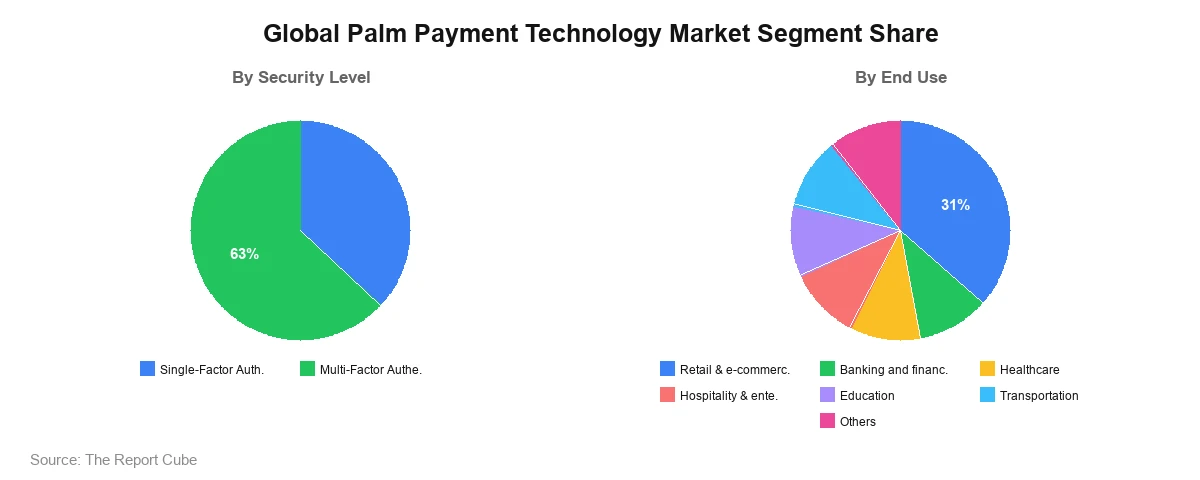
Multi-Factor Authentication commands an estimated 63% market share within the security level segment, driven by enterprise mandates requiring layered identity verification across financial services, healthcare, and government-operated payment environments. Regulatory frameworks such as PSD2 in Europe and FIDO2 standards globally are compelling solution providers to integrate palm recognition as one authentication layer within broader MFA stacks that combine biometric verification with tokenized credentials or device-bound certificates. Banks and large retailers deploying MFA-integrated palm systems report fraud reduction rates of 30 to 40% compared to standalone PIN or card verification environments.
Single-Factor Authentication retains meaningful adoption in lower-risk retail and hospitality environments where deployment simplicity and consumer enrollment speed take priority over layered verification. Convenience-focused verticals such as quick-service restaurants, stadium concessions, and gym access control continue adopting SFA palm systems as a replacement for loyalty card and RFID-based entry mechanisms. Vendors are developing lightweight SFA palm terminals priced below USD 800 per unit to accelerate penetration in price-sensitive mid-market retail segments, supporting broader ecosystem reach for the palm vein scanner hardware market across small and medium enterprise operators.
By End Use
- Retail & e-commerce
- Banking and finance
- Healthcare
- Hospitality & entertainment
- Education
- Transportation
- Others
Retail and e-commerce represents the dominant end-use segment with an estimated 31% market share, driven by the deployment of palm payment terminals at grocery chains, convenience stores, and high-footfall retail locations as operators seek checkout speed improvements and loyalty program integration without physical card or mobile device dependency. Amazon's One palm payment ecosystem, deployed across Whole Foods and Amazon Go locations, has demonstrated that palm-linked purchasing reduces average checkout times to under three seconds, creating competitive pressure on traditional grocery and convenience retail operators to evaluate comparable biometric point-of-sale infrastructure.
Banking and finance is the second-largest contributor as financial institutions expand palm authentication into ATM networks, branch teller verification, and digital onboarding workflows to satisfy strong customer authentication requirements. Healthcare is among the fastest-growing verticals, with hospitals deploying palm recognition for patient identification at registration, pharmacy dispensing, and insurance billing verification to eliminate misidentification risks. Hospitality, education, and transportation operators are piloting palm payment for cashless campus environments, hotel check-in automation, and transit fare collection respectively, with government-backed smart city programs in Asia Pacific and the Middle East funding initial infrastructure buildouts across transportation biometric payment deployment programs.
Regional Projection of Global Palm Payment Technology Market
The Global Palm Payment Technology Market demonstrates distinct regional growth dynamics shaped by biometric regulation maturity, digital payment infrastructure depth, enterprise technology investment cycles, and consumer acceptance of contactless identity verification across payment environments.
|
Region |
Estimated Market Share |
Key Growth Factors |
Consumer Trends |
|---|---|---|---|
|
North America |
38.4% |
Amazon One ecosystem expansion, SCA compliance, fraud mitigation |
High adoption in grocery and financial institution environments |
|
Europe |
26.7% |
GDPR-compliant biometric deployments, PSD2 mandates, retail modernization |
Growing demand for privacy-preserving on-device palm processing |
|
Asia Pacific |
22.1% |
Smart city programs, government digital ID mandates, transit integration |
Rising adoption in urban transit and campus payment environments |
|
Latin America |
7.3% |
Digital banking expansion, financial inclusion programs |
Increasing interest in palm-based mobile banking authentication |
|
Middle East & Africa |
5.5% |
Smart infrastructure investments, Vision 2030 digital economy programs |
Growing enterprise adoption in hospitality and government sectors |
- North America: North America leads the global market with approximately 38.4% share, underpinned by Amazon's One platform deployments across thousands of retail locations and expanding bank-led biometric authentication programs targeting fraud reduction and SCA regulatory compliance.
- Europe: Europe maintains strong investment driven by PSD2 strong customer authentication enforcement, with retailers and banks prioritizing privacy-preserving on-device palm template architectures compliant with GDPR biometric data handling requirements.
- Asia Pacific: Asia Pacific represents the fastest-growing region as government-backed smart city programs in China, Japan, South Korea, and India fund palm payment pilots in transit, healthcare, and campus environments, supported by dense urban retail density.
- Latin America: Latin America is expanding through digital banking infrastructure buildouts and financial inclusion initiatives extending biometric payment access to underbanked populations across Brazil, Mexico, and Colombia.
- Middle East & Africa: The Middle East is accelerating palm payment adoption through Vision 2030 smart economy initiatives in Saudi Arabia and UAE, with hospitality and government sectors serving as primary deployment environments.
Global Palm Payment Technology Market: Recent Development (2025)
- Amazon expanded One palm payment terminals to over 500 new U.S. retail locations in early 2025.
- Fujitsu launched an updated PalmSecure sensor module supporting real-time liveness detection for payment terminals.
- NEC Corporation partnered with a Southeast Asian bank to deploy palm authentication across 200 branches.
- ZKTECO introduced a palm payment kiosk designed for smart city transit fare collection in 2025.
Global Palm Payment Technology Market Future Outlook (2034)
The Global Palm Payment Technology Market is projected to expand at a 26.89% CAGR, reaching approximately USD 730.95 million by 2034. Increasing adoption of palm-linked digital wallets, loyalty programs, and identity verification platforms will drive revenue generation across retail, banking, healthcare, and transportation sectors. Advances in near-infrared sensor miniaturization will enable integration into standard point-of-sale terminals, mobile devices, and wearable form factors, significantly reducing hardware cost barriers and expanding addressable market depth beyond large enterprise operators to mid-market and consumer-facing applications globally.
Long-term growth will be reinforced by AI-powered palm template adaptation algorithms that maintain recognition accuracy across aging, skin condition changes, and environmental variables without requiring re-enrollment. Sovereign digital identity frameworks being developed across the European Union, India, and Gulf Cooperation Council nations are expected to embed palm recognition as a certified biometric modality within national identity architectures, creating institutional demand channels beyond commercial payment applications. Interoperability standards connecting palm payment systems with existing EMV card networks and open banking APIs will further accelerate enterprise adoption, positioning palm biometrics as a foundational layer within global digital identity and payment convergence platforms through the forecast period.
Global Palm Payment Technology Market Report Coverage
|
Report Attribute |
Details |
|---|---|
|
Market Name |
Global Palm Payment Technology Market |
|
Market Size (2026) |
USD 108.76 Million |
|
Market Size (2034) |
USD 730.95 Million |
|
Forecast Period |
2026–2034 |
|
CAGR |
26.89% |
|
Base Year |
2026 |
|
Historical Years |
2021–2025 |
|
Forecast Years |
2026–2034 |
|
Segments Covered |
By Security Level, By End Use, By Authentication Method, By Solution |
|
Regions Covered |
North America, Europe, Asia Pacific, Latin America, Middle East and Africa |
|
Key Companies |
Amazon.com Inc., Fujitsu, NEC Corporation, ZKTECO CO. LTD., Hangzhou Hikvision Digital Technology Co. Ltd., Others |
|
Report Format |
PDF, Excel, PPT |
|
Customization |
Available as per client requirements |
Why Choose This Report?
- Comprehensive analysis covering palm biometric adoption across seven end-use verticals.
- Accurate market sizing with reliable CAGR forecast through 2034.
- Detailed segmentation covering security level and end-use revenue dynamics.
- Regional insights addressing regulatory compliance and biometric privacy frameworks.
- Competitive profiling of leading palm payment technology solution providers.
- Analysis of near-infrared vein imaging and AI-driven authentication advances.
- Strategic insights supporting vendor positioning and enterprise investment decisions.
- Data-driven research aligned with evolving contactless payment and identity standards.
Table of Contents
- Introduction
- Objective of the Study
- Product Definition
- Market Segmentation
- Study Variables
- Research Methodology
- Secondary Data Points
- Companies Interviewed
- Primary Data Points
- Breakdown of Primary Interviews
- Secondary Data Points
- Executive Summary
- Market Dynamics
- Drivers
- Challenges
- Opportunity Assessment
- Recent Trends and Developments
- Policy and Regulatory Landscape
- Global Palm Payment Technology Market Overview and Forecast Analysis (2021-2034)
- Market Size, By Value, By Growth Rate (CAGR/USD Millions)
- Demand – Supply Trends
- Market Share, By Solution
- Hardware
- Software
- Market Share, By Authentication Method
- Palm Vein Recognition
- Palm Print Recognition
- Hybrid methods
- Market Share, By Security Level
- Single-Factor Authentication (SFA)
- Multi-Factor Authentication (MFA)
- Market Share, By End Use
- Retail & e-commerce
- Banking and finance
- Healthcare
- Hospitality & entertainment
- Education
- Transportation
- Others
- Market Share, By Region
- North America
- Europe
- Asia Pacific
- Latin America
- Middle East and Africa
- Market Share, By Competitors
- Competition Characteristics
- Revenue Shares
- Hardware Global Palm Payment Technology Market Overview, 2021-2034F
- By Value (USD Million)
- By Authentication Method – Market Size & Forecast 2021-2034, USD Million
- Palm Vein Recognition
- Palm Print Recognition
- Hybrid methods
- Software Global Palm Payment Technology Market Overview, 2021-2034F
- By Value (USD Million)
- By Authentication Method – Market Size & Forecast 2021-2034, USD Million
- Palm Vein Recognition
- Palm Print Recognition
- Hybrid methods
- Competitive Outlook (Company Profile – Partial List)
- Amazon.com Inc.
- Company Overview
- Business Segments
- Strategic Alliances/Partnerships
- Recent Developments
- Fujitsu
- Company Overview
- Business Segments
- Strategic Alliances/Partnerships
- Recent Developments
- NEC Corporation
- Company Overview
- Business Segments
- Strategic Alliances/Partnerships
- Recent Developments
- ZKTECO CO. LTD.
- Company Overview
- Business Segments
- Strategic Alliances/Partnerships
- Recent Developments
- Hangzhou Hikvision Digital Technology Co. Ltd.
- Company Overview
- Business Segments
- Strategic Alliances/Partnerships
- Recent Developments
- Others
- Amazon.com Inc.
- Contact Us & Disclaimer
Top Key Players & Market Share Outlook
- Amazon.com Inc.
- Fujitsu
- NEC Corporation
- ZKTECO CO. LTD.
- Hangzhou Hikvision Digital Technology Co. Ltd.
- Others
Frequently Asked Questions