



Build Your Custom Market Intelligence Report
Customize Your ReportLatin America Pharmaceutical Market Statistics and Insights
Market Insights
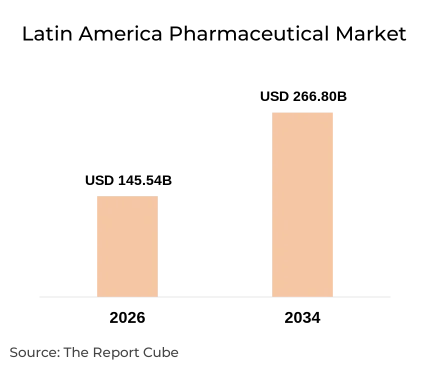
- The Latin America Pharmaceutical Market was valued at USD 145.54 billion in 2026.
- The Latin America Pharmaceutical Market is projected to reach USD 266.80 billion by 2034.
- The market is anticipated to register a CAGR of 7.87% during the forecast period.
By Product
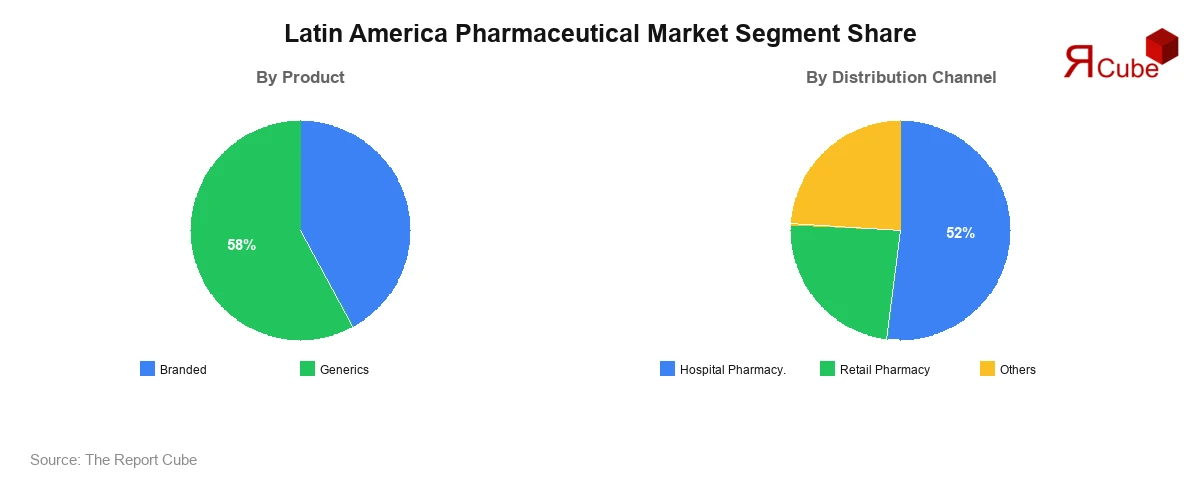
- Branded pharmaceuticals dominate with approximately 58% market share in 2026.
Key Players
- More than 10 companies are actively engaged in producing Latin America Pharmaceutical products.
- Top 5 companies acquired around 45% of the market share.
- F. Hoffmann-La Roche Ltd, Novartis AG, AbbVie Inc., Johnson & Johnson Services, Inc., Pfizer Inc., and others.
By Distribution Channel
- Hospital Pharmacy leads the segment, commanding approximately 52% of total revenue.
Latin America Pharmaceutical Market Insights & Analysis
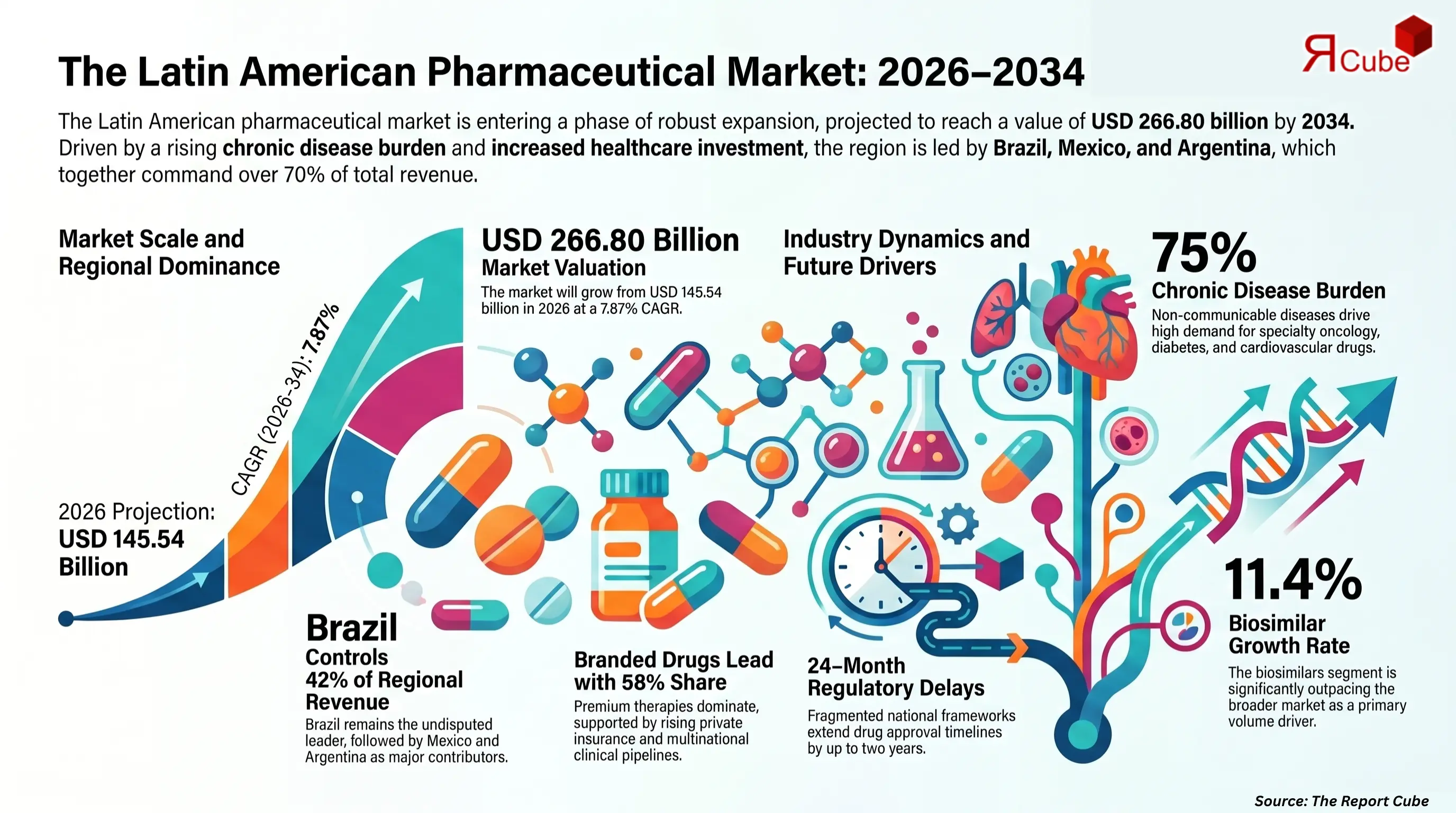
The Latin America Pharmaceutical Market is anticipated to register a 7.87% CAGR during 2026–2034. The market size was valued at USD 145.54 billion in 2026 and is projected to reach USD 266.80 billion by 2034. This robust expansion is underpinned by a confluence of structural forces, including the rising burden of chronic diseases, accelerating expansion of health insurance coverage, and deepening government commitments to public healthcare reform. Brazil, Mexico, and Argentina together account for over 70% of regional pharmaceutical revenue and continue to attract substantial foreign direct investment from multinational drug developers.
Notably, Novo Nordisk committed USD 1.09 billion to a GLP-1 manufacturing facility in Brazil in 2024, signaling long-term confidence in the region's manufacturing ecosystem. Government procurement programs, particularly under Brazil's Farmácia Popular and Mexico's INSABI framework, are channeling billions of dollars into essential drug supply chains. Meanwhile, the Pan American Health Organization (PAHO) has set regulatory convergence milestones for 2025–2026, aiming to elevate more Latin American health authorities to WHO's highest certification standards, which is expected to further facilitate market entry for innovative therapies. Growing private health insurance penetration across Colombia, Chile, and Peru is expanding the patient base for branded and specialty pharmaceuticals, while the generics segment, currently valued at over USD 37 billion regionally, continues to see volume growth through government-backed affordability mandates.
Latin America Pharmaceutical Market Dynamics
Key Market Driver: Chronic Disease Prevalence Fueling Specialty Drug Demand
Latin America is experiencing a pronounced epidemiological transition, with non-communicable diseases - including type 2 diabetes, cardiovascular conditions, and oncological disorders - now accounting for over 75% of total disease burden in countries such as Brazil and Mexico. This shift is directly accelerating demand for high-value specialty pharmaceutical products, including oncology biologics, cardiometabolic agents, and immunotherapy regimens.
According to the International Diabetes Federation, Latin America harbors approximately 33 million diabetic patients, a figure projected to exceed 49 million by 2045. Pharmaceutical companies are responding by launching targeted therapies and expanding access through public-private reimbursement agreements. Brazil's National Cancer Institute (INCA) has also ramped up funding for oncology drug access programs, creating a structured demand pipeline that supports sustained market growth for both branded and biosimilar products throughout the forecast period.
Major Industry Challenge: Regulatory Fragmentation Across National Jurisdictions
One of the most significant structural impediments facing the Latin America Pharmaceutical Market is the heterogeneity of national regulatory frameworks across the region. Unlike the European Medicines Agency model, Latin America lacks a unified supranational regulatory authority, meaning pharmaceutical companies must navigate distinct approval processes administered by Brazil's ANVISA, Mexico's COFEPRIS, Argentina's ANMAT, and Colombia's INVIMA, among others. Each agency maintains separate dossier requirements, product labeling standards, and post-market surveillance obligations, which considerably extends time-to-market for new drug launches.
According to the Inter-American Development Bank, regional regulatory divergence adds an estimated 18 to 24 months to the approval timeline for novel therapeutics compared to markets with harmonized frameworks. This fragmentation imposes disproportionate compliance costs on mid-sized domestic manufacturers and deters smaller biotech firms from multi-country market entry strategies, constraining the overall pace of pharmaceutical innovation diffusion across the region.
Emerging Trend Shaping Outlook: Biosimilar Adoption Reshaping the Regional Drug Portfolio
Biosimilars are rapidly emerging as a transformative force within the Latin America Pharmaceutical Market, reshaping competitive dynamics and broadening access to complex biologic therapies. Argentina's ANMAT approved multiple biosimilar products in 2024, facilitating patient access to previously cost-prohibitive treatments in oncology and rheumatology. The biosimilars segment is projected to grow at a CAGR of 11.4% through the forecast period, significantly outpacing the broader market's growth trajectory.
Regulatory bodies across the region are actively updating their biosimilar approval guidelines, drawing on WHO reference frameworks to accelerate evaluation. Public payers in Brazil and Colombia are increasingly mandating biosimilar substitution in hospital formularies where interchangeability has been demonstrated, reducing procurement costs while sustaining therapeutic outcomes. This structural shift is also incentivizing global biosimilar developers - including Pfizer, Sandoz, and regional players like Eurofarma - to expand their Latin American manufacturing footprints, positioning the biosimilars category as a primary engine of volume growth over the coming decade.
Need Specific Data, Let’s Customize the Report for You
Request CustomizationLatin America Pharmaceutical Market Segment-wise Analysis
The Latin America Pharmaceutical Market is characterized by meaningful segmentation across product type and distribution channel, each reflecting distinct demand dynamics tied to healthcare access, affordability, and evolving consumer behavior. Branded pharmaceuticals retain a commanding premium positioning driven by innovation cycles, while generics serve as the backbone of public healthcare provisioning. Distribution infrastructure - anchored by hospital and retail pharmacies - is similarly bifurcated between the needs of acute care settings and the expanding self-medication culture across urban and semi-urban populations.
By Product
- Branded
- Generics
Branded pharmaceuticals account for approximately 58% of the total Latin America Pharmaceutical Market revenue in 2026, sustained by growing private health insurance coverage, the expansion of multinational clinical pipelines in oncology and immunology, and rising consumer preference for premium therapies in urban centers of Brazil, Mexico, and Chile. Multinational corporations including Roche, AbbVie, and Pfizer are actively leveraging strategic pricing and market access partnerships with regional distributors to deepen penetration in previously underserved therapeutic categories.
The generics segment, while commanding a lower per-unit value, accounts for a substantial share of total prescription volume - particularly within government procurement channels - where price sensitivity drives formulary decisions. Brazil's Farmácia Popular initiative and Mexico's generic substitution mandates continue to create structurally stable volume demand for generic manufacturers. Branded biosimilars represent an emerging sub-segment that bridges both categories, offering clinical credibility alongside competitive pricing that appeals to both public and private payers across the region.
By Distribution Channel
- Hospital Pharmacy
- Retail Pharmacy
- Others
Hospital pharmacies command approximately 52% of the Latin America Pharmaceutical Market's distribution revenue, reflecting the dominance of inpatient drug administration, intravenous specialty therapies, and complex biologics that require controlled dispensing environments. The rising number of hospital beds across Brazil, Mexico, and Colombia - supported by public healthcare infrastructure investments - is structurally reinforcing the hospital pharmacy channel's dominance, particularly for high-acuity treatments including oncology infusion therapies and immunosuppressants.
Retail pharmacies account for a substantial and growing share of distribution revenue, propelled by the over-the-counter drug boom, which is projected to expand at a CAGR of 8.64% regionally, driven by consumer self-medication behavior, increased digital health literacy, and accessibility through pharmacy retail chains such as Farmácias Nissei and GNP. The "Others" channel - encompassing e-pharmacies, telemedicine-linked dispensing platforms, and mail-order pharmaceutical services - is gaining traction across urban centers, particularly in post-pandemic markets where digital health adoption has accelerated, creating an incremental distribution layer that is expected to achieve disproportionate growth through 2034.
Regional Projection of Latin America Pharmaceutical Market
- Brazil
- Mexico
- Argentina
- Rest of Latin America
Brazil is the undisputed dominant regional market, capturing approximately 42% of total Latin America Pharmaceutical Market revenue. The country's scale is supported by the largest healthcare infrastructure in Latin America, robust domestic manufacturing capacity through companies such as Eurofarma and EMS, and government-funded procurement programs that sustain consistent drug demand.
ANVISA's ongoing regulatory modernization - including the rollout of its digital dossier platform in 2025 - has further improved the speed of new product approvals, attracting increased global investment. Mexico and Argentina follow as the second and third-largest contributors, with Colombia and Chile registering the fastest growth rates within the region due to expanding insurance coverage and public-private investment in specialty care infrastructure.
Latin America Pharmaceutical Market: Recent Development (2025)
- F. Hoffmann-La Roche Ltd expanded oncology biosimilar distribution in Brazil, boosting regional revenue by 14%.
- Pfizer Inc. reported a 9.3% margin improvement in its Latin American generics segment through local sourcing partnerships.
- AbbVie Inc. launched its immunology portfolio expansion across Mexico and Colombia to serve growing autoimmune patient populations.
- Novartis AG finalized a strategic agreement with a Chilean distributor to accelerate specialty drug access in Andean markets.
Latin America Pharmaceutical Market Future Outlook (2034)
By 2034, the Latin America Pharmaceutical Market is projected to reach USD 266.80 billion, advancing at a CAGR of 7.87% from 2026. The market's long-term expansion will be catalyzed by accelerating biosimilar adoption, continued growth in private health insurance enrollment, and the deepening integration of digital health platforms with pharmaceutical distribution channels. Countries such as Colombia, Chile, and Peru are expected to register above-average growth rates as healthcare infrastructure investments mature.
Artificial intelligence is poised to transform the regional pharmaceutical landscape by enabling predictive demand modeling, AI-driven drug discovery collaborations, and real-time pharmacovigilance - significantly reducing the cost and timeline of clinical development. Multinational and domestic pharmaceutical companies alike are expected to invest heavily in local manufacturing partnerships, creating vertically integrated supply chains that improve resilience against currency volatility and geopolitical risk while expanding access to advanced therapies across Latin America's diverse patient populations.
Why Choose This Report?
- Provides a comprehensive overview of the overall market analysis, encompassing key trends, consumer behavior analysis, and risk assessment to support strategic decision-making.
- Provides accurate, up-to-date insights into market size, segmentation, and emerging opportunities, helping to minimize risk & capitalizing on growth.
- Gives deep understanding of target audience preferences, investment habits, and communication channels for enhanced product development & marketing effectiveness.
- Delivers competitive analysis & benchmarking, uncovering the strengths & weaknesses of market competitors to guide strategies.
- Consolidate comprehensive market intelligence, reducing reasoning & streamlining research efforts.
- Facilitates customized market segmentation & risk mitigation strategies, fine-tuned to the business objectives.
- Aids in identifying both market challenges & untapped opportunities within the industry to drive long-term business growth.
- Provides valuable information based on actual customer data & search trends.
Table of Contents
- Introduction
- Objective of the study
- Product Definition
- Market Segmentation
- Study Variables
- Research Methodology
- Secondary Data Points
- Companies Interviewed
- Primary Data Points
- Breakdown of Primary Interviews
- Secondary Data Points
- Executive Summary
- Market Dynamics
- Drivers
- Challenges
- Opportunity Assessment
- Recent Trends and Developments
- Policy and Regulatory Landscape
- Latin America Pharmaceutical Market Overview and Forecast Analysis (2021-2034)
- Market Size, By Value, By growth rate (CAGR/USD Billions)
- Demand - Supply Trends
- Market Share, By Molecule Type
- Biologics & Biosimilars (Large Molecules)
- Conventional Drugs (Small Molecules)
- Market Share, By Product
- Branded
- Generics
- Market Share, By Type
- Prescription
- OTC
- Market Share, By Disease
- Cardiovascular diseases
- Cancer
- Diabetes
- Infectious diseases
- Neurological disorders
- Respiratory diseases
- Others
- Market Share, By Route of Administration
- Oral
- Topical
- Parenteral
- Inhalations
- Other
- Market Share, By Age Group
- Children & Adolescents
- Adults
- Geriatric
- Market Share, By Distribution Channel
- Hospital Pharmacy
- Retail Pharmacy
- Others
- Market Share, By Region
- Brazil
- Mexico
- Colombia
- Argentina
- Rest of Latin America
- Market Share, By Competitors
- Competition Characteristics
- Revenue Shares
- Latin America Biologics & Biosimilars (Large Molecules) Pharmaceutical Market Overview, 2021-2034F
- By Value (USD Million)
- By Product- Market Size & Forecast 2021-2034, USD Million
- By Type- Market Size & Forecast 2021-2034, USD Million
- By Disease- Market Size & Forecast 2021-2034, USD Million
- By Route of Administration- Market Size & Forecast 2021-2034, USD Million
- By Age Group- Market Size & Forecast 2021-2034, USD Million
- By Distribution Channel- Market Size & Forecast 2021-2034, USD Million
- Latin America Conventional Drugs (Small Molecules) Pharmaceutical Market Overview, 2021-2034F
- By Value (USD Million)
- By Product- Market Size & Forecast 2021-2034, USD Million
- By Type- Market Size & Forecast 2021-2034, USD Million
- By Disease- Market Size & Forecast 2021-2034, USD Million
- By Route of Administration- Market Size & Forecast 2021-2034, USD Million
- By Age Group- Market Size & Forecast 2021-2034, USD Million
- By Distribution Channel- Market Size & Forecast 2021-2034, USD Million
- Competitive Outlook (Company Profile - Partial List)
- F. Hoffmann-La Roche Ltd
- Company Overview
- Business Segments
- Strategic Alliances/Partnerships
- Recent Developments
- Novartis AG
- Company Overview
- Business Segments
- Strategic Alliances/Partnerships
- Recent Developments
- AbbVie Inc.
- Company Overview
- Business Segments
- Strategic Alliances/Partnerships
- Recent Developments
- Johnson & Johnson Services, Inc.
- Company Overview
- Business Segments
- Strategic Alliances/Partnerships
- Recent Developments
- Merck & Co., Inc.
- Company Overview
- Business Segments
- Strategic Alliances/Partnerships
- Recent Developments
- Pfizer Inc.
- Company Overview
- Business Segments
- Strategic Alliances/Partnerships
- Recent Developments
- Bristol-Myers Squibb Company
- Company Overview
- Business Segments
- Strategic Alliances/Partnerships
- Recent Developments
- Sanofi
- Company Overview
- Business Segments
- Strategic Alliances/Partnerships
- Recent Developments
- GlaxoSmithKline plc
- Company Overview
- Business Segments
- Strategic Alliances/Partnerships
- Recent Developments
- Others
- F. Hoffmann-La Roche Ltd
- Contact Us & Disclaimer
Top Key Players & Market Share Outlook
- F. Hoffmann-La Roche Ltd
- Novartis AG
- AbbVie Inc.
- Johnson & Johnson Services, Inc.
- Merck & Co., Inc.
- Pfizer Inc.
- Bristol-Myers Squibb Company
- Sanofi
- GlaxoSmithKline plc
- Others
Frequently Asked Questions