



Build Your Custom Market Intelligence Report
Customize Your ReportAustralia Plumbing Fixtures Market Insights & Analysis
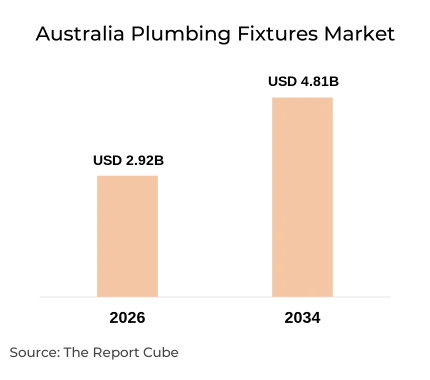
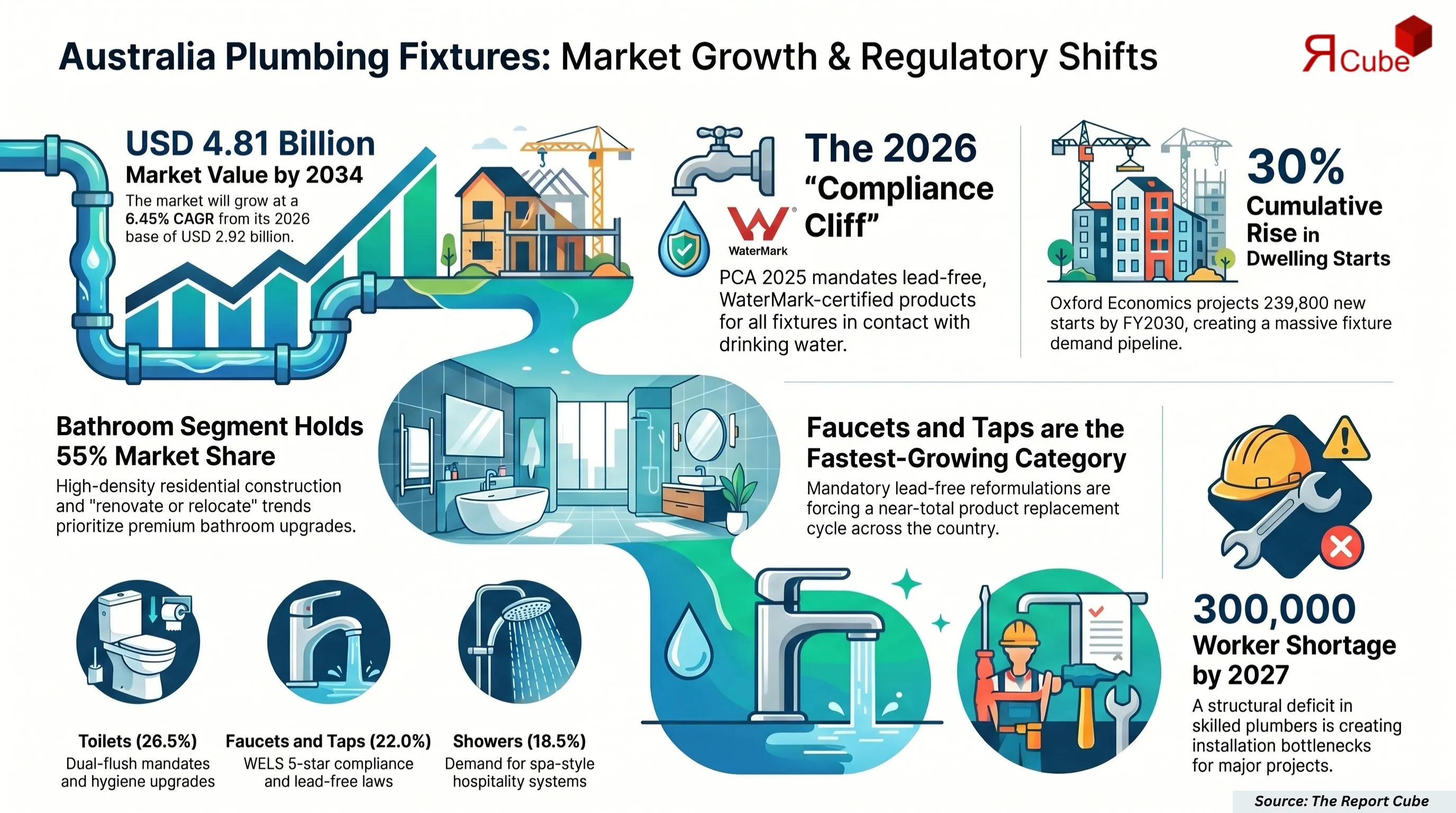
The Australia Plumbing Fixtures Market is anticipated to register a 6.45% CAGR during 2026–2034. The market size was valued at USD 2.92 billion in 2026 and is projected to reach USD 4.81 billion by 2034. Australia's plumbing fixtures sector sits at an important intersection of residential construction recovery, sustainability regulation, and smart home adoption. Following three years of elevated interest rates that subdued household spending, the Reserve Bank of Australia cut its cash rate three times by August 2025, releasing pent-up demand and reigniting both new construction and renovation activity. Oxford Economics Australia projects dwelling starts will rise 30% cumulatively to 239,800 by FY2030, creating a durable pipeline for fixture demand. Regulatory forces are equally decisive: the Plumbing Code of Australia (PCA) 2025, commencing May 1, 2026, mandates lead-free WaterMark-certified products for all copper alloy plumbing fixtures in contact with drinking water.
This compliance cliff is triggering broad product reformulation across the supply chain and shifting procurement decisions toward certified, higher-specification fixtures. Temple & Webster recorded a 25% sales surge in the six months to February 2025, with bathroom products identified as a core growth driver, underscoring growing consumer willingness to invest in premium plumbing fixtures for bathroom upgrades. The Australia home improvement market, valued at AUD 25.52 billion in 2025, is projected to expand at a 7.20% CAGR through 2035, with bathroom and kitchen renovations representing leading expenditure categories, a direct demand engine for plumbing fixtures across both residential and commercial end-users.
Australia Plumbing Fixtures Market Key Takeaways
- Australia plumbing fixtures market is valued at USD 2.92 billion in 2026.
- Market projected to reach USD 4.81 billion at 6.45% CAGR by 2034.
- PCA 2025 lead-free mandate reshapes product certification from May 2026.
- Bathroom location segment dominates with over 53% of total market share.
- WELS-rated faucets and taps segment is the fastest-growing product category.
- New South Wales and Victoria lead regional demand for plumbing fixtures.
- Smart touchless fixtures gaining share in commercial and hospitality sectors.
- GWA Group, Reece Group, and Caroma collectively anchor domestic market position.
Australia Plumbing Fixtures Market Dynamics
Key Market Driver: WELS Compliance Mandates Accelerating Premium Fixture Adoption
Australia's Water Efficiency Labelling and Standards (WELS) scheme now prohibits the sale of any tap, shower, toilet, or urinal that falls below minimum star ratings. Under NCC 2025 Volume Three, all plumbing fixtures must hold WaterMark certification before WELS registration, and sub-minimum-rated products cannot be supplied. This dual-compliance requirement, WaterMark for safety, WELS for water efficiency, has materially elevated the baseline specification for fixtures entering the Australian market.
For residential developers, a BASIX certificate in New South Wales requires committed WELS star ratings that must match installed products at final inspection, with corporate penalties reaching AUD 99,000 per non-compliant product. This enforcement architecture is compelling builders, developers, and plumbing contractors to source water-efficient plumbing fixtures with certified WELS ratings at higher price points, directly lifting average selling values and expanding total market revenue across both new construction and renovation channels.
Major Industry Challenge: Skilled Plumber Shortage Constraining Installation Capacity
Australia's construction sector faces a structural workforce deficit at precisely the moment demand is rebounding. Industry analysts estimate the building industry will require 300,000 additional workers by mid-2027 for major projects, with plumbing identified as one of the most critically short-staffed trades. Females represent just 1% of professional plumbers, and median ages within the trade skew older, limiting natural workforce renewal. This scarcity creates a supply bottleneck that disproportionately affects fixture installation timelines in high-density residential and commercial projects.
Developers in New South Wales and Victoria are reporting extended project delivery windows tied to plumbing delays, which compresses revenue recognition and may defer fixture procurement orders. The imbalance between rising housing demand, with vacancy rates near 1% in most capital cities, and constrained installation capacity creates friction in the market's ability to absorb the full volume of fixture demand that construction pipelines would otherwise generate through the forecast period.
Emerging Trend Shaping Outlook: Direct-to-Trade Channel Disruption Reshaping Fixture Distribution
A notable competitive development is GWA Group's strategic pivot toward direct-to-plumber sales for its Caroma, Dorf, and Methven brands, bypassing traditional wholesale intermediaries including Reece Group, Australia's dominant plumbing distributor. This channel shift, highlighted in a Morningstar analysis from August 2025, reflects deepening tension between fixture manufacturers and distributors who increasingly promote high-margin private-label alternatives (such as Reece's Milli and Posh brands) within their own showrooms.
As distributors leverage their point-of-sale position to erode manufacturer brand loyalty, fixture producers are investing in digital specification platforms, builder loyalty programs, and trade-direct pricing structures. This distribution channel fragmentation is simultaneously creating opportunities for emerging online fixture retail platforms in the Australian market, with e-commerce channels demonstrating the fastest CAGR across all distribution formats as contractors seek price transparency and product availability outside traditional merchant relationships.
Need Specific Data, Let’s Customize the Report for You
Request CustomizationAustralia Plumbing Fixtures Market Segment-wise Analysis
Australia's plumbing fixtures market contains several underrepresented segmentation angles in existing market coverage, particularly granular product-level share analysis and location-based differentiation that accounts for the distinct drivers governing bathroom versus kitchen fixture procurement. This report addresses both gaps through original analysis.
By Product
The product segmentation of Australia's plumbing fixtures market reveals a diverse mix of high-volume commodity categories and faster-growing premium sub-segments. Toilets hold the largest installed base, while faucets and taps represent the most dynamic growth front driven by WELS compliance upgrades.
|
Sub-Segment |
Market Share (%) |
Key Driver |
Competitive Intensity |
|---|---|---|---|
|
Toilets |
26.5% |
Dual-flush mandate and rimless hygiene design upgrades in residential sector |
High |
|
Faucets and Taps |
22.0% |
WELS 5-star compliance driving replacement cycles across residential and commercial |
High |
|
Showers |
18.5% |
Hospitality sector demand for spa-style multi-function shower systems |
Medium |
|
Sinks |
14.0% |
Kitchen renovation wave and stainless steel undermount sink premiumisation |
Medium |
|
Bathtubs |
10.0% |
Luxury residential and hotel spa market driving freestanding bathtub adoption |
Low |
|
Drains |
6.0% |
Waterproofing code changes in NCC 2025 requiring compliant drain installations |
Low |
|
Others |
3.0% |
Accessibility fixtures for aged care and disability support facilities |
Low |
The toilet segment commands the largest share due to a structural driver unique to Australia: the Water Services Association of Australia reports that toilets account for approximately 26% of total household water use, making them the primary target for mandatory water efficiency upgrades under WELS. However, it is the faucets and taps segment that is growing fastest, propelled by the PCA 2025 lead-free WaterMark requirement which has forced a near-total product reformulation cycle among all tapware suppliers. Caroma's January 2025 introduction of a fully lead-free tapware range ahead of the May 2026 deadline exemplifies the proactive reformulation dynamic that is driving premium product replacement rather than like-for-like swaps. This cross-segment effect is notable: as taps are replaced for compliance reasons, consumers and developers frequently upgrade adjacent shower and bathtub fixtures for luxury bathroom renovations, elevating average transaction values across multiple product lines simultaneously.
By Location
Location-based segmentation, bathrooms versus kitchens, reveals meaningfully different competitive dynamics and growth trajectories that most competitor analyses flatten into a single demand narrative.
|
Sub-Segment |
Market Share (%) |
Key Driver |
Competitive Intensity |
|---|---|---|---|
|
Bathroom |
55.0% |
Renovation and new residential construction prioritising premium bathroom design |
High |
|
Kitchen |
31.0% |
Undermount sink adoption and touchless faucet demand in residential renovation |
Medium |
|
Others (laundry, outdoor, commercial) |
14.0% |
Aged care facility upgrades and commercial hospitality infrastructure growth |
Low |
Bathrooms dominate because they concentrate the highest number of regulated fixture types per room, toilet, basin tap, shower, and bathtub, making them the primary site of regulatory compliance expenditure. The bathroom renovation market in Australia is structurally reinforced by the "renovate or relocate" trend that gained momentum through 2025: with median Sydney house prices exceeding AUD 1.7 million, many households are choosing to upgrade existing bathrooms rather than transact into a constrained property market.
The kitchen segment, while smaller, is exhibiting above-average growth driven by the AUD 12 billion quarterly renovation spending recorded by the Australian Bureau of Statistics in 2023, much of it directed toward undermount sink replacements and touchless faucet installations that combine hygiene appeal with water efficiency ratings. The "Others" sub-segment, covering laundry, outdoor, and commercial non-bathroom spaces, is an underserved area where accessible fixture designs for aged care facilities represent a rising niche tied to Australia's ageing population demographic.
Regional Projection of Australia Plumbing Fixtures Market
Australia's plumbing fixtures demand is geographically anchored by its most populous states, with meaningful variation in growth drivers across regions:
- New South Wales and Australian Capital Territory: Leading region, holding approximately 32% of total market share, driven by Sydney's high-density residential construction pipeline, strict BASIX compliance requirements tying WELS ratings to development approval, and a large renovation market among established homeowners in inner-city and suburban areas.
- Victoria and Tasmania: Second-largest contributor at approximately 27% share. NCC 2025 commenced in Tasmania from May 1, 2026, with Victoria's adoption following closely. GWA Group's Melbourne-anchored distribution network and Caroma's sanitaryware dominance reinforce strong fixture penetration rates.
- Queensland: Accounts for roughly 20% of market demand, with strong population inflows into Southeast Queensland and Gold Coast driving new residential construction activity at a rate outpacing the national average.
- Western Australia: Emerging growth corridor at approximately 13% share. Perth's property market recorded robust price growth through 2025 as interstate migration sustained housing demand, supporting both new construction and renovation-linked fixture procurement.
- Northern Territory and South Australia: Combined approximately 8% share. Government-funded social housing and indigenous community infrastructure projects represent distinct demand segments not replicated in other states.
Australia Plumbing Fixtures Market: Recent Development (2025)
- In January 2025, Caroma (GWA Group) launched a comprehensive lead-free tapware range ahead of the PCA 2025 deadline, positioning the brand for compliance-driven replacement cycles. GWA Group generated total revenue of approximately AUD 420.6 million in FY2025, with its sanitaryware and tapware segments sustaining performance across both residential and commercial renovation channels despite flat new housing starts.
- In February 2025, Temple & Webster reported a 25% sales surge in the six months to that date, with revenue reaching USD 313.7 million. Bathroom products were identified as a primary growth driver, signalling accelerating consumer investment in online fixture procurement, a channel increasingly relevant to mid-market and DIY-adjacent buyer segments.
- In March 2026, Australia's regulator granted a two-year extension to the lead content ban on tapware and fittings, extending the compliance window for smaller suppliers still managing product transitions. While the extension provides supply chain relief, it has sparked industry debate about competitive fairness between compliant early movers (such as Caroma) and suppliers retaining legacy inventory.
- In August 2025, Morningstar reported that GWA Group is accelerating direct-to-plumber sales for its Caroma, Dorf, and Methven brands, intensifying competition with Reece Group, whose private-label products (Milli, Posh) compete directly with GWA's branded fixtures within Reece's own showroom network.
Australia Plumbing Fixtures Market Future Outlook (2034)
The Australia Plumbing Fixtures Market is projected to reach USD 4.81 billion by 2034, expanding at a 6.45% CAGR through the forecast period. The growth trajectory is underpinned by three durable forces: a residential construction recovery with dwelling starts forecast to rise 30% cumulatively by FY2030, mandatory product certification cycles linked to WELS and PCA 2025, and rising consumer investment in premium and smart fixtures. Smart bathroom technology, including sensor-operated faucets, touchless flush systems, and app-connected shower controls, is expected to shift from a niche hospitality offering to a mainstream residential inclusion as smart home infrastructure matures in Australian households.
The global smart bathroom market is projected to grow at a 10.8% CAGR through 2030, and Australia's relatively high household income levels and renovation culture position it well to capture above-average smart fixture adoption rates. An underexplored long-term opportunity lies in aged-care-compliant accessible fixture design, as Australia's over-65 population expands and drives demand for grip-assist, height-adjustable, and flow-limited fixtures that existing market participants have not yet systematically addressed.
Australia Plumbing Fixtures Market Report Coverage
|
Report Features |
Details |
|---|---|
|
Base Year |
2026 |
|
Forecast Period |
2026–2034 |
|
Market Value (2026) |
USD 2.92 Billion |
|
Market Value (2034) |
USD 4.81 Billion |
|
CAGR |
6.45% |
|
Segments Covered |
By Product; By Location; By Application; By Distribution Channel; By Distribution Channel |
|
Key Players |
Oliveri, Caroma, Reece Group, GWA Group, Kohler, Roca, Grohe, Dorf, Methven, Others |
|
Geographies Covered |
NSW & ACT, Victoria & Tasmania, Queensland, Western Australia, NT & SA |
|
Customization |
Available |
|
Delivery Formats |
PPT, PDF & Excel |
Why Choose This Report?
- Provides a comprehensive overview of the overall market analysis, encompassing key trends, consumer behavior analysis, and risk assessment to support strategic decision-making.
- Provides accurate, up-to-date insights into market size, segmentation, and emerging opportunities, helping to minimize risk & capitalizing on growth.
- Gives deep understanding of target audience preferences, investment habits, and communication channels for enhanced product development & marketing effectiveness.
- Delivers competitive analysis & benchmarking, uncovering the strengths & weaknesses of market competitors to guide strategies.
- Consolidate comprehensive market intelligence, reducing reasoning & streamlining research efforts.
- Facilitates customized market segmentation & risk mitigation strategies, fine-tuned to the business objectives.
- Aids in identifying both market challenges & untapped opportunities within the industry to drive long-term business growth.
- Provides valuable information based on actual customer data & search trends.
Table of Contents
- Introduction
- Objective of the study
- Product Definition
- Market Segmentation
- Study Variables
- Research Methodology
- Secondary Data Points
- Companies Interviewed
- Primary Data Points
- Breakdown of Primary Interviews
- Secondary Data Points
- Executive Summary
- Market Dynamics
- Drivers
- Challenges
- Opportunity Assessment
- Recent Trends and Developments
- Policy and Regulatory Landscape
- Australia Plumbing Fixtures Market Overview and Forecast Analysis (2021-2034)
- Market Size, By Value, By growth rate (CAGR/USD Billions)
- Demand - Supply Trends
- Market Share, By Product
- Bathtubs
- Sinks
- Toilets
- Showers
- Faucets and Taps
- Drains
- Others
- Market Share, By Location
- Bathroom
- Kitchen
- Others
- Market Share, By Application
- New Construction
- Repair and Renovation
- Market Share, By Distribution Channel
- Online
- Offline
- Market Share, By End User
- Residential
- Commercial
- Market Share, By Region
- New South Wales and Australian Capital Territory
- Victoria and Tasmania
- Queensland
- Western Australia
- Northern Territory and South Australia
- Market Share, By Competitors
- Competition Characteristics
- Revenue Shares
- Australia Bathtubs Plumbing Fixtures Market Overview, 2021-2034F
- By Value (USD Million)
- By Location- Market Size & Forecast 2021-2034, USD Million
- By Application- Market Size & Forecast 2021-2034, USD Million
- By Distribution Channel- Market Size & Forecast 2021-2034, USD Million
- By End User- Market Size & Forecast 2021-2034, USD Million
- Australia Sinks Plumbing Fixtures Market Overview, 2021-2034F
- By Value (USD Million)
- By Location- Market Size & Forecast 2021-2034, USD Million
- By Application- Market Size & Forecast 2021-2034, USD Million
- By Distribution Channel- Market Size & Forecast 2021-2034, USD Million
- By End User- Market Size & Forecast 2021-2034, USD Million
- Australia Toilets Plumbing Fixtures Market Overview, 2021-2034F
- By Value (USD Million)
- By Location- Market Size & Forecast 2021-2034, USD Million
- By Application- Market Size & Forecast 2021-2034, USD Million
- By Distribution Channel- Market Size & Forecast 2021-2034, USD Million
- By End User- Market Size & Forecast 2021-2034, USD Million
- Australia Showers Plumbing Fixtures Market Overview, 2021-2034F
- By Value (USD Million)
- By Location- Market Size & Forecast 2021-2034, USD Million
- By Application- Market Size & Forecast 2021-2034, USD Million
- By Distribution Channel- Market Size & Forecast 2021-2034, USD Million
- By End User- Market Size & Forecast 2021-2034, USD Million
- Australia Faucets and Taps Plumbing Fixtures Market Overview, 2021-2034F
- By Value (USD Million)
- By Location- Market Size & Forecast 2021-2034, USD Million
- By Application- Market Size & Forecast 2021-2034, USD Million
- By Distribution Channel- Market Size & Forecast 2021-2034, USD Million
- By End User- Market Size & Forecast 2021-2034, USD Million
- Australia Drains Plumbing Fixtures Market Overview, 2021-2034F
- By Value (USD Million)
- By Location- Market Size & Forecast 2021-2034, USD Million
- By Application- Market Size & Forecast 2021-2034, USD Million
- By Distribution Channel- Market Size & Forecast 2021-2034, USD Million
- By End User- Market Size & Forecast 2021-2034, USD Million
- Australia Others Plumbing Fixtures Market Overview, 2021-2034F
- By Value (USD Million)
- By Location- Market Size & Forecast 2021-2034, USD Million
- By Application- Market Size & Forecast 2021-2034, USD Million
- By Distribution Channel- Market Size & Forecast 2021-2034, USD Million
- By End User- Market Size & Forecast 2021-2034, USD Million
- Competitive Outlook (Company Profile - Partial List)
- Oliveri
- Company Overview
- Business Segments
- Strategic Alliances/Partnerships
- Recent Developments
- Caroma
- Company Overview
- Business Segments
- Strategic Alliances/Partnerships
- Recent Developments
- Reece Group
- Company Overview
- Business Segments
- Strategic Alliances/Partnerships
- Recent Developments
- GWA Group
- Company Overview
- Business Segments
- Strategic Alliances/Partnerships
- Recent Developments
- Kohler
- Company Overview
- Business Segments
- Strategic Alliances/Partnerships
- Recent Developments
- Roca
- Company Overview
- Business Segments
- Strategic Alliances/Partnerships
- Recent Developments
- Grohe
- Company Overview
- Business Segments
- Strategic Alliances/Partnerships
- Recent Developments
- Dorf
- Company Overview
- Business Segments
- Strategic Alliances/Partnerships
- Recent Developments
- Methven
- Company Overview
- Business Segments
- Strategic Alliances/Partnerships
- Recent Developments
- Others
- Oliveri
- Contact Us & Disclaimer
Top Key Players & Market Share Outlook
- Oliveri
- Caroma
- Reece Group
- GWA Group
- Kohler
- Roca
- Grohe
- Dorf
- Methven
- Others
Frequently Asked Questions






