



Build Your Custom Market Intelligence Report
Customize Your ReportAsia Pacific (APAC) Polylactic Acid Market Statistics and Insights
Market Size Statistics
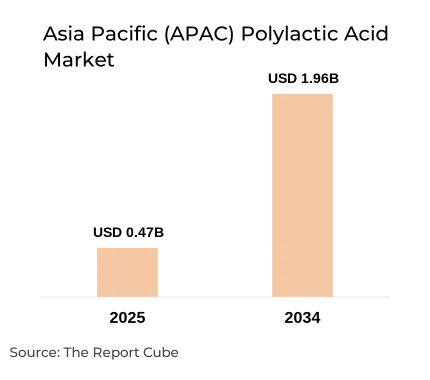
- Market valued at USD 0.47 billion across APAC during 2025
- Market projected reaching USD 1.96 billion by 2034
- Asia Pacific Polylactic Acid Market expanding at 1.96% CAGR
Type
- Regular PLLA accounted for nearly 34% market share
Competition
- More than 10 companies are actively engaged in Asia Pacific polylactic acid production
- Top 5 companies acquired around 59% of the market share.
- NatureWorks LLC, TotalEnergies Corbion, BASF SE, Mitsubishi Chemical Corporation, TORAY INDUSTRIES, INC., and others
Raw Material
- Corn captured approximately 42% market share
Asia Pacific (APAC) Polylactic Acid Market Insights & Analysis
The Asia Pacific (APAC) Polylactic Acid Market is anticipated to register a CAGR of 1.96% during 2026–2034, increasing from a market value of USD 0.47 billion in 2025 to USD 1.96 billion by 2034. The Asia Pacific (APAC) Polylactic Acid Market Analysis highlights steady expansion supported by rising environmental awareness, regulatory restrictions on single-use plastics, and growing demand for biodegradable materials. Polylactic acid (PLA), derived from renewable feedstocks such as corn and sugarcane, is increasingly used in packaging, agriculture films, textiles, and 3D printing applications. Governments across China, Japan, South Korea, and Southeast Asia are implementing policies promoting sustainable materials, supporting Asia Pacific (APAC) Polylactic Acid Market Growth.
Consumer preference for eco-friendly packaging and corporate sustainability commitments are enhancing Asia Pacific (APAC) Polylactic Acid Market Size. Food and beverage manufacturers are shifting toward compostable packaging solutions, particularly in urban markets. Technological advancements in polymer blending and performance enhancement are shaping Asia Pacific (APAC) Polylactic Acid Market Trends and reinforcing a favorable Asia Pacific (APAC) Polylactic Acid Market Outlook.
Asia Pacific (APAC) Polylactic Acid Market Dynamics
Key Market Driver: Rising demand for biodegradable packaging solutions
The increasing ban on conventional plastics in multiple APAC countries is driving demand for bio-based alternatives. PLA offers compostability, transparency, and processability similar to traditional plastics, making it suitable for packaging, disposable cutlery, and agricultural films. Growing e-commerce activity and food delivery services further accelerate demand for sustainable packaging materials.
Major Industry Challenge: Performance limitations compared to conventional plastics
PLA exhibits lower heat resistance and mechanical strength compared to petroleum-based polymers in certain applications. This limits its use in high-temperature or heavy-duty environments. Continuous research and development efforts are required to improve performance characteristics and broaden application scope.
Emerging Trend Shaping Outlook: Development of high-performance PLA blends
Manufacturers are investing in PLA blends and copolymers to enhance flexibility, impact resistance, and thermal stability. Integration with other biodegradable polymers expands usability across automotive interiors, consumer goods, and electronics casings. This innovation is shaping Asia Pacific (APAC) Polylactic Acid Market Trends toward diversified applications.
Need Specific Data, Let’s Customize the Report for You
Contact UsAsia Pacific (APAC) Polylactic Acid Market Segment-wise Analysis
The Asia Pacific (APAC) Polylactic Acid Market segmentation highlights variations in polymer types and raw material sources influencing production economics and performance characteristics.
By Type
- Racemic PLLA (Poly-l-lactic acid)
- PDLA (Poly-d-lactic acid)
- Regular PLLA (Poly-l-lactic acid)
- PDLLA (Poly-dl-lactic acid)
- PLA Blends
Regular PLLA dominates with approximately 34% market share due to its balanced mechanical strength and transparency, making it suitable for packaging and textile applications. PLA blends are witnessing increasing demand due to improved flexibility and performance enhancements tailored for industrial use.
By Raw Material
- Sugarcane
- Corn
- Cassava
- Sugar Beet
- Others
Corn leads with nearly 42% market share owing to established supply chains and cost efficiency. China and Thailand benefit from strong agricultural output supporting PLA production. Sugarcane-based PLA is expanding, particularly in regions focusing on bio-refinery development and renewable feedstocks.
Country Projection of Asia Pacific (APAC) Polylactic Acid Market
Country adoption varies across APAC depending on industrialization levels and sustainability policies.
- China
- Japan
- South Korea
- India
- Southeast Asia
- Australia
China leads the Asia Pacific (APAC) Polylactic Acid Market with approximately 45% share, supported by large-scale manufacturing capacity and strict plastic waste regulations. Japan and South Korea follow due to advanced material research and strong sustainability initiatives. India and Southeast Asia are emerging growth markets driven by packaging demand.
Asia Pacific (APAC) Polylactic Acid Market: Recent Development (2025)
- NatureWorks LLC expanded PLA production capacity targeting Asia Pacific sustainable packaging markets.
- TotalEnergies Corbion introduced high-performance PLA grades for industrial applications in APAC.
- Mitsubishi Chemical Corporation enhanced biodegradable polymer research for automotive components.
- BASF SE partnered with regional converters to promote compostable packaging adoption.
Asia Pacific (APAC) Polylactic Acid Market Future Outlook (2034)
The Asia Pacific (APAC) Polylactic Acid Market Outlook remains positive, with the market projected to reach USD 1.96 billion by 2034, expanding at a CAGR of 1.96%. Growth will be driven by regulatory pressure against plastic waste, rising corporate ESG commitments, and consumer preference for eco-friendly materials.
Advancements in bio-refinery technologies, feedstock diversification, and polymer blending will enhance competitiveness against conventional plastics. Increased investment in recycling and composting infrastructure will further support adoption. As APAC economies continue prioritizing sustainability and circular economy models, the Asia Pacific (APAC) Polylactic Acid Market is positioned for steady long-term expansion.
Why Choose This Report?
- Provides a comprehensive overview of overall market analysis supporting strategic decision-making.
- Delivers accurate insights into market size, segmentation, and emerging biodegradable material opportunities.
- Enhances understanding of regulatory and sustainability-driven demand patterns.
- Offers competitive benchmarking across leading biopolymer producers.
- Consolidates market intelligence, reducing research complexity.
- Enables customized segmentation and risk mitigation strategies.
- Identifies opportunities in high-performance PLA blends and renewable feedstocks.
- Provides insights based on actual packaging and sustainability initiatives.
Table of Contents
- Introduction
- Objective of the study
- Product Definition
- Market Segmentation
- Study Variables
- Research Methodology
- Secondary Data Points
- Companies Interviewed
- Primary Data Points
- Breakdown of Primary Interviews
- Secondary Data Points
- Executive Summary
- Market Dynamics
- Drivers
- Challenges
- Opportunity Assessment
- Recent Trends and Developments
- Policy and Regulatory Landscape
- Asia Pacific (APAC) Polylactic Acid Market Overview (2021-2034)
- Market Size, By Value (in USD Billion)
- Market Share, By Type
- Racemic PLLA (Poly-l-lactic acid)
- PDLA (Poly-d-lactic acid)
- Regular PLLA (Poly-l-lactic acid)
- PDLLA (Poly-dl-lactic acid)
- PLA Blends
- Market Share, By Raw Material
- Sugarcane
- Corn
- Cassava
- Sugar Beet
- Others
- Market Share, By Form
- Films and Sheets
- Coatings
- Fibre
- Others
- Market Share, By Application
- Packaging
- Transport
- Agriculture
- Medical
- Electronics
- Textile
- Hygiene
- Others
- Market Share, By End User
- Plastic Films
- Bottles
- Biodegradable Medical Devices
- Market Share, By Country
- China
- Japan
- South Korea
- India
- Southeast Asia
- Australia
- Rest of Asia Pacific
- Market Share, By Company
- Revenue Shares
- Competition Characteristics
- China (APAC) Polylactic Acid Market Overview, 2021-2034F
- Market Size, By Value (in USD Million/Billion)
- By Type
- By Raw Material
- By Form
- By Application
- By End User
- Japan (APAC) Polylactic Acid Market Overview, 2021-2034F
- Market Size, By Value (in USD Million/Billion)
- By Type
- By Raw Material
- By Form
- By Application
- By End User
- South Korea (APAC) Polylactic Acid Market Overview, 2021-2034F
- Market Size, By Value (in USD Million/Billion)
- By Type
- By Raw Material
- By Form
- By Application
- By End User
- India (APAC) Polylactic Acid Market Overview, 2021-2034F
- Market Size, By Value (in USD Million/Billion)
- By Type
- By Raw Material
- By Form
- By Application
- By End User
- Southeast Asia (APAC) Polylactic Acid Market Overview, 2021-2034F
- Market Size, By Value (in USD Million/Billion)
- By Type
- By Raw Material
- By Form
- By Application
- By End User
- Australia (APAC) Polylactic Acid Market Overview, 2021-2034F
- Market Size, By Value (in USD Million/Billion)
- By Type
- By Raw Material
- By Form
- By Application
- By End User
- Competitive Outlook (Company Profile – Partial List)
- BASF SE
- Company Overview
- Business Segments
- Strategic Alliances/Partnerships
- Recent Developments
- Futerro
- Company Overview
- Business Segments
- Strategic Alliances/Partnerships
- Recent Developments
- NatureWorks LLC
- Company Overview
- Business Segments
- Strategic Alliances/Partnerships
- Recent Developments
- TotalEnergies Corbion
- Company Overview
- Business Segments
- Strategic Alliances/Partnerships
- Recent Developments
- Sulzer Ltd
- Company Overview
- Business Segments
- Strategic Alliances/Partnerships
- Recent Developments
- Mitsubishi Chemical Corporation
- Company Overview
- Business Segments
- Strategic Alliances/Partnerships
- Recent Developments
- TORAY INDUSTRIES, INC.
- Company Overview
- Business Segments
- Strategic Alliances/Partnerships
- Recent Developments
- Merck KGaA, Musashino Chemical Laboratory, Ltd.
- Company Overview
- Business Segments
- Strategic Alliances/Partnerships
- Recent Developments
- Evonik Industries AG
- Company Overview
- Business Segments
- Strategic Alliances/Partnerships
- Recent Developments
- Others
- BASF SE
- Contact Us & Disclaimer
Top Key Players & Market Share Outlook
- BASF SE
- Futerro
- NatureWorks LLC
- TotalEnergies Corbion
- Sulzer Ltd
- Mitsubishi Chemical Corporation
- TORAY INDUSTRIES, INC.
- Merck KGaA, Musashino Chemical Laboratory, Ltd.
- Evonik Industries AG
- Others
Frequently Asked Questions






