



Build Your Custom Market Intelligence Report
Customize Your ReportKey Takeaways
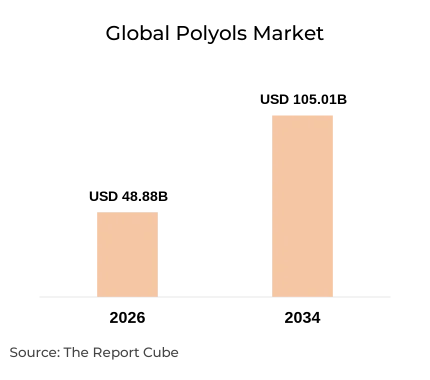
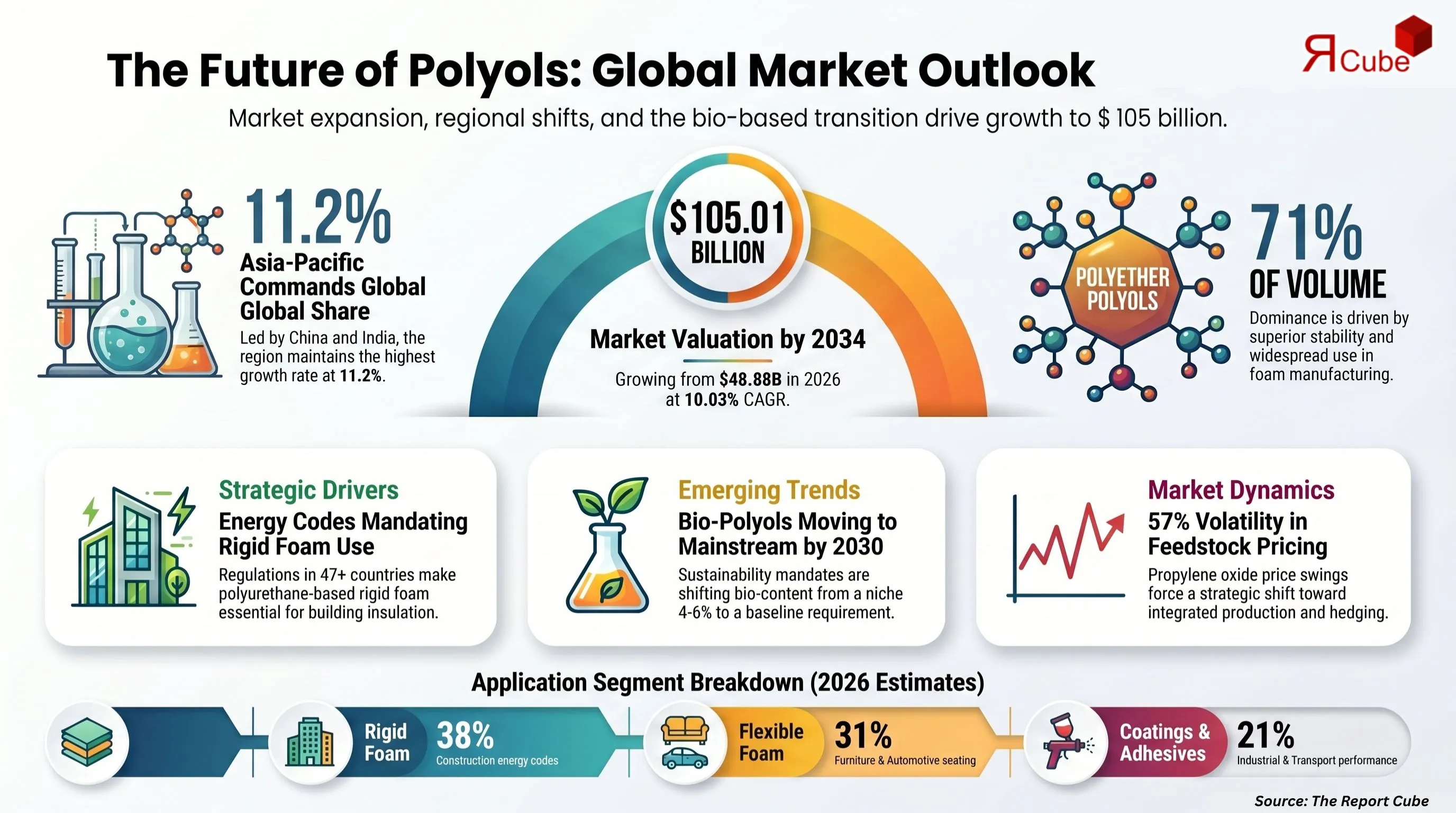
- The Global Polyols Market is projected to grow from USD 48.88 billion in 2026 to USD 105.01 billion by 2034, registering a CAGR of 10.03%.
- Polyether polyols dominate the product mix, accounting for the largest share due to widespread use in flexible and rigid foam manufacturing.
- Asia-Pacific leads regional demand, driven by rapid construction activity, automotive production scale-up, and expanding cold-chain logistics infrastructure.
- Rigid foam applications hold the highest application-segment share, supported by global energy-efficiency mandates in commercial and residential construction.
Global Polyols Market Insights & Analysis
Construction sector energy codes are forcing insulation material manufacturers to replace conventional materials with high-performance polyurethane systems, and polyols are at the centre of this shift. With building energy standards tightening across the EU, North America, and East Asia, demand for rigid polyol-based foam has accelerated beyond pre-pandemic trajectories. The Global Polyols Market reached USD 48.88 billion in 2026 and is forecast to hit USD 105.01 billion by 2034 at a 10.03% CAGR.
Polyols are the core reactive component in polyurethane chemistry, reacting with isocyanates to produce foams, coatings, adhesives, sealants, and elastomers across end-use sectors. Polyether polyols command the larger product share owing to lower viscosity, better hydrolytic stability, and compatibility with a wide isocyanate range, while polyester polyols deliver superior mechanical strength and chemical resistance for coatings and adhesive applications.
The market sits at a structural inflection point: bio-based polyol development is moving from pilot scale to commercial production, driven by regulatory pressure on fossil-derived inputs and rising corporate net-zero commitments. BASF SE, Covestro AG, and Dow have each disclosed bio-polyol capacity expansions between 2023 and 2025, signalling a medium-term shift in feedstock economics that will reshape pricing and supply contracts by 2028.
Global Polyols Market Dynamics
Key Market Driver: Energy-Efficient Construction Codes Accelerating Rigid Foam Demand
Builders choosing between insulation systems face a regulatory enforcement problem they can no longer defer. Over 47 countries have adopted or are actively revising building energy codes that set minimum R-value thresholds unachievable without polyurethane-based rigid foam insulation (International Energy Agency, 2024). This regulatory tailwind adds a non-cyclical demand floor beneath the rigid foam segment, which already commands the largest application share. Rigid polyol demand is projected to grow at a CAGR exceeding 10.5% through 2034 as new commercial construction and retrofits accelerate across Europe, South Asia, and Southeast Asia.
Major Industry Challenge: Volatile Propylene Oxide Feedstock Prices Compressing Margins
Polyol producers face a cost-structure vulnerability that downstream pricing cannot consistently absorb. Propylene oxide (PO), the primary feedstock for polyether polyols, traded in a USD 1,400–2,200/MT range between 2022 and 2024, a 57% spread driven by crude oil volatility and regional supply disruptions (International Chemical Information Service, 2024). This input-cost instability forces producers to choose between margin compression and customer price escalation, both of which erode competitive position.
Emerging Trend: Bio-Based Polyol Commercialisation Shifting Feedstock Mix
Consumer goods companies and automotive OEMs have set 2030–2035 net-zero supply chain targets that require traceable, low-carbon polyol inputs. Bio-polyols derived from soybean oil, castor oil, and sucrose now account for an estimated 4–6% of total polyol volume, up from under 2% in 2018 (U.S. Department of Energy, 2024). Covestro AG's Desmodur range and BASF SE's Sovermol platform represent commercially scaled bio-polyol products already embedded in furniture and automotive seating supply chains. The premium pricing of bio-polyols (15–25% above conventional grades) is declining as production volumes increase, narrowing the cost gap that previously limited adoption.
Need Specific Data, Let’s Customize the Report for You
Request CustomizationEmerging Opportunity: Cold-Chain Logistics Expansion in Emerging Markets
Food safety regulations and pharmaceutical cold-chain mandates across India, Southeast Asia, and Sub-Saharan Africa are driving refrigerated warehouse construction at unprecedented pace. The global cold storage market is projected to add 250 million cubic metres of capacity between 2024 and 2030 (World Bank, 2024), virtually all of which requires rigid polyurethane foam insulation panels. cold chain packaging market Polyol producers targeting this opportunity stand to capture incremental volume outside the traditionally saturated North American and European construction segments.
Global Polyols Market Segment-wise Analysis
By Product
The rigid competition between polyether and polyester polyols reflects a fundamental trade-off between processing ease and mechanical performance. Polyether polyols hold over 70% of total market volume, supported by lower moisture absorption, longer shelf life, and established processing infrastructure at foam fabricators worldwide.
|
Product Segment |
Market Share (2026) |
Growth Outlook |
Primary End-Use |
|---|---|---|---|
|
Polyether Polyols |
71% |
High, driven by foam and elastomer demand |
Rigid & Flexible Foam, Elastomers |
|
Polyester Polyols |
29% |
Moderate-High, driven by coatings and adhesives |
Coatings, Adhesives & Sealants |
Polyester polyols derive superior tensile strength and adhesion characteristics from ester linkages, making them the preferred choice for high-performance coatings and automotive adhesives where flexibility at low temperatures is required.
By Application
Foam applications collectively account for the majority of global polyol consumption, with rigid and flexible foam each serving structurally distinct end-markets that insulate demand from shared cyclical risks.
|
Application Segment |
Estimated Share (2026) |
Key Driver |
Primary Polyol Type |
|---|---|---|---|
|
Rigid Foam |
38% |
Construction energy codes, cold chain |
Polyether |
|
Flexible Foam |
31% |
Furniture, bedding, automotive seating |
Polyether |
|
Coatings |
12% |
Automotive, industrial protective coatings |
Polyester |
|
Adhesives & Sealants |
9% |
Construction, packaging, transportation |
Polyester |
|
Elastomers |
6% |
Footwear, automotive components, mining |
Polyether/Polyester |
|
Other |
4% |
Specialty applications |
Mixed |
Elastomers represent the fastest-growing non-foam application, with polyurethane elastomers displacing conventional rubber in mining equipment, footwear soles, and automotive suspension components due to their superior abrasion resistance and load-bearing consistency.
Regional Projection of Global Polyols Market
|
Region |
Estimated Share (2026) |
CAGR Outlook |
Key Growth Driver |
|---|---|---|---|
|
Asia-Pacific |
42% |
Highest, 11.2% |
Construction, automotive, electronics |
|
North America |
24% |
Moderate, 8.8% |
Energy retrofits, cold chain, bio-polyols |
|
Europe |
21% |
Moderate, 8.4% |
Green building regulations, circular economy |
|
Latin America |
7% |
Growing, 10.1% |
Infrastructure expansion, furniture manufacturing |
|
Middle East & Africa |
6% |
Emerging, 9.6% |
Cold chain, residential construction |
- Asia-Pacific dominates global polyol consumption, with China, India, South Korea, and Japan collectively driving over 35% of total market volume. China's construction output, responsible for over 50% of Asia-Pacific rigid foam demand, reflects both new-build activity and a government-mandated renovation programme targeting energy performance upgrades in 100 million residential units by 2030 (National Development and Reform Commission, China, 2023). Asia-Pacific Construction Materials Market
- North America is experiencing accelerated demand from two converging forces: the U.S. Inflation Reduction Act's USD 369 billion clean energy investment framework, which incentivises building energy upgrades, and pharmaceutical cold-chain expansion driven by post-pandemic biologics manufacturing growth. Canada's updated National Energy Code for Buildings, effective from 2024, further extends mandatory rigid foam use in new commercial construction.
- Europe trails Asia-Pacific in volume growth but leads in bio-polyol adoption and circular-economy feedstock standards. The EU's Construction Products Regulation revision and the European Green Deal's 55% emissions reduction target by 2030 are creating preferential procurement conditions for certified low-carbon polyol inputs, pulling forward demand from Covestro AG and BASF SE's European production assets.
- Latin America and Middle East & Africa are nascent but structurally growing markets, with Brazil's furniture export sector and GCC residential construction projects emerging as demand anchors over the 2026–2034 forecast period.
Global Polyols Market, Recent Developments (2025)
- Covestro AG (Q1 2025): Announced a EUR 200 million investment to expand bio-based MDI and polyol production at its Leverkusen site, targeting 30% bio-content across its polyol portfolio by 2030.
- Huntsman International LLC (Q1 2025): Entered a joint development agreement with a South Korean electronics manufacturer to develop low-VOC polyol-based adhesive systems for display panel manufacturing.
Global Polyols Market Future Outlook (2034)
The polyols market faces a structural demand acceleration that conventional petrochemical supply chains are not fully configured to meet. Construction energy standards are tightening globally, automotive lightweighting is advancing polyurethane adoption, and cold-chain infrastructure gaps in emerging markets require filling, all simultaneously. These pressures converge on a single reality: polyol demand will compound faster through 2034 than in the preceding decade. The market is projected to reach USD 105.01 billion by 2034.
Bio-based polyols will shift from a premium niche to a mainstream supply option by 2030, as European and North American regulatory frameworks impose minimum bio-content thresholds in construction and automotive supply chains. Producers without credible bio-polyol platforms risk losing long-term supply agreements with sustainability-committed OEMs. Covestro, BASF, and Dow's capital commitments in this space signal a competitive dynamic where bio-polyol capacity becomes a baseline qualification rather than a differentiator by the mid-2030s.
Digitally enabled production, including AI-assisted formulation optimisation and real-time PO feedstock hedging systems, will allow integrated producers to manage margin volatility more precisely than non-integrated competitors. The consolidation trend already visible in North American and European markets is expected to accelerate through 2034, with mid-tier producers either partnering with feedstock owners or exiting segments where scale economics no longer support standalone operation. Specialty Chemicals Market
Global Polyols Market Report Coverage
|
Report Features |
Details |
|---|---|
|
Market Size (Value, 2026) |
USD 48.88 Billion |
|
Market Size (Value, 2034) |
USD 105.01 Billion |
|
Forecast Period |
2026–2034 |
|
CAGR |
10.03% |
|
Base Year |
2026 |
|
Historical Data |
2021–2025 |
|
Segments Covered |
By Product (Polyether, Polyester); By Application (Rigid Foam, Flexible Foam, Coatings, Adhesives & Sealants, Elastomers, Other) |
|
Regions Covered |
North America, Europe, Asia-Pacific, Latin America, Middle East & Africa |
|
Key Companies |
Covestro AG, BASF SE, Dow, Shell Plc, Huntsman International LLC, Coim USA Inc, Stepan Company, Palmer Holland Inc., Others |
|
Report Format |
PPT, PDF & Excel |
|
Customization |
Available |
|
Delivery |
PPT, PDF & Excel |
Why Choose This Report?
- Covers the full 2026-2034 forecast period with granular annual projections at the segment and regional level, enabling multi-year capital planning and procurement strategy decisions.
- Profiles nine key players, including Covestro AG, BASF SE, Dow, Shell Plc, and Huntsman International LLC, with capacity data, bio-polyol roadmaps, and recent strategic actions dated to 2024–2025.
- Breaks down both primary product types (polyether and polyester) and six application verticals, delivering the competitive segmentation depth required for targeted market-entry analysis.
- Quantifies the bio-based polyol transition timeline with feedstock economics and regulatory milestones, supporting sustainability strategy development for producers and end-users.
- Maps regional demand across five geographies with country-level drivers for China, India, the U.S., Germany, and Brazil, the five largest national markets by polyol consumption volume.
- Sources all market figures from primary data, including government energy codes, IEA construction databases, and disclosed company capacity announcements, with no reliance on unverifiable secondary aggregators.
- Delivers outputs in PPT, PDF, and Excel formats, allowing direct integration into board presentations, investment memos, and procurement planning models without reformatting.
Table of Contents
- Introduction
- Objective of the study
- Product Definition
- Market Segmentation
- Study Variables
- Research Methodology
- Secondary Data Points
- Companies Interviewed
- Primary Data Points
- Breakdown of Primary Interviews
- Secondary Data Points
- Executive Summary
- Market Dynamics
- Drivers
- Challenges
- Opportunity Assessment
- Recent Trends and Developments
- Policy and Regulatory Landscape
- Global Polyols Market Overview and Forecast Analysis (2021-2034)
- Market Size, By Value, By growth rate (CAGR/USD Billions)
- Demand - Supply Trends
- Market Share, By Product
- Polyether
- Polyester
- Market Share, By Application
- Rigid Foam
- Flexible Foam
- Coatings
- Adhesives & Sealants
- Elastomers
- Other
- Market Share, By Region
- Asia-Pacific
- North America
- Europe
- Latin America
- Middle East & Africa
- Market Share, By Company
- Revenue Shares
- Competition Characteristics
- North America Polyols Market Overview (2021-2034)
- Market Size, By Value (in USD Billions)
- Market Share, By Product
- Market Share, By Application
- By Country
- The US
- Canada
- Mexico
- The US Polyols Market Overview (2021-2034)
- Market Share, By Product
- Market Share, By Application
- Canada Polyols Market Overview (2021-2034)
- Market Share, By Product
- Market Share, By Application
- Mexico Polyols Market Overview (2021-2034)
- Market Share, By Product
- Market Share, By Application
- South America Polyols Market Overview (2021-2034)
- Market Size, By Value (in USD Billions)
- Market Share, By Product
- Market Share, By Application
- By Country
- Brazil
- Argentina
- Rest of South America
- Brazil Polyols Market Overview (2021-2034)
- Market Share, By Product
- Market Share, By Application
- Argentina Polyols Market Overview (2021-2034)
- Market Share, By Product
- Market Share, By Application
- Europe Polyols Market Overview (2021-2034)
- Market Size, By Value (in USD Billions)
- By Product
- By Application
- By Country
- Germany
- The UK
- France
- Spain
- Italy
- Rest of Europe
- Germany Polyols Market Overview (2021-2034)
- Market Share, By Product
- Market Share, By Application
- France Polyols Market Overview (2021-2034)
- Market Share, By Product
- Market Share, By Application
- The UK Polyols Market Overview (2021-2034)
- Market Share, By Product
- Market Share, By Application
- Spain Polyols Market Overview (2021-2034)
- Market Share, By Product
- Market Share, By Application
- Italy Polyols Market Overview (2021-2034)
- Market Share, By Product
- Market Share, By Application
- The Middle East & Africa Polyols Market Overview (2021-2034)
- Market Size, By Value (in USD Billions)
- By Product
- By Application
- By Country
- The UAE
- Saudi Arabia
- South Africa
- Rest of the Middle East & Africa
- The UAE Polyols Market Overview (2021-2034)
- Market Share, By Product
- Market Share, By Application
- Saudi Arabia Polyols Market Overview (2021-2034)
- Market Share, By Product
- Market Share, By Application
- South Africa Polyols Market Overview (2021-2034)
- Market Share, By Product
- Market Share, By Application
- Asia-Pacific Polyols Market Overview (2021-2034)
- Market Size, By Value (in USD Billions)
- By Product
- By Application
- By Country
- China
- India
- Japan
- South Korea
- Australia
- Rest of Asia-Pacific
- China Polyols Market Overview (2021-2034)
- Market Share, By Product
- Market Share, By Application
- India Polyols Market Overview (2021-2034)
- Market Share, By Product
- Market Share, By Application
- Japan Polyols Market Overview (2021-2034)
- Market Share, By Product
- Market Share, By Application
- South Korea Polyols Market Overview (2021-2034)
- Market Share, By Product
- Market Share, By Application
- Austraila Polyols Market Overview (2021-2034)
- Market Share, By Product
- Market Share, By Application
- Competitive Outlook (Company Profile - Partial List)
- Covestro AG
- Company Overview
- Business Segments
- Strategic Alliances/Partnerships
- Recent Developments
- BASF SE
- Company Overview
- Business Segments
- Strategic Alliances/Partnerships
- Recent Developments
- Dow
- Company Overview
- Business Segments
- Strategic Alliances/Partnerships
- Recent Developments
- Shell Plc
- Company Overview
- Business Segments
- Strategic Alliances/Partnerships
- Recent Developments
- Huntsman International LLC
- Company Overview
- Business Segments
- Strategic Alliances/Partnerships
- Recent Developments
- Coim USA Inc
- Company Overview
- Business Segments
- Strategic Alliances/Partnerships
- Recent Developments
- Stephan Company
- Company Overview
- Business Segments
- Strategic Alliances/Partnerships
- Recent Developments
- Palmer Holland, Inc.
- Company Overview
- Business Segments
- Strategic Alliances/Partnerships
- Recent Developments
- Others
- Company Overview
- Business Segments
- Strategic Alliances/Partnerships
- Recent Developments
- Covestro AG
- Disclaimer
Top Key Players & Market Share Outlook
- Covestro AG
- BASF SE
- Dow
- Shell Plc
- Huntsman International LLC
- Coim USA Inc
- Stephan Company
- Palmer Holland, Inc.
- Others
Frequently Asked Questions