



Build Your Custom Market Intelligence Report
Customize Your ReportKey Takeaways
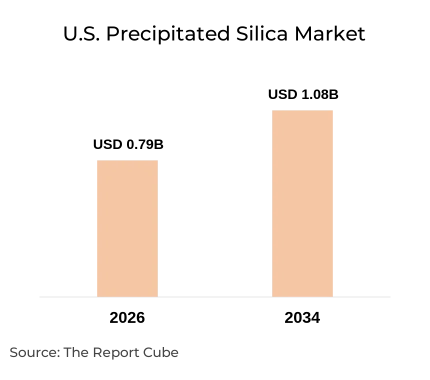
- U.S. Precipitated Silica Market is valued at USD 0.79 billion in 2026.
- The market is projected to reach USD 1.08 billion by 2034.
- Growth is expected at a CAGR of 3.99% during 2026–2034.
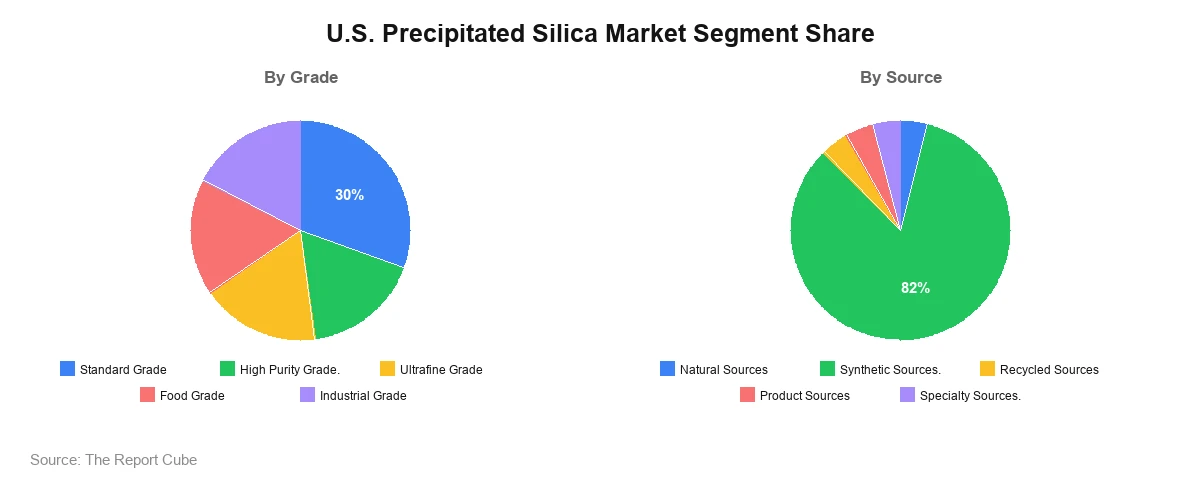
- Standard grade leads the grade segment with an estimated 30% share in 2026.
- Synthetic sources account for an estimated 82% of the source segment in 2026.
- West leads the regional landscape with an estimated 28% share in 2026.
- Evonik Industries, Solvay, Wacker Chemie AG and Tokuyama Corporation are among the supplied key players.
- Performance-oriented tire formulations are a key technology and product trend.
Market Overview
Precipitated silica is a synthetic amorphous form of silicon dioxide produced by reacting sodium silicate with an acid in a controlled wet process. The fine, porous particles function as reinforcing fillers, free flow agents, adsorbents and carriers. Applications include tires and industrial rubber, agrochemical formulations, food and beverage processing, coatings, plastics, personal care and pharmaceutical products.
The U.S. Precipitated Silica Market Analysis shows demand anchored by tire manufacturing and industrial rubber, where silica improves tread performance, wet grip and rolling resistance. Agrochemical formulations and food applications add further functional demand through free-flow, absorption and anti-caking properties, with the market valued at USD 0.79 billion in 2026.
Manufacturers select precipitated silica for reinforcement, flow control, absorption and anti-caking performance across rubber, agrochemical and food applications, while tire producers increasingly seek grades suited to performance-oriented compounds. Production efficiency and reduced environmental impact are also gaining attention among suppliers. The market is projected to grow at a CAGR of 3.99% during 2026–2034.
U.S. Precipitated Silica Market Dynamics
U.S. Precipitated Silica Market Growth depends on tire and rubber production, agrochemical and food formulation requirements, feedstock and energy costs, and product-specification compliance. These forces influence pricing, supplier investment and competition among domestic and international producers, while regulatory requirements shape specialised grade adoption.
|
Factor |
Type |
Specific Impact on Market |
Magnitude |
|---|---|---|---|
|
Rubber and tire demand |
Driver |
Silica serves as a reinforcing filler in tires and industrial rubber products |
High |
|
Agrochemical and food uses |
Driver |
Free-flow, absorption and anti-caking functions broaden demand beyond rubber |
Medium |
|
High-purity and specialty grades |
Opportunity |
Food-grade and specialised formulations create scope for differentiated products |
Medium |
|
Feedstock cost volatility |
Challenge |
Sodium silicate and quartz price changes affect production costs and margins |
Medium–High |
|
Product-specification compliance |
Challenge |
Food and pharmaceutical uses require quality controls and documentation |
Medium |
|
Performance tire formulations |
Trend |
Tread performance, wet grip and rolling resistance drive specialised grade development |
Medium–High |
U.S. Precipitated Silica Market Growth Drivers
Tire and industrial rubber manufacturing remains the principal demand base, because precipitated silica acts as a reinforcing filler that supports tread performance. Historical industry data shows rubber accounted for 55.86% of national revenue in 2022. This figure is a historical benchmark, not a verified 2026 share, but it indicates the importance of rubber applications.
Agrochemical and food applications broaden demand beyond rubber. Precipitated silica serves as a free-flowing agent in agrochemical formulations and as an absorbent and anti-caking agent in food products. Available sources do not quantify the individual U.S. revenue contribution of these uses for 2026, so their effect remains a qualitative driver.
U.S. Precipitated Silica Market Opportunities
The U.S. Food and Drug Administration has evaluated synthetic amorphous silica for specified food uses, including its use in a sugar product. This provides a regulatory precedent for certain food-grade applications, subject to applicable specifications, conditions of use and safety requirements, and may support development of high-purity grades for food and specialty formulations.
Specialised grades for agrochemical formulations represent another opportunity, as precipitated silica can improve flow, dispersion and formulation stability. A global industry forecast places the agrochemical applications segment at a 5.7% CAGR, but that rate refers to worldwide demand rather than the United States, so the size of the domestic opportunity remains unquantified.
U.S. Precipitated Silica Industry Challenges
Feedstock price fluctuations, including sodium silicate and high-purity quartz, can change precipitated silica production costs. Manufacturers must manage procurement, energy use and process efficiency carefully to protect operating margins when input costs rise or fall, and these pressures can complicate pricing discussions with customers across tire, agrochemical and food applications.
Producers serving food, pharmaceutical and other specialised applications must meet product-specific safety and specification requirements. For synthetic amorphous silica intended for specified food uses, the U.S. Food and Drug Administration sets applicable requirements, so manufacturers need robust quality controls, documentation and compliance processes that can add meaningful operating complexity and cost.
Need Specific Data, Let’s Customize the Report for You
Request CustomizationU.S. Precipitated Silica Market Trends
U.S. Precipitated Silica Market Trends include rising use in performance-oriented tire formulations, where silica improves tread performance, wet grip and rolling resistance. This direction supports development of specialised silica grades tailored to demanding tire compound requirements and may influence supplier product portfolios and technical service priorities during the forecast period.
Manufacturers are placing greater emphasis on production efficiency, resource management and reduced environmental impact. These priorities can influence investment in manufacturing assets and process development. The available source does not quantify the U.S. revenue attributable to these initiatives, so the trend is presented as a qualitative indicator rather than a measured market shift.
U.S. Precipitated Silica Market Segment Analysis
U.S. Precipitated Silica Market Share is distributed across grades, sources, end uses, processes and applications, each shaped by performance requirements and regulatory conditions. Leading-segment shares below are supplied estimates for 2026, and shares for other segments are not disclosed.
By Grade
- Standard Grade
- High Purity Grade
- Ultrafine Grade
- Food Grade
- Industrial Grade
Standard grade leads the By Grade segment with an estimated 30% share in 2026, supported by its broad use as a reinforcing filler and functional additive in rubber and general industrial formulations. Evonik and QEMETICA, which acquired PPG’s Lake Charles, Louisiana precipitated silica facilities in 2024, are among the suppliers with U.S. manufacturing relevance. High purity grade serves food, pharmaceutical and electronics-related applications that require tighter quality control, while ultrafine grade addresses formulations where particle size influences dispersion and performance. Food grade is shaped by the conditions under which the U.S. Food and Drug Administration has evaluated synthetic amorphous silica for specified food uses, and industrial grade supports general manufacturing applications. Verified 2026 shares for these grades were not supplied, so they are not quantified.
By Source
- Natural Sources
- Synthetic Sources
- Recycled Sources
- Byproduct Sources
- Specialty Sources
Synthetic sources lead the By Source segment with an estimated 82% share in 2026, reflecting precipitated silica’s production through the controlled reaction of sodium silicate and acid, which allows manufacturers to adjust particle properties for specific applications. Evonik, Solvay and QEMETICA are among the producers of synthetic precipitated silica relevant to rubber and specialty uses. Natural sources, recycled sources, byproduct sources and specialty sources form the remaining categories, with demand depending on raw-material availability, purity requirements and processing economics. Growing attention to resource management and reduced environmental impact may increase interest in alternative feedstock routes, although no U.S. volume data for these sources was supplied.
Regional Analysis
The U.S. Precipitated Silica Market is assessed across West, Southwest, North and Midwest. Only the leading region’s share was supplied; remaining allocations are not assigned.
|
Region |
Estimated Market Share |
Key Growth Factors |
Industry Trends |
|---|---|---|---|
|
West |
28% |
Supplied as the leading region; specific drivers require validation |
Not supplied |
|
Southwest |
- |
Regional drivers require validation |
Not supplied |
|
North |
- |
Regional drivers require validation |
Not supplied |
|
Midwest |
- |
Regional drivers require validation |
Not supplied |
West is the leading region in the U.S. Precipitated Silica Market with an estimated 28% share in 2026. Regional demand is expected to reflect the distribution of rubber, agrochemical, food and specialty manufacturing activity, although supplied data does not identify the specific industries or facilities driving the West’s position. These drivers require validation before publication.
Southwest, North and Midwest complete the regional framework, but estimated shares for these regions were not supplied and are not assigned here. Regional comparison depends on the location of tire and rubber manufacturing, agrochemical formulation, food processing and silica production sites. Verified regional allocations are required to ensure consistency with the 2026 reporting year and national scope.
Market Share & Competitive Landscape
The U.S. Precipitated Silica Market includes global specialty chemical producers, regional manufacturers and Asia-based suppliers. The table summarizes the supplied companies by general capability and relevant segment. It does not represent numerical market share, and recent ownership changes affecting the PPG and Huber silica businesses are noted.
|
Company |
Competitive Strength |
Primary Segment Served |
|---|---|---|
|
Evonik Industries |
Precipitated and fumed silica technology combined with silanes in its Smart Effects unit; acquired Huber’s silica business in 2017 |
Tires, coatings, electronics, consumer health and nutrition |
|
PPG Industries |
Former precipitated silica producer; silicas products business sold to QEMETICA in November 2024 |
Legacy performance-additive silica supply |
|
Solvay |
Precipitated silica production, including highly dispersible grades and a bio-circular silica facility in Italy |
Tire, rubber and specialty silica |
|
Huber Engineered Materials |
Silica business unit sold to Evonik in 2017; current precipitated silica role not verified |
Legacy silica supply |
|
Wacker Chemie AG |
Pyrogenic silica under the HDK brand, with a 13,000 metric tons per year plant in Tennessee |
Silicone elastomers, adhesives, paints |
|
Tokuyama Corporation |
Japan-based specialty chemicals company with silica products; U.S. activity not verified |
Specialty and international silica supply |
|
Fuso Chemical Co Ltd |
Japan-based specialty materials supplier; U.S. activity not verified |
Segment role requires validation |
|
Madhu Silica Pvt Ltd |
India-based precipitated silica manufacturer; U.S. sales not verified |
Precipitated silica supply |
|
Qingdao Wode Silica Co Ltd |
China-based silica manufacturer; capabilities require validation |
Segment role requires validation |
|
QEMETICA |
Acquired PPG’s Lake Charles and Delfzijl precipitated silica facilities; leases operations in Barberton, Ohio and Monroeville, Pennsylvania |
Precipitated silica for performance additive applications |
Key Companies in the U.S. Precipitated Silica Market
- Evonik Industries is headquartered in Essen, Germany. In January 2025 it merged its silica and silanes lines into Smart Effects, with about 3,500 employees, and announced closure of its Havre de Grace, Maryland, silica plant by mid-2026. Strengths include tire silica and silane technology.
- Solvay is headquartered in Brussels, Belgium, and traces its origins to 1863. In January 2026 it inaugurated a bio-circular silica facility in Livorno, Italy, using bio-based sodium silicate. Its strength lies in highly dispersible silica for tire and rubber applications; U.S. activity in 2024–2025 could not be verified.
Recent Developments
|
Year / Month |
Company |
Development |
|---|---|---|
|
January 2025 |
Evonik Industries |
Evonik launched Smart Effects, merging its silica and silanes business lines into a unit of about 3,500 employees. |
|
January 2025 |
Evonik Industries |
Evonik announced plans to close its Havre de Grace, Maryland, precipitated silica plant by mid-2026; this is an announced plan and completion has not been confirmed. |
|
January 2026 |
Solvay |
Solvay inaugurated a bio-circular silica facility in Livorno, Italy, producing highly dispersible silica from bio-based sodium silicate. |
U.S. Precipitated Silica Market Future Outlook
The U.S. Precipitated Silica Market Forecast indicates growth from USD 0.79 billion in 2026 to USD 1.08 billion by 2034 at a CAGR of 3.99%, based on supplied estimates. Demand is expected to remain linked to tire and industrial rubber production, with agrochemical, food and specialty applications providing additional functional demand. These projections are conditional scenarios rather than guaranteed outcomes.
Technology and investment priorities are likely to center on specialised grades, production efficiency and resource management, while ownership changes, including the transfer of PPG’s silicas business to QEMETICA and Evonik’s network adjustments, may reshape competitive positioning. Risks include feedstock cost volatility, product-specification compliance requirements and changes in tire and industrial production, all of which could alter actual outcomes during the forecast period.
U.S. Precipitated Silica Market Report Coverage
This U.S. Precipitated Silica Market Report summarizes the supplied valuation, forecast assumptions, segmentation, regional framework and competitive ecosystem.
|
Parameter |
Details |
|---|---|
|
Market Name |
U.S. Precipitated Silica Market |
|
Market Size 2026 |
USD 0.79 billion |
|
Market Size 2034 |
USD 1.08 billion |
|
Forecast Period |
2026–2034 |
|
CAGR |
3.99% |
|
Base Year |
2025 |
|
Historical Years |
2020-2024 |
|
Forecast Years |
2026–2034 |
|
Segments Covered |
By Grade; By Source; By End-Use; By Process; By Application |
|
Regions Covered |
West, Southwest, North, Midwest |
|
Key Companies |
Evonik Industries, PPG Industries, Solvay, Huber Engineered Materials, Wacker Chemie AG, Tokuyama Corporation, Fuso Chemical Co Ltd, Madhu Silica Pvt Ltd, Qingdao Wode Silica Co Ltd |
|
Customization |
Available as per client requirements |
Why Choose This U.S. Precipitated Silica Market Report?
- Market coverage of precipitated silica across rubber, agrochemical, food, healthcare and industrial applications.
- Clear presentation of the supplied 2026 valuation, 2034 forecast and 3.99% CAGR.
- Segmentation across five grades, five sources, eight end uses, three processes and five applications.
- Regional framework covering West, Southwest, North and Midwest.
- Competitive profiling of supplied global and regional silica producers, with ownership changes noted.
- Trend insights on performance tire formulations, production efficiency and product-specification requirements.
- Forecast context to support product planning, supply strategy and market-entry evaluation.
Table of Contents
- Introduction
- Objective of the Study
- Product Definition
- Market Segmentation
- Study Variables
- Research Methodology
- Secondary Data Points
- Companies Interviewed
- Primary Data Points
- Breakdown of Primary Interviews
- Secondary Data Points
- Executive Summary
- Market Dynamics
- Drivers
- Challenges
- Opportunity Assessment
- Recent Trends and Developments
- Policy and Regulatory Landscape
- U.S Precipitated Silica Market Overview and Forecast Analysis (2021-2034)
- Market Size, By Value, By Growth Rate (CAGR/USD Billions)
- Demand – Supply Trends
- Market Share, By Grade
- Standard Grade
- High Purity Grade
- Ultrafine Grade
- Food Grade
- Industrial Grade
- Market Share, By Source
- Natural Sources
- Synthetic Sources
- Recycled Sources
- Product Sources
- Specialty Sources
- Market Share, By End-Use
- Automotive
- Electronics
- Construction
- Agriculture
- Rubber and Plastics
- Food and Beverage
- Healthcare and Pharmaceuticals
- Others
- Market Share, By Process
- Dry Process
- Wet Process
- Pyrogenic (Fumed) Process
- Market Share, By Application
- Additives
- Free Flow Agents
- Adsorbents
- Catalysts
- Others
- Market Share, By Region
- West
- Southwest
- North
- Midwest
- Market Share, By Competitors
- Competition Characteristics
- Revenue Shares
- Standard Grade U.S Precipitated Silica Market Overview, 2021-2034F
- By Value (USD Million)
- By Source – Market Size & Forecast 2021-2034, USD Million
- Natural Sources
- Synthetic Sources
- Recycled Sources
- Byproduct Sources
- Specialty Sources
- High Purity Grade U.S Precipitated Silica Market Overview, 2021-2034F
- By Value (USD Million)
- By Source – Market Size & Forecast 2021-2034, USD Million
- Natural Sources
- Synthetic Sources
- Recycled Sources
- Byproduct Sources
- Specialty Sources
- Ultrafine Grade U.S Precipitated Silica Market Overview, 2021-2034F
- By Value (USD Million)
- By Source – Market Size & Forecast 2021-2034, USD Million
- Natural Sources
- Synthetic Sources
- Recycled Sources
- Byproduct Sources
- Specialty Sources
- Food Grade U.S Precipitated Silica Market Overview, 2021-2034F
- By Value (USD Million)
- By Source – Market Size & Forecast 2021-2034, USD Million
- Natural Sources
- Synthetic Sources
- Recycled Sources
- Byproduct Sources
- Specialty Sources
- Industrial Grade U.S Precipitated Silica Market Overview, 2021-2034F
- By Value (USD Million)
- By Source – Market Size & Forecast 2021-2034, USD Million
- Natural Sources
- Synthetic Sources
- Recycled Sources
- Byproduct Sources
- Specialty Sources
- Competitive Outlook (Company Profile - Partial List)
- Evonik Industries
- Company Overview
- Business Segments
- Strategic Alliances/Partnerships
- Recent Developments
- PPG Industries
- Company Overview
- Business Segments
- Strategic Alliances/Partnerships
- Recent Developments
- Solvay
- Company Overview
- Business Segments
- Strategic Alliances/Partnerships
- Recent Developments
- Huber Engineered Materials
- Company Overview
- Business Segments
- Strategic Alliances/Partnerships
- Recent Developments
- Wacker Chemie AG
- Company Overview
- Business Segments
- Strategic Alliances/Partnerships
- Recent Developments
- Tokuyama Corporation
- Company Overview
- Business Segments
- Strategic Alliances/Partnerships
- Recent Developments
- Fuso Chemical Co Ltd
- Company Overview
- Business Segments
- Strategic Alliances/Partnerships
- Recent Developments
- Madhu Silica Pvt Ltd
- Company Overview
- Business Segments
- Strategic Alliances/Partnerships
- Recent Developments
- Qingdao Wode Silica Co Ltd
- Company Overview
- Business Segments
- Strategic Alliances/Partnerships
- Recent Developments
- Evonik Industries
- Contact Us & Disclaimer
Top Key Players & Market Share Outlook
- Evonik Industries
- PPG Industries
- Solvay
- Huber Engineered Materials
- Wacker Chemie AG
- Tokuyama Corporation
- Fuso Chemical Co Ltd
- Madhu Silica Pvt Ltd
- Qingdao Wode Silica Co Ltd
Frequently Asked Questions