



Build Your Custom Market Intelligence Report
Customize Your ReportUAE Prefabricated Building Market Insights & Analysis
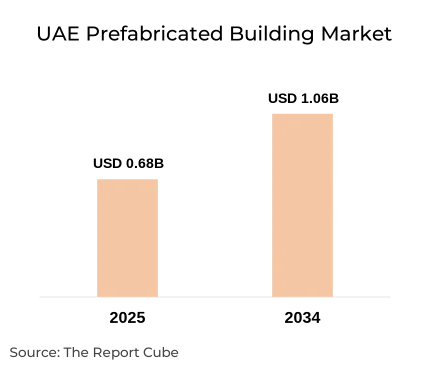
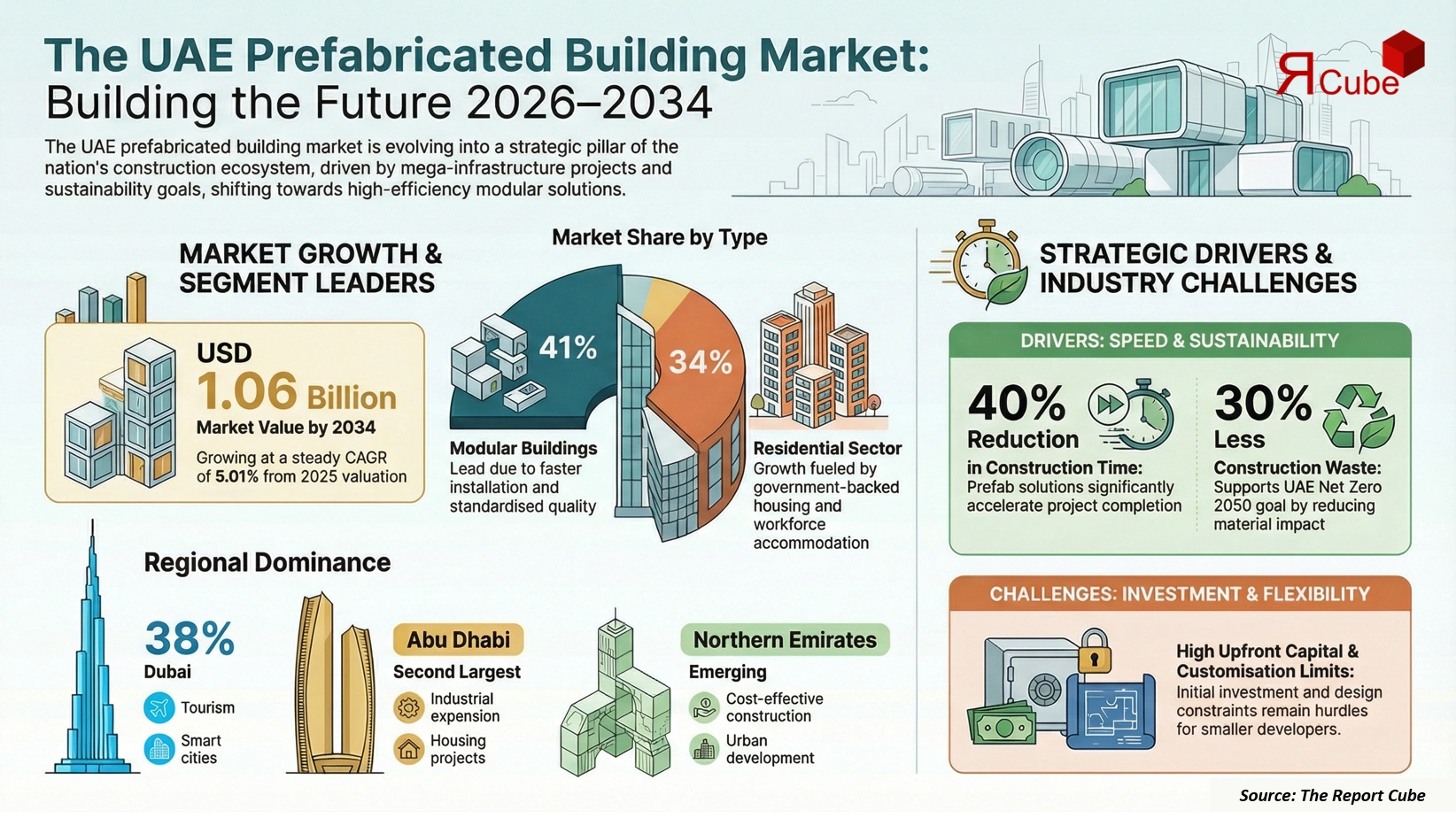
The UAE Prefabricated Building Market is anticipated to register a CAGR of 5.01% during 2026-2034. The market size was valued at USD 0.68 billion in 2025 and is projected to reach USD 1.06 billion by 2034. The market is gaining strong momentum as the UAE accelerates infrastructure development aligned with long-term urbanization and sustainability goals. Prefabricated construction is increasingly preferred due to faster project completion, reduced material waste, and improved cost predictability compared to conventional construction methods.
This growth is closely linked to rising demand from residential, commercial, and industrial projects, particularly in high-growth urban centers such as Dubai and Abu Dhabi. Developers are adopting modular and panelised construction solutions to address labor shortages, tight project timelines, and rising construction costs. Additionally, the UAE’s commitment to green building standards and carbon reduction is reinforcing the adoption of prefabricated structures, which typically generate up to 30% less construction waste than traditional building methods.
Furthermore, the prefabricated building market is benefiting from technological advancements in design, materials, and manufacturing processes. Digital design tools, Building Information Modeling adoption, and factory-controlled production environments are improving quality consistency and structural durability. These factors collectively position the UAE Prefabricated Building Market as a strategic pillar within the country’s evolving construction ecosystem through 2034.
UAE Prefabricated Building Market Recent Developments
- 2025: Red Sea International expanded its modular manufacturing capacity to support large-scale housing and hospitality projects.
- 2025: Speed House Group introduced energy-efficient prefab units designed for rapid deployment across commercial sites.
Government Initiatives & Policies
- UAE Net Zero 2050 Strategic Initiative: Promotes sustainable construction practices, including prefabricated and modular buildings.
- Abu Dhabi Estidama Program: Encourages resource-efficient construction methods across residential and commercial developments.
UAE Prefabricated Building Market Dynamics
Key Driver: Accelerated Infrastructure and Urban Development Projects
Rapid infrastructure expansion across the UAE is a primary driver of the prefabricated building market. Mega-projects in housing, transportation, education, and healthcare demand faster construction timelines and consistent quality standards. Prefabricated solutions reduce on-site construction time by up to 40%, making them highly attractive for government-backed developments and private-sector investments. Additionally, large-scale events, tourism infrastructure, and industrial expansion continue to fuel demand for modular and portable building solutions, particularly in urban and semi-urban zones.
Book your FREE 30-minute expert consultation today
Contact UsIndustry Trends: Growing Adoption of Modular and Hybrid Structures
A key trend shaping the market is the increasing adoption of modular and hybrid prefabricated structures. Modular buildings dominate demand due to their scalability, flexibility, and adaptability across residential and commercial applications. Hybrid structures, combining modular and traditional elements, are gaining traction for complex projects requiring design customization. Technological integration, including digital fabrication and precision engineering, is enhancing structural performance and enabling compliance with strict UAE building regulations.
Major Challenge: High Initial Investment and Design Customization Constraints
Despite strong growth potential, high upfront investment remains a major challenge for the UAE Prefabricated Building Market. Establishing manufacturing facilities, transporting large modules, and meeting local regulatory standards increase initial costs. Additionally, design customization limitations compared to traditional construction can restrict adoption in premium residential and architectural projects. These challenges particularly impact small and mid-sized developers with limited capital flexibility.
Opportunity: Rising Demand from Oil & Gas and Industrial Sectors
The oil & gas and industrial sectors present significant growth opportunities for prefabricated buildings in the UAE. Remote site operations require durable, rapidly deployable housing and operational units, making prefab solutions ideal. Industrial demand for workforce accommodation, site offices, and temporary facilities is increasing steadily. As energy companies prioritize efficiency and worker safety, prefabricated structures are expected to see rising adoption across industrial projects through the forecast period.
UAE Prefabricated Building Market Segment-wise Analysis
By Building Type:
- Modular Buildings
- Panelised Systems
- Portable Cabins
- Hybrid Structures
Modular buildings represent the leading building type, accounting for approximately 41% of the UAE Prefabricated Building Market in 2025. Their dominance is driven by faster installation timelines, standardized quality, and adaptability across residential, commercial, and industrial applications. Modular solutions are widely used in housing, hospitality, and workforce accommodation projects. Panelised systems follow closely, particularly in mid-rise residential developments where design flexibility is required alongside construction efficiency.
By End-User:
- Residential
- Commercial
- Industrial
- Institutional
The residential segment leads end-user demand, holding nearly 34% market share in 2025. Government-backed housing initiatives, affordable housing projects, and workforce accommodations are major contributors. Commercial applications, including offices and retail units, are expanding steadily, while industrial demand is rising due to oil & gas and logistics sector growth. Institutional applications, such as schools and healthcare facilities, further support diversified market expansion.
Regional Projection of UAE Prefabricated Building Industry
- Abu Dhabi
- Dubai
- Sharjah
- Northern Emirates
Dubai leads the UAE Prefabricated Building Market with an estimated 38% share in 2025. The emirate’s continuous investment in real estate, tourism infrastructure, and smart city initiatives drives strong demand for prefabricated solutions. Abu Dhabi follows closely, supported by industrial expansion and government-led housing projects. Sharjah and the Northern Emirates are emerging as high-growth regions, benefiting from cost-effective construction needs and increasing urban development activities.
Need insights for a specific region within this market?
Request Regional DataWhy Choose This Report?
- Provides a comprehensive overview of the overall market analysis, encompassing key trends, consumer behavior analysis, and risk assessment to support strategic decision-making.
- Provides accurate, up-to-date insights into market size, segmentation, and emerging opportunities, helping to minimize risk & capitalizing on growth.
- Gives deep understanding of target audience preferences, investment habits, and communication channels for enhanced product development & marketing effectiveness.
- Delivers competitive analysis & benchmarking, uncovering the strengths & weaknesses of market competitors to guide strategies.
- Consolidate comprehensive market intelligence, reducing reasoning & streamlining research efforts.
- Facilitates customized market segmentation & risk mitigation strategies, fine-tuned to the business objectives.
- Aids in identifying both market challenges & untapped opportunities within the industry to drive long-term business growth.
- Provides valuable information based on actual customer data & search trends.
Table of Contents
- Introduction
- Objective of the Study
- Product and Category Definition
- Market Segmentation
- Study Variables
- Research Methodology
- Secondary Data Points
- Breakdown of Secondary Sources
- Primary Data Points
- Breakdown of Primary Interviews
- Secondary Data Points
- Executive Summary
- Market Dynamics
- Drivers
- Challenges
- Opportunity Assessment
- Recent Trends and Developments
- Regulatory and Policy Landscape
- UAE Prefabricated Building Market Overview (2020-2034)
- Market Size, By Value (AED Billion)
- Market Share, By Building Type
- Modular Buildings
- Panelised Systems
- Portable Cabins
- Hybrid Structures
- Other Prefab Types
- Market Share, By End-User
- Residential
- Commercial
- Industrial
- Institutional
- Oil & Gas
- Market Share, By Material
- Steel
- Concrete
- Wood
- Aluminium
- Other Materials
- Market Share, By Construction Method
- Volumetric Modules
- Panelised Units
- Hybrid Prefab
- Market Share, By Region
- Abu Dhabi
- Dubai
- Sharjah
- Northern Emirates
- Market Share, By Company
- Competition Characteristics
- Revenue Shares & Analysis
- Abu Dhabi Prefabricated Building Market
- Market Size, By Value (AED Billion)
- Market Share, By Building Type
- Market Share, By End-User
- Market Share, By Material
- Market Share, By Construction Method
- Dubai Prefabricated Building Market
- Market Size, By Value (AED Billion)
- Market Share, By Building Type
- Market Share, By End-User
- Market Share, By Material
- Market Share, By Construction Method
- Sharjah Prefabricated Building Market
- Market Size, By Value (AED Billion)
- Market Share, By Building Type
- Market Share, By End-User
- Market Share, By Material
- Market Share, By Construction Method
- Northern Emirates Prefabricated Building Market
- Market Size, By Value (AED Billion)
- Market Share, By Building Type
- Market Share, By End-User
- Market Share, By Material
- Market Share, By Construction Method
- Competitive Outlook and Company Profiles
- LINQ
- Company Overview
- Product Portfolio
- Strategic Alliances/Partnerships
- Recent Developments
- Karmod
- Company Overview
- Product Portfolio
- Strategic Alliances/Partnerships
- Recent Developments
- Bespoke Modular Solutions
- Company Overview
- Product Portfolio
- Strategic Alliances/Partnerships
- Recent Developments
- Speed House Group
- Company Overview
- Product Portfolio
- Strategic Alliances/Partnerships
- Recent Developments
- Al Bait Al Raqi
- Company Overview
- Product Portfolio
- Strategic Alliances/Partnerships
- Recent Developments
- Red Sea International
- Company Overview
- Product Portfolio
- Strategic Alliances/Partnerships
- Recent Developments
- Masah Al Murabaa Prefab
- Company Overview
- Product Portfolio
- Strategic Alliances/Partnerships
- Recent Developments
- Al Arab Prefab Houses
- Company Overview
- Product Portfolio
- Strategic Alliances/Partnerships
- Recent Developments
- Liberty Building System
- Company Overview
- Product Portfolio
- Strategic Alliances/Partnerships
- Recent Developments
- Arabtec Holding
- Company Overview
- Product Portfolio
- Strategic Alliances/Partnerships
- Recent Developments
- Others
- LINQ
- Contact Us and Disclaimer
Top Key Players & Market Share Outlook
- LINQ
- Karmod
- Speed House Group
- Al Bait Al Raqi
- Red Sea International
- Masah Al Murabaa Prefab
- Al Arab Prefab Houses
- Liberty Building System
- Arabtec Holding
- Others
Frequently Asked Questions