



Build Your Custom Market Intelligence Report
Customize Your ReportIndonesia Prefabricated Buildings Market Insights & Analysis
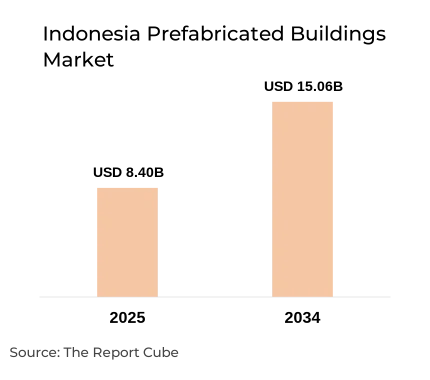
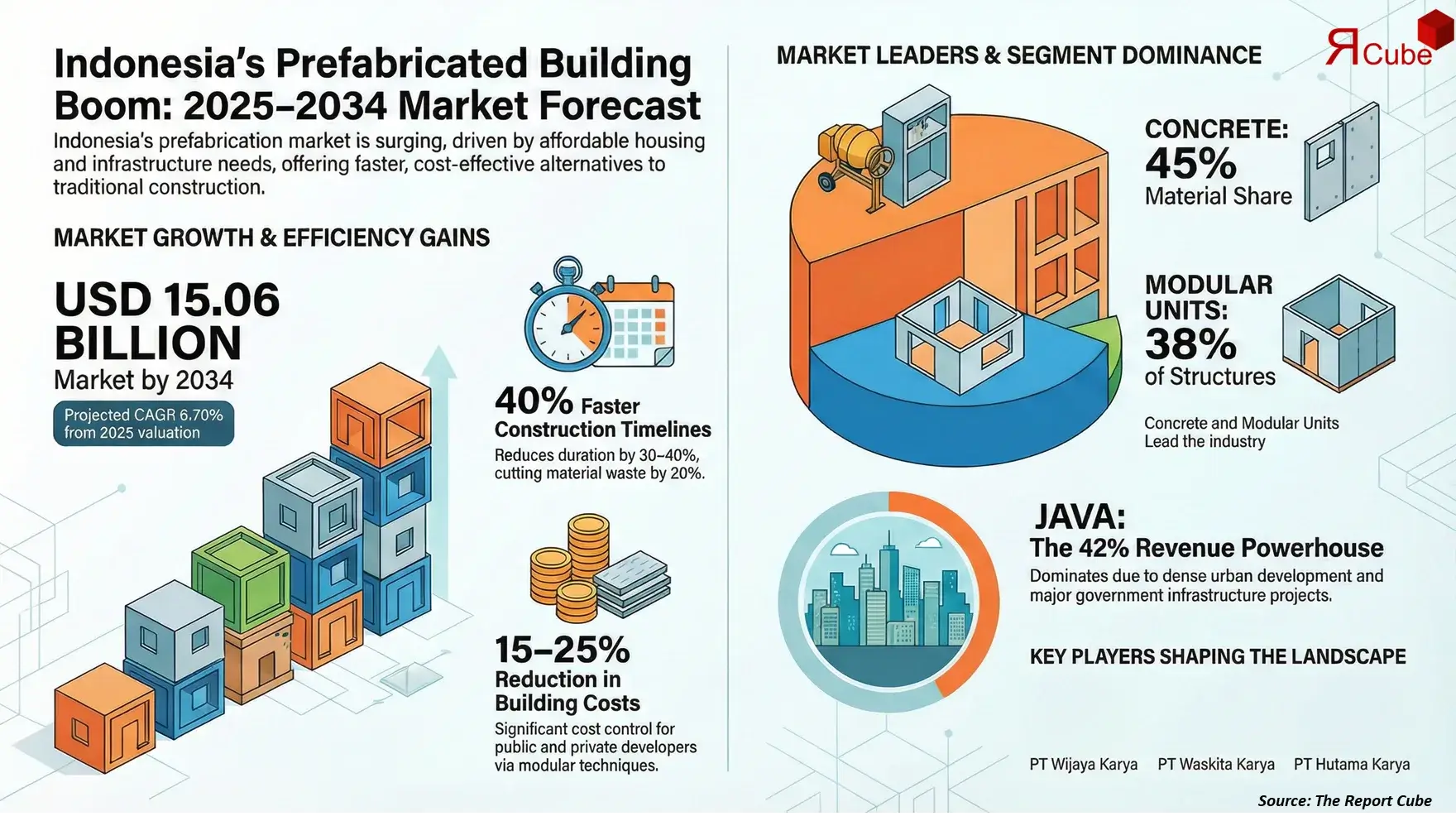
The Indonesia Prefabricated Buildings Market is anticipated to register a CAGR of 6.70% during 2026-2034. The market size was valued at USD 8.4 billion in 2025 and is projected to reach USD 15.06 billion by 2034. the market is gaining strong momentum as the country accelerates infrastructure development, urban housing programs, and industrial expansion. Rapid urbanization has increased demand for faster, cost-efficient, and scalable construction solutions, positioning prefabrication as a preferred alternative to conventional building methods. Government-backed affordable housing schemes and public infrastructure investments are pushing contractors toward modular and panelized construction to meet tight delivery timelines. Prefabricated buildings reduce construction time by nearly 30-40% compared to traditional techniques, while lowering labor dependency and material waste by over 20%, making them suitable for Indonesia’s geographically dispersed islands.
Private sector adoption is also increasing across commercial offices, hospitality, education, and healthcare projects. Manufacturing and logistics hubs in Java and Sumatra increasingly deploy modular units to expand facilities quickly. Additionally, rising awareness of sustainability and green building practices is strengthening market penetration, as prefabrication supports lower carbon emissions and efficient material usage. With strong participation from domestic EPC companies and growing interest from international prefab technology providers, the Indonesia prefabricated buildings market is expected to witness steady, long-term growth through 2034.
Indonesia Prefabricated Buildings Market Recent Developments
- 2025: PT Wijaya Karya launched modular housing solutions for government-backed affordable housing projects across Java.
- 2025: PT Waskita Karya expanded precast concrete capacity to support large-scale infrastructure and transit developments.
Government Initiatives & Policies
- National Strategic Housing Program (PSN): Supports rapid construction of affordable homes using modular and precast technologies.
- Indonesia Green Building Roadmap: Promotes sustainable construction practices, including prefabrication adoption.
Indonesia Prefabricated Buildings Market Dynamics
Key Driver: Rapid Infrastructure Development and Affordable Housing Demand
Indonesia’s aggressive infrastructure expansion remains the primary driver for the prefabricated buildings market. The government allocates over 5% of its annual GDP toward infrastructure, including transportation networks, public housing, schools, and healthcare facilities. Prefabricated construction enables faster project completion, reducing delays caused by labor shortages and weather disruptions. Affordable housing initiatives targeting over one million housing units annually increasingly rely on modular and precast technologies to maintain cost control. Additionally, prefabrication lowers construction costs by approximately 15-25%, making it attractive for both public and private developers operating under tight budgets.
Book your FREE 30-minute expert consultation today
Contact UsIndustry Trends: Shift Toward Modular and Sustainable Construction
The industry is witnessing a strong shift toward modular units and panelized systems that allow customization while maintaining speed. Concrete-based prefabrication dominates large infrastructure projects, while lightweight steel and timber systems gain traction in residential and hospitality segments. Sustainability trends are also shaping the market, with builders integrating energy-efficient materials, recyclable components, and low-emission manufacturing processes. Digital design tools, including Building Information Modeling (BIM), are increasingly used to optimize prefab production and reduce material waste, improving overall project efficiency.
Major Challenge: High Initial Capital Investment and Logistics Complexity
Despite strong growth prospects, high upfront capital requirements remain a major challenge. Setting up prefabrication plants demands significant investment in machinery, skilled labor, and quality control systems. Additionally, Indonesia’s archipelagic geography creates logistical challenges in transporting large prefabricated components to remote regions, increasing delivery costs. Limited standardization across projects also restricts economies of scale, particularly for smaller contractors. Addressing these challenges requires improved supply chain coordination and greater adoption of standardized modular designs.
Opportunity: Expansion of Industrial, Tourism, and Remote Area Projects
Rising investments in industrial parks, tourism infrastructure, and remote-area development present major growth opportunities. Prefabricated buildings are increasingly used for worker accommodations, resorts, hospitals, and schools in regions such as Kalimantan, Papua, and eastern Indonesia. These solutions significantly reduce on-site construction challenges and labor dependence. The relocation of Indonesia’s capital to Nusantara further strengthens long-term demand for modular housing, offices, and public facilities, creating lucrative opportunities for prefab manufacturers.
Indonesia Prefabricated Buildings Market Segment-wise Analysis
By Material Type:
- Concrete
- Metal
- Timber
- Glass
- Other Materials
Concrete remains the leading material segment, accounting for nearly 45% of the total market share in 2025. Its durability, fire resistance, and suitability for large-scale infrastructure projects drive adoption. Precast concrete is widely used in bridges, apartments, and public buildings. Metal-based prefabrication follows closely, driven by industrial and commercial demand due to its lightweight nature and structural flexibility. Timber and glass segments are gaining traction in eco-friendly residential and resort developments, particularly in Bali and Nusa Tenggara.
By Structure Type:
- Modular Units
- Panelized Systems
- Skeleton Systems
- Other Structures
Modular units dominate the structure type segment, holding approximately 38% market share in 2025. Their ability to be fully manufactured off-site and quickly assembled on location significantly reduces construction timelines. Panelized systems are widely used in residential and educational buildings, offering design flexibility. Skeleton systems are mainly deployed in industrial and commercial projects where structural customization is required, while other structures cater to niche applications.
Regional Projection of Indonesia Prefabricated Buildings Industry
- Java
- Sumatra
- Kalimantan
- Sulawesi
- Bali & Nusa Tenggara
- Maluku & Papua
Java leads the Indonesia prefabricated buildings market, contributing nearly 42% of total revenue in 2025. The region benefits from dense urban development, industrial clusters, and major infrastructure projects. High housing demand, manufacturing expansion, and government projects support continued dominance. Sumatra follows due to logistics hubs and industrial estates, while Kalimantan is emerging rapidly with the new capital development. Eastern regions such as Papua and Maluku show rising adoption for remote infrastructure and public facilities.
Need insights for a specific region within this market?
Request Regional DataWhy Choose This Report?
- Provides a comprehensive overview of the overall market analysis, encompassing key trends, consumer behavior analysis, and risk assessment to support strategic decision-making.
- Provides accurate, up-to-date insights into market size, segmentation, and emerging opportunities, helping to minimize risk & capitalizing on growth.
- Gives deep understanding of target audience preferences, investment habits, and communication channels for enhanced product development & marketing effectiveness.
- Delivers competitive analysis & benchmarking, uncovering the strengths & weaknesses of market competitors to guide strategies.
- Consolidate comprehensive market intelligence, reducing reasoning & streamlining research efforts.
- Facilitates customized market segmentation & risk mitigation strategies, fine-tuned to the business objectives.
- Aids in identifying both market challenges & untapped opportunities within the industry to drive long-term business growth.
- Provides valuable information based on actual customer data & search trends.
Table of Contents
- Introduction
- Objective of the Study
- Product and Category Definition
- Market Segmentation
- Study Variables
- Research Methodology
- Secondary Data Points
- Breakdown of Secondary Sources
- Primary Data Points
- Breakdown of Primary Interviews
- Secondary Data Points
- Executive Summary
- Market Dynamics
- Drivers
- Challenges
- Opportunity Assessment
- Recent Trends and Developments
- Regulatory and Policy Landscape
- Indonesia Prefabricated Buildings Market Overview (2020-2034)
- Market Size, By Value (IDR / USD Billion)
- Market Share, By Material Type
- Concrete
- Metal
- Timber
- Glass
- Other Materials
- Market Share, By Structure Type
- Modular Units
- Panelized Systems
- Skeleton Systems
- Other Structures
- Market Share, By Application
- Residential
- Commercial
- Industrial
- Institutional
- Others
- Market Share, By End User
- Developers
- Government
- Industrial Clients
- Institutional Users
- Others
- Market Share, By Region
- Java
- Sumatra
- Kalimantan
- Sulawesi
- Bali & Nusa Tenggara
- Maluku & Papua
- Market Share, By Company
- Market Share, By Company
- Competition Characteristics
- Revenue Shares & Analysis
- Java Prefabricated Buildings Market
- Market Size, By Value (IDR / USD Billion)
- Market Share, By Material Type
- Market Share, By Structure Type
- Market Share, By Application
- Market Share, By End User
- Market Share, By Key City
- Jakarta
- Bandung
- Surabaya
- Other Java Cities
- Sumatra Prefabricated Buildings Market
- Market Size, By Value (IDR / USD Billion)
- Market Share, By Material Type
- Market Share, By Structure Type
- Market Share, By Application
- Market Share, By End User
- Market Share, By Key City
- Medan
- Other Sumatra Cities
- Kalimantan Prefabricated Buildings Market
- Market Size, By Value (IDR / USD Billion)
- Market Share, By Material Type
- Market Share, By Structure Type
- Market Share, By Application
- Market Share, By End User
- Market Share, By Key Area
- East Kalimantan
- Nusantara Capital Region
- Other Kalimantan Areas
- Sulawesi Prefabricated Buildings Market
- Market Size, By Value (IDR / USD Billion)
- Market Share, By Material Type
- Market Share, By Structure Type
- Market Share, By Application
- Market Share, By End User
- Market Share, By Key Area
- Major Urban Centers
- Other Sulawesi Areas
- Bali & Nusa Tenggara Prefabricated Buildings Market
- Market Size, By Value (IDR / USD Billion)
- Market Share, By Material Type
- Market Share, By Structure Type
- Market Share, By Application
- Market Share, By End User
- Market Share, By Key Area
- Bali
- Other Nusa Tenggara Areas
- Maluku & Papua Prefabricated Buildings Market
- Market Size, By Value (IDR / USD Billion)
- Market Share, By Material Type
- Market Share, By Structure Type
- Market Share, By Application
- Market Share, By End User
- Market Share, By Key Area
- Major Resource Hubs
- Other Maluku & Papua Areas
- Competitive Outlook and Company Profiles
- PT Wijaya Karya (Persero) Tbk
- Company Overview
- Prefab Product Portfolio
- Strategic Alliances/Partnerships
- Recent Developments
- PT Waskita Karya (Persero) Tbk
- Company Overview
- Prefab Product Portfolio
- Strategic Alliances/Partnerships
- Recent Developments
- PT Hutama Karya (Persero)
- Company Overview
- Prefab Product Portfolio
- Strategic Alliances/Partnerships
- Recent Developments
- PT Adhi Karya (Persero) Tbk
- Company Overview
- Prefab Product Portfolio
- Strategic Alliances/Partnerships
- Recent Developments
- PT PP (Persero) Tbk
- Company Overview
- Prefab Product Portfolio
- Strategic Alliances/Partnerships
- Recent Developments
- PT Total Bangun Persada Tbk
- Company Overview
- Prefab Product Portfolio
- Strategic Alliances/Partnerships
- Recent Developments
- PT Surya Semesta Internusa Tbk
- Company Overview
- Prefab Product Portfolio
- Strategic Alliances/Partnerships
- Recent Developments
- PT Nusa Raya Cipta Tbk
- Company Overview
- Prefab Product Portfolio
- Strategic Alliances/Partnerships
- Recent Developments
- Bali Prefab
- Company Overview
- Prefab Product Portfolio
- Strategic Alliances/Partnerships
- Recent Developments
- Myfab - PT Solusi Multiguna Prima
- Company Overview
- Prefab Product Portfolio
- Strategic Alliances/Partnerships
- Recent Developments
- Others
- PT Wijaya Karya (Persero) Tbk
- Contact Us and Disclaimer
Top Key Players & Market Share Outlook
- PT Wijaya Karya (Persero) Tbk
- PT Waskita Karya (Persero) Tbk
- PT Hutama Karya (Persero)
- PT Adhi Karya (Persero) Tbk
- PT PP (Persero) Tbk
- PT Total Bangun Persada Tbk
- PT Surya Semesta Internusa Tbk
- PT Nusa Raya Cipta Tbk
- Bali Prefab
- Myfab - PT Solusi Multiguna Prima
- Others
Frequently Asked Questions






