



Build Your Custom Market Intelligence Report
Customize Your ReportUAE Modular Construction Market Insights & Analysis
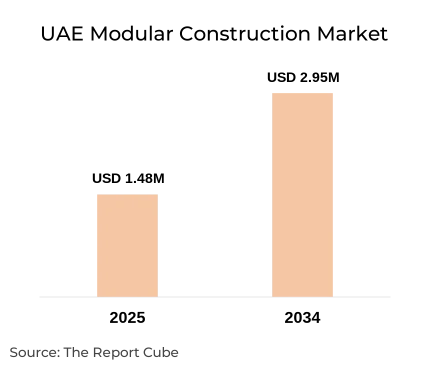
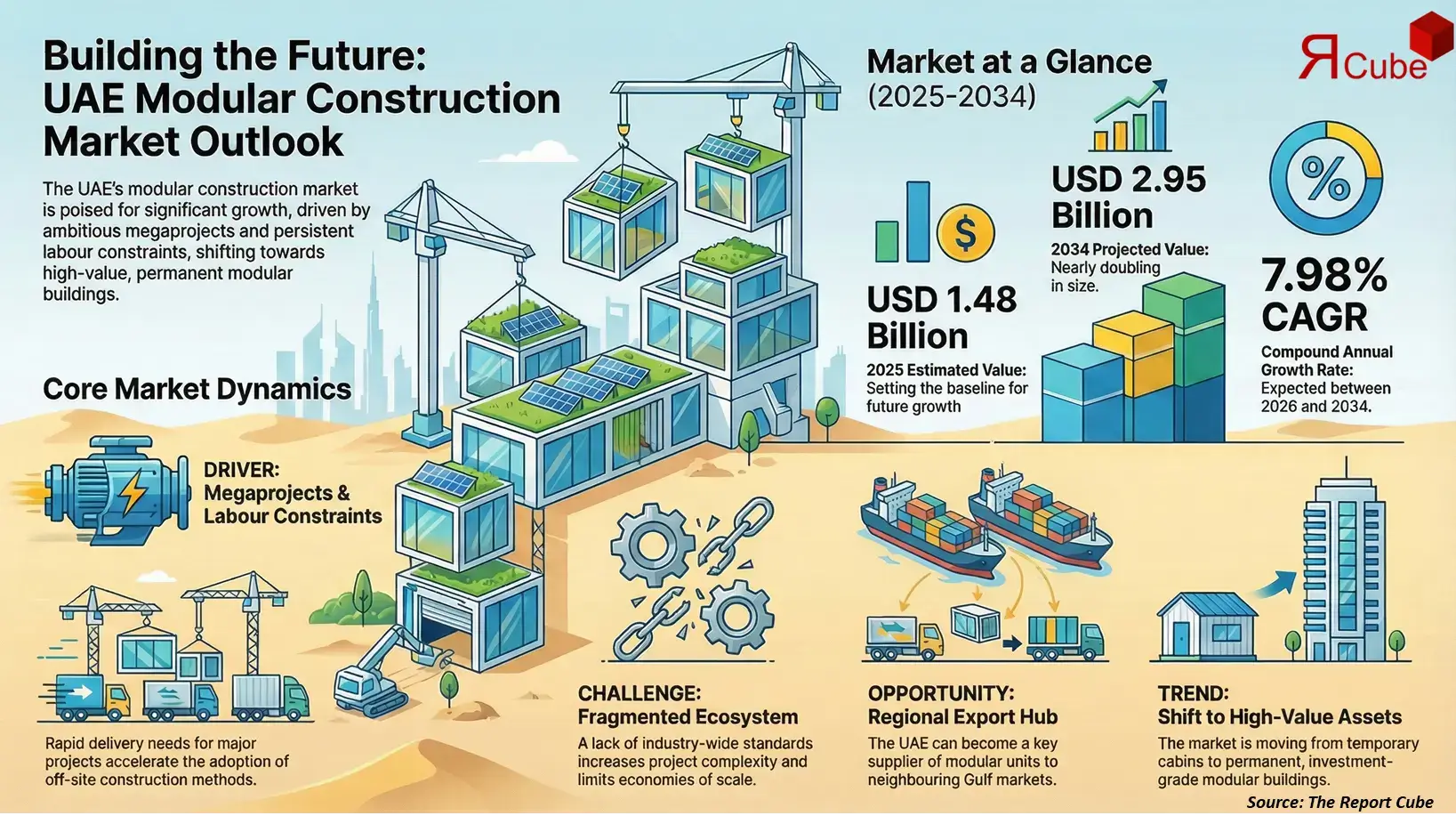
The UAE Modular Construction Market is anticipated to register a CAGR of 7.98% during 2026-2034. The market size was valued at USD 1.48 million in 2025 and is projected to reach USD 2.95 million by 2034. The market is gaining traction as the UAE construction industry increasingly prioritizes speed, cost efficiency, and sustainability. Modular construction offers controlled manufacturing environments, reduced material waste, and faster project delivery, making it an attractive alternative to traditional building methods across residential, commercial, and industrial applications.
The UAE’s ambitious infrastructure development plans, combined with a strong focus on smart cities and sustainable urban development, continue to reinforce demand for modular solutions. Developers are leveraging modular construction to address labor shortages, tight project timelines, and rising construction costs. Additionally, the region’s harsh climatic conditions make factory-built modules appealing due to better quality control and durability. These factors collectively position modular construction as a strategic solution for the evolving UAE built environment.
Furthermore, increased acceptance of prefabricated structures for hotels, healthcare facilities, and workforce accommodations is strengthening market penetration. As confidence in design flexibility and long-term performance grows, modular construction is transitioning from niche adoption toward mainstream implementation across the UAE.
UAE Modular Construction Market Recent Developments
- 2025: Red Sea International secured a large workforce housing contract supporting energy and infrastructure projects in Abu Dhabi.
- 2025: Al Baddad International expanded its modular manufacturing capacity to meet rising hospitality sector demand.
Government Initiatives & Policies
- UAE Net Zero 2050 Strategic Initiative: Promotes sustainable construction practices, supporting modular and prefabricated solutions.
- Dubai Urban Master Plan 2040: Encourages efficient building methods to support rapid urban expansion.
UAE Modular Construction Market Dynamics
Key Driver: Accelerated Infrastructure and Real Estate Development
Rapid infrastructure expansion and real estate development across the UAE remain the primary drivers of the modular construction market. Mega projects in housing, hospitality, logistics, and industrial zones require fast-track delivery models to meet tight deadlines. Modular construction reduces project timelines by up to 30-40% compared to conventional methods, making it highly attractive for developers. Additionally, government-backed investments in transportation networks, tourism infrastructure, and energy facilities are fueling consistent demand for modular solutions, particularly for temporary and semi-permanent structures.
Book your FREE 30-minute expert consultation today
Contact UsIndustry Trends: Growing Adoption of Sustainable and Off-Site Construction
Sustainability-focused construction practices are becoming a defining trend in the UAE Modular Construction Market. Developers are increasingly adopting off-site construction to minimize waste, lower carbon emissions, and improve worker safety. Modular buildings can reduce construction waste by nearly 50%, aligning well with the UAE’s environmental targets. Moreover, advancements in digital design tools, including Building Information Modeling, are improving precision and customization, allowing modular structures to meet high aesthetic and performance standards.
Major Challenge: Perception and Design Limitations
Despite its advantages, modular construction faces challenges related to market perception and perceived design constraints. Some developers and end-users associate modular buildings with limited architectural flexibility or temporary use, which can slow adoption in high-end residential and commercial segments. Additionally, transportation logistics and regulatory approvals can add complexity to large modular projects. These factors create hesitation among stakeholders unfamiliar with modern modular capabilities, impacting broader market penetration.
Opportunity: Expansion in Hospitality and Workforce Accommodation
The hospitality sector and workforce accommodation projects present significant growth opportunities for modular construction in the UAE. Hotels, resorts, and labor housing developments benefit from modular construction’s speed and scalability, especially in remote or high-demand locations. With tourism arrivals expected to rise steadily, modular solutions offer a practical way to add capacity quickly while maintaining quality standards. Strategic partnerships between modular suppliers and real estate developers can unlock substantial long-term growth.
UAE Modular Construction Market Segment-wise Analysis
By Type:
- Permanent Modular
- Relocatable Modular
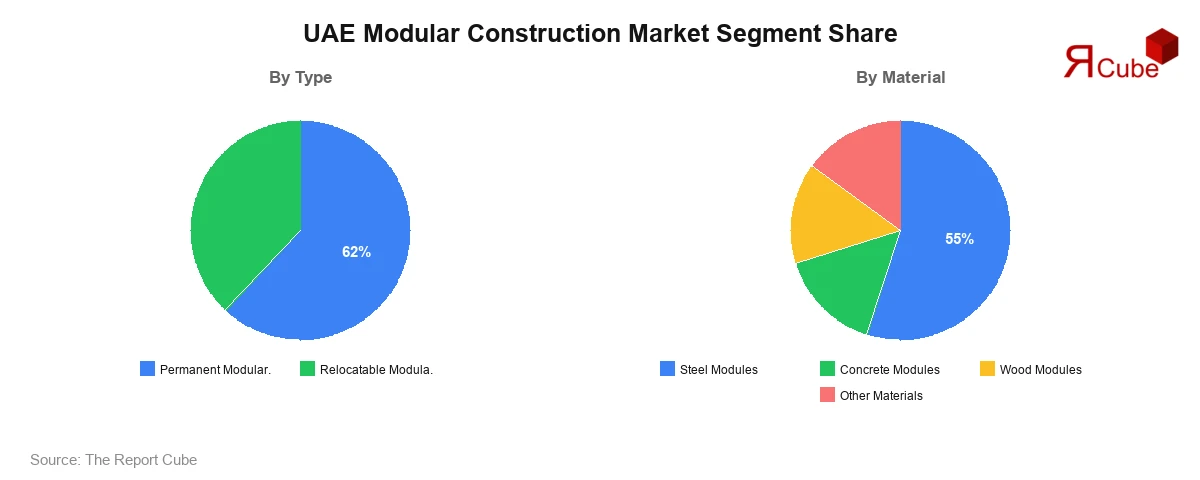
Permanent modular construction leads the market, accounting for nearly 62% of total revenue in 2025. Its dominance is driven by increasing use in residential buildings, hotels, and commercial facilities where long-term durability is essential. Permanent modules offer design flexibility comparable to traditional construction while delivering faster completion. Relocatable modular solutions remain important for temporary offices, workforce housing, and emergency facilities, benefiting from reusability and cost efficiency.
By Material:
- Steel Modules
- Concrete Modules
- Wood Modules
- Other Materials
Steel modules dominate the material segment with approximately 55% market share, owing to their strength, durability, and suitability for the UAE’s climate. Steel modules support multi-story construction and comply with stringent safety standards. Concrete modules are gaining traction for residential and institutional projects, while wood modules remain limited due to climatic considerations, though niche sustainable applications are emerging.
Regional Projection of UAE Modular Construction Industry
- Abu Dhabi
- Dubai
- Sharjah
- Ras Al Khaimah
Dubai leads the UAE Modular Construction Market, contributing nearly 34% of total market share in 2025. The emirate’s strong pipeline of hospitality, residential, and mixed-use developments drives demand for modular solutions. Dubai’s emphasis on smart construction methods and sustainability further supports adoption. Abu Dhabi follows closely, supported by industrial and energy-related projects, while Sharjah and Ras Al Khaimah are emerging as growth regions due to expanding affordable housing and industrial developments.
Need insights for a specific region within this market?
Request Regional DataWhy Choose This Report?
- Provides a comprehensive overview of the overall market analysis, encompassing key trends, consumer behavior analysis, and risk assessment to support strategic decision-making.
- Provides accurate, up-to-date insights into market size, segmentation, and emerging opportunities, helping to minimize risk & capitalizing on growth.
- Gives deep understanding of target audience preferences, investment habits, and communication channels for enhanced product development & marketing effectiveness.
- Delivers competitive analysis & benchmarking, uncovering the strengths & weaknesses of market competitors to guide strategies.
- Consolidate comprehensive market intelligence, reducing reasoning & streamlining research efforts.
- Facilitates customized market segmentation & risk mitigation strategies, fine-tuned to the business objectives.
- Aids in identifying both market challenges & untapped opportunities within the industry to drive long-term business growth.
- Provides valuable information based on actual customer data & search trends.
Table of Contents
- Introduction
- Objective of the Study
- Product and Category Definition
- Market Segmentation
- Study Variables
- Research Methodology
- Secondary Data Points
- Breakdown of Secondary Sources
- Primary Data Points
- Breakdown of Primary Interviews
- Secondary Data Points
- Executive Summary
- Market Dynamics
- Drivers
- Challenges
- Opportunity Assessment
- Recent Trends and Developments
- Regulatory and Policy Landscape
- UAE Modular Construction Market Overview (2020-2034)
- Market Size, By Value (USD Million)
- Market Share, By Type
- Permanent Modular
- Relocatable Modular
- Market Share, By Material
- Steel Modules
- Concrete Modules
- Wood Modules
- Other Materials
- Market Share, By Application
- Residential
- Commercial
- Industrial
- Infrastructure
- Other Uses
- Market Share, By End User
- Developers
- Contractors
- Government
- Industrial Clients
- Market Share, By Region
- Abu Dhabi
- Dubai
- Sharjah
- Ajman
- Ras Al Khaimah
- Fujairah
- Umm Al Quwain
- Market Share, By Company
- Competition Characteristics
- Revenue Shares & Analysis
- Abu Dhabi Modular Construction Market
- Market Size, By Value (USD Million)
- Market Share, By Type
- Market Share, By Material
- Market Share, By Application
- Market Share, By End User
- Dubai Modular Construction Market
- Market Size, By Value (USD Million)
- Market Share, By Type
- Market Share, By Material
- Market Share, By Application
- Market Share, By End User
- Other Emirates Modular Construction Market
- Sharjah Modular Market
- Ras Al Khaimah Modular Market
- Ajman Modular Market
- Fujairah Modular Market
- Umm Al Quwain Modular Market
- Competitive Outlook and Company Profiles
- LINQ Modular
- Company Overview
- Product Portfolio
- Strategic Alliances/Partnerships
- Recent Developments
- Red Sea International
- Company Overview
- Product Portfolio
- Strategic Alliances/Partnerships
- Recent Developments
- Al Arab Prefab Houses
- Company Overview
- Product Portfolio
- Strategic Alliances/Partnerships
- Recent Developments
- Modular Prefab (UAE)
- Company Overview
- Product Portfolio
- Strategic Alliances/Partnerships
- Recent Developments
- Speed House Group
- Company Overview
- Product Portfolio
- Strategic Alliances/Partnerships
- Recent Developments
- Al Bait Al Raqi
- Company Overview
- Product Portfolio
- Strategic Alliances/Partnerships
- Recent Developments
- Al Baddad International
- Company Overview
- Product Portfolio
- Strategic Alliances/Partnerships
- Recent Developments
- TSSC Group
- Company Overview
- Product Portfolio
- Strategic Alliances/Partnerships
- Recent Developments
- NAFFCO Modular
- Company Overview
- Product Portfolio
- Strategic Alliances/Partnerships
- Recent Developments
- EMKAY Prefab
- Company Overview
- Product Portfolio
- Strategic Alliances/Partnerships
- Recent Developments
- Others
- LINQ Modular
- Contact Us and Disclaimer
Top Key Players & Market Share Outlook
- LINQ Modular
- Red Sea International
- Al Arab Prefab Houses
- Modular Prefab (UAE)
- Speed House Group
- Al Bait Al Raqi
- Al Baddad International
- TSSC Group
- NAFFCO Modular
- EMKAY Prefab
- Others
Frequently Asked Questions






