



Build Your Custom Market Intelligence Report
Customize Your ReportIndia Prepaid Cards Market Statistics and Insights
Market Insight
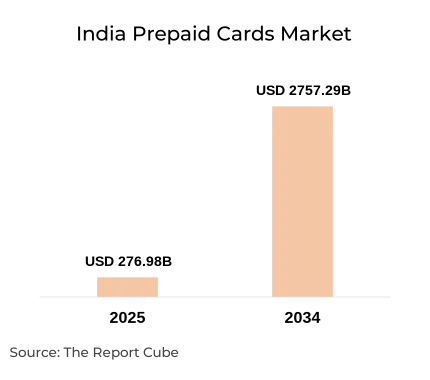
- India Prepaid Cards Market was valued at USD 276.98 billion in 2025.
- India Prepaid Cards Market is projected to reach USD 2757.29 billion by 2034.
- India Prepaid Cards Market is anticipated to grow at a 29.09% CAGR.
By Card Type
- Open Loop Cards dominate with approximately 72% market share in 2025.
Competitive Landscape
- More than 10 companies are actively engaged in producing India Prepaid Cards Market solutions.
- Top 5 companies acquired around 65% of the market share.
- State Bank of India, HDFC Bank, ICICI Bank, Paytm Payments Bank, MobiKwik, and others.
By Purpose
- General Purpose Reloadable (GPR) Cards lead with approximately 30% market share in 2025.
India Prepaid Cards Market Insights & Analysis
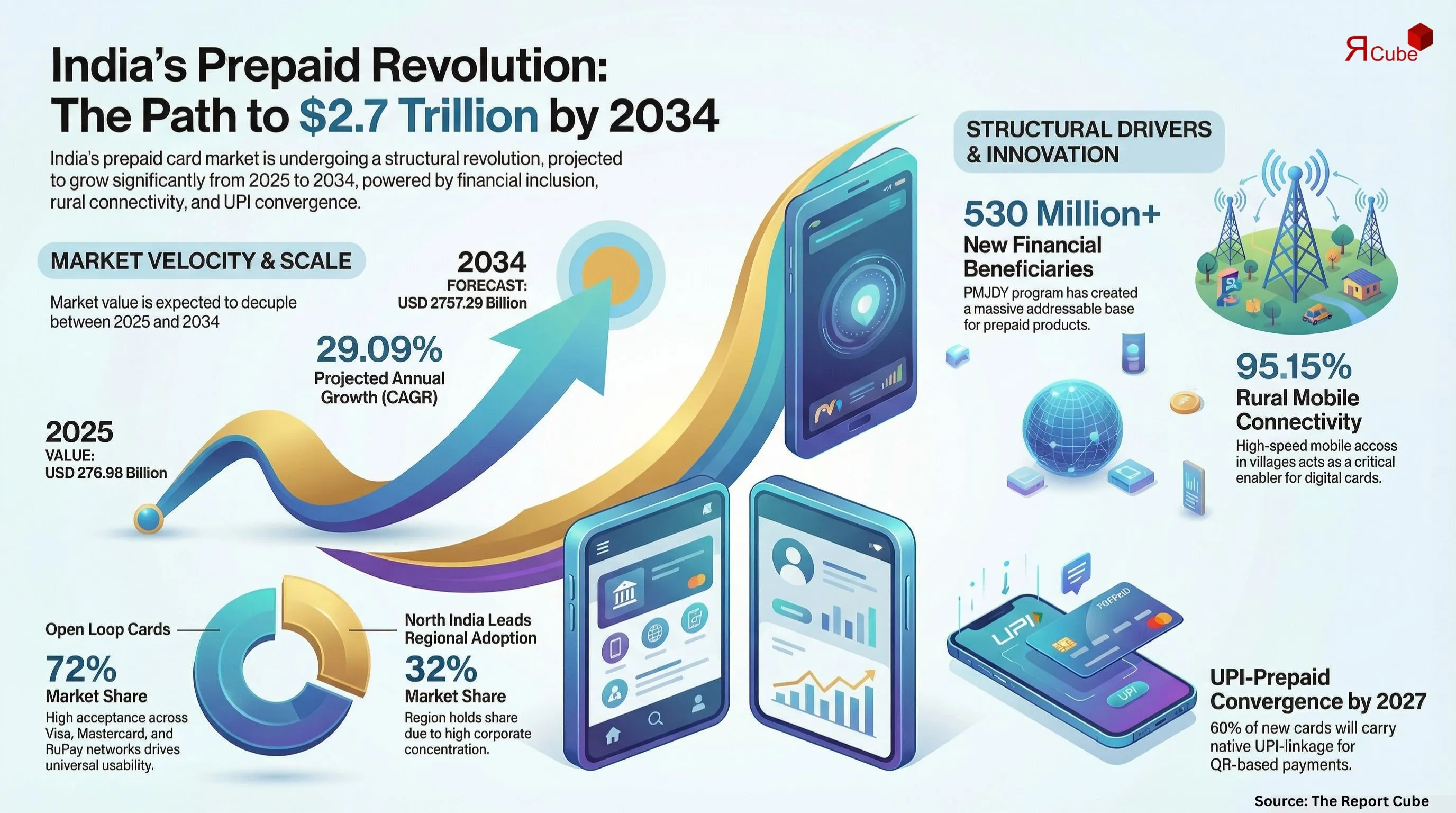
The India Prepaid Cards Market is anticipated to register a 29.09% CAGR during 2026-2034. The market size was valued at USD 276.98 billion in 2025 and is projected to reach USD 2757.29 billion by 2034. India's prepaid cards ecosystem is undergoing a structural revolution powered by the government's relentless push toward a less-cash economy. The Digital India initiative, BharatNet's rural connectivity rollout, and the Pradhan Mantri Jan Dhan Yojana (PMJDY), which has onboarded over 530 million beneficiaries, have collectively expanded the addressable base for prepaid instruments.
Approximately 95.15% of Indian villages now have access to 3G or 4G mobile connectivity as of 2024, a critical enabler for prepaid card usage. Revolut secured full Reserve Bank of India (RBI) authorization in April 2025 to issue prepaid wallets and cards, underscoring the confidence global fintech players are placing in India's prepaid opportunity. Corporate adoption for payroll disbursements and expense management is further compounding momentum, with firms like Zaggle and Pluxee India expanding user bases across Maharashtra and Gujarat.
India Prepaid Cards Market Dynamics
Key Market Driver Financial Inclusion Through Government-Backed Digitalization
India's prepaid cards market is riding an extraordinary wave of government-orchestrated financial inclusion. The PMJDY program's 530 million-plus account holders represent a vast population newly introduced to formal financial instruments, with prepaid cards serving as the gateway product. The RBI's card acceptance development fund has actively co-financed point-of-sale infrastructure deployment in underserved districts, adding over 2.6 million new merchant acceptance points since 2022.
Simultaneously, the Direct Benefit Transfer (DBT) scheme, disbursing over INR 6.3 trillion annually, increasingly channels funds via prepaid instruments, embedding card usage into daily economic participation for rural and semi-urban households. This policy-led adoption is structural, not cyclical, providing long-term foundational demand.
Major Industry Challenge Low Consumer Awareness in Non-Urban Segments
Despite robust urban uptake, a significant challenge constraining broader India Prepaid Cards Market expansion remains the insufficient awareness and financial literacy in tier-3 and tier-4 towns and rural belts. Studies indicate that a meaningful share of India's sub-250,000-population towns still associate prepaid cards primarily with gift cards rather than recognizing their utility as payroll, travel, or remittance instruments.
This perception gap translates into low activation rates and card dormancy post-issuance. Issuers investing in last-mile distribution often encounter friction when cardholders lack the onboarding support to complete KYC digitally or navigate IVR-based card management systems. Bridging this literacy deficit requires sustained investment in vernacular-language user interfaces and community-based financial education programs, which add to distribution overhead without immediate revenue return.
Emerging Trend Shaping Outlook UPI-Linked Prepaid Card Convergence Reshaping Ecosystems
One of the most consequential trends redefining the India prepaid cards landscape is the convergence of prepaid card instruments with Unified Payments Interface (UPI) rails. The NPCI's interoperability frameworks now permit prepaid wallets and cards to initiate and receive UPI transactions, effectively dissolving the traditional boundaries between card-based and account-based digital payments.
This fusion dramatically expands the merchant acceptance universe for prepaid cardholders, since UPI's QR code network covers over 300 million touchpoints. Issuers are launching RuPay-powered prepaid products natively embedded with UPI functionality, combining the spending controls of a prepaid card with the ubiquity of UPI. By 2027, analysts expect over 60% of newly issued prepaid cards in India to carry native UPI-linkage, fundamentally reshaping how consumer financial management products are architected.
Need Specific Data, Let’s Customize the Report for You
Request CustomizationIndia Prepaid Cards Market Segment-wise Analysis
India's prepaid cards market exhibits clear segmentation by card type and by purpose, with each dimension reflecting distinct consumer behaviors, regulatory stimuli, and corporate adoption patterns. Understanding these segments is critical to identifying where growth is concentrated and which sub-segments present the highest incremental revenue opportunity through 2034.
By Card Type
- Closed Loop Cards
- Open Loop Cards
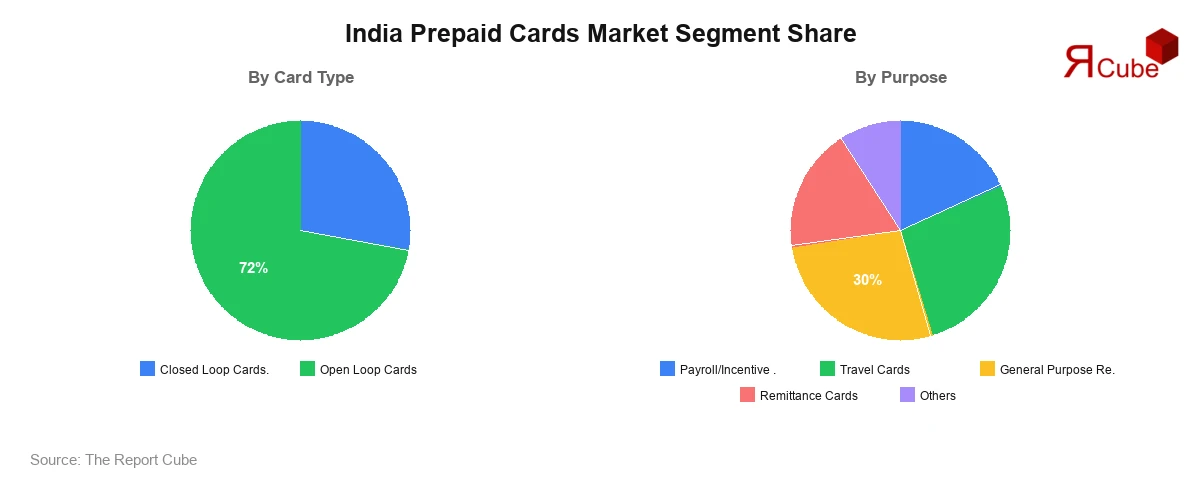
Open Loop Cards have established commanding leadership in the India Prepaid Cards Market, accounting for approximately 72% of total market value in 2025. Their dominance is rooted in their acceptance across any merchant terminal affiliated with major card networks such as Visa, Mastercard, and RuPay, giving cardholders near-universal usability without the restrictions inherent to closed loop instruments.
The RBI's regulatory framework actively favors open loop products by setting clear issuance and KYC guidelines that have brought banking institutions and fintech firms into a structured, competitive marketplace. Mobile wallet providers including Paytm and MobiKwik have integrated open loop card functionalities, expanding utility across e-commerce and physical retail. Corporate enterprises have adopted open loop prepaid products extensively for employee expense reimbursements and travel allowances, valuing the real-time spend visibility and reconciliation capabilities these instruments offer compared to traditional reimbursement cycles.
Closed Loop Cards, while holding a smaller share of approximately 28%, occupy strategically important niches. They are dominant in gifting, loyalty programs, public transit systems, and campus environments where spend is intentionally restricted to defined merchant categories. Retail chains and large corporates deploy closed loop cards for staff welfare and canteen payments, valuing their fraud-containment and budget discipline characteristics.
Government and municipal transport authorities in cities such as Delhi, Mumbai, and Chennai rely extensively on closed loop transit cards, generating high-frequency transaction volumes that sustain issuer revenues. As urban mobility infrastructure expands under the Smart Cities Mission, closed loop card issuances tied to transit and public utility services are expected to register above-average growth through 2034.
By Purpose
- Payroll/Incentive Cards
- Travel Cards
- General Purpose Reloadable (GPR) Cards
- Remittance Cards
- Others
General Purpose Reloadable (GPR) Cards are the dominant sub-segment by purpose, capturing approximately 30% of the India Prepaid Cards Market in 2025. Their broad appeal cuts across individual consumers, gig economy workers, freelancers, and micro-businesses who value the ability to reload funds on demand without maintaining a full-service bank account. GPR cards are increasingly the instrument of choice for platforms such as urban delivery networks and ride-hailing services disbursing earnings to their driver and delivery partner ecosystems.
Payroll and Incentive Cards represent a rapidly scaling segment, driven by large manufacturing and services enterprises digitizing their wage disbursement processes, particularly for contractual and daily-wage workforces who were previously cash-paid. Travel Cards are gaining traction among outbound Indian travelers and corporate travel desks seeking multi-currency, fee-efficient instruments, with issuers such as Axis Bank and HDFC Bank strengthening their forex prepaid offerings. Remittance Cards are carving out a distinct niche, facilitating intra-India remittances for migrant workers sending earnings to rural families, complementing but increasingly competing with traditional money transfer operators.
Regional Projection of India Prepaid Cards Market
The India Prepaid Cards Market demonstrates meaningful regional variation, reflecting differences in digital infrastructure maturity, corporate concentration, and consumer financial literacy.
- North India
- West India
- South India
- East India
North India leads the India Prepaid Cards Market with approximately 32% of total market share in 2025. The region's dominance is driven by the high population density of the National Capital Region, the concentration of corporate headquarters, and advanced digital payment infrastructure across Delhi-NCR and adjacent tier-two cities such as Jaipur, Lucknow, and Chandigarh.
Government procurement and DBT disbursements routed through public sector banks headquartered in the region further consolidate North India's prepaid card transaction volumes. West India follows closely, anchored by Mumbai's financial services infrastructure and the strong SME and startup ecosystems of Pune, Ahmedabad, and Surat driving corporate prepaid adoption.
India Prepaid Cards Market: Recent Development (2025)
- Revolut received full RBI authorization in April 2025, launching prepaid wallets and UPI-linked card services in India.
- HDFC Bank expanded its prepaid card portfolio in Q1 2025, reporting a 22% year-on-year rise in prepaid card fee income.
- Paytm Payments Bank restructured its prepaid product suite in 2025, improving quarterly EBITDA margins to approximately 18%.
- MobiKwik launched an upgraded GPR card in 2025, onboarding over 3 million gig economy workers as primary cardholders.
India Prepaid Cards Market Future Outlook (2034)
The India Prepaid Cards Market is poised for extraordinary expansion, forecast to register a 29.09% CAGR through 2034 and reach USD 2757.29 billion by the end of the forecast period. Growth will be sustained by continued financial inclusion mandates, the maturation of UPI-prepaid convergence, and the scaling of corporate expense management adoption across India's expanding organized sector.
Technological advancement will be a central pillar, with biometric-authenticated prepaid instruments, blockchain-based settlement rails, and AI-driven fraud detection systems becoming standard features across issuer platforms. As smartphone penetration pushes toward near-saturation in urban India and deepens in rural markets, digital-first prepaid card management will become the norm. Tier-2 and tier-3 city residents will represent the highest incremental user growth cohort through 2034, unlocking the next phase of India's prepaid cards market expansion.
Why Choose This Report?
- Provides a comprehensive overview of the overall market analysis, encompassing key trends, consumer behavior analysis, and risk assessment to support strategic decision-making.
- Provides accurate, up-to-date insights into market size, segmentation, and emerging opportunities, helping to minimize risk & capitalizing on growth.
- Gives deep understanding of target audience preferences, investment habits, and communication channels for enhanced product development & marketing effectiveness.
- Delivers competitive analysis & benchmarking, uncovering the strengths & weaknesses of market competitors to guide strategies.
- Consolidate comprehensive market intelligence, reducing reasoning & streamlining research efforts.
- Facilitates customized market segmentation & risk mitigation strategies, fine-tuned to the business objectives.
- Aids in identifying both market challenges & untapped opportunities within the industry to drive long-term business growth.
- Provides valuable information based on actual customer data & search trends.
Table of Contents
- Introduction
- Objective of the study
- Product Definition
- Market Segmentation
- Study Variables
- Research Methodology
- Secondary Data Points
- Companies Interviewed
- Primary Data Points
- Breakdown of Primary Interviews
- Secondary Data Points
- Executive Summary
- Market Dynamics
- Drivers
- Challenges
- Opportunity Assessment
- Recent Trends and Developments
- Policy and Regulatory Landscape
- India Prepaid Cards Market Overview (2021-2034)
- Market Size, By Value (in USD Billions)
- Market Share, By Card Type
- Closed Loop Cards
- Open Loop Cards
- Market Share, By Purpose
- Payroll/Incentive Cards
- Travel Cards
- General Purpose Reloadable (GPR) Cards
- Remittance Cards
- Others
- Market Share, By Vertical
- Corporate/Organization
- Retail
- Government
- Others
- Market Share, By Region
- South India
- West India
- North India
- East India
- Market Share, By Competitors
- Competition Characteristics
- Revenue Shares
- India Closed Loop Cards Prepaid Cards Market Overview, 2021-2034F
- By Value (USD Million/Billion)
- By Purpose- Market Size & Forecast 2021-2034, USD Million/Billion
- By Vertical- Market Size & Forecast 2021-2034, USD Million/Billion
- India Open Loop Cards Prepaid Cards Market Overview, 2021-2034F
- By Value (USD Million/Billion)
- By Purpose- Market Size & Forecast 2021-2034, USD Million/Billion
- By Vertical- Market Size & Forecast 2021-2034, USD Million/Billion
- Competitive Outlook (Company Profile - Partial List)
- State Bank of India
- Company Overview
- Business Segments
- Strategic Alliances/Partnerships
- Recent Developments
- HDFC Bank
- Company Overview
- Business Segments
- Strategic Alliances/Partnerships
- Recent Developments
- ICICI Bank
- Company Overview
- Business Segments
- Strategic Alliances/Partnerships
- Recent Developments
- Paytm Payments Bank
- Company Overview
- Business Segments
- Strategic Alliances/Partnerships
- Recent Developments
- MobiKwik
- Company Overview
- Business Segments
- Strategic Alliances/Partnerships
- Recent Developments
- Axis Bank
- Company Overview
- Business Segments
- Strategic Alliances/Partnerships
- Recent Developments
- Punjab National Bank
- Company Overview
- Business Segments
- Strategic Alliances/Partnerships
- Recent Developments
- Yes Bank
- Company Overview
- Business Segments
- Strategic Alliances/Partnerships
- Recent Developments
- Kotak Mahindra Bank
- Company Overview
- Business Segments
- Strategic Alliances/Partnerships
- Recent Developments
- Others
- State Bank of India
- Contact Us & Disclaimer
Top Key Players & Market Share Outlook
- State Bank of India
- HDFC Bank
- ICICI Bank
- Paytm Payments Bank
- MobiKwik
- Axis Bank
- Punjab National Bank
- Yes Bank
- Kotak Mahindra Bank
- Others
Frequently Asked Questions






