




Build Your Custom Market Intelligence Report
Customize Your ReportGlobal Protein Analyzer Market Insights & Analysis
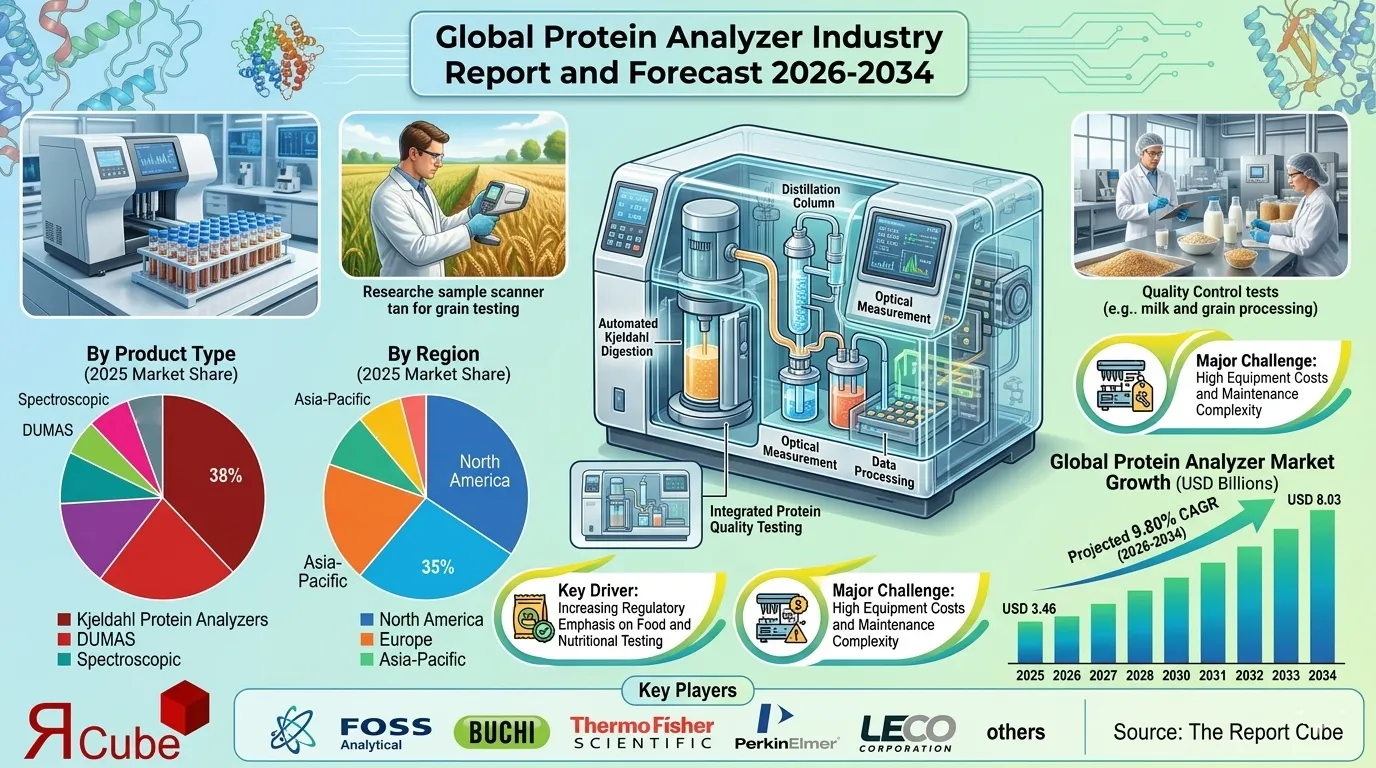
The Global Protein Analyzer Market is anticipated to register a 9.80% CAGR during 2026-2034. The market size was valued at USD 3.46 billion in 2025 and is projected to reach USD 8.03 billion by 2034.
The market is expanding rapidly as demand for accurate protein quantification increases across food testing, pharmaceuticals, biotechnology, and agricultural sectors. Protein analyzers play a critical role in determining nitrogen and protein content in raw materials and finished products, ensuring regulatory compliance and quality assurance. The rising global emphasis on food safety and nutritional labeling standards has significantly boosted adoption rates. Over 70% of food manufacturers now rely on automated protein analysis systems to meet stringent international quality benchmarks.
Technological advancements such as automation, real-time data integration, and near-infrared (NIR) spectroscopy are enhancing analytical precision while reducing turnaround time. In parallel, pharmaceutical and biotech industries are expanding R&D investments, further strengthening demand for advanced protein quantification tools. Emerging economies are witnessing increased laboratory infrastructure development, particularly in Asia Pacific, which is driving new installations. As industries prioritize quality control and compliance, the Global Protein Analyzer Market is positioned for sustained high-growth momentum through 2034.
Global Protein Analyzer Market Recent Developments
- 2025: Thermo Fisher Scientific launched an upgraded automated nitrogen analyzer for high-throughput food laboratories.
- 2025: FOSS Analytical introduced next-generation NIR protein analyzers with enhanced cloud connectivity features.
Government Initiatives & Policies
- US FDA Food Safety Modernization Act (FSMA): Strengthens food testing and quality control compliance.
- EU Food Information to Consumers Regulation: Mandates accurate nutritional labeling and protein content disclosure.
Global Protein Analyzer Market Dynamics
Key Driver: Increasing Regulatory Emphasis on Food and Nutritional Testing
Growing regulatory scrutiny in food and agricultural industries is a primary growth driver for the Global Protein Analyzer Market. Governments worldwide are enforcing stricter food labeling and quality testing standards, requiring accurate protein content analysis in packaged goods and raw materials. Protein quantification is essential for verifying nutritional claims and maintaining export compliance. Approximately 65% of food recalls globally are linked to labeling inaccuracies and quality deviations, increasing demand for reliable testing systems. Automated analyzers based on Kjeldahl, Dumas, and NIR technologies offer improved reproducibility and reduced human error. In the animal feed sector, protein testing ensures optimal feed formulation and livestock productivity. Additionally, pharmaceutical manufacturers rely on precise protein measurement during biologics production and drug development. As regulatory bodies intensify inspections and audits, investment in advanced protein analyzers is expected to grow steadily across multiple end-use industries.
Industry Trends: Automation and Integration of Spectroscopy-Based Technologies
Automation and advanced spectroscopy technologies are reshaping the protein analyzer landscape. Near-infrared (NIR) protein analyzers are gaining strong momentum due to rapid, non-destructive testing capabilities. NIR systems reduce analysis time by nearly 50% compared to traditional wet chemistry methods. Automatic and semi-automatic analyzers are increasingly replacing manual systems, particularly in high-volume food processing facilities. Approximately 60% of newly installed systems in developed markets are fully automated units with digital data integration features. Cloud connectivity and laboratory information management systems (LIMS) are also enhancing workflow efficiency. Manufacturers are focusing on compact, energy-efficient designs suitable for decentralized testing facilities. Additionally, multi-parameter analyzers capable of measuring moisture, fat, and protein simultaneously are gaining adoption. These advancements are improving productivity while lowering operational costs, reinforcing the market’s technological evolution.
Major Challenge: High Equipment Costs and Maintenance Complexity
Despite strong growth potential, high capital investment remains a significant challenge in the Global Protein Analyzer Market. Advanced automated systems require substantial upfront expenditure, often ranging between USD 25,000 to USD 80,000 per unit depending on configuration. Small and medium-sized laboratories may find these costs prohibitive. Maintenance requirements, including calibration, reagent replenishment, and periodic servicing, further increase total cost of ownership. Skilled personnel are necessary to operate sophisticated systems, adding training expenses. In emerging markets, limited technical expertise and budget constraints may slow adoption rates. Additionally, fluctuations in raw material prices for laboratory components can impact manufacturing costs. To address these concerns, companies are offering leasing models and service contracts to improve affordability and accessibility.
Opportunity: Expansion in Biotech Research and Emerging Economies
The expanding biotechnology and pharmaceutical sectors present significant growth opportunities for protein analyzer manufacturers. Rising biologics development, including monoclonal antibodies and recombinant proteins, requires precise protein quantification at various production stages. Global biotech R&D spending continues to increase at over 8% annually, supporting sustained instrument demand. Emerging economies in Asia Pacific and Latin America are investing heavily in laboratory infrastructure modernization. Governments are establishing food testing laboratories and agricultural research centers to strengthen domestic quality standards. Portable and compact analyzers designed for field applications are also opening new revenue streams. As personalized medicine and precision agriculture gain traction, the demand for advanced protein analysis solutions is expected to accelerate further through 2034.
Global Protein Analyzer Market Segment-wise Analysis
By Product Type:
- Kjeldahl Protein Analyzers
- Dumas Protein Analyzers
- NIR Protein Analyzers
- Others
Kjeldahl Protein Analyzers hold the largest share, accounting for approximately 38% of the global market in 2025. Their long-standing reliability and regulatory acceptance make them widely used in food and feed testing. Dumas analyzers are gaining traction due to faster processing times and reduced chemical usage. NIR Protein Analyzers represent the fastest-growing segment, supported by rapid and non-destructive testing capabilities. Continuous technological innovation is enhancing multi-functionality across product categories.
By Application:
- Food & Beverage Testing
- Animal Feed Testing
- Pharmaceuticals
- Biotechnology
- Agriculture & Fertilizers
- Environmental Testing
Food & Beverage Testing dominates the application segment, contributing nearly 44% of global revenue in 2025. Stringent labeling regulations and export quality requirements drive sustained demand. Animal Feed Testing follows closely, ensuring balanced nutritional formulations. Pharmaceutical and Biotechnology applications are projected to register the highest CAGR through 2034 due to rising biologics research. Agricultural and Environmental Testing applications continue to grow as soil and fertilizer analysis gains importance in sustainable farming initiatives.
Regional Projection of Global Protein Analyzer Industry
- North America
- Europe
- Asia Pacific
- South America
North America leads the Global Protein Analyzer Market, holding approximately 35% market share in 2025. The region benefits from advanced laboratory infrastructure, strong regulatory enforcement, and high R&D investment in pharmaceuticals and biotechnology. Europe follows closely due to stringent food safety standards and established analytical equipment manufacturers. Asia Pacific is projected to witness the fastest CAGR during 2026–2034, driven by expanding food processing industries and increasing laboratory modernization initiatives. South America is gradually expanding as agricultural exports demand higher quality testing compliance. Regional trends highlight balanced contributions from mature markets while emerging economies accelerate incremental growth.
Why Choose This Report?
- Provides a comprehensive overview of the overall market analysis, encompassing key trends, consumer behavior analysis, and risk assessment to support strategic decision-making.
- Provides accurate, up-to-date insights into market size, segmentation, and emerging opportunities, helping to minimize risk & capitalizing on growth.
- Gives deep understanding of target audience preferences, investment habits, and communication channels for enhanced product development & marketing effectiveness.
- Delivers competitive analysis & benchmarking, uncovering the strengths & weaknesses of market competitors to guide strategies.
- Consolidate comprehensive market intelligence, reducing reasoning & streamlining research efforts.
- Facilitates customized market segmentation & risk mitigation strategies, fine-tuned to the business objectives.
- Aids in identifying both market challenges & untapped opportunities within the industry to drive long-term business growth.
- Provides valuable information based on actual customer data & search trends.
Table of Contents
- Introduction
- Objective of the Study
- Protein Analyzer Definition
- Market Segmentation
- Study Variables
- Research Methodology
- Secondary Data Points
- Breakdown of Secondary Sources
- Primary Data Points
- Breakdown of Primary Interviews
- Secondary Data Points
- Executive Summary
- Market Dynamics
- Drivers
- Challenges
- Opportunity Assessment
- Recent Trends and Developments
- Regulatory and Policy Landscape
- Global Protein Analyzer Market Overview (2026–2034)
- Market Size, By Value (USD Billion)
- Market Share, By Product Type
- Kjeldahl Protein Analyzers
- Dumas Protein Analyzers
- NIR Protein Analyzers
- Others
- Market Share, By Mode of Operation
- Automatic
- Semi-Automatic
- Manual
- Market Share, By Application
- Food & Beverage Testing
- Animal Feed Testing
- Pharmaceuticals
- Biotechnology
- Agriculture & Fertilizers
- Environmental Testing
- Market Share, By End User
- Food Processing Companies
- Testing Laboratories
- Research Institutes
- Pharmaceutical & Biotech Companies
- Agricultural Organizations
- Market Share, By Company
- Competition Characteristics
- Revenue Shares & Analysis
- Market Share, By Region
- North America Protein Analyzer Market
- Market Size, By Value
- Market Share, By Product Type
- Market Share, By Application
- Europe Protein Analyzer Market
- Market Size, By Value
- Market Share, By Product Type
- Market Share, By Application
- Asia Pacific Protein Analyzer Market
- Market Size, By Value
- Market Share, By Product Type
- Market Share, By Application
- Middle East and Africa Protein Analyzer Market
- Market Size, By Value
- Market Share, By Product Type
- Market Share, By Application
- South America Protein Analyzer Market
- Market Size, By Value
- Market Share, By Product Type
- Market Share, By Application
- North America Protein Analyzer Market
- Competitive Outlook and Company Profiles
- FOSS Analytical
- Company Overview
- Protein Analyzer Portfolio
- Strategic Alliances/Partnerships
- Recent Developments
- BUCHI Labortechnik
- Company Overview
- Protein Analyzer Portfolio
- Strategic Alliances/Partnerships
- Recent Developments
- Thermo Fisher Scientific
- Company Overview
- Protein Analysis Solutions
- Strategic Alliances/Partnerships
- Recent Developments
- PerkinElmer
- Company Overview
- Protein Analysis Instruments
- Strategic Alliances/Partnerships
- Recent Developments
- LECO Corporation
- Company Overview
- Protein Analyzer Portfolio
- Strategic Alliances/Partnerships
- Recent Developments
- Others
- Company Overview
- Business Segments
- Strategic Alliances/Partnerships
- Recent Developments
- FOSS Analytical
- Contact Us / Disclaimer
Top Key Players & Market Share Outlook
- FOSS Analytical
- BUCHI Labortechnik
- Thermo Fisher Scientific
- PerkinElmer
- LECO Corporation
Frequently Asked Questions






