



Build Your Custom Market Intelligence Report
Customize Your ReportKey Takeaways
- India Public Cloud Market valued at USD 40.68 billion in 2026, reflecting accelerating enterprise cloud adoption.
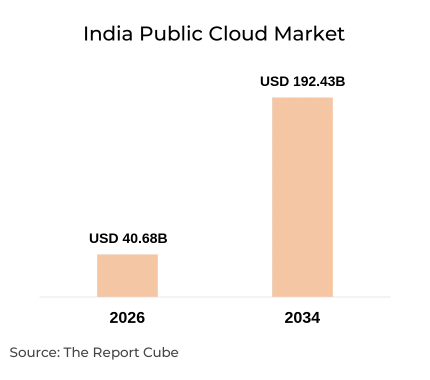
- Market projected to reach USD 192.43 billion by 2034, expanding at a 21.44% CAGR through the forecast period.
- Large enterprises lead enterprise size segmentation, driven by digital transformation and hybrid IT investment.
- AI and Machine Learning is the fastest-growing application segment across India's public cloud landscape.
- Data and Analytics remains the dominant workload category driving multi-cloud procurement decisions.
- Pay-As-You-Go pricing model holds the largest share across cloud consumption patterns in India.
- Amazon Web Services, Microsoft Azure, and Google Cloud lead public cloud infrastructure supply in India.
- Government-backed digital initiatives and expanding data center capacity continue reshaping India's cloud market.
Market Overview
India Public Cloud Market analysis shows the market was valued at USD 40.68 billion in 2026 and is projected to reach USD 192.43 billion by 2034, expanding at a 21.44% CAGR. Rapid enterprise digitalization, government-led programs including Digital India and BharatNet, and the proliferation of AI-native workloads across banking, retail, and manufacturing sectors are collectively sustaining exceptional demand for public cloud infrastructure, platforms, and managed services across the country.
India's growing population of digital-native startups, expanding mid-market enterprise IT budgets, and increasing adoption of cloud-first application modernization strategies are accelerating multi-cloud and hyperscaler procurement. Amazon Web Services, Microsoft Azure, and Google Cloud have invested substantially in Indian data center regions, strengthening latency, compliance, and data residency capabilities. IBM Corporation and Oracle Corporation have deepened cloud partnerships with public sector entities and financial services institutions targeting hybrid cloud and mission-critical workload migration.
Market Size & Forecast
|
Metric |
Details |
|---|---|
|
Market Size (2026) |
USD 40.68 Billion |
|
Market Size (2034) |
USD 192.43 Billion |
|
CAGR (2026–2034) |
21.44% |
|
Base Year |
2026 |
|
Historical Years |
2021–2025 |
|
Forecast Years |
2026–2034 |
The India Public Cloud Market size stood at USD 40.68 billion in 2026 and is forecast to reach USD 192.43 billion by 2034, growing at a 21.44% CAGR. This trajectory outpaces the global public cloud average, driven by India's unique combination of large-scale enterprise digital transformation programs, a rapidly maturing startup ecosystem, and sustained hyperscaler infrastructure investment across multiple domestic availability zones.
Market Dynamics
India's public cloud sector is expanding at an exceptional rate as enterprise IT budgets shift from capital expenditure toward operational cloud consumption, government workloads migrate to managed cloud environments, and AI-intensive applications demand scalable on-demand compute resources. Rising data center investments by global hyperscalers, increasing broadband penetration, and progressive cloud procurement policies across regulated industries are reinforcing India Public Cloud Market growth across all consumption segments.
|
Factor |
Type |
Specific Impact on Market |
Magnitude |
|---|---|---|---|
|
Digital India and government cloud mandates |
Driver |
Accelerates public sector cloud adoption and procurement volume growth |
High |
|
AI and ML workload proliferation |
Driver |
Drives demand for GPU-intensive compute and managed AI platform services |
High |
|
Data sovereignty and localization requirements |
Challenge |
Increases compliance complexity and limits cross-border data architecture options |
Medium |
|
Expansion of hyperscaler data center capacity in India |
Opportunity |
Reduces latency, improves service availability, and attracts regulated industry workloads |
High |
|
Rise of cloud-native development practices |
Trend |
Shifts procurement toward PaaS and containerized workload environments |
Medium |
- Growth Drivers - Digital Transformation and AI Adoption: India's enterprise sector is undergoing broad-based technology modernization across BFSI, retail, healthcare, and manufacturing verticals. Government digital infrastructure programs and mandatory cloud-first procurement policies for central ministries have expanded public cloud consumption. Amazon Web Services and Microsoft Azure have secured large-scale government and enterprise contracts supporting this acceleration.
- Market Restraints - Data Localization and Compliance Costs: India's evolving data protection framework under the Digital Personal Data Protection Act 2023 imposes residency and processing obligations on cloud consumers. Compliance complexity, multi-jurisdiction data governance requirements, and increasing audit burdens create friction for enterprises managing sensitive workloads across hybrid and multi-cloud architectures, particularly in BFSI and healthcare verticals.
- Market Opportunities - Tier-2 and Tier-3 Enterprise Cloud Expansion: Mid-market enterprises and digital-native startups in India's Tier-2 cities represent a substantially underpenetrated segment for cloud infrastructure services. Affordable pay-as-you-go pricing, expanding regional connectivity through BharatNet, and government incentives for technology adoption collectively open new procurement channels for hyperscalers and managed service providers targeting these geographies.
- Industry Challenges - Cloud Skills Gap and Vendor Lock-in Concerns: India faces a persistent shortage of certified cloud architects, DevOps engineers, and security professionals capable of designing and managing enterprise-grade multi-cloud environments. Vendor lock-in concerns, particularly around proprietary managed services and migration complexity, slow large-scale workload transitions and extend infrastructure procurement cycles for CIO and IT procurement teams.
Need Specific Data, Let’s Customize the Report for You
Request CustomizationMarket Trends
- Emerging Trends: India Public Cloud Market trends show accelerating multi-cloud adoption, with enterprises distributing workloads across AWS, Azure, and Google Cloud to optimize cost and avoid single-vendor dependency. Sovereign cloud deployments and government-dedicated cloud environments are gaining procurement traction across defense, banking, and public administration sectors.
- Technology Trends: Generative AI integration within cloud platforms - including AWS Bedrock, Microsoft Azure OpenAI Service, and Google Vertex AI - is reshaping enterprise application development cycles. Serverless computing, Kubernetes-managed containerization, and edge cloud infrastructure are becoming standard deployment architecture patterns across India's technology-intensive industries.
- Consumer / Buyer Trends: Enterprise cloud buyers in India increasingly demand flexible commercial structures combining reserved commitments for predictable baseline workloads with spot pricing for burst compute requirements. IT procurement teams now prioritize vendor-provided FinOps tooling, carbon-usage reporting, and service-level agreement granularity when selecting primary hyperscaler partnerships.
- Regulatory Trends: India's Digital Personal Data Protection Act 2023 introduces new cloud data processing obligations affecting storage location, consent management, and cross-border transfer governance. MeitY's cloud service provider empanelment framework continues to define eligibility requirements for government cloud procurement, with AWS, Microsoft, and IBM Cloud maintaining active empanelment certifications.
India Public Cloud Market Segment Analysis
The India Public Cloud Market serves a diverse range of enterprise sizes, application workloads, and commercial pricing structures, each shaped by distinct procurement priorities, budget cycles, and technology maturity levels across industry verticals. India Public Cloud Market share distribution across segments reflects both the scale of large enterprise adoption and the rapid growth of AI-native and startup-driven cloud consumption patterns.
By Enterprise Size
- Large Enterprises
- Mid-Market Enterprises
- Small Enterprises
- Digital-Native Startups
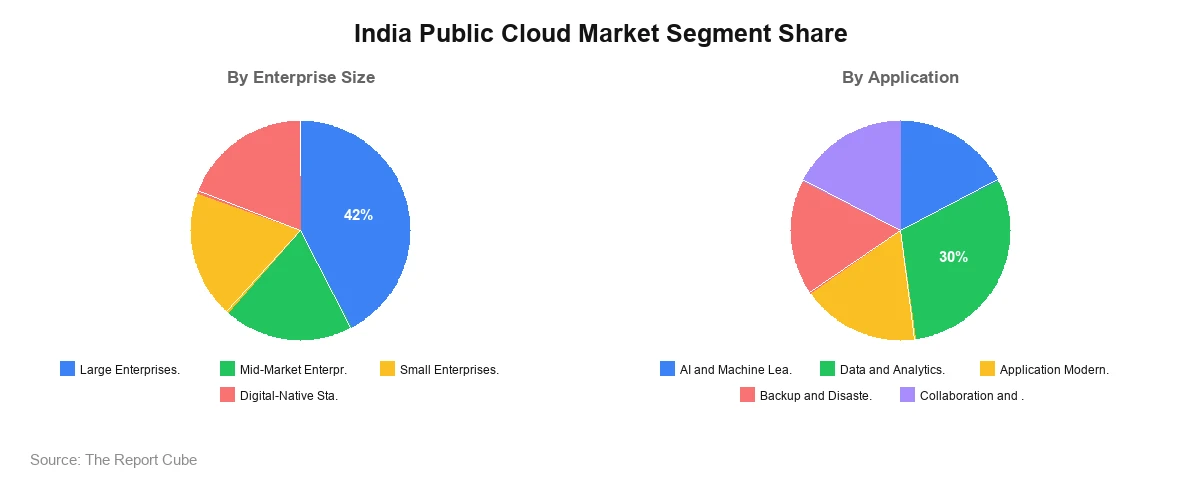
Large enterprises account for an estimated 42% of India's public cloud market by enterprise size in 2026. Amazon Web Services and Microsoft Azure hold the majority of large enterprise contracts, providing managed infrastructure, hybrid cloud connectivity, and enterprise support agreements to BFSI, manufacturing, and telecommunications sectors. Mid-market enterprises represent approximately 28%, with Google Cloud and IBM Cloud competing actively for ERP modernization and analytics workloads. Small enterprises hold around 18% share, predominantly consuming SaaS-adjacent infrastructure and collaboration tools. Digital-native startups, comprising approximately 12%, are disproportionately high-growth consumers of GPU compute, serverless platforms, and AI development environments offered by AWS and Google Cloud.
By Application
- AI and Machine Learning
- Data and Analytics
- Application Modernization
- Backup and Disaster Recovery
- Collaboration and Productivity
Data and Analytics represents the largest application segment, commanding an estimated 30% share in 2026, as enterprises accelerate data lakehouse adoption on AWS, Google BigQuery, and Azure Synapse platforms. AI and Machine Learning follows at approximately 25% and is the fastest-growing application category, fueled by demand for large language model training, inference workloads, and managed AI services. Application Modernization accounts for around 20%, with Oracle Cloud Infrastructure and IBM Cloud supporting legacy ERP and mainframe migration programs. Backup and Disaster Recovery holds approximately 15% share, while Collaboration and Productivity - anchored by Microsoft 365 cloud infrastructure - represents the remaining 10%.
Regional Analysis
|
Region |
Estimated Market Share |
Key Growth Factors |
Consumer Trends |
|---|---|---|---|
|
North India |
32% |
Delhi NCR technology hub, government cloud procurement, BFSI cluster concentration |
Multi-cloud enterprise adoption, regulatory-compliant workload migration |
|
South India |
35% |
Bengaluru IT corridor, hyperscaler data center investment, startup density |
AI/ML platform consumption, application modernization, SaaS development |
|
West India |
25% |
Mumbai financial services concentration, BFSI cloud mandates, media and retail sector growth |
Reserved commitment procurement, fintech and e-commerce cloud infrastructure |
|
East India |
8% |
Emerging IT corridors in Kolkata and Bhubaneswar, government digital initiatives |
SME cloud adoption, public sector workload migration, backup infrastructure |
- South India - 35% Market Share: The South India region leads national public cloud consumption, anchored by Bengaluru's position as India's primary technology and startup hub. Google Cloud's Indian data center region, Microsoft Azure's Pune-linked infrastructure, and AWS's Mumbai-Hyderabad availability zones collectively concentrate hyperscaler capacity in this corridor. AI/ML development, SaaS company infrastructure, and IT services firm cloud environments drive the region's disproportionately high per-capita cloud spend.
- North India - 32% Market Share: The Delhi-NCR metropolitan region houses India's highest concentration of central government ministries, public sector undertakings, and large enterprise headquarters driving structured cloud procurement. MeitY's empanelled cloud providers - including AWS, Azure, and IBM Cloud - supply the majority of government-mandated cloud infrastructure. BFSI and telecom sector cloud modernization programs further sustain North India's cloud consumption volumes.
- West India - 25% Market Share: Mumbai's financial services cluster generates consistent high-volume demand for compliant, low-latency cloud infrastructure supporting core banking systems, trading platforms, and insurance data workloads. The AWS Mumbai region and Microsoft Azure's West India zone serve as primary infrastructure anchors. Media, retail, and e-commerce companies headquartered in Mumbai and Pune contribute significant cloud platform and CDN consumption to this region's share.
- East India - 8% Market Share: East India represents the India Public Cloud Market's least penetrated but increasingly active geographic segment. Government-backed smart city programs, emerging IT parks in Kolkata and Bhubaneswar, and rising SME digitalization are generating new cloud consumption demand. Infrastructure investment by state governments and improving broadband connectivity through BharatNet are expected to increase East India's share progressively through 2034.
Market Share & Competitive Landscape
The India Public Cloud Market's competitive structure is hyperscaler-dominated at the infrastructure layer, with Amazon Web Services, Microsoft Azure, and Google Cloud controlling the majority of enterprise IaaS and PaaS revenues. Oracle and IBM compete on differentiated workloads including database cloud services, hybrid cloud, and regulated industry deployments.
|
Company |
Competitive Strength |
Primary Segment Served |
|---|---|---|
|
Amazon Web Services (AWS) |
Broadest service portfolio, largest India developer ecosystem, multiple AZ regions |
Large enterprises, digital-native startups, government |
|
Microsoft Corporation (Azure) |
Enterprise licensing integration, hybrid cloud leadership, OpenAI partnership |
Large enterprises, mid-market, BFSI, government |
|
Google LLC (Google Cloud) |
AI/ML platform superiority, data analytics tooling, startup ecosystem |
AI-native startups, data and analytics, application modernization |
|
Oracle Corporation (OCI) |
Database cloud leadership, autonomous database, competitive pricing |
BFSI, enterprise ERP, large enterprise database workloads |
|
IBM Corporation (IBM Cloud) |
Hybrid cloud architecture, regulated industry compliance, mainframe integration |
Government, BFSI, healthcare, enterprise hybrid cloud |
Key Companies in the India Public Cloud Market
Amazon Web Services (AWS)
Amazon Web Services, headquartered in Seattle, USA, operates the world's largest public cloud platform across more than 30 geographic regions. In India, AWS maintains two active availability zones in Mumbai and Hyderabad and announced a USD 12.7 billion infrastructure investment commitment through 2030. AWS leads enterprise IaaS procurement across India's BFSI, technology services, and government sectors, supported by its largest dedicated developer ecosystem in Asia.
Microsoft Corporation (Azure)
Microsoft Corporation, headquartered in Redmond, USA, operates Azure as the world's second-largest public cloud platform with data center presence across India's West, South, and Central regions. In 2025, Microsoft committed USD 3 billion in AI and cloud infrastructure investment for India, deepening Azure OpenAI Service availability for enterprise customers. Azure's integration with Microsoft 365 and enterprise licensing agreements positions it as the dominant enterprise cloud choice across India's large corporate and public sector segments.
Recent Developments
|
Year |
Company |
Development |
|---|---|---|
|
Mar 2025 |
Microsoft Corporation (Azure) |
Announced USD 3 billion AI and cloud infrastructure investment in India, expanding Azure OpenAI Service availability |
|
Jan 2025 |
Amazon Web Services (AWS) |
Launched new AWS Asia Pacific (Hyderabad) infrastructure expansion, increasing regional availability and compliance capability |
|
2025 |
Google LLC (Google Cloud) |
Opened new Google Cloud region in Delhi NCR, adding sovereign cloud capacity for government and regulated enterprise customers |
Future Outlook
The India Public Cloud Market forecast shows the market reaching USD 192.43 billion by 2034, expanding at a 21.44% CAGR through the forecast period. Continued acceleration of enterprise AI adoption, expansion of hyperscaler data center capacity across multiple Indian availability zones, and deepening government cloud procurement through MeitY-empanelled providers will sustain exceptional revenue growth. Amazon Web Services, Microsoft Azure, and Google Cloud are expected to strengthen competitive positions through AI-native platform differentiation and regional infrastructure expansion.
Generative AI integration across cloud platforms will reshape enterprise application development, with GPU-as-a-service and managed LLM inference emerging as high-growth service categories by 2030. Sustainable cloud infrastructure practices - including renewable energy-powered data centers and carbon reporting compliance - will increasingly influence enterprise procurement decisions as India's leading technology companies align with net-zero commitments. Regulatory clarity under the Digital Personal Data Protection Act framework will accelerate migration of regulated-industry workloads that currently remain on-premise due to data residency uncertainty.
India Public Cloud Market Report Coverage
The India Public Cloud Market report provides comprehensive coverage of market sizing, segmentation, regional distribution, competitive dynamics, and strategic outlook across the 2026–2034 forecast period.
|
Report Attribute |
Details |
|---|---|
|
Market Name |
India Public Cloud Market |
|
Market Size (2026) |
USD 40.68 Billion |
|
Market Size (2034) |
USD 192.43 Billion |
|
Forecast Period |
2026–2034 |
|
CAGR |
21.44% |
|
Base Year |
2026 |
|
Historical Years |
2021–2025 |
|
Forecast Years |
2026–2034 |
|
Segments Covered |
By Service Model, By Deployment Model, By End-Use Industry, By Enterprise Size, By Application |
|
Regions Covered |
North India, South India, West India, East India |
|
Key Companies |
Amazon Web Services (AWS), Microsoft Corporation (Azure), Google LLC (Google Cloud), Oracle Corporation (OCI), IBM Corporation (IBM Cloud), Others |
|
Report Format |
PDF, Excel, PPT |
|
Customization |
Available as per client requirements |
Why Choose This India Public Cloud Market Report?
- Comprehensive coverage of India's public cloud infrastructure, platform, and services market through 2034.
- Accurate market sizing from USD 40.68 billion in 2026 with validated 21.44% CAGR trajectory.
- Detailed segmentation across enterprise size, application workload, and pricing model dimensions.
- Regional insights covering North, South, West, and East India with estimated market share breakdowns.
- Competitive profiling of five leading hyperscalers and cloud infrastructure providers operating in India.
- Analysis of AI, ML, and generative AI platform trends reshaping enterprise cloud procurement decisions.
- Forecast data supporting technology investment, vendor partnership, and market entry strategy planning.
- Research aligned with India's Digital India mission, MeitY cloud policy framework, and data protection regulation.
Table of Contents
- Introduction
- Objective of the Study
- Product Definition
- Market Segmentation
- Study Variables
- Research Methodology
- Secondary Data Points
- Companies Interviewed
- Primary Data Points
- Breakdown of Primary Interviews
- Secondary Data Points
- Executive Summary
- Market Dynamics
- Drivers
- Challenges
- Opportunity Assessment
- Recent Trends and Developments
- Policy and Regulatory Landscape
- India Public Cloud Market Overview and Forecast Analysis (2021-2034)
- Market Size, By Value, By Growth Rate (CAGR/USD Billions)
- Demand – Supply Trends
- Market Share, By Service Model
- Infrastructure as a Service
- Platform as a Service
- Software as a Service
- Desktop as a Service
- Market Share, By Deployment Model
- Single Public Cloud
- Multi-Public-Cloud
- Hybrid Cloud Extension
- Sovereign and Regulated Public Cloud
- Market Share, By End-Use Industry
- BFSI
- IT and ITeS
- Retail and E-Commerce
- Manufacturing
- Government and Public Services
- Market Share, By Enterprise Size
- Large Enterprises
- Mid-Market Enterprises
- Small Enterprises
- Digital-Native Startups
- Market Share, By Application
- AI and Machine Learning
- Data and Analytics
- Application Modernization
- Backup and Disaster Recovery
- Collaboration and Productivity
- Market Share, By Region
- North India
- South India
- East India
- West India
- Market Share, By Competitors
- Competition Characteristics
- Revenue Shares
- Infrastructure as a Service India Public Cloud Market Overview, 2021-2034F
- By Value (USD Million)
- By Deployment Model – Market Size & Forecast 2021-2034, USD Million
- Single Public Cloud
- Multi-Public-Cloud
- Hybrid Cloud Extension
- Sovereign and Regulated Public Cloud
- Platform as a Service India Public Cloud Market Overview, 2021-2034F
- By Value (USD Million)
- By Deployment Model – Market Size & Forecast 2021-2034, USD Million
- Single Public Cloud
- Multi-Public-Cloud
- Hybrid Cloud Extension
- Sovereign and Regulated Public Cloud
- Software as a Service India Public Cloud Market Overview, 2021-2034F
- By Value (USD Million)
- By Deployment Model – Market Size & Forecast 2021-2034, USD Million
- Single Public Cloud
- Multi-Public-Cloud
- Hybrid Cloud Extension
- Sovereign and Regulated Public Cloud
- Desktop as a Service India Public Cloud Market Overview, 2021-2034F
- By Value (USD Million)
- By Deployment Model – Market Size & Forecast 2021-2034, USD Million
- Single Public Cloud
- Multi-Public-Cloud
- Hybrid Cloud Extension
- Sovereign and Regulated Public Cloud
- Competitive Outlook (Company Profile –- Partial List)
- Amazon Web Services (AWS)
- Company Overview
- Business Segments
- Strategic Alliances/Partnerships
- Recent Developments
- Microsoft Corporation (Azure)
- Company Overview
- Business Segments
- Strategic Alliances/Partnerships
- Recent Developments
- Google LLC (Google Cloud)
- Company Overview
- Business Segments
- Strategic Alliances/Partnerships
- Recent Developments
- Oracle Corporation (OCI)
- Company Overview
- Business Segments
- Strategic Alliances/Partnerships
- Recent Developments
- IBM Corporation (IBM Cloud)
- Company Overview
- Business Segments
- Strategic Alliances/Partnerships
- Recent Developments
- Others
- Amazon Web Services (AWS)
- Contact Us & Disclaimer
Top Key Players & Market Share Outlook
- Amazon Web Services (AWS)
- Microsoft Corporation (Azure)
- Google LLC (Google Cloud)
- Oracle Corporation (OCI)
- IBM Corporation (IBM Cloud)
- Others
Frequently Asked Questions






