



Build Your Custom Market Intelligence Report
Customize Your ReportKey Takeaways
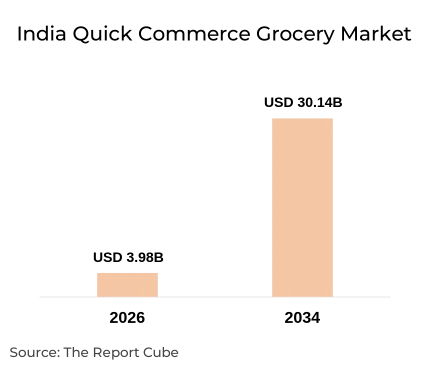
- India Quick Commerce Grocery Market valued at USD 3.98 billion in 2026, reflecting rapid urban demand acceleration.
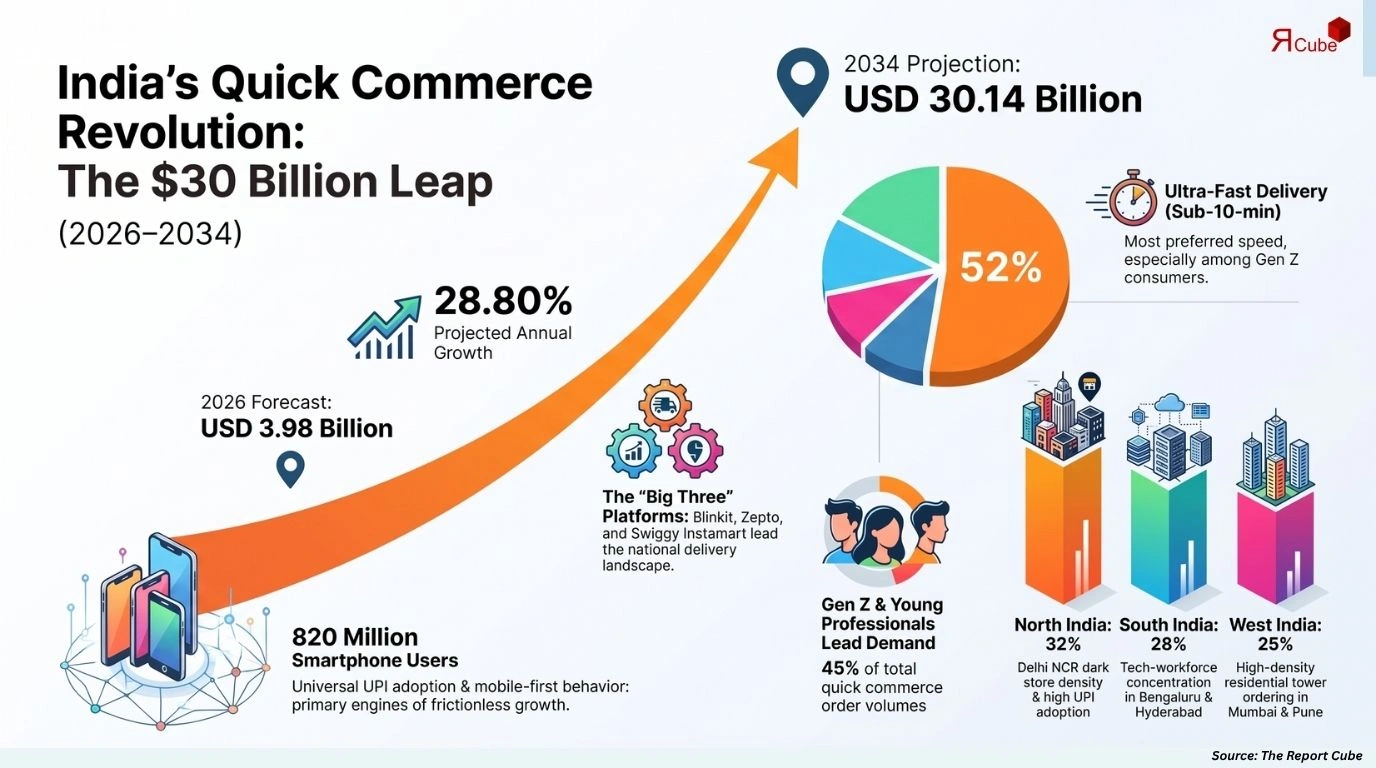
- Market projected to reach USD 30.14 billion by 2034, expanding at a 28.80% CAGR through the forecast period.
- Ultra-fast delivery leads the delivery speed segment, driven by Gen Z consumer preference for sub-10-minute fulfilment.
- Tier 1 metros dominate geographic demand, accounting for the majority of active quick commerce order volumes.
- Gen Z and young professionals represent the fastest-growing consumer segment across India's quick commerce platforms.
- Blinkit, Zepto, and Swiggy Instamart command leading platform positions in India's quick grocery delivery landscape.
- Dark store network expansion and AI-driven inventory optimization are reshaping last-mile fulfillment infrastructure nationally.
Market Overview
A comprehensive India Quick Commerce Grocery Market Analysis reveals a sector undergoing structural transformation, with the market valued at USD 3.98 billion in 2026 and projected to grow at a 28.80% CAGR through 2034. Rapid smartphone penetration, expanding urban middle-class disposable income, and shifting consumer preferences for on-demand grocery delivery are collectively sustaining demand. Government digital infrastructure programs under the National Logistics Policy and the Open Network for Digital Commerce (ONDC) framework are accelerating platform-level investment across Indian metropolitan corridors.
Platform consolidation and geographic deepening beyond Tier 1 metros are defining the second phase of India's quick commerce evolution. Blinkit, backed by Zomato, and Zepto, supported by significant venture funding rounds, have scaled dark store operations across Delhi NCR, Mumbai, Bengaluru, and Hyderabad. Nuclear working families and dual-income households are consistently driving repeat order frequency, particularly for fresh produce, dairy, and personal care categories. Swiggy Instamart and Flipkart Minutes are investing in category breadth to capture festival and event-led demand spikes across Tier 2 corridors.
Market Size & Forecast
|
Metric |
Details |
|---|---|
|
Market Size (2026) |
USD 3.98 Billion |
|
Market Size (2034) |
USD 30.14 Billion |
|
CAGR (2026–2034) |
28.80% |
|
Base Year |
2026 |
|
Historical Years |
2021–2025 |
|
Forecast Years |
2026–2034 |
The India Quick Commerce Grocery Market Size study values the sector at USD 3.98 billion in 2026, with projections reaching USD 30.14 billion by 2034 at a 28.80% CAGR. This growth rate is among the highest globally for grocery retail verticals, driven by India's 820 million smartphone users, accelerating dark store density, and rising consumer tolerance for delivery convenience premiums over traditional kirana procurement alternatives.
Market Dynamics
The India Quick Commerce Grocery Market is expanding at an exceptional pace as platform operators scale dark store networks, consumer adoption broadens across demographic cohorts, and grocery retail digitalizes at a structural level. India Quick Commerce Grocery Market Growth is primarily driven by the intersection of mobile-first consumer behavior, compressed delivery expectations, and platform-level capital investment in last-mile infrastructure across both established and emerging urban geographies.
|
Factor |
Type |
Specific Impact on Market |
Magnitude |
|---|---|---|---|
|
Smartphone and UPI penetration |
Driver |
Expands addressable consumer base and frictionless payment adoption for grocery orders |
High |
|
Dark store network scaling |
Driver |
Reduces average delivery time below 15 minutes; improves unit economics across dense urban clusters |
High |
|
Profitability pressure on platforms |
Restraint |
Compresses margin at scale; forces fee structures and basket-size minimums on cost-sensitive consumers |
Medium |
|
Tier 2 city demand emergence |
Opportunity |
Opens new high-growth corridors beyond saturated Tier 1 metros for platform expansion |
High |
|
Kirana retail competition |
Challenge |
Entrenched neighborhood store relationships limit quick commerce penetration among older, price-sensitive buyer cohorts |
Medium |
|
AI and hyperlocal inventory optimization |
Trend |
Improves fulfillment accuracy, reduces waste, and enables predictive restocking across dark store networks |
High |
Growth Drivers - Smartphone Penetration and Dark Store Infrastructure
India's base of over 820 million smartphone users, combined with near-universal UPI payment adoption, has lowered entry barriers for quick commerce platforms. Blinkit and Zepto have each crossed 500+ dark store locations nationally, enabling sub-15-minute fulfillment SLAs that sustain repeat order rates among urban millennials and dual-income working households in major metropolitan geographies.
Market Opportunities - Tier 2 City Expansion and Category Diversification
Tier 2 cities including Jaipur, Lucknow, Indore, and Coimbatore represent India's next quick commerce growth frontier as disposable incomes and smartphone adoption rates increase. Category expansion beyond groceries into electronics, pharmacy, beauty, and home essentials is multiplying average order values. BigBasket's BB Now service and Flipkart Minutes are actively piloting Tier 2 market entry with localized dark store formats.
Industry Challenges - Kirana Competition and Consumer Price Sensitivity
Kirana stores - India's 12 million neighborhood grocery retailers - retain consumer loyalty through credit relationships, personalized service, and flexible pricing that quick commerce platforms structurally cannot replicate at scale. Consumer price sensitivity across non-metro geographies remains a barrier to sustained platform adoption, particularly for commodity grocery categories where platform convenience premiums are perceived as disproportionately high by value-conscious shoppers.
Need Specific Data, Let’s Customize the Report for You
Request CustomizationMarket Trends
- Emerging Trends: Among the most notable India Quick Commerce Grocery Market Trends is the rapid emergence of dark stores as the defining infrastructure unit of hyperlocal retail delivery. Platform operators are replacing leased warehouse models with micro-fulfillment dark stores averaging 2,000–4,000 sq. ft., positioned within two kilometers of high-density residential clusters across Indian metros.
- Technology Trends: AI-powered demand forecasting, computer vision-based inventory management, and route optimization algorithms are being deployed at scale by Blinkit and Zepto to reduce pick-pack-deliver cycle times. Electric vehicle fleets and IoT-enabled cold chain equipment are entering platform delivery operations, improving fresh produce fulfillment reliability and reducing last-mile carbon intensity across urban delivery corridors.
- Consumer / Buyer Trends: Gen Z consumers and nuclear working families are driving the highest order frequency rates on quick commerce platforms, with basket compositions tilting toward fresh produce, ready-to-cook meals, dairy, and personal care products. Festival demand spikes - particularly during Diwali, Navratri, and Holi cycles - are generating significant single-day GMV peaks that platforms increasingly prepare for through pre-stocked dark store inventory protocols.
- Regulatory Trends: India's ONDC framework is expanding quick commerce participation beyond incumbents, enabling smaller platform operators and kirana aggregators to offer 30–60 minute delivery on the open network. FDI regulations governing multi-brand retail inventory ownership continue to shape how quick commerce platforms structure their dark store operational models. FSSAI standards on cold chain compliance and product traceability are tightening oversight requirements for perishable grocery delivery across platform operators.
India Quick Commerce Grocery Market Segment Analysis
India's quick commerce grocery sector serves buyers across distinct delivery speed expectations, geographic market tiers, and consumer demographic cohorts, each carrying differentiated procurement patterns, basket compositions, and platform loyalty behaviors.
By Delivery Speed & Promise
- Ultra-Fast Delivery
- Quick Delivery
- Scheduled Quick Delivery
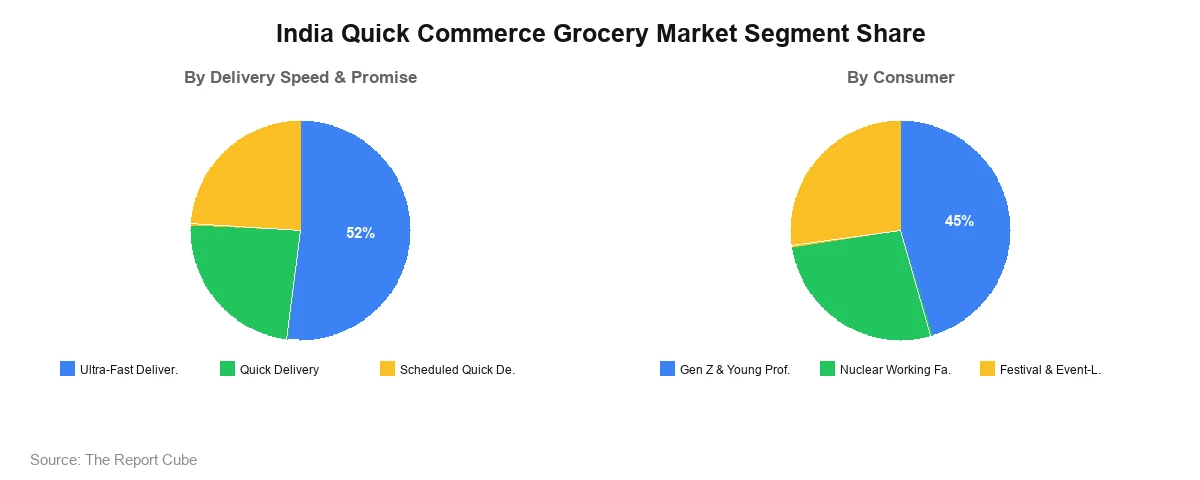
Ultra-fast delivery leads the By Delivery Speed & Promise segment, commanding an estimated 52% India Quick Commerce Grocery Market Share in 2026. Blinkit and Zepto have built their core consumer propositions on sub-10-minute delivery SLAs, concentrating dark stores within dense residential clusters in Bengaluru, Mumbai, and Delhi NCR. Quick delivery, representing approximately 33%, captures working professionals and dual-income households with moderate delivery urgency. Swiggy Instamart and Flipkart Minutes serve this segment with 15–30 minute fulfillment windows. Scheduled quick delivery, accounting for 15% of segment demand, serves systematic shoppers - particularly nuclear families using BigBasket's subscription-led model for weekly grocery replenishment at reduced platform fees.
By Consumer
- Gen Z & Young Professionals
- Nuclear Working Families
- Festival & Event-Led Shoppers
Gen Z and young professionals represent the dominant consumer segment at an estimated 45% demand share in 2026. Blinkit and Zepto target this cohort with gamified app experiences, referral programs, and SKU assortments weighted toward beverages, snacks, and convenience meal formats. Nuclear working families, accounting for approximately 38%, drive high basket-value repeat orders for fresh produce, dairy, and household essentials. BigBasket and Swiggy Instamart have specifically designed subscription programs targeting this segment's predictable replenishment cycles. Festival and event-led shoppers, representing 17% of consumer demand, generate concentrated demand during celebration and gifting cycles, with Flipkart Minutes and Swiggy Instamart investing in festival-specific SKU curation and promotional inventory for seasonal procurement peaks.
Regional Analysis
|
Region |
Estimated Market Share |
Key Growth Factors |
Consumer Trends |
|---|---|---|---|
|
North India |
32% |
Delhi NCR dark store density, UP Tier 2 expansion, high UPI adoption |
Gen Z and dual-income household demand; festival purchase spikes |
|
South India |
28% |
Bengaluru and Hyderabad tech-workforce concentration, high smartphone penetration |
Premium category adoption, health-conscious grocery demand |
|
West India |
25% |
Mumbai and Pune platform density, strong logistics infrastructure |
Nuclear family repeat ordering, convenience meal and dairy demand |
|
East India |
15% |
Kolkata platform entry, emerging Tier 2 activity in Bhubaneswar and Patna |
Price-sensitive ordering, gradual quick commerce adoption among younger consumers |
- North India: North India commands approximately 32% of total India Quick Commerce Grocery Market demand, anchored by Delhi NCR's high-density dark store network operated by Blinkit, Zepto, and Swiggy Instamart. Lucknow, Jaipur, and Kanpur are emerging as active Tier 2 quick commerce corridors where platform operators are deploying micro-dark stores to capture Gen Z consumer bases with expanding disposable incomes.
- South India: South India accounts for an estimated 28% of national demand, with Bengaluru functioning as India's quick commerce innovation hub. High technology workforce concentration, above-average household incomes, and a culture of digital-first consumer behavior have established Bengaluru as the highest GMV-per-capita quick commerce market. Zepto and Blinkit have recorded particularly strong category depth expansion in fresh produce, organic groceries, and health supplements across South Indian metro operations.
- West India: West India represents approximately 25% of market share, with Mumbai and Pune generating substantial platform order volumes from nuclear working families and young professionals residing in high-density residential towers. Platform operators report elevated average basket sizes in West India compared to national averages, particularly for dairy, personal care, and ready-to-cook meal categories delivered through Swiggy Instamart and Flipkart Minutes network infrastructure.
- East India: East India holds an estimated 15% share, reflecting the region's earlier stage of quick commerce penetration. Kolkata has seen Blinkit and Swiggy Instamart expand operations during 2024 and 2025, while Tier 2 cities including Bhubaneswar, Patna, and Guwahati are in initial platform seeding phases. Consumer price sensitivity and lower average basket sizes characterize East Indian quick commerce demand, with platforms adjusting SKU assortments and delivery fee structures to build sustainable order volumes.
Market Share & Competitive Landscape
India's quick commerce grocery sector operates as a platform-concentrated competitive market, where scale, dark store density, and technology investment determine consumer retention and GMV share. Platform operators compete across delivery speed SLAs, assortment depth, loyalty programs, and geographic coverage breadth.
|
Company |
Competitive Strength |
Primary Segment Served |
|---|---|---|
|
Blinkit |
Zomato parent backing, 600+ dark stores, sub-10-min SLA leadership |
Gen Z, young professionals, metro urban households |
|
Zepto |
Rapid dark store scaling, high GMV growth, Tier 2 city expansion |
Gen Z, dual-income working families |
|
Swiggy Instamart |
Integrated food-grocery app ecosystem, broad metro coverage |
Nuclear working families, young professionals |
|
Flipkart Minutes |
Walmart-backed, leveraging Flipkart's supply chain and logistics assets |
Festival shoppers, value-oriented urban consumers |
|
BigBasket |
Tata-backed, subscription model, fresh produce leadership |
Nuclear families, scheduled delivery consumers |
|
Others |
Regional and niche operators in emerging corridors |
Tier 2 cities, price-sensitive consumers |
Key Companies in the India Quick Commerce Grocery Market
Blinkit
Blinkit, headquartered in Gurugram, India, and backed by Zomato, operates one of the country's largest quick commerce dark store networks with over 600 active locations across major metros as of 2025. In 2024, Blinkit expanded into electronics and pharmacy categories and crossed 10 million monthly transacting users, positioning itself as the leading platform by GMV and dark store count in the India Quick Commerce Grocery Market.
Zepto
Zepto, headquartered in Mumbai and founded in 2021, has grown from a student startup to one of India's most capitalized quick commerce operators, raising over USD 1.4 billion in funding through 2024–2025. The platform operates 350+ dark stores with a 10-minute delivery promise, achieving unicorn status in 2023 and filing for an IPO in 2025 while actively expanding into Tier 2 geographies across North and South India.
Recent Developments
|
Year |
Company |
Development |
|---|---|---|
|
2025 |
Blinkit |
Crossed 600 operational dark stores nationwide; expanded into electronics, toys, and pharmacy categories |
|
2025 |
Zepto |
Filed for IPO; raised Series F round; launched Zepto Cafe quick-service food delivery vertical |
|
2025 |
Flipkart Minutes |
Expanded to 40+ cities; integrated with Flipkart's main app for bundled grocery and e-commerce orders |
Future Outlook
The India Quick Commerce Grocery Market Forecast projects the sector reaching USD 30.14 billion by 2034, sustaining a 28.80% CAGR driven by Tier 2 city penetration, category expansion beyond core grocery, and rising repeat order frequency among nuclear working family segments. Blinkit, Zepto, and Swiggy Instamart are expected to deepen consumer loyalty through subscription models, private label development, and ultra-fast pharmacy and electronics delivery verticals through 2034.
Technological advancement in dark store automation - including robotic picking systems, AI-led demand forecasting, and EV-based last-mile delivery - will progressively reduce operational costs and improve fulfillment accuracy across India's quick commerce infrastructure. Regulatory evolution under ONDC and tightening FSSAI compliance for perishable delivery will shape platform investment priorities, pushing operators toward sustainable cold chain systems, transparent sourcing disclosures, and hyper-local supplier integration strategies through the forecast period.
India Quick Commerce Grocery Market Report Coverage
This India Quick Commerce Grocery Market Report covers the full forecast period from 2026 through 2034, providing granular segmentation, regional breakdowns, competitive intelligence, and demand-side consumer analysis for investors, platform operators, and institutional buyers.
|
Report Attribute |
Details |
|---|---|
|
Market Name |
India Quick Commerce Grocery Market |
|
Market Size (2026) |
USD 3.98 Billion |
|
Market Size (2034) |
USD 30.14 Billion |
|
Forecast Period |
2026–2034 |
|
CAGR |
28.80% |
|
Base Year |
2026 |
|
Historical Years |
2021–2025 |
|
Forecast Years |
2026–2034 |
|
Segments Covered |
By Product Category, By Delivery Speed & Promise, By Geographic Location |
|
Regions Covered |
North India, South India, West India, East India |
|
Key Companies |
Blinkit, Zepto, Swiggy Instamart, Flipkart Minutes, BigBasket, Others |
|
Report Format |
PDF, Excel, PPT |
|
Customization |
Available as per client requirements |
Why Choose This India Quick Commerce Grocery Market Report?
- Comprehensive coverage of India's fast-evolving quick commerce grocery platform ecosystem through 2034.
- Accurate market sizing from USD 3.98 billion in 2026 with a validated 28.80% CAGR growth trajectory.
- Detailed segmentation across delivery speed promise, geographic market tier, and consumer demographic cohort.
- Regional insights covering North, South, West, and East India with market share estimates and growth factors.
- Competitive profiling of six leading platform operators including Blinkit, Zepto, and Swiggy Instamart.
- Analysis of dark store expansion, AI-driven inventory optimization, and EV delivery fleet adoption trends.
- Forecast data aligned with India's ONDC framework and National Logistics Policy investment priorities.
- Strategic intelligence supporting platform operators, private equity investors, and FMCG supplier partnerships.
Table of Contents
- Introduction
- Objective of the Study
- Product Definition
- Market Segmentation
- Study Variables
- Research Methodology
- Secondary Data Points
- Companies Interviewed
- Primary Data Points
- Breakdown of Primary Interviews
- Secondary Data Points
- Executive Summary
- Market Dynamics
- Drivers
- Challenges
- Opportunity Assessment
- Recent Trends and Developments
- Policy and Regulatory Landscape
- India Quick Commerce Grocery Market Overview and Forecast Analysis (2021-2034)
- Market Size, By Value, By Growth Rate (CAGR/USD Billions)
- Demand - Supply Trends
- Market Share, By Product Category
- Grocery & Daily Staple
- Snacks & Beverages
- Dairy & Fresh Produce
- Household & Cleaning Essentials
- Personal Care & Beaut
- Emerging Non-Grocery
- Market Share, By Delivery Speed & Promise
- Ultra-Fast Delivery
- Quick Delivery
- Scheduled Quick Delivery
- Market Share, By Geographic Location
- Tier 1 Metros
- Tier 2 Cities
- Market Share, By Region
- North India
- South India
- East India
- West India
- Market Share, By Competitors
- Competition Characteristics
- Revenue Shares
- Grocery & Daily Staple India Quick Commerce Grocery Market Overview, 2021-2034F
- By Value (USD Million)
- By Delivery Speed & Promise - Market Size & Forecast 2021-2034, USD Million
- Ultra-Fast Delivery
- Quick Delivery
- Scheduled Quick Delivery
- Snacks & Beverages India Quick Commerce Grocery Market Overview, 2021-2034F
- By Value (USD Million)
- By Delivery Speed & Promise - Market Size & Forecast 2021-2034, USD Million
- Ultra-Fast Delivery
- Quick Delivery
- Scheduled Quick Delivery
- Dairy & Fresh Produce India Quick Commerce Grocery Market Overview, 2021-2034F
- By Value (USD Million)
- By Delivery Speed & Promise - Market Size & Forecast 2021-2034, USD Million
- Ultra-Fast Delivery
- Quick Delivery
- Scheduled Quick Delivery
- Household & Cleaning Essentials India Quick Commerce Grocery Market Overview, 2021-2034F
- By Value (USD Million)
- By Delivery Speed & Promise - Market Size & Forecast 2021-2034, USD Million
- Ultra-Fast Delivery
- Quick Delivery
- Scheduled Quick Delivery
- Personal Care & Beaut India Quick Commerce Grocery Market Overview, 2021-2034F
- By Value (USD Million)
- By Delivery Speed & Promise - Market Size & Forecast 2021-2034, USD Million
- Ultra-Fast Delivery
- Quick Delivery
- Scheduled Quick Delivery
- Emerging Non-Grocery India Quick Commerce Grocery Market Overview, 2021-2034F
- By Value (USD Million)
- By Delivery Speed & Promise - Market Size & Forecast 2021-2034, USD Million
- Ultra-Fast Delivery
- Quick Delivery
- Scheduled Quick Delivery
- Competitive Outlook (Company Profile - Partial List)
- Blinkit
- Company Overview
- Business Segments
- Strategic Alliances/Partnerships
- Recent Developments
- Zepto
- Company Overview
- Business Segments
- Strategic Alliances/Partnerships
- Recent Developments
- Swiggy Instamart
- Company Overview
- Business Segments
- Strategic Alliances/Partnerships
- Recent Developments
- Flipkart Minutes
- Company Overview
- Business Segments
- Strategic Alliances/Partnerships
- Recent Developments
- BigBasket
- Company Overview
- Business Segments
- Strategic Alliances/Partnerships
- Recent Developments
- Others
- Blinkit
- Contact Us & Disclaimer
Top Key Players & Market Share Outlook
- Blinkit
- Zepto
- Swiggy Instamart
- Flipkart Minutes
- BigBasket
- Others
Frequently Asked Questions






