



Build Your Custom Market Intelligence Report
Customize Your ReportJapan Rare Disease Patient Identification Services Market Key Highlights
By Service Type:
Claims and Electronic Health Record Mining segment leads the market with around 28% market share.
By Disease Focus:
Oncology Rare Diseases segment dominates the market with nearly 31% of revenue.
Regional Outlook:
Honshu region dominates the Japan Rare Disease Patient Identification Services market with approximately 64% share.
Japan Rare Disease Patient Identification Services Market Insights & Analysis
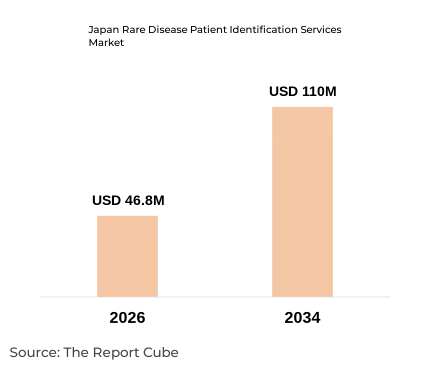
The Japan Rare Disease Patient Identification Services Market is anticipated to register a CAGR of around 11.4% during the forecast period 2026-2034. The market size is valued at USD 46.8 million in 2026 and is projected to reach USD 110.0 million by 2034. The rising burden of rare diseases, estimated to affect nearly 5-7% of Japan’s population, is creating strong demand for accurate patient identification tools. Pharmaceutical firms are increasing their investments in orphan drug development, which directly drives the need for precise patient recruitment and cohort identification services.
Japan’s healthcare ecosystem is evolving rapidly with the integration of real-world data, electronic health records, and genomic databases. By 2025, over 85% of hospitals in Japan had digitized patient records, allowing service providers to deploy advanced analytics for rare disease identification. Market growth is further supported by collaborative efforts between biotechnology firms and contract research organizations to streamline clinical trial enrollment. These factors collectively enhance the Japan Rare Disease Patient Identification Services market size and revenue potential while improving diagnostic timelines for complex conditions.
Japan Rare Disease Patient Identification Services Market Dynamics
Key Driver: Rising Demand for Precision Medicine and Orphan Drug Development
The increasing focus on precision medicine is a major driver of the Japan Rare Disease Patient Identification Services market growth. Pharmaceutical and biotechnology companies are prioritizing targeted therapies, particularly for rare diseases where patient populations are small and scattered. In Japan, orphan drug approvals have grown steadily, with more than 60 new designations recorded between 2023 and 2025. This surge creates a direct requirement for accurate patient identification systems to support clinical trials and treatment accessibility.
Additionally, Japan’s universal healthcare system ensures high patient data availability, which enhances the effectiveness of identification services. Advanced data integration platforms are enabling faster matching of patients with clinical trials. As a result, companies are increasingly investing in predictive modeling and registry development, strengthening the overall Japan Rare Disease Patient Identification Services market trends and long-term expansion.
Book your FREE 30-minute expert consultation today
Contact UsIndustry Trends: Integration of Genomics and Real-World Data Analytics
A key trend shaping the Japan Rare Disease Patient Identification Services market is the integration of genomic sequencing with real-world evidence. By 2025, genomic testing adoption in Japan increased by over 22%, allowing service providers to combine genetic insights with clinical data for precise patient identification. This approach significantly improves diagnostic accuracy, especially for complex and rare genetic disorders.
Moreover, the use of artificial intelligence-driven algorithms is enhancing predictive capabilities. Service providers are leveraging claims data, wearable device inputs, and patient registries to build comprehensive patient profiles. These advancements are not only improving patient outcomes but also increasing operational efficiency for stakeholders, contributing to the overall market value and innovation landscape.
Major Challenge: Data Privacy Regulations and Integration Complexity
One of the primary challenges in the Japan Rare Disease Patient Identification Services market is the strict regulatory framework governing patient data privacy. Japan’s Act on the Protection of Personal Information imposes stringent requirements on data usage, limiting the seamless sharing of patient information across platforms. This creates operational hurdles for service providers attempting to build unified datasets.
In addition, integrating diverse data sources such as hospital records, genomic databases, and insurance claims remains complex. Variations in data formats and lack of standardization increase processing time and costs. These challenges can slow down service adoption and affect the overall market growth, particularly for smaller service providers with limited technological infrastructure.
Opportunity: Expansion of Digital Health Platforms and Patient Registries
The rapid expansion of digital health platforms presents a significant opportunity for the Japan Rare Disease Patient Identification Services market. Mobile health applications and cloud-based platforms are enabling continuous patient monitoring and data collection, which enhances identification accuracy. By 2026, digital health adoption in Japan is expected to surpass 70%, creating a large pool of real-time patient data.
Furthermore, the development of national and disease-specific patient registries is opening new avenues for market players. These registries facilitate better patient tracking, improve clinical trial recruitment, and support long-term research initiatives. As healthcare providers and research institutions collaborate more closely, the Japan Rare Disease Patient Identification Services market revenue is expected to witness substantial growth.
Japan Rare Disease Patient Identification Services Market Segment-wise Analysis
By Service Type:
- Data Analytics and Predictive Modeling
- Genomic and Biomarker Profiling
- Claims and Electronic Health Record Mining
- Real-World Evidence and Registry Development
- Patient Recruitment and Referral Management
- Consulting and Advisory Services
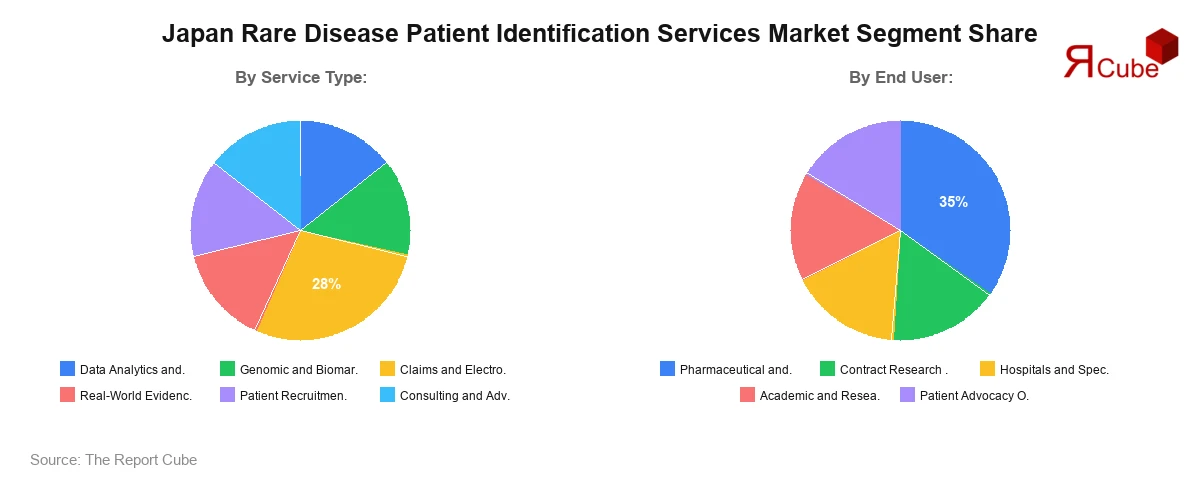
The claims and electronic health record mining segment holds the leading position in the Japan Rare Disease Patient Identification Services market, accounting for approximately 28% share. This dominance is driven by the widespread digitization of healthcare records across Japan, enabling large-scale data extraction and analysis.
Hospitals and research institutions increasingly rely on EHR mining to identify rare disease patients efficiently. The segment benefits from the availability of structured and unstructured clinical data, which allows advanced analytics tools to detect patterns and anomalies associated with rare conditions. Additionally, partnerships between healthcare providers and analytics firms are strengthening this segment’s growth, making it a core contributor to market expansion.
By End User:
- Pharmaceutical and Biotechnology Companies
- Contract Research Organizations
- Hospitals and Specialty Clinics
- Academic and Research Institutions
- Patient Advocacy Organizations
Pharmaceutical and biotechnology companies dominate this segment with nearly 35% of the Japan Rare Disease Patient Identification Services market share. Their leadership is driven by increasing investments in rare disease drug development and clinical trials. These companies rely heavily on patient identification services to locate eligible participants quickly and reduce trial timelines.
The growing number of orphan drug pipelines in Japan further strengthens demand from this segment. Moreover, collaborations with contract research organizations and data analytics providers enhance operational efficiency, allowing pharmaceutical firms to improve success rates in clinical research and accelerate market entry.
Regional Projection of Japan Rare Disease Patient Identification Services Industry
- Hokkaido
- Honshu
- Shikoku
- Kyushu
Honshu leads the Japan Rare Disease Patient Identification Services market with an estimated 64% share, driven by its concentration of advanced healthcare infrastructure and research institutions. Major metropolitan areas such as Tokyo and Osaka host a large number of hospitals, pharmaceutical companies, and research centers, creating a strong demand for patient identification services.
The region also benefits from higher adoption of digital health technologies and data analytics platforms. Furthermore, government-backed research initiatives and funding programs are primarily concentrated in Honshu, enabling faster implementation of innovative solutions. These factors collectively position Honshu as the central hub for market growth and technological advancements in Japan.
Government Initiatives & Policies
- Japan Rare/Intractable Disease Policy Reform (2025): Expanded national registry systems and funding for rare disease research, improving patient data collection and identification efficiency.
- Digital Health Transformation Program (2026): Promotes integration of EHRs and cloud-based healthcare data platforms to enhance diagnostics and patient identification accuracy.
Japan Rare Disease Patient Identification Services Industry Recent Developments
- 2025: Linical Co., Ltd. was recognized at the Citeline Japan Awards for innovation in trial recruitment strategies, strengthening its capabilities in identifying and enrolling rare disease patients across Japan.
- 2025: CMIC Holdings Co., Ltd. highlighted Japan’s growing rare disease ecosystem, emphasizing increased investments and demand for data-driven patient identification and registry services.
- 2025: IQVIA expanded its analytics-driven patient identification solutions in Japan using EHR and claims data, improving cohort precision for clinical research programs.
- 2026: Buzzreach Inc. gained recognition as a key provider of digital recruitment and engagement platforms, enhancing patient identification and trial enrollment workflows.
Need insights for a specific region within this market?
Request Regional DataWhy Choose This Report?
- Provides a comprehensive overview of the overall market analysis, encompassing key trends, consumer behavior analysis, and risk assessment to support strategic decision-making.
- Provides accurate, up-to-date insights into market size, segmentation, and emerging opportunities, helping to minimize risk & capitalizing on growth.
- Gives deep understanding of target audience preferences, investment habits, and communication channels for enhanced product development & marketing effectiveness.
- Delivers competitive analysis & benchmarking, uncovering the strengths & weaknesses of market competitors to guide strategies.
- Consolidate comprehensive market intelligence, reducing reasoning & streamlining research efforts.
- Facilitates customized market segmentation & risk mitigation strategies, fine-tuned to the business objectives.
- Aids in identifying both market challenges & untapped opportunities within the industry to drive long-term business growth.
- Provides valuable information based on actual customer data & search trends.
Table of Contents
- Introduction
- Objective of the Study
- Product and Category Definition
- Market Segmentation
- Study Variables
- Research Methodology
- Secondary Data Points
- Breakdown of Secondary Sources
- Primary Data Points
- Breakdown of Primary Interviews
- Secondary Data Points
- Executive Summary
- Market Dynamics
- Drivers
- Challenges
- Opportunity Assessment
- Recent Trends and Developments
- Regulatory and Policy Landscape
- Japan Rare Disease Patient Identification Services Market Overview (2021-2034)
- Market Size, By Value (USD Million)
- Market Share, By Service Type
- Data Analytics and Predictive Modeling
- Genomic and Biomarker Profiling
- Claims and Electronic Health Record Mining
- Real-World Evidence and Registry Development
- Patient Recruitment and Referral Management
- Consulting and Advisory Services
- Market Share, By Disease Focus
- Oncology Rare Diseases
- Neurology Rare Diseases
- Metabolic and Endocrine Disorders
- Immunology and Autoimmune Diseases
- Hematology Rare Diseases
- Others
- Market Share, By Method
- Algorithm-Based Identification
- Genetics-Based Identification
- Chart and Claims Review
- Provider and Site-Based Identification
- Hybrid Identification Approaches
- Market Share, By End User
- Pharmaceutical and Biotechnology Companies
- Contract Research Organizations
- Hospitals and Specialty Clinics
- Academic and Research Institutions
- Patient Advocacy Organizations
- Market Share, By Mode of Delivery
- On-Premise Services
- Cloud-Based Platforms
- Hybrid Delivery Models
- Market Share, By Region
- Hokkaido
- Honshu
- Shikoku
- Kyushu
- Market Share, By Company
- Revenue Shares and Analysis
- Competitive Landscape
- Hokkaido Rare Disease Patient Identification Services Market
- Market Size, By Value (USD Million)
- Market Share, By Service Type
- Market Share, By Disease Focus
- Market Share, By Method
- Market Share, By End User
- Market Share, By Mode of Delivery
- Honshu Rare Disease Patient Identification Services Market
- Market Size, By Value (USD Million)
- Market Share, By Service Type
- Market Share, By Disease Focus
- Market Share, By Method
- Market Share, By End User
- Market Share, By Mode of Delivery
- Shikoku Rare Disease Patient Identification Services Market
- Market Size, By Value (USD Million)
- Market Share, By Service Type
- Market Share, By Disease Focus
- Market Share, By Method
- Market Share, By End User
- Market Share, By Mode of Delivery
- Kyushu Rare Disease Patient Identification Services Market
- Market Size, By Value (USD Million)
- Market Share, By Service Type
- Market Share, By Disease Focus
- Market Share, By Method
- Market Share, By End User
- Market Share, By Mode of Delivery
- Competitive Outlook and Company Profiles
- Linical Co., Ltd.
- Company Overview
- Product and Service Portfolio
- Strategic Alliances and Partnerships
- Recent Developments
- IQVIA
- Company Overview
- Product and Service Portfolio
- Strategic Alliances and Partnerships
- Recent Developments
- DCT Japan
- Company Overview
- Product and Service Portfolio
- Strategic Alliances and Partnerships
- Recent Developments
- CMIC Holdings Co., Ltd.
- Company Overview
- Product and Service Portfolio
- Strategic Alliances and Partnerships
- Recent Developments
- Parexel International (MA) Corporation
- Company Overview
- Product and Service Portfolio
- Strategic Alliances and Partnerships
- Recent Developments
- Eisai Co., Ltd.
- Company Overview
- Product and Service Portfolio
- Strategic Alliances and Partnerships
- Recent Developments
- Buzzreach Inc.
- Company Overview
- Product and Service Portfolio
- Strategic Alliances and Partnerships
- Recent Developments
- Others
- Linical Co., Ltd.
- Contact Us and Disclaimer
Top Key Players & Market Share Outlook
- Linical Co., Ltd.
- IQVIA
- DCT Japan
- CMIC Holdings Co., Ltd.
- Parexel International (MA) Corporation
- Eisai Co., Ltd.
- Buzzreach Inc.
Frequently Asked Questions






