



Build Your Custom Market Intelligence Report
Customize Your ReportGlobal Re-Commerce Market Key Highlights
By Type:
Peer-to-Peer Marketplaces segment leads the market with nearly 46.3% share.
By Product:
Electronics segment dominates the market with around 38.7% of revenue.
Regional Outlook:
North America dominates the Global Re-Commerce Market with approximately 35.8% share.
Global Re-Commerce Market Insights & Analysis
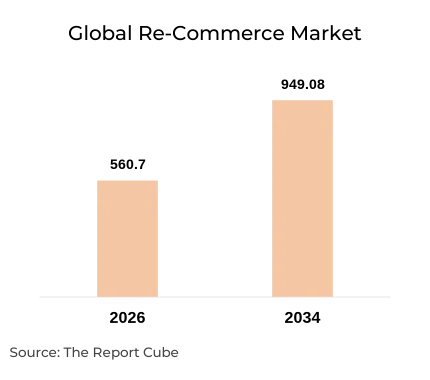
The Global Re-Commerce Market is anticipated to register a CAGR of around 6.80% during the forecast period 2026-2034. The market size is valued at USD 560.70 billion in 2026 and is projected to reach USD 949.08 billion by 2034. Market expansion is being supported by the rapid adoption of circular retail practices, growing acceptance of refurbished products, and increasing pressure on retailers to reduce waste generation. Large-scale digital platforms are improving resale operations through authenticated listings, secure payment systems, and streamlined logistics networks. Electronics and fashion categories continue to generate strong transaction volumes due to rising consumer preference for value-oriented purchasing and premium branded products at lower prices.
Retailers and manufacturers are also integrating resale models into their long-term sustainability strategies to strengthen customer retention and extend product lifecycles. In 2025, several global brands expanded buyback and refurbishment programs to improve inventory recovery and reduce environmental impact. Companies including ThredUp, Back Market, and Poshmark are strengthening operational capabilities through automated product grading, authentication technologies, and faster fulfillment services. The growing popularity of certified refurbished electronics and branded resale programs is further improving consumer confidence across developed and emerging economies.
Global Re-Commerce Market Insights & Analysis
| Factor | Type | Specific Impact on Market | Magnitude | Business Implication |
|---|---|---|---|---|
| Sustainability & Gen Z Preferences | Consumer | 55% Gen Z prefer sustainable brands driving re-commerce | High | Position as eco-friendly; target millennial consumers |
| Refurbished Smartphone Demand | Market | Affordability drives demand in Europe and India markets | High | Expand refurbished electronics with quality assurance |
| E-Commerce Promotion Initiatives | Regulatory | Saudi Arabia, India promote e-commerce infrastructure | Medium | Partner with local platforms for market expansion |
| Counterfeit Luxury Availability | Competitive | Fake products from Asia-Pacific undercut genuine resale | High | Implement authentication; educate on genuine value |
| Luxury Brand Resale Programs | Market | Brands launch second-hand programs maintaining control | Medium–High | Collaborate with luxury brands for certified resale |
| Economic Uncertainty & Inflation | Market | Rising costs reduce consumer budgets; IMF forecasts 2.8% | Medium | Emphasize value retention and affordability messaging |
| Supply Chain & Logistics Fragility | Market | Geopolitical tensions and tariffs disrupt freight flow | Medium | Diversify suppliers; adopt nearshoring strategies |
| Regulatory Compliance Complexity | Regulatory | Fragmented trade rules and taxes across markets in 2026 | High | Embed compliance teams; ensure seller verification |
| Digital Platform Integration | Technological | Brands integrate resale into primary retail channels | High | Build seamless omnichannel resale experience platforms |
| Circular Economy Legislation | Environmental | Europe modernizes laws supporting circular practices | Medium–High | Align with EU transparency rules; capitalize on trust |
Global Re-Commerce Market Dynamics
Key Driver: Growing Adoption of Sustainable and Cost-Efficient Shopping Models
Rising living costs and increasing environmental awareness are encouraging consumers to shift toward secondhand and refurbished products across multiple categories. Re-commerce platforms provide affordable alternatives for electronics, apparel, furniture, and automotive products while supporting sustainable consumption practices. Younger consumers, particularly millennials and Gen Z, are increasingly participating in resale ecosystems due to strong interest in budget-friendly and environmentally responsible purchasing decisions.
Retailers are responding by expanding trade-in programs, certified resale channels, and refurbishment partnerships to improve customer engagement. Refurbished smartphones, laptops, and premium fashion products are witnessing particularly strong demand due to improving product quality standards and warranty-backed offerings. The continued expansion of mobile commerce platforms and digital payment infrastructure is also supporting higher transaction volumes within the global re-commerce industry.

Book your FREE 30-minute expert consultation today
Contact UsIndustry Trends: Integration of Brand-Led Resale and Refurbishment Services
Major brands and online marketplaces are increasingly integrating resale and refurbishment services into their retail ecosystems to strengthen sustainability initiatives and improve customer loyalty. Fashion labels, consumer electronics manufacturers, and luxury retailers are launching dedicated resale channels to recover product value and extend merchandise lifecycles. This trend is helping companies create additional revenue streams while reducing excess inventory and product waste.
Luxury resale platforms are investing in authentication technologies and expert verification systems to improve buyer trust and reduce counterfeit risks. Companies such as Apple, Amazon, and Back Market continue expanding certified refurbished product portfolios supported by warranty protection and quality testing procedures. In addition, AI-supported inventory management and automated pricing systems are improving operational efficiency for resale marketplaces globally.
Major Challenge: Product Authentication and Quality Assurance Concerns
Product authenticity and quality consistency remain major operational challenges within the global re-commerce market. Consumers purchasing high-value secondhand electronics, luxury handbags, and branded apparel often require assurance regarding product condition and originality. Counterfeit products and inaccurate product descriptions can negatively impact customer trust and platform credibility.
To address these concerns, marketplace operators are increasing investments in authentication centers, product inspection services, and seller verification programs. However, maintaining standardized quality checks across high transaction volumes remains complex for several regional and emerging resale platforms. Reverse logistics, product returns, and refurbishment expenses also increase operational costs for companies operating within the re-commerce ecosystem.
Opportunity: Expansion of Circular Economy Initiatives Across Retail Industries
The growing focus on circular economy practices is creating substantial opportunities for re-commerce companies worldwide. Governments, retailers, and manufacturers are increasingly promoting reuse, repair, and refurbishment activities to reduce landfill waste and improve resource efficiency. Electronics and apparel sectors are expected to benefit significantly from these initiatives due to shorter replacement cycles and rising sustainability commitments from global brands.
Emerging economies across Asia Pacific and Latin America are witnessing higher adoption of resale applications supported by smartphone penetration and expanding digital commerce infrastructure. Luxury resale, refurbished electronics, and pre-owned furniture categories are expected to generate notable growth opportunities through 2034. The increasing use of automated grading technologies, warehouse optimization systems, and integrated logistics services is further helping platforms scale operations more efficiently.
Global Re-Commerce Market Segment-wise Analysis
By Type:
- Peer-to-Peer Marketplaces
- Resale Marketplaces
- Refurbished Goods Marketplaces
Peer-to-Peer Marketplaces account for the largest share of the global re-commerce market due to increasing participation in direct online buying and selling activities. The segment represented nearly 46.3% of overall market revenue in 2025 supported by strong user engagement across digital resale platforms. Consumers are increasingly using peer-driven applications for electronics, apparel, home goods, and automotive accessories because of competitive pricing and broader product availability.
Platforms such as OLX, Craigslist, Depop, and OfferUp continue strengthening customer engagement through secure transaction systems, location-based listings, and integrated communication features. The segment also benefits from lower operating costs compared to traditional retail models. Growing smartphone adoption and social commerce integration are further improving accessibility for users participating in secondhand product transactions globally.
By Product:
- Electronics
- Fashion and Apparel
- Furniture and Home Goods
- Automotive
- Sports and Fitness Equipment
- Others
The Electronics segment dominates the global re-commerce market with approximately 38.7% revenue share driven by rising demand for certified refurbished smartphones, laptops, and tablets. Consumers are increasingly purchasing refurbished electronics due to lower prices, improved quality assurance standards, and growing environmental awareness regarding electronic waste management.
Major technology companies and online marketplaces are expanding refurbishment programs supported by product testing, battery replacement services, and warranty-backed offerings. Refurbished devices are witnessing higher adoption among students, remote workers, and price-sensitive consumers seeking reliable alternatives to newly launched products. In addition, rapid technological upgrades and shorter replacement cycles continue generating a stable supply of pre-owned consumer electronics across global resale platforms.
Regional Projection of Global Re-Commerce Industry
- North America
- Europe
- Asia Pacific
- Middle East and Africa
- South America
North America holds the leading position in the global re-commerce market with nearly 35.8% share supported by advanced e-commerce infrastructure, high digital payment adoption, and strong consumer participation in resale activities. The United States remains the primary revenue contributor due to the established presence of resale companies including eBay, ThredUp, OfferUp, and Poshmark.
The region is witnessing strong growth in refurbished electronics, branded apparel resale, and luxury secondhand products as consumers increasingly prioritize affordability and sustainability. Retailers across North America are also expanding trade-in and buyback programs to strengthen circular retail strategies and improve customer retention. Well-developed logistics infrastructure, high internet penetration, and widespread smartphone usage continue supporting the long-term expansion of the regional re-commerce industry.
Global Re-Commerce Industry Regional Analysis
The global re-commerce industry varies significantly across regions due to economic conditions, digital infrastructure, sustainability awareness, and consumer purchasing power.
| Region | Demand Level | Key Markets | System Dominance | Core Demand Logic | Growth Nature |
|---|---|---|---|---|---|
| North America | Very High | USA, Canada, Mexico | Fashion & Electronics | Sustainability focus & affluent resale culture | Premium-driven expansion |
| Europe | High | UK, Germany, France | Fashion & Home Goods | Circular economy & cost management strategy | Policy-supported growth |
| Asia Pacific | Very High | China, Japan, India | Electronics & Fashion | Digital engagement & sustainability shift | Fastest-growing segment |
| Middle East & Africa | Medium | UAE, Saudi Arabia, S. Africa | Electronics & Automotive | Urbanization & certified refurbishment trust | Gradual formalization |
| South America | High | Brazil, Argentina, Colombia | C2C Mobile Platforms | Economic constraints & peer-network trust | Informal to formal shift |
Need insights for a specific region within this market?
Request Regional DataGovernment Initiatives & Policies
- United States Right to Repair Policies: Several U.S. states expanded right-to-repair regulations during 2025 to improve product repair accessibility and encourage refurbished electronics adoption across resale ecosystems.
- European Circular Economy Action Plan: The European Union strengthened circular economy regulations in 2025 promoting reuse, repair, and resale activities to reduce electronic and textile waste generation.
Global Re-Commerce Industry Recent Developments
- 2025: ThredUp Inc. announced a major expansion of its Resale-as-a-Service platform by eliminating branded resale fees and introducing advanced operational tools for retailers. The initiative is designed to simplify resale integration, improve profitability, and accelerate adoption of branded secondhand commerce across apparel and accessories categories.
Why Choose This Report?
- Provides a comprehensive overview of the overall market analysis, encompassing key trends, consumer behavior analysis, and risk assessment to support strategic decision-making.
- Provides accurate, up-to-date insights into market size, segmentation, and emerging opportunities, helping to minimize risk & capitalizing on growth.
- Gives deep understanding of target audience preferences, investment habits, and communication channels for enhanced product development & marketing effectiveness.
- Delivers competitive analysis & benchmarking, uncovering the strengths & weaknesses of market competitors to guide strategies.
- Consolidate comprehensive market intelligence, reducing reasoning & streamlining research efforts.
- Facilitates customized market segmentation & risk mitigation strategies, fine-tuned to the business objectives.
- Aids in identifying both market challenges & untapped opportunities within the industry to drive long-term business growth.
- Provides valuable information based on actual customer data & search trends.
Table of Contents
- Introduction
- Objective of the Study
- Product and Category Definition
- Market Segmentation
- Study Variables
- Research Methodology
- Secondary Data Points
- Breakdown of Secondary Sources
- Primary Data Points
- Breakdown of Primary Interviews
- Secondary Data Points
- Executive Summary
- Market Dynamics
- Emerging Opportunities
- Adoption Trends
- Demand Drivers
- Disruption Analysis (Challenges)
- Industry Analysis and Strategic Insights
- Supply and Value Chain Analysis
- Pricing Analysis
- Go-To-Market Strategy
- BCG Matrix
- Recent Trends and Developments
- Regulatory and Policy Landscape
- Region-Wise Policies
- Government Initiatives
- Global Re-Commerce Market Overview and Forecast Analysis (2021-2034)
- Market Size, By Value, By Growth Rate (CAGR/USD Billion)
- Market Share, By Type
- Peer-to-Peer Marketplaces
- Resale Marketplaces
- Refurbished Goods Marketplaces
- Market Share, By Product
- Electronics
- Smartphones and Tablets
- Laptops and Computers
- Cameras and Photography Equipment
- Home Appliances
- Others
- Fashion and Apparel
- Clothing
- Footwear
- Accessories
- Furniture and Home Goods
- Sofas and Couches
- Tables and Chairs
- Home Decor
- Others
- Automotive
- Used Vehicles
- Vehicle Parts and Accessories
- Sports and Fitness Equipment
- Others
- Electronics
- Market Share, By Product Category
- Non-Luxury
- Luxury
- Market Share, By Age Group
- Up to 18 Years
- 19-25 Years
- 26-40 Years
- 41-55 Years
- Above 56 Years
- Market Share, By Region
- North America
- Europe
- Asia Pacific
- Middle East and Africa
- South America
- Market Share, By Company
- Revenue Shares and Analysis
- Competitive Landscape
- North America Re-Commerce Market Overview and Forecast Analysis (2021-2034)
- Market Size, By Value, By Growth Rate (CAGR/USD Billion/Million)
- Market Share, By Type
- Market Share, By Product
- Market Share, By Product Category
- Market Share, By Age Group
- Market Share, By Country
- United States
- Canada
- Mexico
- Rest of North America
- Europe Re-Commerce Market Overview and Forecast Analysis (2021-2034)
- Market Size, By Value, By Growth Rate (CAGR/USD Billion/Million)
- Market Share, By Type
- Market Share, By Product
- Market Share, By Product Category
- Market Share, By Age Group
- Market Share, By Country
- Germany
- United Kingdom
- France
- Italy
- Spain
- Netherlands
- Russia
- Poland
- Belgium
- Sweden
- Rest of Europe
- Asia Pacific Re-Commerce Market Overview and Forecast Analysis (2021-2034)
- Market Size, By Value, By Growth Rate (CAGR/USD Billion/Million)
- Market Share, By Type
- Market Share, By Product
- Market Share, By Product Category
- Market Share, By Age Group
- Market Share, By Country
- China
- India
- Japan
- South Korea
- Australia
- Indonesia
- Thailand
- Malaysia
- Vietnam
- Philippines
- Singapore
- New Zealand
- Rest of Asia Pacific
- Middle East and Africa Re-Commerce Market Overview and Forecast Analysis (2021-2034)
- Market Size, By Value, By Growth Rate (CAGR/USD Billion/Million)
- Market Share, By Type
- Market Share, By Product
- Market Share, By Product Category
- Market Share, By Age Group
- Market Share, By Country
- Saudi Arabia
- United Arab Emirates
- South Africa
- Egypt
- Nigeria
- Morocco
- Turkey
- Rest of Middle East and Africa
- South America Re-Commerce Market Overview and Forecast Analysis (2021-2034)
- Market Size, By Value, By Growth Rate (CAGR/USD Billion/Million)
- Market Share, By Type
- Market Share, By Product
- Market Share, By Product Category
- Market Share, By Age Group
- Market Share, By Country
- Brazil
- Argentina
- Chile
- Colombia
- Peru
- Rest of South America
- Competitive Analysis, 2026
- Market Share of Key Players
- Competitive Mapping for Each Segment and Companies Operating Regionally
- North America Re-Commerce Companies Share and Competitive Analysis, 2026
- Europe Re-Commerce Companies Share and Competitive Analysis, 2026
- Asia Pacific Re-Commerce Companies Share and Competitive Analysis, 2026
- Middle East and Africa Re-Commerce Companies Share and Competitive Analysis, 2026
- South America Re-Commerce Companies Share and Competitive Analysis, 2026
- Company Profiles (Partial List)
- Rebag
- Company Overview
- Product Portfolio
- Strategic Alliances/Partnerships
- Recent Developments
- OLX
- Company Overview
- Product Portfolio
- Strategic Alliances/Partnerships
- Recent Developments
- OfferUp
- Company Overview
- Product Portfolio
- Strategic Alliances/Partnerships
- Recent Developments
- Amazon
- Company Overview
- Product Portfolio
- Strategic Alliances/Partnerships
- Recent Developments
- Swap
- Company Overview
- Product Portfolio
- Strategic Alliances/Partnerships
- Recent Developments
- Poshmark
- Company Overview
- Product Portfolio
- Strategic Alliances/Partnerships
- Recent Developments
- Depop
- Company Overview
- Product Portfolio
- Strategic Alliances/Partnerships
- Recent Developments
- MusicMagpie
- Company Overview
- Product Portfolio
- Strategic Alliances/Partnerships
- Recent Developments
- LePrix
- Company Overview
- Product Portfolio
- Strategic Alliances/Partnerships
- Recent Developments
- eBay Inc.
- Company Overview
- Product Portfolio
- Strategic Alliances/Partnerships
- Recent Developments
- Back Market
- Company Overview
- Product Portfolio
- Strategic Alliances/Partnerships
- Recent Developments
- Archive
- Company Overview
- Product Portfolio
- Strategic Alliances/Partnerships
- Recent Developments
- Craigslist
- Company Overview
- Product Portfolio
- Strategic Alliances/Partnerships
- Recent Developments
- Apple Inc.
- Company Overview
- Product Portfolio
- Strategic Alliances/Partnerships
- Recent Developments
- Rush Re-Commerce
- Company Overview
- Product Portfolio
- Strategic Alliances/Partnerships
- Recent Developments
- Rebelle
- Company Overview
- Product Portfolio
- Strategic Alliances/Partnerships
- Recent Developments
- ReFlaunt
- Company Overview
- Product Portfolio
- Strategic Alliances/Partnerships
- Recent Developments
- ThredUp Inc.
- Company Overview
- Product Portfolio
- Strategic Alliances/Partnerships
- Recent Developments
- Others (Partial List)
- Rebag
- Contact Us and Disclaimer
Top Key Players & Market Share Outlook
- Rebag
- OLX
- OfferUp
- Amazon
- Swap
- Poshmark
- Depop
- MusicMagpie
- LePrix
- eBay Inc.
- Back Market
- Archive
- Craigslist
- Apple Inc.
- Rush Re-Commerce
- Rebelle
- ReFlaunt
- ThredUp Inc.
- Others
Frequently Asked Questions






