



Build Your Custom Market Intelligence Report
Customize Your ReportChina Real Estate Market Insights & Analysis
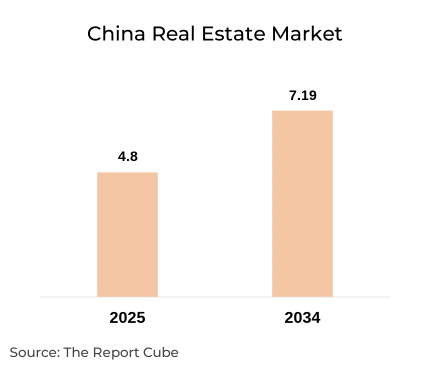
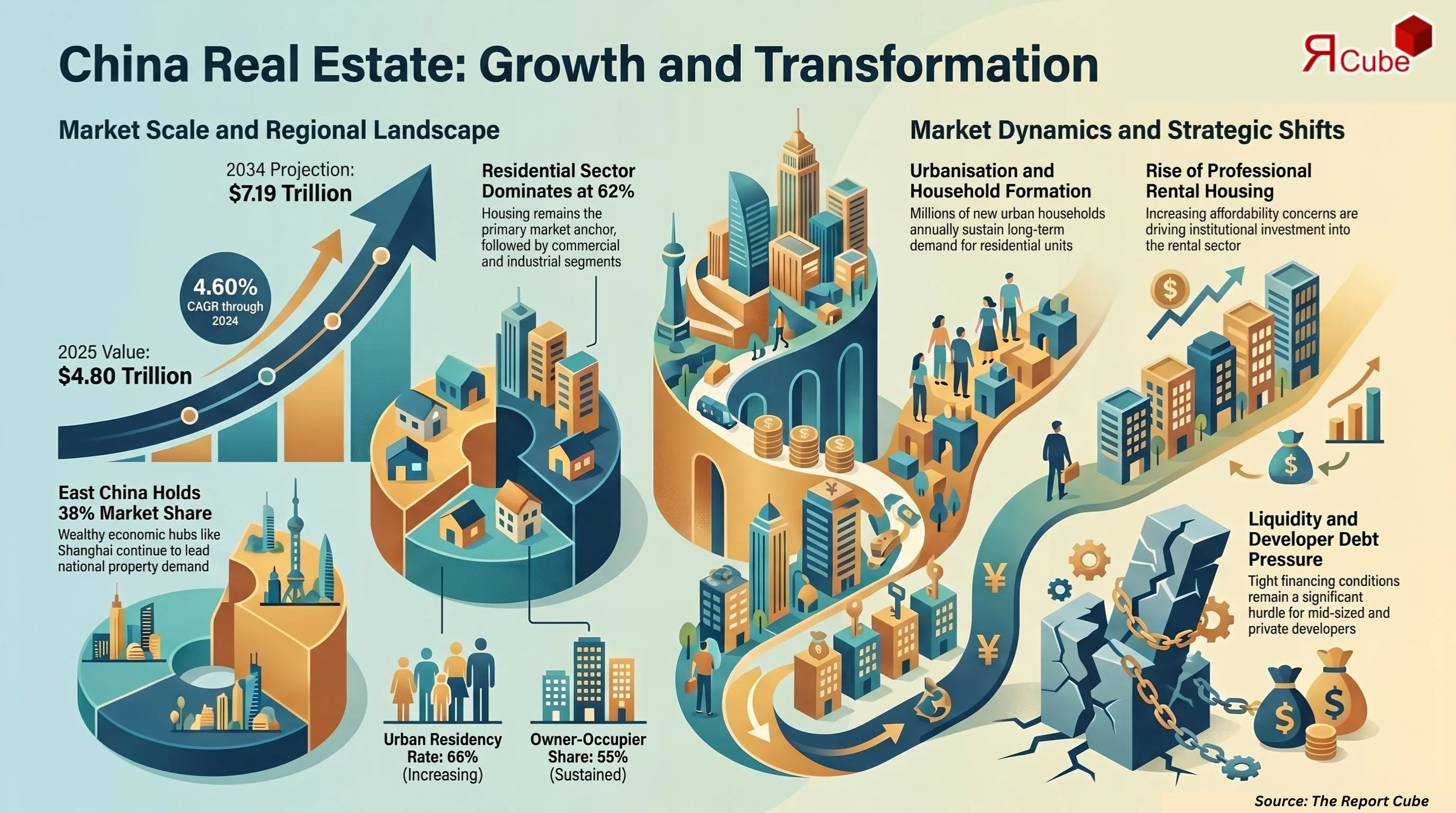
The China Real Estate Market is anticipated to register a CAGR of 4.60% during 2026-2034. The market size was valued at USD 4.80 trillion in 2025 and is projected to reach USD 7.19 trillion by 2034. The market remains one of the largest and most influential real estate ecosystems globally, supported by China’s urbanization scale, infrastructure depth, and evolving housing demand. Despite recent structural adjustments, real estate continues to serve as a critical pillar of China’s economy, contributing significantly to fixed asset investment and employment.
Market stabilization efforts, policy recalibration, and gradual recovery in buyer confidence are reshaping the industry’s trajectory. Demand is increasingly shifting toward high-quality residential projects, mixed-use developments, and urban renewal initiatives. Meanwhile, tier-one and strong tier-two cities are witnessing steadier transaction volumes due to better income levels and population inflows, helping balance regional disparities.
Additionally, developers are reorienting strategies toward asset-light models, prudent land acquisition, and improved cash flow management. Institutional capital participation, rental housing expansion, and commercial asset repositioning are reinforcing long-term market resilience. Together, these interconnected forces are expected to guide the China Real Estate Market toward sustainable growth through 2034.
China Real Estate Market Recent Developments
- 2025: China Vanke Co. accelerated urban renewal projects across major tier-one cities to enhance residential quality.
- 2025: Poly Developments expanded rental housing portfolios focusing on long-term urban leasing demand.
Government Initiatives & Policies
- Housing Stability Support Measures: Policies aimed at ensuring project delivery and stabilizing housing demand.
- Urban Renewal Action Plan: National initiative promoting redevelopment of aging residential and commercial areas.
China Real Estate Market Dynamics
Key Driver: Continuous Urbanization and Household Formation
Urbanization remains a fundamental driver of the China Real Estate Market, with urban residency exceeding 66% in 2025 and continuing to rise steadily. Millions of new urban households are formed annually, sustaining demand for residential housing across core and peripheral cities. Government-backed infrastructure investments, including metro systems and industrial corridors, further stimulate property demand by improving connectivity and livability. Additionally, rising disposable incomes in urban centers are supporting upgrades from basic housing to higher-quality residential units. These interconnected trends collectively underpin stable long-term demand, despite short-term market fluctuations.
Book your FREE 30-minute expert consultation today
Contact UsIndustry Trends: Shift Toward High-Quality and Mixed-Use Developments
A notable industry trend is the shift away from volume-driven expansion toward quality-focused and mixed-use developments. Developers are prioritizing projects that integrate residential, commercial, and lifestyle components to enhance asset value and occupancy rates. Green building standards, smart property management, and community-centric designs are becoming mainstream, particularly in economically developed regions. This evolution reflects changing buyer preferences favoring long-term livability and investment stability, while also aligning with regulatory emphasis on sustainable urban development.
Major Challenge: Liquidity Constraints and Developer Debt Pressure
Liquidity constraints and elevated debt levels among developers remain a significant challenge for the market. Tight financing conditions and cautious lending practices have limited access to capital, particularly for mid-sized and private developers. Project delays and slower sales recovery in lower-tier cities further strain cash flows. Although policy support has eased some pressure, restoring broad-based confidence among investors and homebuyers continues to require time and disciplined execution, making financial resilience a key determinant of competitive survival.
Opportunity: Expansion of Rental Housing and Institutional Participation
The growing emphasis on rental housing presents a substantial opportunity within the China Real Estate Market. Rising housing affordability concerns and workforce mobility are driving demand for professionally managed rental properties. Institutional investors are increasingly entering the rental segment, attracted by stable yields and policy support. This trend encourages diversification beyond traditional for-sale residential projects and supports more balanced market development. Over the forecast period, rental housing is expected to become a vital growth engine, particularly in large metropolitan areas.
China Real Estate Market Segment-wise Analysis
By Property Type:
- Residential
- Commercial
- Industrial
- Land
Residential properties dominate the China Real Estate Market, accounting for approximately 62% of total market value in 2025. This leadership reflects sustained housing demand from urban households and ongoing urban renewal initiatives. Commercial properties, including offices and retail spaces, are adapting to flexible usage models, while industrial real estate benefits from logistics and manufacturing upgrades. Among these, residential real estate continues to anchor market stability due to its scale and essential nature.
By End User:
- Owner-Occupier
- Institutional Investor
- Individual Investor
- Corporate Occupier
Owner-occupiers represent the largest end-user segment, holding nearly 55% market share in 2025. Demand from this group is driven by household formation and upgrading needs. Institutional investors are gradually expanding their presence, particularly in commercial and rental residential assets, attracted by long-term income stability. Corporate occupiers contribute steadily through demand for office and industrial spaces aligned with economic activity and business expansion.
Regional Projection of China Real Estate Industry
- East China
- North China
- South China
- Central China
- West China
East China leads the China Real Estate Market, contributing approximately 38% of total market value in 2025. The region benefits from strong economic fundamentals, dense urban populations, and mature infrastructure networks. Cities such as Shanghai and surrounding economic hubs attract sustained residential and commercial demand. While East China remains dominant, Central and West China are emerging growth regions, supported by industrial relocation and infrastructure investment, gradually narrowing regional disparities.
Need insights for a specific region within this market?
Request Regional DataWhy Choose This Report?
- Provides a comprehensive overview of the overall market analysis, encompassing key trends, consumer behavior analysis, and risk assessment to support strategic decision-making.
- Provides accurate, up-to-date insights into market size, segmentation, and emerging opportunities, helping to minimize risk & capitalizing on growth.
- Gives deep understanding of target audience preferences, investment habits, and communication channels for enhanced product development & marketing effectiveness.
- Delivers competitive analysis & benchmarking, uncovering the strengths & weaknesses of market competitors to guide strategies.
- Consolidate comprehensive market intelligence, reducing reasoning & streamlining research efforts.
- Facilitates customized market segmentation & risk mitigation strategies, fine-tuned to the business objectives.
- Aids in identifying both market challenges & untapped opportunities within the industry to drive long-term business growth.
- Provides valuable information based on actual customer data & search trends.
Table of Contents
- Introduction
- Objective of the Study
- Product and Category Definition
- Market Segmentation
- Study Variables
- Research Methodology
- Secondary Data Points
- Breakdown of Secondary Sources
- Primary Data Points
- Breakdown of Primary Interviews
- Secondary Data Points
- Executive Summary
- Market Dynamics
- Drivers
- Challenges
- Opportunity Assessment
- Recent Trends and Developments
- Regulatory and Policy Landscape
- China Real Estate Market Overview (2021-2034)
- Market Size, By Value (USD Trillion)
- Market Share, By Property Type
- Residential
- Commercial
- Industrial
- Land
- Market Share, By End User
- Owner‑Occupier
- Institutional Investor
- Individual Investor
- Corporate Occupier
- Market Share, By Transaction Type
- New Sales
- Resale
- Leasing
- Market Share, By City Tier
- Tier 1 Cities
- Tier 2 Cities
- Tier 3 Cities
- Tier 4 Cities
- Market Share, By Region
- East China
- North China
- South China
- Central China
- West China
- Market Share, By Company
- Market Share, By Company
- Competition Characteristics
- Revenue Shares & Analysis
- East China Real Estate Market
- Market Size, By Value (USD Billion)
- Market Share, By Property Type
- Market Share, By End User
- Market Share, By Transaction Type
- Market Share, By City Tier
- Market Share, By Key City
- Shanghai
- Hangzhou
- Nanjing
- Other Cities
- North China Real Estate Market
- Market Size, By Value (USD Billion)
- Market Share, By Property Type
- Market Share, By End User
- Market Share, By Transaction Type
- Market Share, By City Tier
- Market Share, By Key City
- Beijing
- Tianjin
- Shijiazhuang
- Other Cities
- South China Real Estate Market
- Market Size, By Value (USD Billion)
- Market Share, By Property Type
- Market Share, By End User
- Market Share, By Transaction Type
- Market Share, By City Tier
- Market Share, By Key City
- Shenzhen
- Guangzhou
- Foshan
- Other Cities
- Central China Real Estate Market
- Market Size, By Value (USD Billion)
- Market Share, By Property Type
- Market Share, By End User
- Market Share, By Transaction Type
- Market Share, By City Tier
- Market Share, By Key City
- Wuhan
- Changsha
- Zhengzhou
- Other Cities
- West China Real Estate Market
- Market Size, By Value (USD Billion)
- Market Share, By Property Type
- Market Share, By End User
- Market Share, By Transaction Type
- Market Share, By City Tier
- Market Share, By Key City
- Chengdu
- Chongqing
- Xian
- Other Cities
- Competitive Outlook and Company Profiles
- Country Garden Holdings
- Company Overview
- Project Portfolio
- Strategic Alliances/Partnerships
- Recent Developments
- China Vanke Co.
- Company Overview
- Project Portfolio
- Strategic Alliances/Partnerships
- Recent Developments
- Poly Developments
- Company Overview
- Project Portfolio
- Strategic Alliances/Partnerships
- Recent Developments
- China Overseas Land
- Company Overview
- Project Portfolio
- Strategic Alliances/Partnerships
- Recent Developments
- China Resources Land
- Company Overview
- Project Portfolio
- Strategic Alliances/Partnerships
- Recent Developments
- China Merchants Shekou
- Company Overview
- Project Portfolio
- Strategic Alliances/Partnerships
- Recent Developments
- Longfor Group
- Company Overview
- Project Portfolio
- Strategic Alliances/Partnerships
- Recent Developments
- Greenland Holdings
- Company Overview
- Project Portfolio
- Strategic Alliances/Partnerships
- Recent Developments
- Seazen Holdings
- Company Overview
- Project Portfolio
- Strategic Alliances/Partnerships
- Recent Developments
- Sunac China
- Company Overview
- Project Portfolio
- Strategic Alliances/Partnerships
- Recent Developments
- Others
- Country Garden Holdings
- Contact Us and Disclaimer
Top Key Players & Market Share Outlook
- Country Garden Holdings
- China Vanke Co.
- Poly Developments
- China Overseas Land
- China Resources Land
- China Merchants Shekou
- Longfor Group
- Greenland Holdings
- Seazen Holdings
- Sunac China
- Others
Frequently Asked Questions






