



Build Your Custom Market Intelligence Report
Customize Your ReportJapan Real Estate Market Key Takeaways
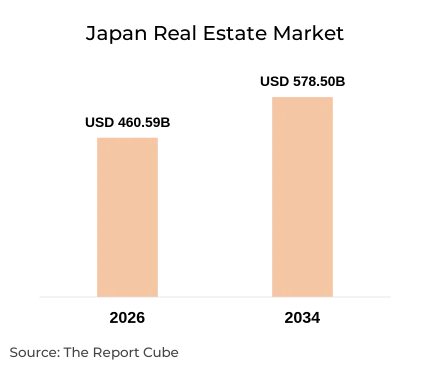
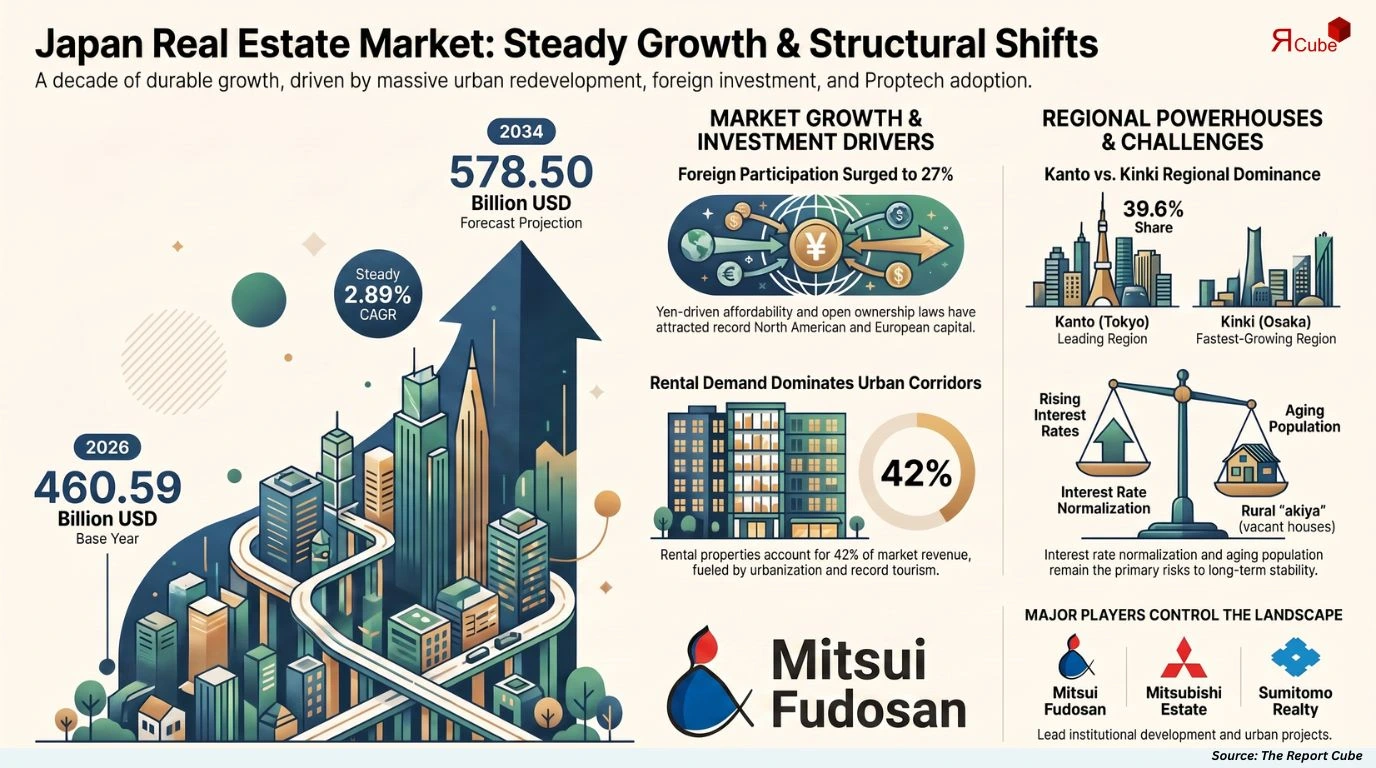
- Japan Real Estate Market was valued at USD 460.59 billion in 2026, reflecting sustained urban property investment momentum.
- The market is projected to reach USD 578.50 billion by 2034, expanding at a steady 2.89% CAGR.
- Owner-Occupier segment leads by buyer type, driven by strong domestic homeownership culture and demand.
- Rental use type dominates urban property demand, particularly across Tokyo and Osaka metropolitan corridors.
- Kanto region commands the largest regional share owing to Tokyo's status as Asia's premier commercial hub.
- Foreign buyer participation surged to 27% of total transactions in 2025, reflecting yen-driven affordability advantages.
- Kinki region emerges as the fastest-growing area, buoyed by Osaka Expo legacy investment and hospitality development.
- Leading companies include Mitsui Fudosan, Mitsubishi Estate, Sumitomo Realty, Daiwa House, and Sekisui House.
Japan Real Estate Market Insights & Analysis
The Japan Real Estate Market is anticipated to register a 2.89% CAGR during 2026–2034. The market size was valued at USD 460.59 billion in 2026 and is projected to reach USD 578.50 billion by 2034. The market continues to benefit from persistent demand concentration in urban centers, a prolonged period of structurally low interest rates, and an accelerating influx of foreign institutional capital. Government-backed urban redevelopment initiatives across Tokyo, Osaka, and Nagoya are simultaneously stimulating new supply pipelines and reinforcing long-term land value appreciation in transit-linked corridors. Japan accounted for an estimated 8.9% of the global real estate market in 2024, affirming its position as a strategically significant destination for cross-border property allocation.
The broader investment landscape has been further energized by the weak yen, which has provided overseas buyers a 20–30% purchasing advantage compared to five years prior. Foreign real estate investment reached approximately JPY 2.3 trillion in 2024, representing a 12% year-on-year increase, with North American and European institutional funds accounting for 68% of those inflows. Residential investment by foreign entities rose 18% year-on-year to JPY 740 billion in 2024, while Japan's commercial property transactions across logistics, office, and hospitality assets continue attracting global capital at record volumes. These dynamics collectively position the market for a decade of measured but durable growth through 2034.
Japan Real Estate Market Dynamics
Japan's property market is navigating a period of structural recalibration, where favorable macroeconomic conditions, foreign capital inflows, and sustained urban redevelopment pipelines coexist with demographic headwinds and a gradual monetary policy normalization cycle. Market momentum remains concentrated in major metropolitan centers while regional bifurcation continues widening, creating differentiated investment opportunities across asset classes and geographies. The convergence of proptech adoption, green building mandates, and evolving ownership models is reshaping demand characteristics across both the residential and commercial segments.
|
Factor |
Type |
Specific Impact on Market |
Magnitude |
|---|---|---|---|
|
Yen depreciation and foreign capital inflows |
Driver |
Expands cross-border buyer participation and transaction volumes |
Very High |
|
Urban redevelopment and transit-linked projects |
Driver |
Sustains land value appreciation in Kanto and Kinki regions |
High |
|
Bank of Japan interest rate normalization |
Challenge |
Moderates investment yield spreads and caps leveraged returns |
High |
|
Proptech and digital transaction platforms |
Trend |
Improves market transparency and broadens buyer access |
High |
|
Aging population and akiya housing stock |
Challenge |
Suppresses demand and pricing in rural and suburban periphery markets |
Medium |
Key Market Driver: Foreign Capital Reshaping Urban Residential Demand
Japan's open foreign ownership framework, transparent legal environment, and persistent yen weakness have combined to make Japanese residential and commercial real estate one of Asia-Pacific's most compelling institutional allocation targets. Foreign participation in total property transactions rose to 27% in 2025, up from 18% the prior year, and overseas buyers now account for an estimated 40% of new apartment sales in central Tokyo wards. In Q2 2025, Japan led the Asia-Pacific region with USD 7.6 billion in cross-border investment, concentrated in the office and multifamily segments, while demand from high-net-worth individuals across Hong Kong, Singapore, and the United States remained elevated in the JPY 100 million to JPY 300 million residential bracket. This sustained foreign demand is directly contributing to new luxury residential development pipelines across the Tokyo metropolitan area, reinforcing urban land values and supporting price floor stability in prime wards.
Major Industry Challenge: Interest Rate Normalization Compressing Investment Yields
After more than a decade of near-zero benchmark rates, the Bank of Japan has begun a gradual tightening cycle, introducing upward pressure on mortgage costs, construction financing, and capitalization rate assumptions across the sector. While absolute interest rate levels remain globally competitive, the directional shift has prompted investors to reassess yield spreads, particularly in mid-market residential and suburban commercial assets where rental income growth has been modest. Rising construction costs driven by domestic labor shortages and material price inflation are compounding margin pressure for developers, with new condominium development costs in Tokyo projected to continue rising through 2027. Institutional investors are increasingly pivoting toward assets with income-growth characteristics - namely logistics, data centers, and short-term rental properties - to preserve return profiles in an environment of moderating leveraged yields.
Emerging Trend Shaping Outlook: Proptech Digitization and Build-to-Rent Expansion
Digital transformation is accelerating across Japan's property sector, with online platforms now representing approximately 18.8% of real estate transaction mode share in 2025, driven by younger demographic cohorts preferring digital-first engagement tools for search, underwriting, and closing. Simultaneously, the build-to-rent model is gaining institutional traction, with foreign REITs and domestic developers partnering to deliver purpose-built multifamily rental assets in Tokyo and Osaka, targeting the growing population of urban renters who cannot or choose not to purchase. The Japan residential rental property market is benefiting from sustained structural undersupply in prime urban wards and expanding demand from digital nomads, foreign professionals, and single-person households. AI-powered property valuation tools, smart building energy management systems, and blockchain-enabled transaction verification platforms are further modernizing the transaction lifecycle and improving operational efficiency for developers, landlords, and brokers alike.
Need Specific Data, Let’s Customize the Report for You
Request CustomizationJapan Real Estate Market Segment-wise Analysis
Japan's real estate market presents a layered investment landscape shaped by buyer motivation, use type, and regional concentration. Owner dynamics, financing structures, and end-use differentiation drive distinct sub-market behaviors across the residential, rental, and commercial verticals, with significant variation observed between domestic and foreign buyer cohorts.
By Buyer Type
- Owner-Occupier
- Private Investor
- Institutional
- Foreign Buyer
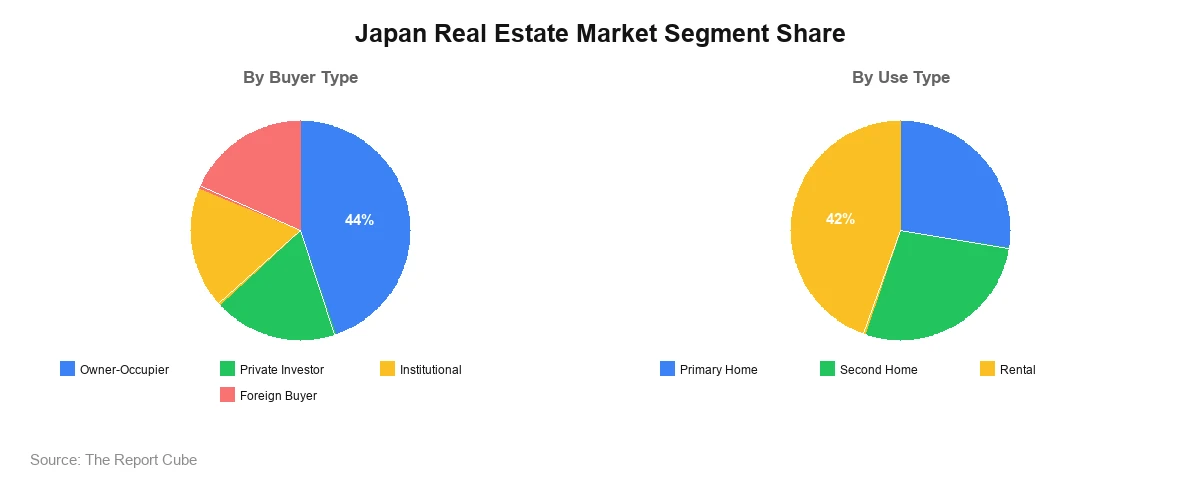
Owner-Occupier buyers represent the dominant segment, accounting for approximately 44% of total transaction volume, underpinned by Japan's deep cultural emphasis on homeownership, government housing loan incentives through the Japan Housing Finance Agency, and the widespread preference for newly built condominium units in major urban corridors. Low-interest mortgage products - historically available at sub-1% fixed rates - have sustained domestic purchase activity even as benchmark rates begin normalizing, with prime urban condominium demand remaining robust across Kanto and Kinki markets driven by household formation among dual-income urban professionals.
Private Investor and Institutional buyer segments are collectively expanding their footprint, particularly in the rental and logistics asset classes. Institutional buyers - including J-REITs, global funds such as Blackstone and GIC, and domestic pension vehicles - collectively deployed over JPY 900 billion into Japanese logistics alone through mid-2025, reflecting the outsized yield premium available versus competing gateway markets. The Foreign Buyer segment, while smaller by volume, is demonstrating the fastest growth trajectory, with transaction participation rising from 18% to 27% of total deals between 2024 and 2025, concentrated in luxury residential and hospitality assets across Tokyo, Osaka, and Kyoto.
By Use Type
- Primary Home
- Second Home
- Rental
Rental use type is the leading segment by transaction activity and institutional investment volume, commanding an estimated 42% share of total market revenue. Sustained urbanization, the expanding base of foreign residents and professionals, housing undersupply in central wards, and the growth of short-term hospitality rentals tied to Japan's record inbound tourism recovery - with over 33 million annual visitors projected - have collectively driven vacancy rates in prime Tokyo rental properties to near historic lows. Rental yields of 3–4% in central Tokyo and 5–8% in regional cities continue to attract both domestic and foreign income-seeking investors seeking stable cash-flow assets in a low-default market.
The Primary Home segment maintains substantial baseline demand, particularly in transit-linked suburban corridors where newly built detached houses and mid-rise condominiums offer family buyers a combination of value and accessibility. Property prices in newly built Tokyo condominiums are projected to appreciate 5–6% in 2025, sustaining primary home buyer competition for limited inventory. The Second Home segment, while smaller in absolute share, is an emerging growth area driven by domestic resort property demand in Hokkaido, Hakone, and Kyushu destinations as remote work flexibility enables urban households to acquire lifestyle properties outside primary metropolitan centers.
Regional Projection of Japan Real Estate Market
Japan's property market exhibits pronounced regional differentiation, with metropolitan Kanto and Kinki corridors absorbing the majority of domestic and foreign investment capital, while Central/Chubu benefits from industrial demand, and Kyushu-Okinawa captures rising tourism and lifestyle-driven interest.
|
Region |
Estimated Market Share |
Key Growth Factors |
Consumer Trends |
|---|---|---|---|
|
Kanto |
39.6% |
Tokyo institutional demand, urban redevelopment, transit-linked supply |
Rising foreign buyer participation and luxury condominium demand |
|
Kinki |
27.4% |
Osaka Expo 2025 legacy investment, hotel and hospitality development |
Strong short-term rental and commercial asset acquisition activity |
|
Central/Chubu |
15.8% |
Automotive and aerospace industrial real estate, Nagoya office absorption |
Logistics and industrial property investment expanding |
|
Kyushu-Okinawa |
10.2% |
Tourism recovery, resort development, digital nomad demand |
Second home and lifestyle property acquisition growing |
|
Others |
7.0% |
Akiya renovation programs, agricultural and rural asset repositioning |
Emerging investor interest in discounted rural housing stock |
- Kanto: Kanto leads nationally with approximately 39.6% revenue share, underpinned by Tokyo's role as Asia's premier institutional real estate hub, where the average land price growth rate across all uses rose to 7.7% in 2025, up from 6.0% in 2024, and record net office absorption validated continued institutional appetite for ESG-compliant commercial assets.
- Kinki: Kinki is the fastest-growing region, with Osaka commercial land values posting 6.7% annual appreciation in 2025, driven by Expo 2025 legacy infrastructure investment, a sustained hotel and serviced apartment development boom, and expanding mixed-use and hospitality real estate demand.
- Central/Chubu: Central/Chubu maintains steady institutional demand tied to Nagoya's automotive and aerospace cluster, with all-grade office vacancy falling to 2.3% in Q4 2025, its lowest level in four years, supporting continued commercial and logistics development activity.
- Kyushu-Okinawa: Kyushu-Okinawa is gaining traction as a lifestyle investment destination, with tourism-linked hospitality and resort assets attracting both domestic second-home buyers and foreign investors seeking high-yield alternatives to saturated Tokyo markets.
- Others: Rural and semi-rural prefectures continue facing population decline and akiya accumulation pressures, but government-backed renovation incentive programs and discounted entry prices are beginning to attract niche investor interest in asset repositioning plays.
Japan Real Estate Market: Recent Development (2025)
- Mitsui Fudosan Residential signed a landmark agreement with Hilton to launch Waldorf Astoria Residences Tokyo Nihonbashi in September 2025.
- Nomura Real Estate completed the 41-story Proud Tower Sagami-Ono Cross condominium, delivering 687 residential units in October 2025.
- Mitsubishi Estate recorded a 36% net profit jump in April–December 2024, driven by rising Marunouchi office rents and expanded hospitality revenues.
- Daiwa House Industry expanded its logistics development program, targeting cumulative investment exceeding JPY 1.3 trillion across Japan and overseas.
Japan Real Estate Market Future Outlook (2034)
The Japan Real Estate Market is projected to expand at a 2.89% CAGR, reaching approximately USD 578.50 billion by 2034. Long-term growth will be anchored by continued urban redevelopment across Kanto and Kinki corridors, sustained foreign institutional capital allocation, and structural demand for purpose-built rental, logistics, and hospitality assets. The normalization of build-to-rent as a mainstream investment vehicle, combined with expanding proptech infrastructure and government-supported urban regeneration programs, will sustain transactional activity across residential, commercial, and industrial segments through the forecast period. Japan's transparent property ownership framework and competitive yield profile relative to other gateway markets in Asia-Pacific will continue supporting cross-border capital inflows.
AI-driven property valuation, smart building energy management, and blockchain-enabled transaction platforms will increasingly define competitive differentiation among developers and asset managers through 2034. Green building certification requirements are expected to become mandatory for institutional-grade assets, redirecting capital toward ESG-compliant residential and commercial portfolios. The growth of Japan logistics and industrial real estate investment trusts will reshape capital allocation priorities, while digital nomad housing demand, senior living facilities catering to Japan's rapidly aging population, and data center development will emerge as high-growth niche segments supplementing core residential and office market performance.
Japan Real Estate Market Report Coverage
|
Report Attribute |
Details |
|---|---|
|
Market Name |
Japan Real Estate Market |
|
Market Size (2026) |
USD 460.59 Billion |
|
Market Size (2034) |
USD 578.50 Billion |
|
Forecast Period |
2026–2034 |
|
CAGR |
2.89% |
|
Base Year |
2026 |
|
Historical Years |
2021–2025 |
|
Forecast Years |
2026–2034 |
|
Segments Covered |
By Property, By Price Band, By Buyer Type, By Use Type |
|
Regions Covered |
Kanto, Kinki, Central/Chubu, Kyushu-Okinawa, Others |
|
Key Companies |
Mitsui Fudosan Co., Ltd., Mitsubishi Estate Co., Ltd., Sumitomo Realty & Development Co., Ltd., Daiwa House Industry Co., Ltd., Tokyu Fudosan Holdings, Nomura Real Estate Holdings, Inc., Sekisui House, Ltd., Others |
|
Report Format |
PDF, Excel, PPT |
|
Customization |
Available as per client requirements |
Why Choose This Report?
- Comprehensive analysis of Japan's real estate dynamics across buyer type and use segments.
- Accurate market sizing with data-backed forecast projections through 2034.
- In-depth regional breakdown covering Kanto, Kinki, Chubu, and Kyushu-Okinawa markets.
- Competitive profiling of leading Japanese developers and institutional property investors.
- Insights into foreign buyer trends, yen dynamics, and cross-border capital allocation.
- Coverage of proptech adoption, build-to-rent expansion, and green building compliance trends.
- Strategic intelligence supporting investment decisions across residential, commercial, and logistics assets.
- Data-driven research grounded in verified 2025 market developments and regulatory developments.
Table of Contents
- Introduction
- Objective of the Study
- Product Definition
- Market Segmentation
- Study Variables
- Research Methodology
- Secondary Data Points
- Companies Interviewed
- Primary Data Points
- Breakdown of Primary Interviews
- Secondary Data Points
- Executive Summary
- Market Dynamics
- Drivers
- Challenges
- Opportunity Assessment
- Recent Trends and Developments
- Policy and Regulatory Landscape
- Japan Real Estate Market Overview and Forecast Analysis (2021-2034)
- Market Size, By Value, By Growth Rate (CAGR/USD Billions)
- Demand – Supply Trends
- Market Share, By Property
- Residential
- Office
- Retail
- Industrial
- Hospitality
- Market Share, By Price Band
- Affordable
- Mid‑range
- Luxury
- Market Share, By Buyer Type
- Owner‑Occupier
- Private Investor
- Institutional
- Foreign Buyer
- Market Share, By Use Type
- Primary Home
- Second Home
- Rental
- Market Share, By Region
- Kanto
- Kinki
- Central/Chubu
- Kyushu-Okinawa
- Others
- Market Share, By Competitors
- Competition Characteristics
- Revenue Shares
- Residential Japan Real Estate Market Overview, 2021-2034F
- By Value (USD Million)
- By Price Band – Market Size & Forecast 2021-2034, USD Million
- Affordable
- Mid‑range
- Luxury
- Office Japan Real Estate Market Overview, 2021-2034F
- By Value (USD Million)
- By Price Band – Market Size & Forecast 2021-2034, USD Million
- Affordable
- Mid‑range
- Luxury
- Retail Japan Real Estate Market Overview, 2021-2034F
- By Value (USD Million)
- By Price Band – Market Size & Forecast 2021-2034, USD Million
- Affordable
- Mid‑range
- Luxury
- Industrial Japan Real Estate Market Overview, 2021-2034F
- By Value (USD Million)
- By Price Band – Market Size & Forecast 2021-2034, USD Million
- Affordable
- Mid‑range
- Luxury
- Hospitality Japan Real Estate Market Overview, 2021-2034F
- By Value (USD Million)
- By Price Band – Market Size & Forecast 2021-2034, USD Million
- Affordable
- Mid‑range
- Luxury
- Competitive Outlook (Company Profile – Partial List)
- Mitsui Fudosan Co.
- Company Overview
- Business Segments
- Strategic Alliances/Partnerships
- Recent Developments
- Ltd.
- Company Overview
- Business Segments
- Strategic Alliances/Partnerships
- Recent Developments
- Mitsubishi Estate Co.
- Company Overview
- Business Segments
- Strategic Alliances/Partnerships
- Recent Developments
- Ltd.
- Company Overview
- Business Segments
- Strategic Alliances/Partnerships
- Recent Developments
- Sumitomo Realty & Development Co.
- Company Overview
- Business Segments
- Strategic Alliances/Partnerships
- Recent Developments
- Ltd.
- Company Overview
- Business Segments
- Strategic Alliances/Partnerships
- Recent Developments
- Daiwa House Industry Co.
- Company Overview
- Business Segments
- Strategic Alliances/Partnerships
- Recent Developments
- Ltd.
- Company Overview
- Business Segments
- Strategic Alliances/Partnerships
- Recent Developments
- Tokyu Fudosan Holdings.
- Company Overview
- Business Segments
- Strategic Alliances/Partnerships
- Recent Developments
- Nomura Real Estate Holdings
- Company Overview
- Business Segments
- Strategic Alliances/Partnerships
- Recent Developments
- Inc.
- Company Overview
- Business Segments
- Strategic Alliances/Partnerships
- Recent Developments
- Sekisui House
- Company Overview
- Business Segments
- Strategic Alliances/Partnerships
- Recent Developments
- Ltd.
- Company Overview
- Business Segments
- Strategic Alliances/Partnerships
- Recent Developments
- Others
- Mitsui Fudosan Co.
- Contact Us & Disclaimer
Top Key Players & Market Share Outlook
- Mitsui Fudosan Co., Ltd.
- Mitsubishi Estate Co., Ltd.
- Sumitomo Realty & Development Co., Ltd.
- Daiwa House Industry Co., Ltd.
- Tokyu Fudosan Holdings.
- Nomura Real Estate Holdings, Inc.
- Sekisui House, Ltd.
- Others
Frequently Asked Questions






