



Build Your Custom Market Intelligence Report
Customize Your ReportIsrael Real Estate Market Insights & Analysis
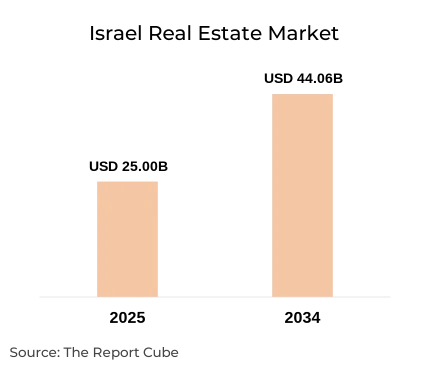
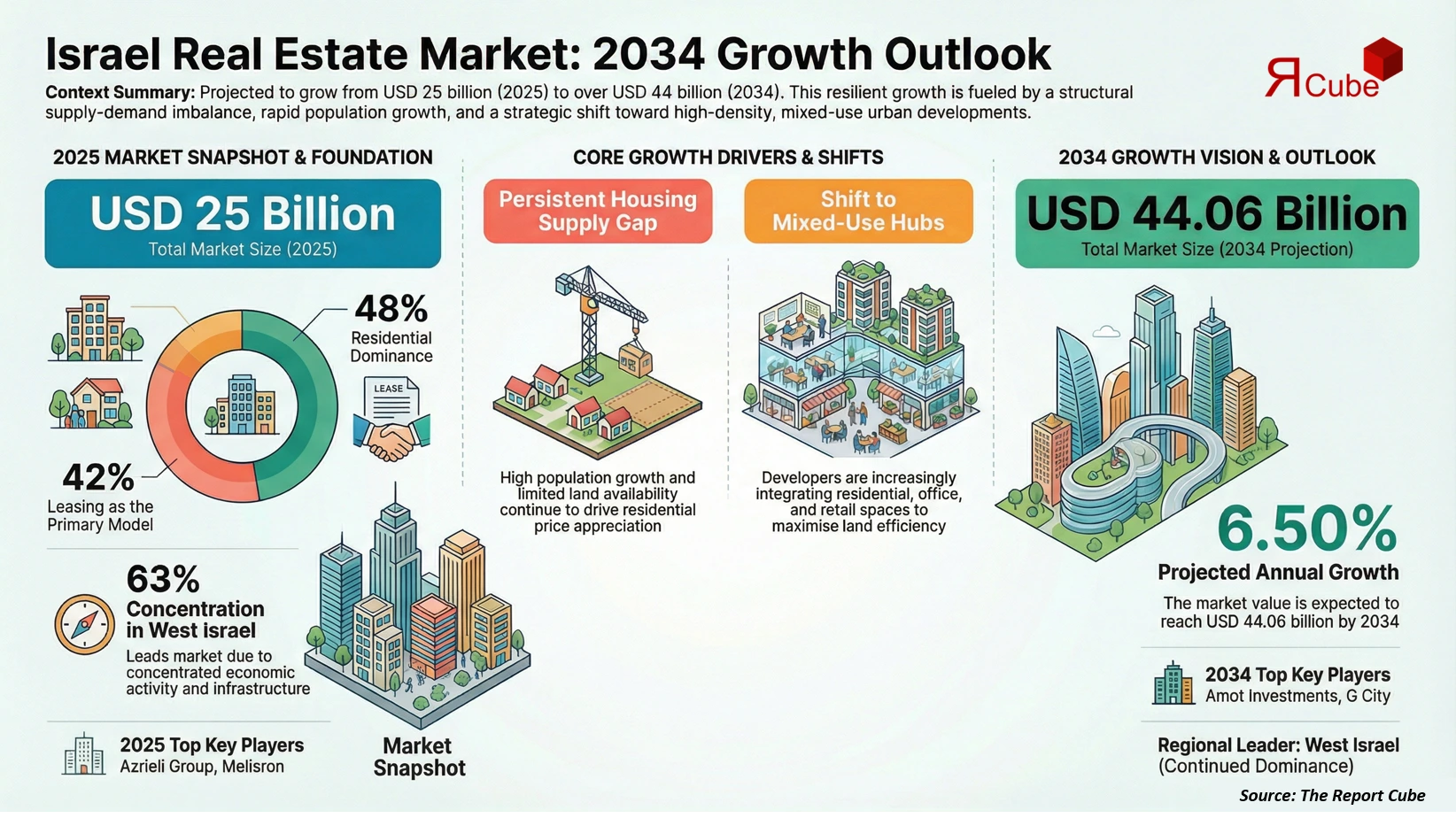
The Israel Real Estate Market is anticipated to register a CAGR of 6.50% during 2026-2034. The market size was valued at USD 25 billion in 2025 and is projected to reach USD 44.06 billion by 2034. The market continues to demonstrate resilience, supported by strong population growth, limited land availability, and consistent demand across residential, commercial, and mixed-use developments. Urbanization trends, combined with Israel’s position as a global technology and innovation hub, are sustaining long-term real estate demand despite periodic economic fluctuations.
Residential real estate remains a cornerstone of the market, driven by rising household formation and sustained immigration inflows. At the same time, commercial segments such as office and retail properties are undergoing structural transformation as developers adapt to hybrid work models and experiential retail concepts. These shifts are encouraging flexible property designs and mixed-use projects that integrate living, working, and leisure spaces.
Furthermore, institutional investment activity has increased steadily, with property funds and REIT structures gaining prominence. Capital inflows from domestic pension funds and international investors seeking stable yields continue to support market liquidity. Collectively, these dynamics position the Israel Real Estate Market for stable expansion through 2034.
Israel Real Estate Market Recent Developments
- 2025: Azrieli Group announced a large-scale mixed-use development expansion in Tel Aviv’s central business district.
- 2025: G City Ltd. advanced redevelopment of urban retail centers into mixed-use lifestyle complexes.
Government Initiatives & Policies
- National Housing Acceleration Program: Government initiative to increase housing supply and reduce approval timelines.
- Urban Renewal and Pinui-Binui Program: Supports redevelopment of aging residential zones into high-density projects.
Israel Real Estate Market Dynamics
Key Driver: Persistent Housing Demand Amid Limited Land Availability
One of the most influential drivers of the Israel Real Estate Market is the structural imbalance between housing demand and land availability. Israel’s population growth rate remains among the highest in developed economies, while developable land is constrained by geographic, regulatory, and security considerations. As a result, housing demand consistently outpaces supply, supporting price appreciation and new project launches. Residential demand is further strengthened by favorable mortgage accessibility and cultural preference for home ownership. These conditions encourage continuous investment in residential and mixed-use developments, sustaining overall market growth.
Book your FREE 30-minute expert consultation today
Contact UsIndustry Trends: Expansion of Mixed-Use and Transit-Oriented Developments
The market is witnessing a clear trend toward mixed-use and transit-oriented developments. Developers are increasingly integrating residential, office, retail, and leisure components within single projects to maximize land efficiency and diversify revenue streams. Proximity to public transportation hubs is becoming a key valuation driver, particularly in dense urban centers. This trend aligns with government urban renewal objectives and changing consumer lifestyles, where convenience and accessibility are prioritized. As a result, mixed-use developments are capturing higher occupancy rates and long-term tenant stability.
Major Challenge: Regulatory Complexity and Lengthy Approval Processes
Despite strong fundamentals, regulatory complexity remains a major challenge for the Israel Real Estate Market. Lengthy planning approvals, zoning restrictions, and environmental compliance requirements can delay project execution and increase development costs. These challenges disproportionately affect smaller developers, limiting competition and slowing supply expansion. Additionally, periodic policy interventions aimed at cooling housing prices introduce uncertainty, affecting investor sentiment and project feasibility. Managing regulatory risk continues to be a critical concern across the industry.
Opportunity: Growth of Institutional Investment and REIT Structures
The rising participation of institutional investors presents a significant opportunity for the market. REITs and property funds are attracting capital from pension funds and insurance companies seeking stable, inflation-linked returns. These structures enhance transparency, improve governance, and increase market liquidity. As institutional ownership expands, demand for high-quality, income-generating assets such as office parks, logistics centers, and retail complexes is expected to rise, supporting sustained market growth.
Israel Real Estate Market Segment-wise Analysis
By Property:
- Residential
- Office
- Retail
- Industrial
Residential property leads the market, accounting for approximately 48% of total market value in 2025. This dominance is driven by continuous housing demand, urban densification, and government-backed development programs. Office and mixed-use assets follow, supported by Israel’s strong technology sector, while industrial real estate benefits from growing logistics and e-commerce activity.
By Business Model:
- Development
- Leasing
- REITs
- Property Funds
Leasing-based models represent the leading business segment, holding nearly 42% market share in 2025. Long-term lease agreements provide predictable cash flows, making them attractive to institutional investors. REITs are gaining traction as an efficient investment vehicle, while development-focused models remain essential for addressing structural supply shortages.
Regional Projection of Israel Real Estate Industry
- East Israel
- West Israel
West Israel dominates the market, contributing approximately 63% of total real estate value in 2025. Major urban centers, economic activity, and infrastructure concentration drive sustained demand across residential and commercial segments. East Israel, while smaller in market share, is witnessing gradual growth through targeted infrastructure investments and housing initiatives, supporting balanced regional development.
Need insights for a specific region within this market?
Request Regional DataWhy Choose This Report?
- Provides a comprehensive overview of the overall market analysis, encompassing key trends, consumer behavior analysis, and risk assessment to support strategic decision-making.
- Provides accurate, up-to-date insights into market size, segmentation, and emerging opportunities, helping to minimize risk & capitalizing on growth.
- Gives deep understanding of target audience preferences, investment habits, and communication channels for enhanced product development & marketing effectiveness.
- Delivers competitive analysis & benchmarking, uncovering the strengths & weaknesses of market competitors to guide strategies.
- Consolidate comprehensive market intelligence, reducing reasoning & streamlining research efforts.
- Facilitates customized market segmentation & risk mitigation strategies, fine-tuned to the business objectives.
- Aids in identifying both market challenges & untapped opportunities within the industry to drive long-term business growth.
- Provides valuable information based on actual customer data & search trends.
Table of Contents
- Introduction
- Objective of the Study
- Product and Category Definition
- Market Segmentation
- Study Variables
- Research Methodology
- Secondary Data Points
- Breakdown of Secondary Sources
- Primary Data Points
- Breakdown of Primary Interviews
- Secondary Data Points
- Executive Summary
- Market Dynamics
- Drivers
- Challenges
- Opportunity Assessment
- Recent Trends and Developments
- Regulatory and Policy Landscape
- Israel Real Estate Market Overview (2021-2034)
- Market Size, By Value (USD Billion)
- Market Share, By Segment
- Residential
- Office
- Retail
- Industrial
- Mixed Use
- Market Share, By Business Model
- Development
- Leasing
- REITs
- Property Funds
- Market Share, By Buyer Type
- Owner Occupier
- Private Investor
- Institutional
- Market Share, By End User
- Households
- Corporates
- Public Sector
- Market Share, By Region
- East Israel
- West Israel
- Market Share, By Company
- Competition Characteristics
- Revenue Shares & Analysis
- East Israel Real Estate Market
- Market Size, By Value (USD Billion)
- Market Share, By Segment
- Market Share, By Business Model
- Market Share, By Buyer Type
- Market Share, By End User
- Market Share, By Sub‑Region
- Jerusalem
- Haifa
- North District
- Rest of East Israel
- West Israel Real Estate Market
- Market Size, By Value (USD Billion)
- Market Share, By Segment
- Market Share, By Business Model
- Market Share, By Buyer Type
- Market Share, By End User
- Market Share, By Sub‑Region
- Tel Aviv
- Central District
- South District
- Rest of West Israel
- Competitive Outlook and Company Profiles
- Azrieli Group Ltd.
- Company Overview
- Property Portfolio
- Strategic Alliances/Partnerships
- Recent Developments
- Melisron Ltd.
- Company Overview
- Property Portfolio
- Strategic Alliances/Partnerships
- Recent Developments
- Amot Investments Ltd.
- Company Overview
- Property Portfolio
- Strategic Alliances/Partnerships
- Recent Developments
- G City Ltd.
- Company Overview
- Property Portfolio
- Strategic Alliances/Partnerships
- Recent Developments
- BIG Shopping Centers Ltd.
- Company Overview
- Property Portfolio
- Strategic Alliances/Partnerships
- Recent Developments
- Alony‑Hetz Properties Ltd.
- Company Overview
- Property Portfolio
- Strategic Alliances/Partnerships
- Recent Developments
- Gav‑Yam Land Corp. Ltd.
- Company Overview
- Property Portfolio
- Strategic Alliances/Partnerships
- Recent Developments
- Mivne Real Estate (K.D.) Ltd.
- Company Overview
- Property Portfolio
- Strategic Alliances/Partnerships
- Recent Developments
- Ashtrom Group Ltd.
- Company Overview
- Property Portfolio
- Strategic Alliances/Partnerships
- Recent Developments
- Arko Holdings Ltd.
- Company Overview
- Property Portfolio
- Strategic Alliances/Partnerships
- Recent Developments
- Others
- Azrieli Group Ltd.
- Contact Us and Disclaimer
Top Key Players & Market Share Outlook
- Azrieli Group Ltd.
- Melisron Ltd.
- Amot Investments Ltd.
- G City Ltd.
- BIG Shopping Centers Ltd.
- Alony‑Hetz Properties Ltd.
- Gav‑Yam Land Corp. Ltd.
- Mivne Real Estate (K.D.) Ltd.
- Ashtrom Group Ltd.
- Arko Holdings Ltd.
- Others
Frequently Asked Questions






