



Build Your Custom Market Intelligence Report
Customize Your ReportKey Takeaways
- U.S. Recycled Carbon Fiber Market valued at USD 0.76 billion in 2026, reflecting accelerating sustainability-driven procurement.
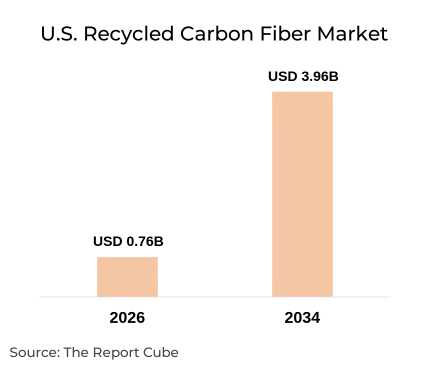
- Industry projected to reach USD 3.96 billion by 2034, expanding at a 22.90% CAGR through the forecast period.
- Chopped carbon fiber leads the fiber type segment, favored for its versatility in injection molding and composite applications.
- Pre-consumer scrap dominates the source segment due to consistent quality and easier processing logistics.
- Aerospace and automotive end-users represent the fastest-growing procurement channels for recycled carbon fiber.
- Vartega Inc. and Carbon Fiber Remanufacturing are key domestic recycled carbon fiber processors operating across the U.S.
- Lightweighting mandates, federal sustainability directives, and circular economy policy frameworks are reshaping fiber procurement decisions.
- Non-woven mats and milled fiber formats are gaining procurement share among industrial composite and tooling manufacturers.
Market Overview
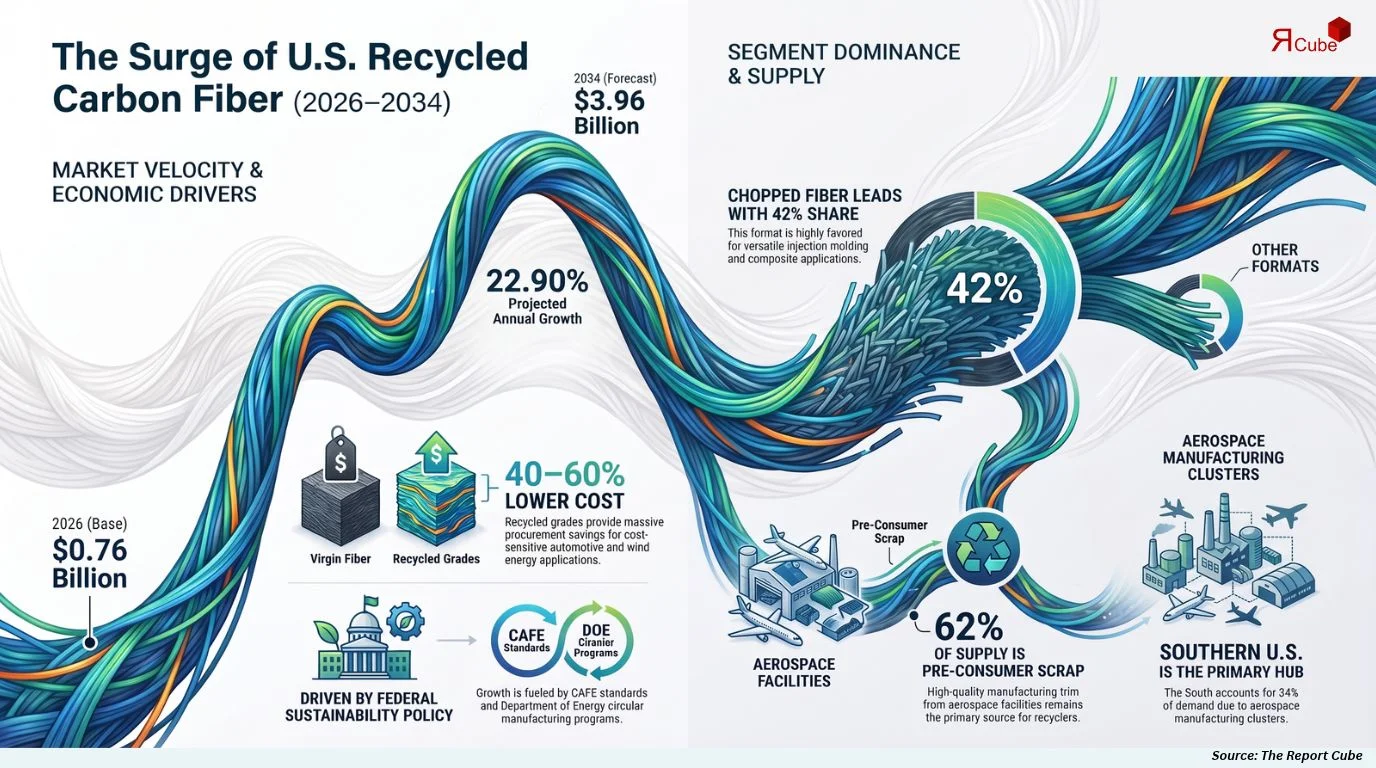
A comprehensive U.S. Recycled Carbon Fiber Market Analysis reveals that the market was valued at USD 0.76 billion in 2026 and is projected to reach USD 3.96 billion by 2034, advancing at a 22.90% CAGR. Surging demand from aerospace, automotive, wind energy, and construction sectors is driving procurement of cost-effective, performance-grade recycled carbon fiber. Federal sustainability initiatives, including Department of Energy-backed circular manufacturing programs, are strengthening domestic processing infrastructure and enabling scale-up of pyrolysis-based fiber recovery operations across key U.S. industrial states.
The U.S. recycled carbon fiber sector benefits from a growing volume of pre-consumer manufacturing scrap generated by aerospace and industrial composite facilities, alongside increasing post-consumer end-of-life inputs from decommissioned wind turbine blades and retired aircraft. Suppliers including Vartega Inc. and Carbon Fiber Remanufacturing are expanding processing capacity to meet rising buyer demand for consistent-quality chopped and milled fiber formats. Hexcel Corporation's involvement in advanced fiber supply chains further reinforces domestic procurement confidence among high-performance composite manufacturers.
Market Size & Forecast
|
Metric |
Details |
|---|---|
|
Market Size (2026) |
USD 0.76 Billion |
|
Market Size (2034) |
USD 3.96 Billion |
|
CAGR (2026–2034) |
22.90% |
|
Base Year |
2026 |
|
Historical Years |
2021–2025 |
|
Forecast Years |
2026–2034 |
The U.S. Recycled Carbon Fiber Market Size study values the industry at USD 0.76 billion in 2026, projecting growth to USD 3.96 billion by 2034 at a 22.90% CAGR. This trajectory significantly outpaces global advanced composites market averages, driven by expanding domestic scrap volumes, scaled pyrolysis processing capacity, and accelerating adoption of recycled fiber in structural automotive and aerospace composite applications through the forecast period.
Market Dynamics
The U.S. recycled carbon fiber sector is undergoing transformative structural expansion as composite scrap volumes rise, processing technologies mature, and end-user industries intensify sustainability commitments. Federal lightweighting regulations, expanding wind energy decommissioning activity, and growing commercial pressure to reduce virgin carbon fiber dependency are collectively accelerating the U.S. Recycled Carbon Fiber Market Growth across automotive, aerospace, and industrial composite manufacturing channels.
|
Factor |
Type |
Specific Impact on Market |
Magnitude |
|---|---|---|---|
|
Lightweighting mandates in automotive and aerospace |
Driver |
Accelerates recycled carbon fiber adoption in structural component manufacturing |
High |
|
Wind turbine blade decommissioning volumes |
Driver |
Expands post-consumer scrap supply for recycled fiber recovery operations |
High |
|
High virgin carbon fiber substitution cost savings |
Opportunity |
Incentivizes OEM procurement shift toward recycled fiber grade integration |
High |
|
Inconsistent fiber mechanical property distribution |
Challenge |
Limits recycled fiber adoption in high-specification structural applications |
Medium |
|
Circular economy and EPA sustainability frameworks |
Trend |
Encourages manufacturer investment in closed-loop composite recycling systems |
Medium |
- Growth Drivers - Lightweighting Policy and Composite Scrap Availability: Federal Corporate Average Fuel Economy (CAFE) standards and aerospace emissions reduction targets are compelling manufacturers to adopt lightweight composite materials. Simultaneously, expanding composite manufacturing scrap from Boeing, Airbus U.S. facilities, and automotive body panel producers is providing consistent pre-consumer fiber inputs to processors including Vartega Inc. and Carbon Fiber Remanufacturing.
- Market Restraints - Mechanical Property Variability in Recovered Fiber: Recycled carbon fiber, particularly post-consumer grades, exhibits tensile strength variability compared to virgin fiber, limiting uptake in load-critical aerospace structural components. Inconsistent fiber length distribution from pyrolysis processing creates quality grading challenges that increase downstream composite formulation complexity and restrict penetration into primary structural applications.
- Market Opportunities - Cost Parity and OEM Circular Supply Chain Programs: Recycled carbon fiber commands a 40–60% cost discount versus virgin equivalents, creating compelling procurement economics for cost-sensitive automotive and wind energy applications. Major OEMs including BMW, Ford, and Siemens Gamesa are actively developing circular fiber supply agreements with domestic processors, generating long-term offtake certainty that supports further processing capacity investment.
- Industry Challenges - Scaling Post-Consumer Collection Infrastructure: Post-consumer carbon fiber recovery - particularly from end-of-life wind blades and retired aircraft - requires coordinated logistics, deconstruction capability, and standardized quality classification systems. The absence of a nationally unified composite waste collection framework increases processing costs and complicates supply chain planning for recycled fiber producers targeting volume-scale commercial markets.
Need Specific Data, Let’s Customize the Report for You
Request CustomizationMarket Trends
- Emerging Trends: The U.S. Recycled Carbon Fiber Market Trends reflect a decisive shift toward circular composite supply chains, with aerospace and automotive OEMs establishing direct partnerships with domestic fiber recyclers. Growing volumes of decommissioned wind turbine blades entering the recycling stream are transforming post-consumer scrap into a structurally significant and increasingly reliable fiber input source.
- Technology Trends: Pyrolysis remains the dominant commercial recycling technology, with continuous improvement in temperature control enabling higher tensile strength retention in recovered fiber. Solvolysis and supercritical fluid processes are advancing toward commercial scale, promising cleaner fiber surface chemistry and improved resin compatibility for high-performance composite remanufacturing applications.
- Consumer / Buyer Trends: Procurement teams at aerospace primes and automotive OEMs are developing formal recycled content specifications and supplier qualification protocols, treating recycled carbon fiber as a strategic material category rather than a cost alternative. Over 70% of U.S. composite fabricators surveyed report active evaluation of recycled fiber integration into at least one product line by 2026.
- Regulatory Trends: The U.S. EPA's circular economy framework and emerging extended producer responsibility (EPR) regulations for composite materials are accelerating corporate adoption of recycled fiber procurement targets. The Inflation Reduction Act's clean manufacturing incentives provide additional fiscal support for domestic recycled fiber processing facilities investing in energy-efficient pyrolysis systems.
U.S. Recycled Carbon Fiber Market Segment Analysis
The U.S. recycled carbon fiber market serves distinct end-use manufacturing applications across multiple fiber format types and scrap source categories, each governed by unique quality requirements, processing pathways, and commercial procurement drivers.
By Fiber Type
- Chopped Carbon Fiber
- Milled Carbon Fiber
- Non-Woven Mats / Felts
- Continuous Recycled Yarn / Fabric
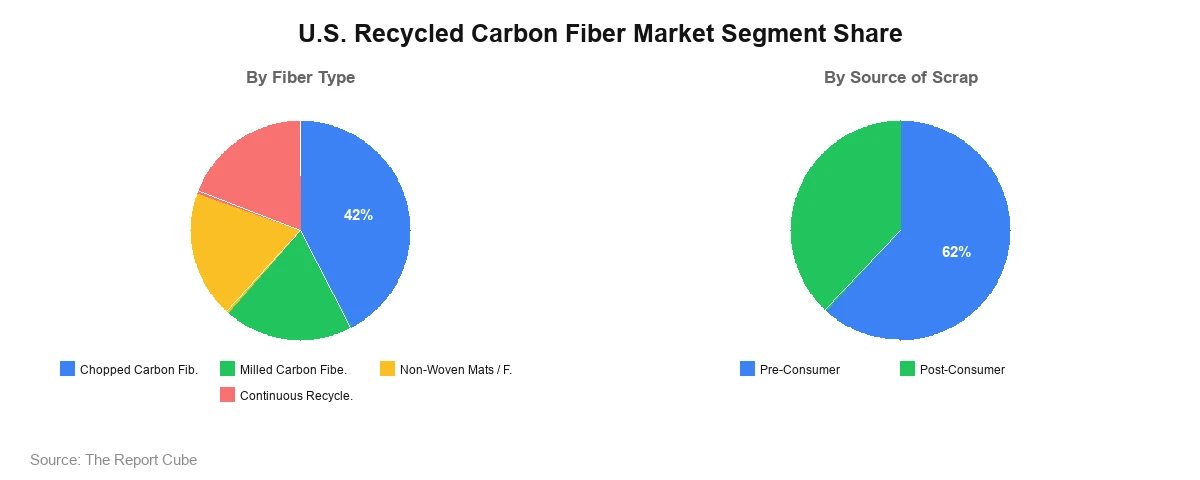
Chopped carbon fiber commands the leading U.S. Recycled Carbon Fiber Market Share among all fiber type sub-segments, accounting for an estimated 42% of 2026 market volume. Vartega Inc. and Carbon Fiber Remanufacturing supply chopped fiber grades widely used in injection-molded automotive components, sports equipment housings, and industrial tooling applications. Milled carbon fiber holds approximately 28% share, serving thermoplastic compounders and friction material manufacturers. Non-woven mats and felts represent around 20% of fiber type demand, with Hexcel Corporation supplying composite preform manufacturers. Continuous recycled yarn and fabric captures the remaining 10%, primarily serving niche performance textile and advanced composite applications.
By Source of Scrap
- Pre-Consumer
- Post-Consumer
Pre-consumer scrap sources dominate the U.S. recycled carbon fiber procurement landscape, representing approximately 62% of 2026 market volume. Manufacturing trim, cut-offs, and out-of-spec material from aerospace composite fabricators - including facilities supplying Boeing and Lockheed Martin programs - provide high-quality, chemically consistent fiber inputs. Vartega Inc. and Carbon Fiber Remanufacturing process significant volumes of pre-consumer scrap under direct supply agreements with aerospace composite manufacturers. Post-consumer sources account for approximately 38% of market volume, with decommissioned wind turbine blades constituting the fastest-growing input category as the first generation of commercial wind installations reaches end-of-life through 2026–2034.
Regional Analysis
|
Region |
Estimated Market Share |
Key Growth Factors |
Consumer Trends |
|---|---|---|---|
|
South |
34% |
Aerospace manufacturing concentration, Boeing and Airbus U.S. facilities, wind energy decommissioning activity |
Pre-consumer scrap procurement, chopped fiber demand from aerospace composite shops |
|
West |
28% |
Advanced automotive OEM presence, SpaceX and aerospace composites, clean technology manufacturing growth |
High-performance recycled fiber adoption, continuous yarn demand from aerospace |
|
Midwest |
22% |
Automotive manufacturing base, wind turbine production and decommissioning volumes, industrial composites |
Chopped fiber for injection molding, non-woven mat procurement for automotive |
|
Northeast |
16% |
Defense and marine composite manufacturing, academic R&D commercialization, infrastructure composite adoption |
Specialty fiber format demand, milled fiber for friction and tooling materials |
- South (34%): The South leads U.S. recycled carbon fiber market demand, anchored by aerospace composite manufacturing clusters in Alabama, South Carolina, and Texas. Boeing's South Carolina composite fabrication operations generate substantial pre-consumer scrap volumes, supporting regional fiber recovery activity. Wind energy decommissioning across Texas - the nation's largest wind power state - is rapidly expanding post-consumer fiber inputs to regional processors.
- West (28%): California, Washington, and Arizona host advanced aerospace, electric vehicle, and commercial space manufacturing operations generating consistent pre-consumer composite scrap. Tesla's vehicle lightweighting programs and SpaceX's composite-intensive launch vehicle manufacturing contribute to regional recycled carbon fiber procurement demand. Domestic processors are expanding West Coast partnerships with automotive and aerospace OEMs.
- Midwest (22%): Michigan, Ohio, and Indiana automotive manufacturing clusters represent significant chopped recycled carbon fiber procurement markets, with OEM suppliers integrating recycled fiber into injection-molded structural components. The Midwest's wind turbine installation density - particularly in Iowa, Illinois, and Minnesota - is creating substantial post-consumer blade decommissioning volumes that will increasingly feed regional fiber recovery operations.
- Northeast (16%): Defense shipbuilding, marine composites, and advanced manufacturing clusters across Connecticut, Massachusetts, and New York generate specialty fiber demand. University commercialization programs and DOE-funded composites research centers in the Northeast are advancing fiber recycling technologies toward commercial adoption, supporting longer-term regional market development.
Market Share & Competitive Landscape
The U.S. recycled carbon fiber competitive landscape centers on a concentrated set of specialized domestic processors and integrated composite material manufacturers, with competition focused on fiber quality consistency, processing throughput, format versatility, and strategic OEM supply relationships.
|
Company |
Competitive Strength |
Primary Segment Served |
|---|---|---|
|
Vartega Inc. |
Pyrolysis-based chopped fiber recovery, OEM supply partnerships |
Aerospace pre-consumer scrap, automotive chopped fiber |
|
Carbon Fiber Remanufacturing |
Scalable domestic processing, multi-format output capability |
Pre-consumer and post-consumer scrap, industrial composites |
|
Hexcel Corporation |
Integrated composite material supply chain, advanced fiber formats |
Non-woven mats, aerospace and defense composite fabricators |
|
Others |
Emerging processors, regional scrap collectors, specialty format suppliers |
Post-consumer wind blade scrap, niche composite applications |
Key Companies in the U.S. Recycled Carbon Fiber Market
Vartega Inc.
Vartega Inc., headquartered in Golden, Colorado, is a specialized recycled carbon fiber processor founded to address aerospace composite manufacturing scrap recovery. The company operates a proprietary solvent-based fiber recovery process that preserves fiber mechanical properties. In 2024, Vartega expanded processing agreements with aerospace composite manufacturers, strengthening its position as a leading domestic pre-consumer fiber recovery partner serving automotive and aerospace end-users.
Carbon Fiber Remanufacturing
Carbon Fiber Remanufacturing, based in the United States, focuses on recovering high-quality carbon fiber from manufacturing scrap and end-of-life composite structures. The company's multi-format processing capability enables production of chopped, milled, and non-woven mat fiber products for industrial and automotive customers. In 2025, it advanced post-consumer wind blade scrap processing programs, addressing one of the U.S. market's most rapidly expanding recycled fiber supply streams.
Recent Developments
|
Year |
Company |
Development |
|---|---|---|
|
2025 |
Vartega Inc. |
Announced expanded commercial processing capacity and new OEM supply agreements for aerospace-grade recycled chopped carbon fiber |
|
2025 |
Carbon Fiber Remanufacturing |
Advanced wind turbine blade-to-fiber processing program targeting post-consumer composite scrap from decommissioned U.S. wind installations |
Future Outlook
The U.S. Recycled Carbon Fiber Market Forecast projects the industry reaching USD 3.96 billion by 2034, driven by rising composite scrap volumes, expanding post-consumer wind blade decommissioning, and accelerating OEM circular fiber procurement programs. Aerospace, automotive, and wind energy sectors will sustain the strongest end-user demand growth, with Vartega Inc., Carbon Fiber Remanufacturing, and Hexcel Corporation expected to deepen market penetration through expanded processing infrastructure and long-term OEM supply partnerships through 2034.
Advanced recycling technologies - including solvolysis systems capable of recovering fiber with near-virgin mechanical properties - will increasingly enter commercial operation, expanding recycled fiber adoption into primary structural aerospace and automotive applications. Federal circular economy incentives under the Inflation Reduction Act, evolving EPA composite waste frameworks, and growing corporate net-zero procurement commitments will collectively reinforce market growth through stringent sustainability standards across the U.S. recycled carbon fiber supply chain.
U.S. Recycled Carbon Fiber Market Report Coverage
This U.S. Recycled Carbon Fiber Market Report covers the full forecast period 2026–2034, providing complete segmentation, regional, and competitive intelligence for industry stakeholders.
|
Report Attribute |
Details |
|---|---|
|
Market Name |
U.S. Recycled Carbon Fiber Market |
|
Market Size (2026) |
USD 0.76 Billion |
|
Market Size (2034) |
USD 3.96 Billion |
|
Forecast Period |
2026–2034 |
|
CAGR |
22.90% |
|
Base Year |
2026 |
|
Historical Years |
2021–2025 |
|
Forecast Years |
2026–2034 |
|
Segments Covered |
By End-Use, By Fiber Type, By Source of Scrap |
|
Regions Covered |
Northeast, Midwest, South, West |
|
Key Companies |
Vartega Inc., Carbon Fiber Remanufacturing, Hexcel Corporation, Others |
|
Report Format |
PDF, Excel, PPT |
|
Customization |
Available as per client requirements |
Why Choose This U.S. Recycled Carbon Fiber Market Report?
- Comprehensive coverage of the U.S. recycled carbon fiber market across all fiber type formats and scrap source categories.
- Accurate market sizing from USD 0.76 billion in 2026 through the USD 3.96 billion 2034 forecast at 22.90% CAGR.
- Detailed segmentation by fiber type (Chopped, Milled, Non-Woven Mats, Continuous Yarn) and scrap source (Pre-Consumer, Post-Consumer).
- Regional insights covering all four U.S. census divisions with estimated demand share and growth factor analysis.
- Competitive profiling of key domestic recycled carbon fiber processors and integrated composite material suppliers.
- Analysis of pyrolysis and solvolysis technology trends reshaping fiber quality and commercial application scope.
- Forecast data supporting strategic sourcing, investment planning, and OEM circular supply chain development decisions.
- Research aligned with U.S. federal circular economy, clean manufacturing, and Inflation Reduction Act sustainability policy frameworks.
Table of Contents
- Introduction
- Objective of the Study
- Product Definition
- Market Segmentation
- Study Variables
- Research Methodology
- Secondary Data Points
- Companies Interviewed
- Primary Data Points
- Breakdown of Primary Interviews
- Secondary Data Points
- Executive Summary
- Market Dynamics
- Drivers
- Challenges
- Opportunity Assessment
- Recent Trends and Developments
- Policy and Regulatory Landscape
- Recycled Carbon Fiber Market Overview and Forecast Analysis (2021-2034)
- Market Size, By Value, By Growth Rate (CAGR/USD Billions)
- Demand – Supply Trends
- Market Share, By End-Use
- Aerospace & Defense
- Automotive
- Sporting Goods
- Wind Energy
- Marine & Construction
- Market Share, By Fiber Type
- Chopped Carbon Fiber
- Milled Carbon Fiber
- Non-Woven Mats / Felts
- Continuous Recycled Yarn / Fabric
- Market Share, By Source of Scrap
- Pre-Consumer
- Post-Consumer
- Market Share, By Region
- Northeast
- Midwest
- South
- West
- Market Share, By Competitors
- Competition Characteristics
- Revenue Shares
- Aerospace & Defense Recycled Carbon Fiber Market Overview, 2021-2034F
- By Value (USD Million)
- By Fiber Type – Market Size & Forecast 2021-2034, USD Million
- Chopped Carbon Fiber
- Milled Carbon Fiber
- Non-Woven Mats / Felts
- Continuous Recycled Yarn / Fabric
- Automotive Recycled Carbon Fiber Market Overview, 2021-2034F
- By Value (USD Million)
- By Fiber Type – Market Size & Forecast 2021-2034, USD Million
- Chopped Carbon Fiber
- Milled Carbon Fiber
- Non-Woven Mats / Felts
- Continuous Recycled Yarn / Fabric
- Sporting Goods Recycled Carbon Fiber Market Overview, 2021-2034F
- By Value (USD Million)
- By Fiber Type – Market Size & Forecast 2021-2034, USD Million
- Chopped Carbon Fiber
- Milled Carbon Fiber
- Non-Woven Mats / Felts
- Continuous Recycled Yarn / Fabric
- Wind Energy Recycled Carbon Fiber Market Overview, 2021-2034F
- By Value (USD Million)
- By Fiber Type – Market Size & Forecast 2021-2034, USD Million
- Chopped Carbon Fiber
- Milled Carbon Fiber
- Non-Woven Mats / Felts
- Continuous Recycled Yarn / Fabric
- Marine & Construction Recycled Carbon Fiber Market Overview, 2021-2034F
- By Value (USD Million)
- By Fiber Type – Market Size & Forecast 2021-2034, USD Million
- Chopped Carbon Fiber
- Milled Carbon Fiber
- Non-Woven Mats / Felts
- Continuous Recycled Yarn / Fabric
- Competitive Outlook (Company Profile - Partial List)
- Vartega Inc.
- Company Overview
- Business Segments
- Strategic Alliances/Partnerships
- Recent Developments
- Carbon Fiber Remanufacturing
- Company Overview
- Business Segments
- Strategic Alliances/Partnerships
- Recent Developments
- Hexcel Corporation
- Company Overview
- Business Segments
- Strategic Alliances/Partnerships
- Recent Developments
- Others
- Vartega Inc.
- Contact Us & Disclaimer
Top Key Players & Market Share Outlook
- Vartega Inc.
- Carbon Fiber Remanufacturing
- Hexcel Corporation
- Others
Frequently Asked Questions






