



Build Your Custom Market Intelligence Report
Customize Your ReportGlobal Recycled Polyester Market Key Highlights
By Feedstock Source:
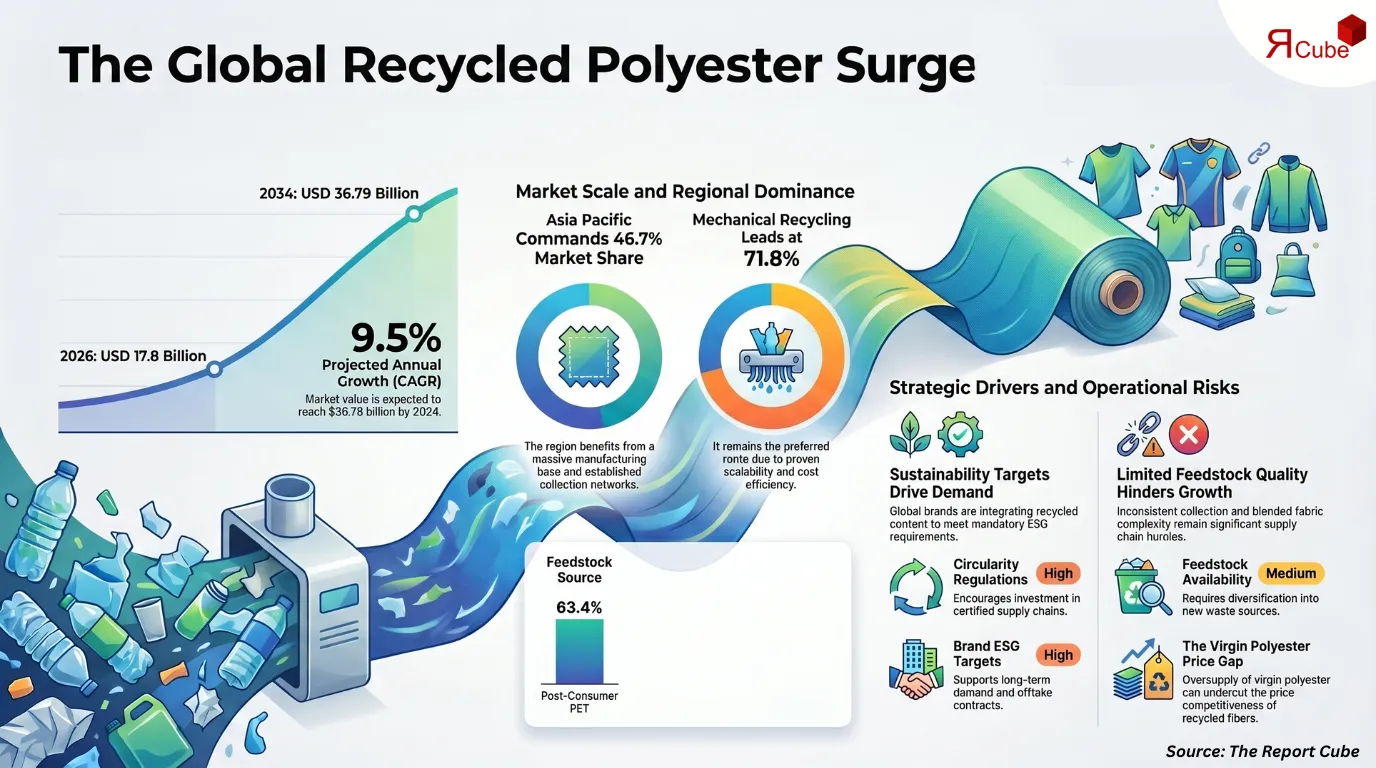
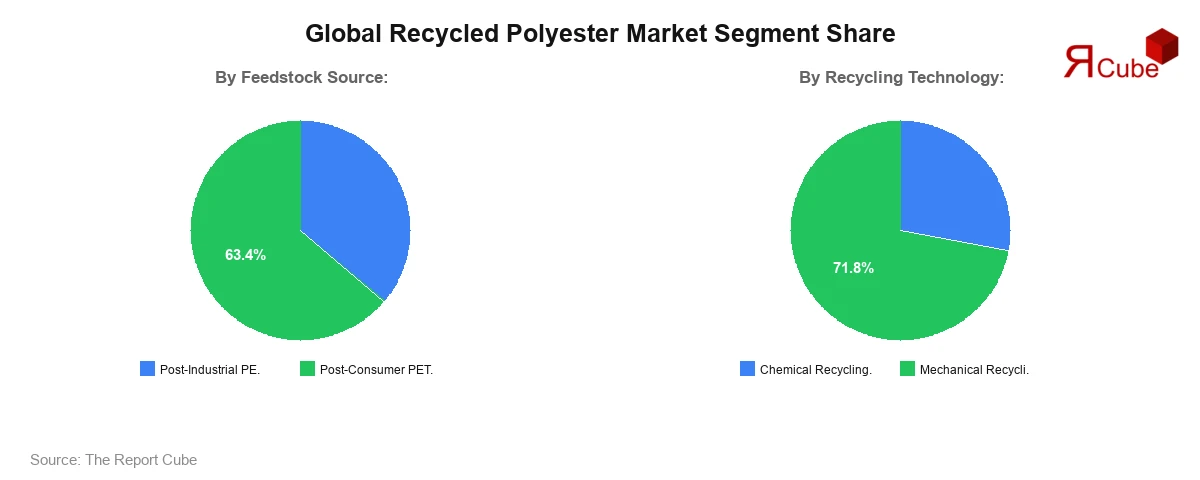
Post-Consumer PET segment leads the market with nearly 63.4% share.
By Recycling Technology:
Mechanical Recycling segment dominates the market with approximately 71.8% of revenue.
Regional Outlook:
Asia Pacific region dominates the Global Recycled Polyester Market with around 46.7% share.
Global Recycled Polyester Market Insights & Analysis
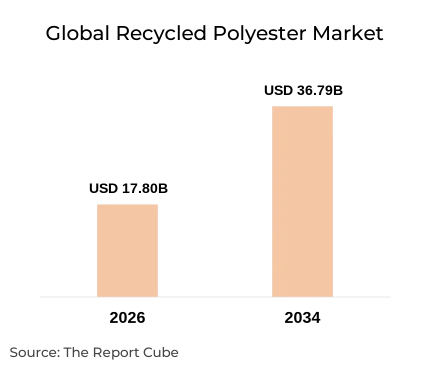
The Global Recycled Polyester Market is anticipated to register a CAGR of around 9.5% during the forecast period 2026-2034. The market size is valued at USD 17.8 billion in 2026 and is projected to reach USD 36.79 billion by 2034. Market momentum is increasingly linked to sustainability commitments established by global apparel manufacturers, packaging companies, and consumer brands seeking to reduce dependence on virgin petrochemical-based fibers. Recycled polyester has emerged as a strategic material within corporate decarbonization roadmaps because its production can significantly reduce greenhouse gas emissions and energy consumption compared to conventional polyester manufacturing. The rapid expansion of recycled content requirements across textile supply chains is further strengthening long-term demand.
Industry participants are also witnessing a structural shift in raw material sourcing and recycling technologies. Investments in textile recovery facilities, advanced sorting systems, and chemical depolymerization plants are improving the commercial viability of textile-to-textile recycling. Several multinational fiber producers and recycling companies have announced capacity expansion projects to secure feedstock availability and strengthen regional supply chains. In parallel, improvements in traceability platforms and certification frameworks are helping brands verify recycled content claims, supporting wider adoption across premium apparel, automotive textiles, home furnishings, and industrial applications.
Global Recycled Polyester Market Impact Analysis
| Factor | Type | Specific Impact on Market | Magnitude | Business Implication |
|---|---|---|---|---|
| Brand Sustainability Commitments | Market Driver | Apparel and textile brands set recycled content and ESG targets globally | High | Supports long term demand visibility and offtake contracts for rPET |
| Regulations on Waste and Circularity | Regulatory Driver | Policies on EPR, packaging waste and textile recycling favor recycled inputs | High | Encourages investment in recycling plants and certified supply chains |
| Environmental Footprint Advantage | Environmental | Lower carbon, energy and water use versus virgin polyester production | High | Enables premium positioning and access to climate linked financing tools |
| Feedstock Availability and Quality | Supply Constraint | Heavy reliance on PET bottles and limited textile to textile streams | Medium | Requires diversification into new waste sources and better collection |
| Technology Innovation in Recycling | Technological | Mechanical and chemical routes improve yields and fibre performance | Medium | Creates scope for higher value applications beyond basic textiles |
| Price Gap with Virgin Polyester | Competitive | Virgin polyester oversupply can undercut rPET price competitiveness | Medium | Necessitates value selling on ESG benefits and long term contracts |
| Consumer Preference for Eco Textiles | Consumer | Rising awareness of waste and microplastic issues lifts green demand | Medium | Supports brand differentiation using certified recycled polyester lines |
Global Recycled Polyester Market Dynamics
Key Driver: Sustainability Commitments and Circular Economy Targets Accelerating Polyester Recycling
Sustainability commitments from major apparel and consumer goods companies have transformed recycled polyester from an alternative material into a mainstream sourcing strategy. Global brands are increasingly integrating recycled polyester into product portfolios to meet environmental targets, reduce reliance on fossil fuel-derived feedstocks, and align with evolving stakeholder expectations. As environmental disclosures become more transparent, companies are prioritizing materials capable of demonstrating measurable reductions in carbon emissions and resource consumption.
The shift is particularly visible across sportswear, fashion, and outdoor apparel segments, where recycled polyester content is becoming a standard procurement requirement rather than a niche offering. Long-term purchasing agreements between manufacturers and recyclers are creating greater supply chain stability while encouraging investment in collection and processing infrastructure. These developments are reinforcing the role of recycled polyester as a core material within the broader transition toward circular manufacturing systems
Industry Trends: Commercialization of Textile-to-Textile Recycling Technologies
One of the most influential developments shaping the industry is the emergence of textile-to-textile recycling. Historically, recycled polyester production relied heavily on PET bottles; however, increasing demand for circular textile solutions is encouraging the recovery and reuse of post-consumer garments. This transition enables the industry to address growing volumes of textile waste while creating a more sustainable fiber production ecosystem.
At the same time, advanced recycling technologies are moving beyond pilot-scale operations into commercial deployment. Processes such as glycolysis, methanolysis, and enzymatic recycling are attracting investment because they can recover high-quality polyester from complex waste streams that are difficult to process through conventional methods. As these technologies mature, manufacturers are expected to achieve higher material recovery rates, improved product consistency, and expanded access to premium-value applications.
Book your FREE 30-minute expert consultation today
Contact UsMajor Challenge: Limited Availability of High-Quality Feedstock
Although recycling capacity continues to expand globally, securing a reliable supply of high-quality polyester waste remains a significant operational challenge. Many regions still lack efficient collection systems for post-consumer textiles, resulting in inconsistent feedstock availability and elevated contamination levels. The increasing use of blended fabrics further complicates recycling processes because separating polyester from natural fibers often requires additional processing steps and higher costs.
Market participants must also navigate fluctuations in virgin polyester pricing, which can influence purchasing decisions among cost-sensitive end users. During periods of lower petrochemical feedstock prices, recycled polyester manufacturers may face pressure on margins and competitiveness. Addressing these challenges will require coordinated investments in collection networks, automated sorting technologies, and waste management infrastructure capable of supporting large-scale circular textile systems.
Opportunity: Regulatory Support Creating Long-Term Growth Potential
Government-backed circular economy initiatives are creating favorable conditions for recycled polyester manufacturers worldwide. Regulatory frameworks focused on waste reduction, recycling targets, and producer accountability are encouraging greater participation in material recovery programs. These policies are improving collection rates while increasing the availability of recyclable feedstock across key markets.
Additional opportunities are emerging from recycled content requirements introduced across textile, packaging, and consumer goods sectors. As manufacturers prepare for stricter sustainability standards, demand for certified recycled polyester is expected to accelerate. Companies investing in advanced recycling infrastructure, traceability systems, and closed-loop manufacturing models are likely to benefit from expanding procurement requirements and long-term supply agreements across global value chains.
Global Recycled Polyester Market Segment-wise Analysis
By Feedstock Source:
- Post-Industrial PET
- Film Scrap
- Resin and Polymer Production Scrap
- Textile and Yarn Waste
- Post-Consumer PET
- PET Packaging Waste
- Used Polyester Textiles
- PET Bottles
- Others
Post-Consumer PET emerged as the leading feedstock segment in the Global Recycled Polyester Market, capturing approximately 63.4% of total market revenue in 2026. The segment benefits from a rapidly expanding collection network for PET bottles and growing investments in textile waste recovery infrastructure across major economies. Beverage containers remain the most widely recycled source due to their consistent material quality and established processing ecosystem.
At the same time, the recovery of used polyester garments is gaining commercial traction as apparel manufacturers accelerate their transition toward circular production models and recycled content commitments. Regulatory measures aimed at reducing landfill disposal and increasing recycling rates are encouraging municipalities and private waste management operators to strengthen collection programs. Continuous improvements in sorting efficiency, contamination removal technologies, and fiber-to-fiber recycling capabilities are expected to enhance feedstock availability, reinforcing the strategic importance of post-consumer PET throughout the forecast period.
By Recycling Technology:
- Chemical Recycling
- Hydrolysis
- Enzymatic Recycling
- Methanolysis
- Glycolysis
- Others
- Mechanical Recycling
Mechanical Recycling accounted for nearly 71.8% of the Global Recycled Polyester Market revenue in 2026, supported by its proven scalability, cost efficiency, and widespread commercial adoption. The technology remains the preferred recycling route for converting post-consumer PET bottles into polyester fibers used in apparel, home textiles, automotive fabrics, and packaging applications.
Established processing infrastructure and relatively lower operational costs continue to make mechanical recycling attractive for manufacturers seeking reliable recycled material supply. Meanwhile, chemical recycling technologies are attracting growing industry attention as they offer the ability to process complex, blended, and contaminated polyester waste streams that are difficult to recycle mechanically. Advancements in depolymerization processes, glycolysis systems, and emerging enzymatic solutions are improving material purity and enabling the production of high-performance recycled polyester with properties comparable to virgin fibers. These developments are expected to diversify recycling pathways and support long-term market expansion.
Regional Projection of Global Recycled Polyester Industry
- North America
- Europe
- Asia Pacific
- Middle East and Africa
- South America
Asia Pacific held the dominant position in the Global Recycled Polyester Market, representing approximately 46.7% of global revenue in 2026. The region's leadership is supported by its extensive textile and apparel manufacturing base, abundant availability of recyclable PET waste, and significant investments in recycling infrastructure. Countries such as China, India, Taiwan, Indonesia, and Vietnam continue to strengthen their roles in global recycled fiber production through capacity expansions and technological upgrades. Growing environmental regulations, increasing recycled-content requirements, and corporate sustainability initiatives are encouraging manufacturers to integrate recycled polyester into mainstream production processes.
In addition, the region benefits from a well-developed supply chain that connects waste collection, material processing, and textile manufacturing operations. Europe remains a key contributor driven by circular economy policies and sustainable textile regulations, while North America is witnessing increased investment in advanced recycling facilities and domestic sourcing strategies aimed at enhancing supply chain resilience and reducing dependence on imported recycled materials.
Need insights for a specific region within this market?
Request Regional DataGlobal Recycled Polyester Market Regional Analysis
The global recycled polyester market varies significantly across regions due to regulatory frameworks, manufacturing capabilities, and sustainability adoption rates.
| Region | Demand Level | Key Areas | System Dominance | Core Demand Logic | Growth Nature |
|---|---|---|---|---|---|
| North America | High | US, Canada | Bottle-to-fiber recycling | Brand sustainability & consumer awareness | Regulatory-driven growth |
| Europe | Very High | Germany, UK, France | Textile-to-textile & chemical recycling | Mandatory waste collection & circular economy | Fastest regulatory push |
| Asia Pacific | Extremely High | China, India, Indonesia | Large-scale mechanical recycling | Manufacturing dominance & waste generation | Volume-driven expansion |
| Middle East and Africa | Low to Medium | UAE, South Africa | Emerging recycled PSF adoption | Infrastructure investment & retail growth | Early-stage development |
| South America | Medium | Brazil, Colombia, Peru | Limited rPET infrastructure | Nearshoring & textile processing growth | Infrastructure-constrained |
Government Initiatives & Policies
- European Union Strategy for Sustainable and Circular Textiles: The European Commission promotes recyclable textile production, recycled fiber adoption, waste reduction, and circular material systems across member states, supporting long-term growth of recycled polyester manufacturing and textile recycling infrastructure.
- U.S. EPA National Strategy to Prevent Plastic Pollution: The program supports circular economy development through improved recycling systems, waste reduction initiatives, material recovery investments, and policies designed to strengthen recycled plastic and polyester value chains.
Global Recycled Polyester Industry Recent Developments
- 2025: Unifi, Inc. released its 2024 Sustainability Snapshot, highlighting measurable progress in textile-to-textile recycling initiatives and the expansion of next-generation REPREVE® recycled product offerings designed to strengthen circular textile manufacturing.
- 2025: Indorama Ventures Public Company Limited announced that it had recycled 150 billion PET bottles globally, reinforcing its position in circular economy development and expanding recycled polyester feedstock availability for downstream industries.
Why Choose This Report?
- Provides a comprehensive overview of the overall market analysis, encompassing key trends, consumer behavior analysis, and risk assessment to support strategic decision-making.
- Provides accurate, up-to-date insights into market size, segmentation, and emerging opportunities, helping to minimize risk & capitalizing on growth.
- Gives deep understanding of target audience preferences, investment habits, and communication channels for enhanced product development & marketing effectiveness.
- Delivers competitive analysis & benchmarking, uncovering the strengths & weaknesses of market competitors to guide strategies.
- Consolidate comprehensive market intelligence, reducing reasoning & streamlining research efforts.
- Facilitates customized market segmentation & risk mitigation strategies, fine-tuned to the business objectives.
- Aids in identifying both market challenges & untapped opportunities within the industry to drive long-term business growth.
- Provides valuable information based on actual customer data & search trends.
Table of Contents
- Introduction
- Objective of the Study
- Product and Category Definition
- Market Segmentation
- Study Variables
- Research Methodology
- Secondary Data Points
- Breakdown of Secondary Sources
- Primary Data Points
- Breakdown of Primary Interviews
- Secondary Data Points
- Executive Summary
- Market Dynamics
- Emerging Opportunities
- Adoption Trends
- Demand Drivers
- Disruption Analysis (Challenges)
- Industry Analysis & Strategic Insights
- Supply/Value Chain Analysis
- Pricing Analysis
- Go-To-Market (GTM) Strategy
- BCG Matrix
- Recent Trends and Developments
- Import and Export Analysis
- Regulatory and Policy Landscape
- Region-wise Policies
- Government Initiatives
- Global Recycled Polyester Market Overview and Forecast Analysis (2021-2034)
- Market Size, By Value, By Growth Rate (CAGR/USD Billion)
- Market Share, By Feedstock Source
- Post-Industrial PET
- Film Scrap
- Resin and Polymer Production Scrap
- Textile and Yarn Waste
- Post-Consumer PET
- PET Packaging Waste
- Used Polyester Textiles
- PET Bottles
- Others
- Post-Industrial PET
- Market Share, By Recycling Technology
- Chemical Recycling
- Hydrolysis
- Enzymatic Recycling
- Methanolysis
- Glycolysis
- Others
- Mechanical Recycling
- Chemical Recycling
- Market Share, By Product Form
- Recycled Polyester Resin
- Recycled Polyester Chips
- Recycled Polyester Pellets
- Recycled Polyester Flakes
- Recycled Polyester Filament Yarn
- Recycled Polyester Staple Fiber
- Market Share, By Purity Level
- Low Purity Recycled Polyester
- Medium Purity Recycled Polyester
- High Purity Recycled Polyester
- Market Share, By Application
- Industrial
- Automotive
- Consumer Goods
- Packaging
- Textiles
- Others
- Market Share, By Region
- North America
- Europe
- Asia Pacific
- Middle East and Africa
- South America
- Market Share, By Company
- Revenue Shares and Analysis
- Competitive Landscape
- North America Recycled Polyester Market Overview and Forecast Analysis (2021-2034)
- Market Size, By Value, By Growth Rate (CAGR/USD Billion/Million)
- Market Share, By Feedstock Source
- Market Share, By Recycling Technology
- Market Share, By Product Form
- Market Share, By Purity Level
- Market Share, By Application
- Market Share, By Country
- United States
- Canada
- Mexico
- Rest of North America
- Europe Recycled Polyester Market Overview and Forecast Analysis (2021-2034)
- Market Size, By Value, By Growth Rate (CAGR/USD Billion/Million)
- Market Share, By Feedstock Source
- Market Share, By Recycling Technology
- Market Share, By Product Form
- Market Share, By Purity Level
- Market Share, By Application
- Market Share, By Country
- Germany
- United Kingdom
- France
- Italy
- Spain
- Netherlands
- Russia
- Poland
- Belgium
- Sweden
- Rest of Europe
- Asia Pacific Recycled Polyester Market Overview and Forecast Analysis (2021-2034)
- Market Size, By Value, By Growth Rate (CAGR/USD Billion/Million)
- Market Share, By Feedstock Source
- Market Share, By Recycling Technology
- Market Share, By Product Form
- Market Share, By Purity Level
- Market Share, By Application
- Market Share, By Country
- China
- India
- Japan
- South Korea
- Australia
- Indonesia
- Thailand
- Malaysia
- Vietnam
- Philippines
- Singapore
- New Zealand
- Rest of Asia Pacific
- Middle East and Africa Recycled Polyester Market Overview and Forecast Analysis (2021-2034)
- Market Size, By Value, By Growth Rate (CAGR/USD Billion/Million)
- Market Share, By Feedstock Source
- Market Share, By Recycling Technology
- Market Share, By Product Form
- Market Share, By Purity Level
- Market Share, By Application
- Market Share, By Country
- Saudi Arabia
- United Arab Emirates
- South Africa
- Egypt
- Nigeria
- Morocco
- Turkey
- Rest of Middle East and Africa
- South America Recycled Polyester Market Overview and Forecast Analysis (2021-2034)
- Market Size, By Value, By Growth Rate (CAGR/USD Billion/Million)
- Market Share, By Feedstock Source
- Market Share, By Recycling Technology
- Market Share, By Product Form
- Market Share, By Purity Level
- Market Share, By Application
- Market Share, By Country
- Brazil
- Argentina
- Chile
- Colombia
- Peru
- Rest of South America
- Competitive Analysis, 2026
- Market Share of Key Players
- Competitive Mapping for Each Segment and Companies Operating Regionally
- North America Recycled Polyester Companies Share and Competitive Analysis, 2026
- Europe Recycled Polyester Companies Share and Competitive Analysis, 2026
- Asia Pacific Recycled Polyester Companies Share and Competitive Analysis, 2026
- Middle East and Africa Recycled Polyester Companies Share and Competitive Analysis, 2026
- South America Recycled Polyester Companies Share and Competitive Analysis, 2026
- Company Profile (Partial List)
- Toray Industries, Inc.
- Company Overview
- Product Portfolio
- Strategic Alliances/Partnerships
- Recent Developments
- Far Eastern New Century Corporation
- Company Overview
- Product Portfolio
- Strategic Alliances/Partnerships
- Recent Developments
- Syre
- Company Overview
- Product Portfolio
- Strategic Alliances/Partnerships
- Recent Developments
- Alpek, S.A.B. de C.V.
- Company Overview
- Product Portfolio
- Strategic Alliances/Partnerships
- Recent Developments
- revalyu Recycling (India) Limited
- Company Overview
- Product Portfolio
- Strategic Alliances/Partnerships
- Recent Developments
- Indorama Ventures Public Company Limited
- Company Overview
- Product Portfolio
- Strategic Alliances/Partnerships
- Recent Developments
- Li Peng Enterprise Co., Ltd.
- Company Overview
- Product Portfolio
- Strategic Alliances/Partnerships
- Recent Developments
- Reliance Industries Limited
- Company Overview
- Product Portfolio
- Strategic Alliances/Partnerships
- Recent Developments
- Unifi, Inc.
- Company Overview
- Product Portfolio
- Strategic Alliances/Partnerships
- Recent Developments
- Others (Partial List)
- Toray Industries, Inc.
- Contact Us and Disclaimer
Top Key Players & Market Share Outlook
- Toray Industries, Inc.
- Far Eastern New Century Corporation
- Syre
- Alpek, S.A.B. de C.V.
- revalyu Recycling (India) Limited
- Indorama Ventures Public Company Limited
- Li Peng Enterprise Co., Ltd.
- Reliance Industries Limited
- Unifi, Inc.
Frequently Asked Questions