



Build Your Custom Market Intelligence Report
Customize Your ReportUS Refrigeration Compressor Market Key Highlights
By Compressor Type:
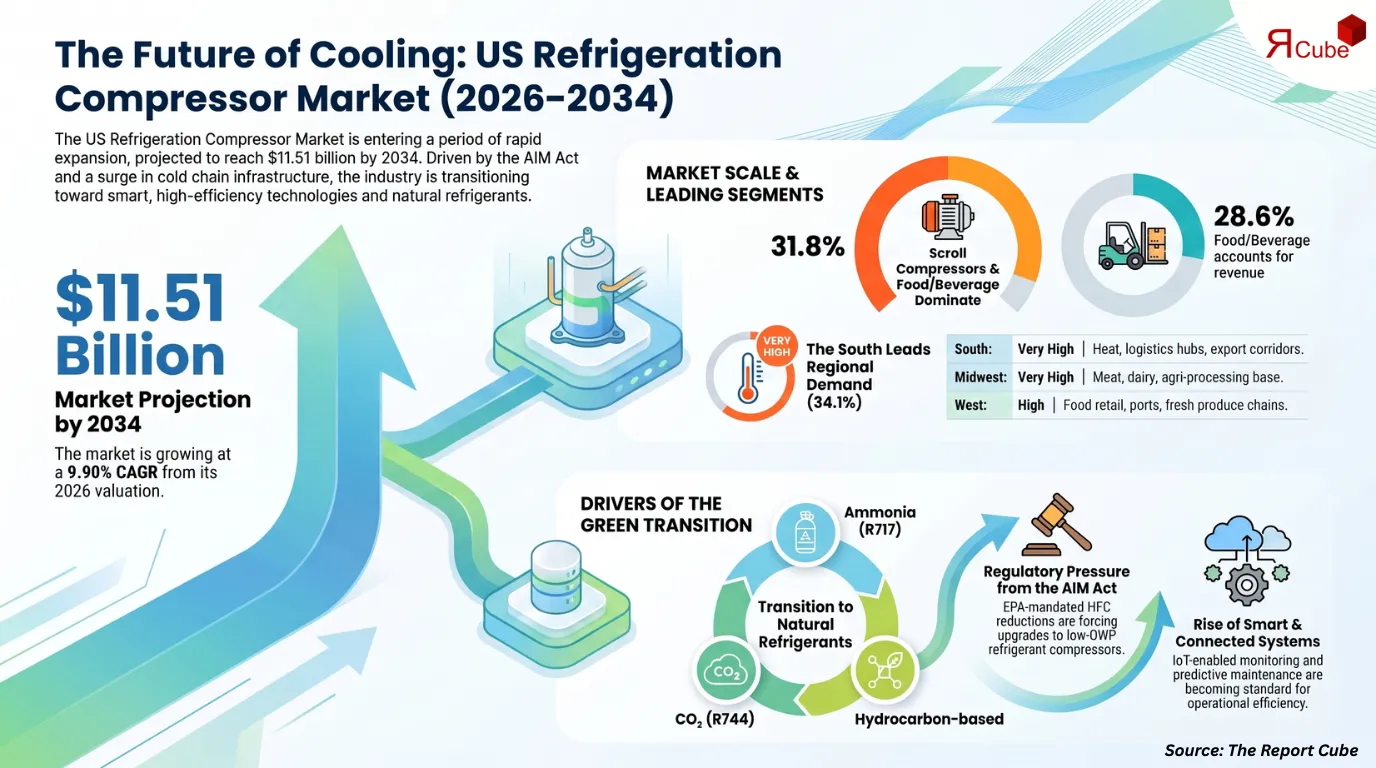
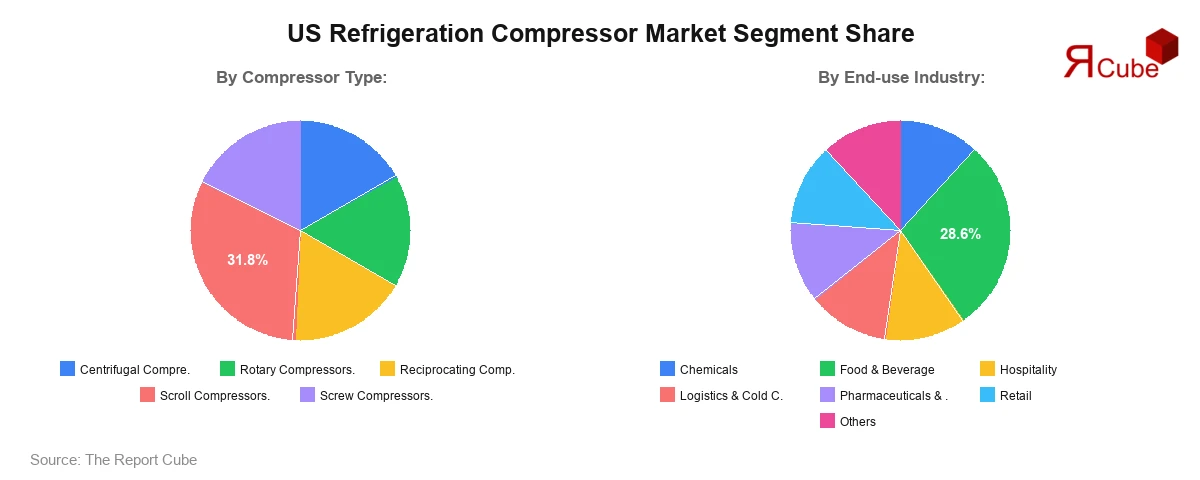
Scroll Compressors segment leads the market with approximately 31.8% share.
By End-use Industry:
Food & Beverage segment dominates the market with nearly 28.6% of total revenue.
Regional Outlook:
The South region dominates the US Refrigeration Compressor Market with an estimated 34.1% share.
US Refrigeration Compressor Market Insights & Analysis
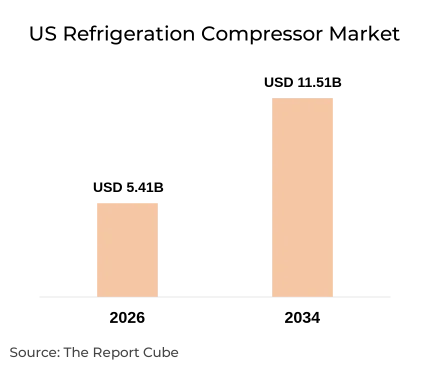
The US Refrigeration Compressor Market is anticipated to register a CAGR of around 9.90% during the forecast period of 2026-2034. The market size is valued at USD 5.41 billion in 2026 and is projected to reach USD 11.51 billion by 2034. Stable investments in food preservation infrastructure, pharmaceutical cold storage, commercial buildings, and industrial manufacturing continue to strengthen demand for refrigeration compressors across the country. Businesses are increasingly replacing aging cooling equipment with high-efficiency refrigeration system compressors to reduce electricity costs and comply with stricter environmental standards. Commercial refrigeration compressor installations are accelerating in supermarkets, convenience stores, distribution centers, and hospitality facilities where reliable temperature control directly influences operational efficiency and product quality. At the same time, industrial refrigeration compressor adoption is expanding across chemical processing, food manufacturing, and refrigerated warehousing as operators modernize facilities with equipment capable of supporting lower-emission refrigerants and higher operating efficiencies.
Technological innovation continues to reshape product development across the refrigeration compressor industry. Manufacturers are introducing advanced refrigerant compressor solutions featuring variable-speed drives, enhanced compressor control algorithms, oil-free operation, and real-time performance monitoring to improve energy utilization and equipment reliability. The ongoing transition toward natural refrigerants, including ammonia, carbon dioxide, and hydrocarbon-based alternatives, is encouraging redesigns of both HVAC compressor and refrigeration unit compressor platforms to accommodate higher operating pressures while maintaining system efficiency. Continued expansion of temperature-controlled logistics, rising pharmaceutical production, and sustained investment in modern cold storage facilities are expected to support long-term market growth. These structural trends are creating new opportunities for manufacturers offering durable, energy-efficient compressor for refrigeration applications across commercial and industrial sectors.
US Refrigeration Compressor Market Impact Analysis
| Factor | Type | Specific Impact on Market | Magnitude | Business Implication |
|---|---|---|---|---|
| Cold Chain Infrastructure Expansion | Market | Growing food, pharma, and logistics sectors lift compressor demand | High | Supports sustained orders for medium and large capacity units nationwide |
| Data Center Cooling Investments | Market | Rising hyperscale data centers drive industrial cooling systems need | High | Creates strong pipeline for high capacity efficient chiller compressors |
| Energy Efficiency Regulations | Regulatory | Stricter efficiency norms push advanced variable speed technologies | High | Encourages upgrades to premium efficient compressor product lines |
| Low GWP Refrigerant Transition | Environmental | Policies shift systems from legacy HFCs to climate friendly gases | Medium | Requires redesign of compressors compatible with new refrigerants |
| Moderate Market Consolidation | Competitive | Few large players shape pricing, technology, and distribution reach | Medium | Smaller firms must focus on niches and partnerships to stay viable |
| Smart and Connected Systems Adoption | Technological | IoT enabled monitoring raises demand for advanced digital compressors | Medium | Opens service revenue from analytics, maintenance, and retrofits |
| Residential and Commercial Construction | Market | New buildings increase installed base of refrigeration appliances | Medium | Strengthens baseline demand for small and mid size compressor units |
US Refrigeration Compressor Market Dynamics
Key Driver: Expanding Cold Chain Infrastructure and Energy-Efficient Refrigeration Modernization
Rising investment in temperature-controlled infrastructure remains a primary growth catalyst for the US Refrigeration Compressor Market. The expansion of cold storage warehouses, food processing facilities, pharmaceutical distribution centers, and refrigerated transportation networks has significantly increased demand for high-performance refrigeration compressors capable of maintaining stable operating conditions under continuous workloads. According to industry estimates, the United States continues to add millions of cubic feet of temperature-controlled storage capacity as retailers, grocery distributors, and healthcare providers strengthen supply chain resilience. This infrastructure expansion is driving procurement of commercial refrigeration compressors and industrial refrigeration compressor systems that deliver higher reliability, lower energy consumption, and improved lifecycle performance.
Facility owners are also prioritizing replacement of older refrigeration system compressors with advanced cooling compressor technologies that support variable-capacity operation and environmentally responsible refrigerants. Higher electricity prices and stricter efficiency standards have accelerated investment in equipment capable of reducing operating expenses without compromising cooling performance. Compressor manufacturers are responding by expanding product portfolios featuring inverter-driven HVAC compressors, intelligent capacity controls, and optimized refrigerant compatibility, enabling customers to achieve measurable improvements in energy efficiency while lowering maintenance requirements across diverse refrigeration applications.
Industry Trends: Natural Refrigerants and Smart Compressor Technologies Gain Wider Adoption
The competitive landscape is increasingly shaped by the industry's transition toward sustainable refrigeration technologies. Growing implementation of EPA refrigerant regulations and corporate sustainability initiatives has accelerated deployment of refrigeration compressors designed for ammonia (R717), carbon dioxide (R744), and hydrocarbon refrigerants. Equipment manufacturers are engineering compressor platforms capable of operating under higher pressures while maintaining long-term reliability, allowing end users to reduce greenhouse gas emissions without sacrificing cooling capacity. These product advancements are supporting broader adoption across supermarkets, food manufacturing plants, pharmaceutical facilities, and industrial cold storage operations.
Digitalization is becoming a defining feature of next-generation refrigeration equipment. Modern refrigerant compressor systems increasingly incorporate cloud-connected monitoring platforms, predictive maintenance software, and intelligent diagnostics that provide continuous visibility into equipment health and operating performance. These capabilities help facility managers detect efficiency losses before equipment failure occurs, reducing maintenance costs and minimizing operational disruptions. Oil-free centrifugal compressor designs, high-efficiency scroll compressors, and advanced screw compressors equipped with variable-speed drives are also gaining commercial acceptance as organizations pursue lower operating costs and long-term sustainability objectives.
Book your FREE 30-minute expert consultation today
Contact UsMajor Challenge: Capital-Intensive Equipment Upgrades and Refrigerant Transition Requirements
Although demand for modern refrigeration compressors continues to strengthen, replacing existing refrigeration infrastructure requires substantial financial investment. Many commercial facilities continue operating legacy systems because converting to new refrigerant technologies often involves upgrading compressors, piping, controls, condensers, evaporators, and safety systems simultaneously. For small food retailers, independent cold storage operators, and regional distribution companies, these capital requirements can delay modernization projects despite the long-term operational savings offered by high-efficiency refrigeration unit compressors.
Compliance with evolving environmental regulations adds another layer of complexity for manufacturers and end users. Developing compressor for refrigeration applications that operate efficiently with multiple low-global-warming-potential refrigerants requires extensive engineering validation, product certification, and performance testing. In addition, the limited availability of highly skilled refrigeration technicians capable of installing and servicing advanced compressor systems has created workforce constraints in several regions. These factors can temporarily slow equipment replacement cycles while increasing implementation costs for both manufacturers and customers.
Opportunity: Industrial Decarbonization Accelerates Demand for Advanced Refrigeration Compressor Technologies
Decarbonization strategies across industrial and commercial sectors are creating substantial opportunities for manufacturers supplying advanced refrigeration compressors. Food and beverage companies, pharmaceutical manufacturers, cold storage operators, and chemical processing facilities are investing in refrigeration systems that deliver lower carbon emissions, improved energy performance, and compatibility with natural refrigerants. These investment priorities are encouraging wider adoption of high-capacity screw compressors, oil-free centrifugal compressors, and next-generation cooling compressor technologies capable of supporting demanding industrial applications while reducing overall operating costs.
Long-term growth opportunities are also emerging from the modernization of commercial buildings and expansion of temperature-controlled logistics infrastructure throughout the United States. Increased construction of automated distribution centers, refrigerated warehouses, healthcare storage facilities, and grocery fulfillment hubs continues to generate sustained demand for reliable HVAC compressors, commercial refrigeration compressors, and industrial refrigeration compressor solutions. Manufacturers that combine energy-efficient engineering, digital performance optimization, and refrigerant flexibility are expected to strengthen their competitive position as customers prioritize equipment offering lower lifecycle costs, improved operational reliability, and regulatory compliance through 2034.
US Refrigeration Compressor Market Segment-wise Analysis
By Compressor Type:
- Centrifugal Compressors
- Rotary Compressors
- Reciprocating Compressors
- Scroll Compressors
- Screw Compressors
Among all compressor types, the scroll compressors accounted for approximately 31.8% of the US Refrigeration Compressor Market in 2026, making them the leading compressor type across commercial and light industrial refrigeration applications. Their strong market position is supported by high energy efficiency, compact footprint, lower vibration levels, and dependable performance under varying cooling loads. Supermarkets, restaurants, convenience stores, pharmacies, healthcare facilities, and office buildings increasingly prefer scroll-based refrigeration system compressors because they deliver consistent cooling while lowering electricity consumption. The widespread adoption of inverter-driven HVAC compressor systems has further strengthened demand for this compressor category as building owners seek greater operational efficiency and compliance with modern energy standards.
Manufacturers continue to enhance scroll refrigeration compressors through advanced motor designs, variable-speed operation, and improved refrigerant compatibility, enabling seamless integration with low-global-warming-potential refrigerants such as R454B, R290, and R744-based systems. The growing replacement of aging reciprocating compressor installations across commercial refrigeration and cold storage facilities is also contributing to sustained segment growth. Rising investment in food retail modernization, pharmaceutical storage infrastructure, and refrigerated logistics facilities is expected to maintain healthy demand for high-efficiency cooling compressor solutions, reinforcing the leadership of the scroll compressor segment throughout the forecast period.
By End-use Industry:
- Chemicals
- Food & Beverage
- Hospitality
- Logistics & Cold Chain
- Pharmaceuticals & Healthcare
- Retail
- Others
The Food & Beverage industry captured nearly 28.6% of total market revenue in 2026, making it the largest end-use segment for refrigeration compressors in the United States. Strict food safety regulations, expanding production of frozen and processed foods, and increasing consumer demand for fresh products continue to drive investment in reliable refrigeration infrastructure. Processing plants, dairy facilities, beverage manufacturers, meat processors, and supermarket distribution centers require commercial refrigeration compressors capable of maintaining stable temperatures throughout production, storage, and transportation. Continuous expansion of temperature-controlled warehousing has further accelerated installations of industrial refrigeration compressor systems across the food supply chain.
Changing consumption patterns and rapid growth in grocery e-commerce are encouraging companies to modernize refrigeration assets with energy-efficient refrigeration unit compressors that reduce operating costs while improving product preservation. Food manufacturers are also adopting advanced refrigerant compressor technologies compatible with natural refrigerants to meet sustainability objectives and comply with evolving environmental regulations. Continued investment in cold chain logistics, automated food distribution centers, and value-added food processing facilities is expected to support long-term demand for compressor for refrigeration applications, strengthening the Food & Beverage segment's leadership during the forecast period.
Regional Projection of US Refrigeration Compressor Industry
- West
- East
- South
- Midwest
- Others
The South region held the largest share of the US Refrigeration Compressor Market, accounting for approximately 34.1% of total revenue in 2026. States including Texas, Florida, Georgia, North Carolina, and Tennessee continue to attract substantial investment in food manufacturing, pharmaceutical distribution, refrigerated logistics, and large-scale cold storage facilities. The region's expanding population, strong retail activity, and favorable business environment have encouraged construction of modern warehouse infrastructure equipped with advanced refrigeration system compressors. In addition, consistently warm climatic conditions generate year-round demand for commercial cooling equipment, increasing installations of HVAC compressors and commercial refrigeration compressor systems across hospitality, healthcare, and retail establishments.
Industrial development throughout the South is further strengthening regional demand for high-capacity refrigeration compressors used in chemical processing, beverage manufacturing, food preservation, and export-oriented logistics operations. Public and private investments in transportation infrastructure, distribution hubs, and automated fulfillment centers continue to support expansion of temperature-controlled supply chains across the region. Growing adoption of natural refrigerants and energy-efficient cooling technologies is also encouraging businesses to replace legacy compressor equipment with next-generation industrial refrigeration compressor solutions. These favorable economic, industrial, and infrastructure trends are expected to help the South maintain its leading position in the US Refrigeration Compressor Market through 2034.
Need insights for a specific region within this market?
Request Regional DataUS Refrigeration Compressor Market Regional Analysis
The US refrigeration compressor market shows varied regional demand patterns driven by cold chain, food retail, climate, and industrial activity.
| Region | Demand Level | Key Areas | System Dominance | Core Demand Logic | Growth Nature |
|---|---|---|---|---|---|
| West | High | California, Washington, Oregon | Commercial & cold‑storage compressors | Food retail, ports, fresh produce chains | ESG‑driven efficiency upgrades |
| East | High | New York, New Jersey, Massachusetts | Urban supermarket & data‑center units | Dense retail, pharma cold chain growth | Regulation‑led replacement demand |
| South | Very High | Texas, Florida, Georgia | Industrial & transport refrigeration | Heat, logistics hubs, export corridors | Fastest volume and fleet expansion |
| Midwest | Very High | Illinois, Ohio, Michigan | Processing plant & warehouse systems | Meat, dairy, and agri‑processing base | Stable, capacity‑driven growth |
| Others | Medium | Mountain & rural corridor states | Small store and farm‑level units | Expanding regional cold chain coverage | Network build‑out, catch‑up growth |
Government Initiatives & Policies
- American Innovation and Manufacturing (AIM) Act Implementation (EPA): During 2025 and 2026, the U.S. Environmental Protection Agency continued implementing phased HFC reductions under the AIM Act, encouraging manufacturers to adopt low-GWP refrigerants and develop refrigeration compressors compatible with CO₂, ammonia, and hydrocarbon refrigerants.
- Department of Energy Energy Conservation Standards: The U.S. Department of Energy continued strengthening energy conservation standards for commercial refrigeration equipment, promoting deployment of high-efficiency compressors and advanced refrigeration systems that reduce electricity consumption and lifecycle operating costs.
US Refrigeration Compressor Industry Recent Developments
- 2026: Trane Technologies and Garrett Motion announced a strategic collaboration to integrate Garrett's oil-free high-speed centrifugal compressor technology into Trane's commercial HVAC portfolio, including rooftop units, modular chillers, and large-capacity chillers. Commercial production and field validation begin in 2026, targeting significant improvements in energy efficiency and support for next-generation low-GWP refrigerants.
- 2025: GEA introduced the Grasso L XHP, a high-pressure screw compressor engineered for ammonia (R717) heat pumps. Operating at pressures up to 70 bar and delivering heating capacities ranging from 2 MW to 11 MW, the compressor expands ammonia applications into high-temperature industrial heating, supporting decarbonization projects across food processing, beverage manufacturing, and district heating facilities.
- 2025: Copeland launched a new transcritical CO2 scroll compressor featuring Dynamic Vapor Injection (DVI) technology. Available in both fixed-speed and variable-speed configurations, the solution enhances refrigeration efficiency and system performance in supermarket booster systems while helping retailers transition toward natural refrigerants and comply with evolving EPA refrigerant regulations.
Why Choose This Report?
- Provides a comprehensive overview of the overall market analysis, encompassing key trends, consumer behavior analysis, and risk assessment to support strategic decision-making.
- Provides accurate, up-to-date insights into market size, segmentation, and emerging opportunities, helping organizations minimize investment risks while capitalizing on high-growth opportunities.
- Offers a detailed understanding of customer purchasing behavior, technology adoption trends, and end-user demand patterns to strengthen product development and marketing strategies.
- Delivers extensive competitive benchmarking by evaluating the strategies, product portfolios, expansion activities, and innovation initiatives of major refrigeration compressor manufacturers.
- Consolidates reliable market intelligence into a single report, reducing research efforts while improving business planning and strategic forecasting.
- Facilitates customized market segmentation and risk mitigation strategies tailored to individual business objectives, investment priorities, and target industries.
- Identifies emerging opportunities, market restraints, regulatory developments, and evolving technology trends influencing long-term business growth across the refrigeration compressor industry.
- Provides valuable market intelligence supported by industry developments, customer demand trends, regulatory frameworks, and ongoing investments across the United States.
Table of Contents
- Introduction
- Objective of the Study
- Product and Category Definition
- Market Segmentation
- Study Variables
- Research Methodology
- Secondary Data Points
- Breakdown of Secondary Sources
- Primary Data Points
- Breakdown of Primary Interviews
- Secondary Data Points
- Executive Summary
- Market Dynamics
- Emerging Opportunities
- Adoption Trends
- Demand Drivers
- Disruption Analysis (Challenges)
- Industry Analysis & Strategic Insights
- Supply/Value Chain Analysis
- Pricing Analysis
- Go-To-Market (GTM) Strategy
- BCG Matrix
- Recent Trends and Developments
- Import and Export Analysis
- Regulatory and Policy Landscape
- Region-wise Policies
- Government Initiatives
- US Refrigeration Compressor Market Overview and Forecast Analysis (2021-2034)
- Market Size, By Value, By Growth Rate (CAGR/USD Billion)
- Market Share, By Compressor Type
- Centrifugal Compressors
- Rotary Compressors
- Reciprocating Compressors
- Scroll Compressors
- Screw Compressors
- Market Share, By Refrigerant Used
- Ammonia (NH₃)
- CO₂ (R744)
- HFC-based
- Hydrocarbon (Propane/R290, Isobutane/R600a)
- Others
- Market Share, By Capacity
- Below 5 HP
- 5-20 HP
- Above 20 HP
- Market Share, By End-use Industry
- Chemicals
- Food & Beverage
- Hospitality
- Logistics & Cold Chain
- Pharmaceuticals & Healthcare
- Retail
- Others
- Market Share, By Region
- West
- East
- South
- Midwest
- Others
- Market Share, By Company
- Revenue Shares & Analysis
- Competitive Landscape
- West US Refrigeration Compressor Market Overview and Forecast Analysis (2021-2034)
- Market Size, By Value, By Growth Rate (CAGR/USD Billion/Million)
- Market Share, By Compressor Type
- Market Share, By Refrigerant Used
- Market Share, By Capacity
- Market Share, By End-use Industry
- East US Refrigeration Compressor Market Overview and Forecast Analysis (2021-2034)
- Market Size, By Value, By Growth Rate (CAGR/USD Billion/Million)
- Market Share, By Compressor Type
- Market Share, By Refrigerant Used
- Market Share, By Capacity
- Market Share, By End-use Industry
- South US Refrigeration Compressor Market Overview and Forecast Analysis (2021-2034)
- Market Size, By Value, By Growth Rate (CAGR/USD Billion/Million)
- Market Share, By Compressor Type
- Market Share, By Refrigerant Used
- Market Share, By Capacity
- Market Share, By End-use Industry
- Midwest US Refrigeration Compressor Market Overview and Forecast Analysis (2021-2034)
- Market Size, By Value, By Growth Rate (CAGR/USD Billion/Million)
- Market Share, By Compressor Type
- Market Share, By Refrigerant Used
- Market Share, By Capacity
- Market Share, By End-use Industry
- Competitive Analysis, 2026
- Market Share of Key Players
- Competitive Mapping for Each Segment and Companies Operating Regionally
- West US Refrigeration Compressor Companies Share & Competitive Analysis, 2026
- East US Refrigeration Compressor Companies Share & Competitive Analysis, 2026
- South US Refrigeration Compressor Companies Share & Competitive Analysis, 2026
- Midwest US Refrigeration Compressor Companies Share & Competitive Analysis, 2026
- Company Profile (Partial List)
- AAON, Inc.
- Company Overview
- Product Portfolio
- Strategic Alliances/Partnerships
- Recent Developments
- Carrier Global Corporation
- Company Overview
- Product Portfolio
- Strategic Alliances/Partnerships
- Recent Developments
- Hillphoenix Inc.
- Company Overview
- Product Portfolio
- Strategic Alliances/Partnerships
- Recent Developments
- Hussmann Corporation
- Company Overview
- Product Portfolio
- Strategic Alliances/Partnerships
- Recent Developments
- Parker Hannifin Corporation
- Company Overview
- Product Portfolio
- Strategic Alliances/Partnerships
- Recent Developments
- Heatcraft Refrigeration Products LLC
- Company Overview
- Product Portfolio
- Strategic Alliances/Partnerships
- Recent Developments
- Emerson Climate Technologies
- Company Overview
- Product Portfolio
- Strategic Alliances/Partnerships
- Recent Developments
- Zero Zone Inc.
- Company Overview
- Product Portfolio
- Strategic Alliances/Partnerships
- Recent Developments
- Johnson Controls International plc (FRICK & YORK Refrigeration)
- Company Overview
- Product Portfolio
- Strategic Alliances/Partnerships
- Recent Developments
- Tecumseh Products Company LLC
- Company Overview
- Product Portfolio
- Strategic Alliances/Partnerships
- Recent Developments
- Others (Partial List)
- AAON, Inc.
- Contact Us and Disclaimer
Top Key Players & Market Share Outlook
- AAON, Inc.
- Carrier Global Corporation
- Hillphoenix Inc.
- Hussmann Corporation
- Parker Hannifin Corporation
- Heatcraft Refrigeration Products LLC
- Emerson Climate Technologies
- Zero Zone Inc.
- Johnson Controls International plc (FRICK & YORK Refrigeration)
- Tecumseh Products Company LLC
- Others
Frequently Asked Questions






