



Build Your Custom Market Intelligence Report
Customize Your ReportPhilippines Residential Real Estate Market Key Highlights
By Property Type:
Condominiums segment lead the market, with around 34% market share.
By Pricing Category:
Mid-Income Housing segment dominate the market, accounting for nearly 38% of total revenue.
Regional Outlook:
Luzon region dominates the Philippines residential real estate market, with around 62% market share.
Government Initiatives & Policies
- Expanded Pambansang Pabahay Para sa Pilipino Housing (4PH) Program - Department of Human Settlements and Urban Development (DHSUD): The Philippine government accelerated its flagship 4PH housing program after 2025, targeting one million housing units annually to address the country’s 6.5 million housing backlog through public-private partnerships and concessional financing.
- National Shelter Program and Pag-IBIG Fund Affordable Housing Financing Expansion (2026 Budget Allocation): The government increased funding allocations for socialized and economic housing through Pag-IBIG Fund loan programs, enhancing access to low-interest housing loans for first-time buyers and Overseas Filipino Workers (OFWs).
Philippines Residential Real Estate Market Insights & Analysis
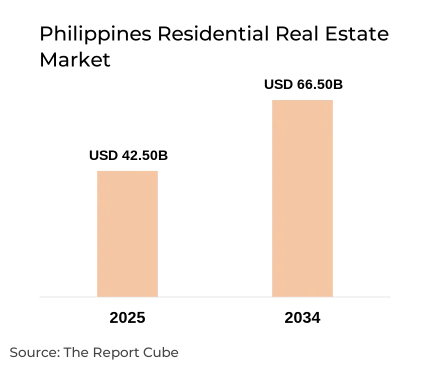
The Philippines Residential Real Estate Market is anticipated to register a CAGR of 5.1% during 2026-2034. The market size was valued at USD 42.5 billion in 2025 and is projected to reach USD 66.50 billion by 2034. Growth is primarily supported by rapid urbanization, demographic expansion, overseas remittances, infrastructure modernization, and rising middle-income households. Residential construction accounts for more than 55% of total construction output in the country, reflecting the structural importance of housing to the national economy.
Urban population growth continues to exceed 2% annually, with Metro Manila, Central Luzon, and Calabarzon acting as primary demand centers. Infrastructure investments under the “Build Better More” program have improved connectivity across Luzon, Visayas, and Mindanao, reducing travel time and expanding suburban housing corridors. Remittances from Overseas Filipino Workers reached over USD 36 billion in 2025, directly influencing home purchases, especially in mid-income subdivisions and condominiums. Developers are also expanding township developments that integrate residential, retail, and office spaces. Digitalization of property listings and online mortgage pre-approvals have improved transaction efficiency, reducing closing time by nearly 20% compared to 2022 levels. As interest rates stabilize and financing becomes more accessible, the residential sector is positioned for steady expansion through 2034.
Philippines Residential Real Estate Market Dynamics
Key Driver: Urbanization and Rising Middle-Class Purchasing Power
Urban migration remains a central growth catalyst for the Philippines Residential Real Estate Market. Over 48% of the population now resides in urban centers, and this ratio is expected to cross 52% by 2030. The rise of dual-income households has strengthened mortgage eligibility, particularly in Metro Manila and Cebu. Mid-income families are allocating nearly 25-30% of household income toward home acquisition, reflecting strong aspiration-driven ownership culture. Infrastructure projects such as expressways, rail transit expansions, and airport modernization have unlocked new suburban growth belts in Bulacan, Laguna, Pampanga, and Davao. Developers are responding with master-planned subdivisions and mixed-use communities. The shift from renting to ownership among young professionals is also driving condominium absorption rates, particularly for studio and one-bedroom units. As disposable incomes grow at an average of 6-7% annually, residential demand remains fundamentally strong.
Book your FREE 30-minute expert consultation today
Contact UsIndustry Trends: Integrated Townships and Transit-Oriented Developments
Integrated township developments are reshaping the competitive landscape. Large developers are building self-contained communities with schools, retail malls, healthcare facilities, and business parks. These developments improve property value retention by up to 15% compared to standalone projects. Transit-oriented developments near rail stations and expressways are gaining traction, particularly in Luzon. Green building certifications and energy-efficient designs are increasingly standard, with around 28% of new launches in 2025 incorporating solar-ready rooftops and water recycling systems. Smart home features such as app-controlled security systems and IoT-enabled appliances are also becoming mainstream in mid-income and premium housing segments. Developers are leveraging pre-selling models, where nearly 60% of condominium units are sold before completion, ensuring capital efficiency and risk mitigation. This shift toward integrated living environments continues to attract both owner-occupiers and investors.
Major Challenge: Housing Affordability and Financing Gaps
Affordability constraints remain a structural challenge in the Philippines Residential Real Estate Market. The country faces a housing backlog exceeding 6 million units, primarily within socialized and economic housing categories. Construction material inflation, which increased by an average of 5-8% annually between 2022 and 2025, has pushed property prices upward. Mortgage penetration remains below 10% of GDP, significantly lower than regional peers. Many informal workers struggle to meet formal lending requirements, limiting their ability to secure home loans. Land acquisition costs in Metro Manila have surged by nearly 12% annually, further increasing project development expenses. Developers are responding by expanding into provincial growth areas; however, financing accessibility gaps persist. Addressing this challenge requires continued public-private collaboration and innovative financing models such as rent-to-own schemes and longer-term mortgage tenures.
Opportunity: Affordable Housing and Provincial Expansion
The largest opportunity lies within socialized, economic, and mid-income housing segments. Government-backed financing programs and public-private partnerships are accelerating affordable housing supply. Developers expanding into Visayas and Mindanao are witnessing land costs that are 30-40% lower than Metro Manila, improving project feasibility. Davao, Iloilo, and Cagayan de Oro are emerging as secondary growth hubs. Remote work trends are encouraging migration to suburban and provincial locations, increasing demand for single-family homes and gated communities. Smart city initiatives and improved broadband connectivity further support decentralized housing demand. Investors are increasingly targeting rental yields in university towns and business process outsourcing (BPO) corridors, where occupancy rates exceed 90%. As economic decentralization strengthens, provincial markets offer long-term expansion potential for residential developers.
Philippines Residential Real Estate Market Segment-wise Analysis
By Property Type:
- Single-Family Homes
- Multi-Family Homes
- Condominiums
- Townhouses
- Subdivisions and Gated Communities
- Socialized and Affordable Housing
- Others
Condominiums hold approximately 34% of total market revenue, making them the leading property type. Studio and one-bedroom units dominate new launches, particularly in Metro Manila, Cebu, and Davao. High-rise residential developments near central business districts account for nearly 65% of total condominium supply. Investors favor condominium properties due to rental yields ranging between 5-8% annually. Pre-selling models remain popular, with nearly 60% of projects achieving strong absorption before turnover. Premium and luxury condominium units are also growing in key districts such as Makati and Bonifacio Global City, driven by expatriates and high-net-worth individuals. The flexibility, security features, and proximity to workplaces make condominiums the preferred option for young professionals and small households.
By Pricing Category:
- Socialized Housing
- Economic Housing
- Mid-Income Housing
- High-End Housing
- Luxury Housing
Mid-Income Housing dominates with nearly 38% revenue share. This segment benefits from rising dual-income families and stable remittance inflows. Units priced between PHP 2 million to PHP 6 million witness the highest transaction volumes. Developers report that nearly 45% of buyers fall within this income bracket. Financing accessibility through Pag-IBIG loans supports sustained demand. Mid-income subdivisions and townhouses in Cavite, Laguna, and Bulacan record strong year-on-year sales growth above 7%. Buyers prioritize community amenities, security, and access to schools and commercial hubs. As employment in BPO, manufacturing, and services sectors expands, this segment continues to anchor overall market growth.
Regional Projection of Philippines Residential Real Estate Industry
- Luzon
- Visayas
- Mindanao
Luzon accounts for approximately 62% of total residential real estate activity. Metro Manila remains the core demand hub, while surrounding provinces such as Bulacan, Pampanga, and Laguna are witnessing rapid suburban expansion. Infrastructure developments including new expressways and railway systems are improving connectivity and unlocking residential corridors. Condominium developments dominate Metro Manila, while subdivisions and townhouses expand in peri-urban zones. Visayas contributes around 22%, led by Cebu and Iloilo, benefiting from tourism and BPO expansion. Mindanao accounts for nearly 16%, with Davao City emerging as a strong residential investment location due to stable economic growth and industrial development. Regional diversification continues to strengthen national housing resilience.
Philippines Residential Real Estate Market Recent Developments
- 2025: Brenntag Philippines expanded its distribution partnership with Momentive Performance Materials, strengthening access to advanced silicone and specialty solutions for construction-related applications, indirectly supporting higher-quality building materials demand across Philippine residential projects.
- 2025: Yokogawa Philippines participated in the 2nd Powerplant Energy Summit 2025 in Manila, showcasing digital automation and energy-efficiency solutions that enhance reliable power supply, a critical infrastructure component supporting long-term housing expansion.
- 2025: Atlas Fertilizer Corp. initiated a Kaizen renovation project in Cebu to improve operational efficiency, contributing to rural income stability and peri-urban housing demand growth in agricultural regions.
- 2025: BASF Philippines aligned with BASF’s 2025-2028 Asia Pacific capital expansion strategy, strengthening supply of specialty chemicals for construction materials that support infrastructure and residential development.
Need insights for a specific region within this market?
Request Regional DataWhy Choose This Report?
- Provides a comprehensive overview of the overall market analysis, encompassing key trends, consumer behavior analysis, and risk assessment to support strategic decision-making.
- Provides accurate, up-to-date insights into market size, segmentation, and emerging opportunities, helping to minimize risk & capitalizing on growth.
- Gives deep understanding of target audience preferences, investment habits, and communication channels for enhanced product development & marketing effectiveness.
- Delivers competitive analysis & benchmarking, uncovering the strengths & weaknesses of market competitors to guide strategies.
- Consolidate comprehensive market intelligence, reducing reasoning & streamlining research efforts.
- Facilitates customized market segmentation & risk mitigation strategies, fine-tuned to the business objectives.
- Aids in identifying both market challenges & untapped opportunities within the industry to drive long-term business growth.
- Provides valuable information based on actual customer data & search trends.
Table of Contents
- Introduction
- Objective of the Study
- Product and Category Definition
- Market Segmentation
- Study Variables
- Research Methodology
- Secondary Data Points
- Breakdown of Secondary Sources
- Primary Data Points
- Breakdown of Primary Interviews
- Secondary Data Points
- Executive Summary
- Market Dynamics
- Drivers
- Challenges
- Opportunity Assessment
- Recent Trends and Developments
- Regulatory and Policy Landscape
- Philippines Residential Real Estate Market Overview (2021-2034)
- Market Size, By Value (PHP Billion / USD Billion)
- Market Share, By Property Type
- Single-Family Homes
- Detached Houses
- Semi-Detached Houses
- Bungalows
- Multi-Family Homes
- Low-Rise Apartments
- Mid-Rise Apartments
- High-Rise Apartments
- Condominiums
- Studio Units
- One-Bedroom Units
- Two-Bedroom Units
- Three-Bedroom and Larger Units
- Premium and Luxury Condominium Units
- Townhouses
- Row Houses
- Clustered Townhouses
- Subdivisions and Gated Communities
- Mass Housing Subdivisions
- Middle-Income Subdivisions
- High-End and Exclusive Subdivisions
- Socialized and Affordable Housing
- Government-Supported Housing Projects
- Developer-Led Affordable Housing
- Others
- Single-Family Homes
- Market Share, By Pricing Category
- Socialized Housing
- Economic Housing
- Mid-Income Housing
- High-End Housing
- Luxury Housing
- Market Share, By Buyer Profile
- Owner-Occupiers
- Investors
- Philippine Residents
- Overseas Filipino Workers and Overseas Buyers
- Market Share, By Mode of Sale
- Primary Sales (Developers)
- Secondary Sales (Resale Market)
- Real Estate Brokerage and Agencies
- Online Real Estate Platforms
- Market Share, By Region
- Luzon
- Visayas
- Mindanao
- Market Share, By Company
- Revenue Shares and Analysis
- Competitive Landscape
- Luzon Residential Real Estate Market
- Market Size, By Value (PHP Billion / USD Billion/Million)
- Market Share, By Property Type
- Market Share, By Pricing Category
- Market Share, By Buyer Profile
- Market Share, By Mode of Sale
- Visayas Residential Real Estate Market
- Market Size, By Value (PHP Billion / USD Billion/Million)
- Market Share, By Property Type
- Market Share, By Pricing Category
- Market Share, By Buyer Profile
- Market Share, By Mode of Sale
- Mindanao Residential Real Estate Market
- Market Size, By Value (PHP Billion / USD Billion/Million)
- Market Share, By Property Type
- Market Share, By Pricing Category
- Market Share, By Buyer Profile
- Market Share, By Mode of Sale
- Competitive Outlook and Company Profiles
- IGAWorks
- Company Overview
- Product Portfolio
- Strategic Alliances/Partnerships
- Recent Developments
- Adbrix
- Company Overview
- Product Portfolio
- Strategic Alliances/Partnerships
- Recent Developments
- Naver Cloud
- Company Overview
- Product Portfolio
- Strategic Alliances/Partnerships
- Recent Developments
- Kakao Enterprise
- Company Overview
- Product Portfolio
- Strategic Alliances/Partnerships
- Recent Developments
- Hackle
- Company Overview
- Product Portfolio
- Strategic Alliances/Partnerships
- Recent Developments
- Samsung SDS
- Company Overview
- Product Portfolio
- Strategic Alliances/Partnerships
- Recent Developments
- LG CNS
- Company Overview
- Product Portfolio
- Strategic Alliances/Partnerships
- Recent Developments
- Airbridge (AB180)
- Company Overview
- Product Portfolio
- Strategic Alliances/Partnerships
- Recent Developments
- Datasolution
- Company Overview
- Product Portfolio
- Strategic Alliances/Partnerships
- Recent Developments
- KT NexR
- Company Overview
- Product Portfolio
- Strategic Alliances/Partnerships
- Recent Developments
- BI Matrix
- Company Overview
- Product Portfolio
- Strategic Alliances/Partnerships
- Recent Developments
- Retentics (Fridays Lab)
- Company Overview
- Product Portfolio
- Strategic Alliances/Partnerships
- Recent Developments
- Plus Zero
- Company Overview
- Product Portfolio
- Strategic Alliances/Partnerships
- Recent Developments
- WiseTracker
- Company Overview
- Product Portfolio
- Strategic Alliances/Partnerships
- Recent Developments
- SK Planet
- Company Overview
- Product Portfolio
- Strategic Alliances/Partnerships
- Recent Developments
- NHN Data
- Company Overview
- Product Portfolio
- Strategic Alliances/Partnerships
- Recent Developments
- Liapp (Lockin Co.)
- Company Overview
- Product Portfolio
- Strategic Alliances/Partnerships
- Recent Developments
- Others
- IGAWorks
- Contact Us and Disclaimer
Top Key Players & Market Share Outlook
- Air Liquide Philippines
- Atlas Fertilizer Corp.
- Yara Philippines
- Centaur Chem Enterprise
- La Filipina Uy Gongco
- Rurich Industrial Trading
- BASF Philippines
- Sojitz Philippines
- Chemtrade International
- Dole Philippines
- Yokogawa Philippines
- Brenntag Philippines
- Sytengco Philippines
- Mabuhay Vinyl Corp.
- International Chem. Ind.
- Neco Philippines
Frequently Asked Questions






